Share
The Quiet Archive: Atmospheric History
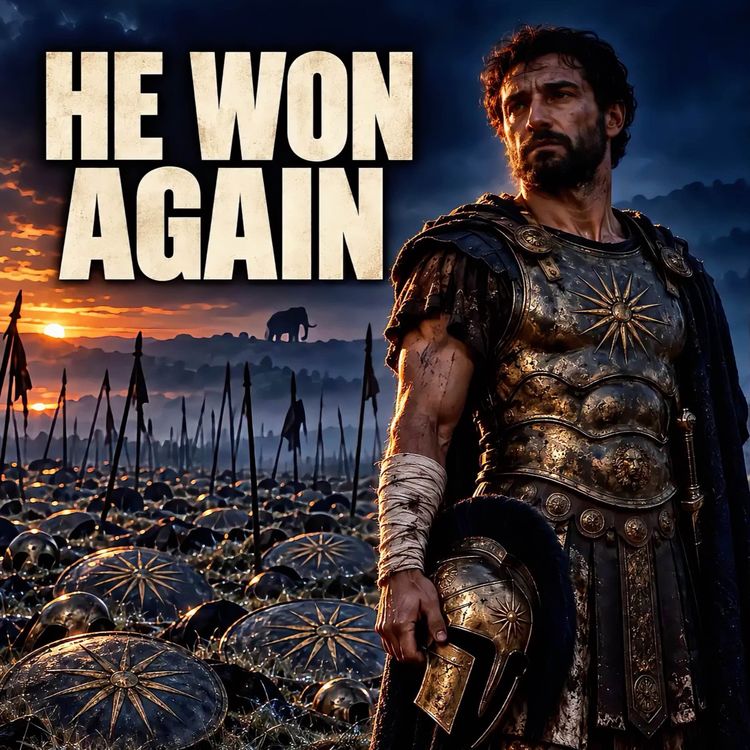
Pyrrhus Beat Rome Twice. One More Victory Would Ruin Him.
A cup turns slowly in a king's hand while the lamps burn down and a friend waits for an answer.
⟡ This narration features AI-assisted voice production, carefully crafted for consistency and clarity.
─── ◈ ───
PYRRHUS BEAT ROME TWICE. ONE MORE VICTORY WOULD RUIN HIM.
In 280 BC, a king from the mountains of Epirus crossed the sea with twenty elephants to fight a city that had never faced a Greek army. He won, and won again, and every victory left him with fewer men than the one before. Beside him stood the one friend who kept asking where it would all end. This is the story of a king who kept winning, and of the question he never answered.
◈ A Roman ambassador mocked in a Greek theatre, and a king who could not refuse a war
◈ Elephants on an Italian plain, and two victories that cost more than defeats
◈ A blind senator carried into the Senate, and gifts no Roman would accept
◈ An island won and lost in two years, and a street in Argos with a woman on the roof
Somewhere between Italy and Sicily, the man who asked the question disappears from the record.
The story of Pyrrhus of Epirus and the Pyrrhic War, from Tarentum, Heraclea and Asculum to Sicily, Beneventum and Argos, 280–272 BC.
History told with space to breathe.
─── ◈ ───
✧ Support the project: https://linktr.ee/quietarchivum
✧ Help keep these stories alive — quietly, consistently.
─── ◈ ───
✧ Subscribe for history told without noise.
✧ New stories arrive when they're ready — and not before.
✧ Leave a comment if this one stayed with you.
─── ◈ ───
Sources & further reading
◈ Plutarch, Life of Pyrrhus (Parallel Lives), trans. Bernadotte Perrin, Loeb Classical Library
◈ Dionysius of Halicarnassus, Roman Antiquities, Books 19–20 (fragments)
◈ Diodorus Siculus, Library of History, Book 22 (fragments)
◈ Justin, Epitome of Pompeius Trogus, Books 17–18 and 23–25
◈ Jeff Champion, Pyrrhus of Epirus (Pen & Sword, 2009)
◈ Petros Garoufalias, Pyrrhus, King of Epirus (Stacey International, 1979)
#Pyrrhus #PyrrhicVictory #PyrrhusOfEpirus #PyrrhicWar #Cineas #Plutarch #RomanRepublic #AncientRome #AncientGreece #HellenisticPeriod #Epirus #MilitaryHistory #AncientHistory #HistoryPodcast #HistoryStorytelling
More episodes
View all episodes

America Feared Malcolm X. The Men Who Killed Him Called Him Brother.
01:20:05|A four-year-old stands in a November yard in his nightclothes, the heat of a burning house on his face.⟡ This narration features AI-assisted voice production, carefully crafted for consistency and clarity.─── ◈ ───AMERICA FEARED MALCOLM X. THE MEN WHO KILLED HIM CALLED HIM BROTHER.At twenty he was a burglar with eight to ten years ahead of him and barely enough words to write a letter. Within fifteen years, he was the voice white America feared most, and the most famous man in a movement that called him brother. Then he walked away from it. This is the story of Malcolm, and of every name he answered to.◈ A house in Lansing burns in 1929, and the town and the family tell two different stories◈ A prisoner copies a dictionary by hand, page by page, by the light from a corridor◈ A minister raises one hand outside a Harlem hospital, and a crowd of thousands disappears◈ A courtroom in 2021 clears two men convicted of a killing they were never part ofThen the people who called him brother began to call him something else.The life and assassination of Malcolm X, from Lansing and Boston to Harlem, Mecca and the Audubon Ballroom, 1925 to 1965.History told with space to breathe.─── ◈ ───✧ Support the project: https://linktr.ee/quietarchivum✧ Help keep these stories alive — quietly, consistently.─── ◈ ───✧ Subscribe for history told without noise.✧ New stories arrive when they're ready — and not before.✧ Leave a comment if this one stayed with you.─── ◈ ───Sources & further readingThe Autobiography of Malcolm X, as told to Alex Haley (1965)Manning Marable, Malcolm X: A Life of Reinvention (2011)Les Payne and Tamara Payne, The Dead Are Arising: The Life of Malcolm X (2020)Manhattan District Attorney's Office, review and vacatur of the Aziz and Islam convictions (November 2021)#MalcolmX #ElHajjMalikElShabazz #NationOfIslam #AudubonBallroom #ElijahMuhammad #BettyShabazz #Harlem #CivilRightsHistory #BlackHistory #1960sAmerica #AmericanHistory #HistoryPodcast #NarrativeHistory #AtmosphericHistory #TheQuietArchive
Oppenheimer's Team Feared the Bomb Could Ignite the Atmosphere. They Were Almost Sure It Wouldn't.
01:13:19|A man finishes writing on a blackboard, and the room stops talking.⟡ This narration features AI-assisted voice production, carefully crafted for consistency and clarity.─── ◈ ───OPPENHEIMER'S SCIENTISTS FEARED THE FIRST ATOMIC BOMB COULD END THE WORLD. THEY TESTED IT ANYWAY.In the summer of 1942, before a single atomic bomb existed, a handful of physicists in a locked office asked whether it might set the Earth's air on fire. For three years they calculated, checked and argued, and each answer came back reassuring, but never quite certain. This is the story of that question, and of the people who had to decide whether almost certain was certain enough.◈ A locked office in Berkeley, where the danger was first written down◈ A beach in Michigan, where a physicist demanded odds close to zero◈ A betting sheet at base camp, on the night before the first atomic test◈ A secret report, written a year later, still asking for further workAnd at 5:29 in the morning, the only experiment that could settle it began.The Trinity test of July 16, 1945 — the Manhattan Project, Los Alamos and the Jornada del Muerto desert in New Mexico, and the fear that the first atomic bomb could ignite the atmosphere.History told with space to breathe.─── ◈ ───✧ Support the project: https://linktr.ee/quietarchivum✧ Help keep these stories alive — quietly, consistently.─── ◈ ───✧ Subscribe for history told without noise.✧ New stories arrive when they're ready — and not before.✧ Leave a comment if this one stayed with you.─── ◈ ───Sources & further reading◈ E. J. Konopinski, C. Marvin & E. Teller, "Ignition of the Atmosphere with Nuclear Bombs" (Los Alamos report LA-602, 1946)◈ Arthur H. Compton, Atomic Quest (1956)◈ Leslie R. Groves, Now It Can Be Told (1962)◈ Richard Rhodes, The Making of the Atomic Bomb (1986)◈ John Horgan, "Bethe, Teller, Trinity and the End of Earth," Scientific American◈ "Manhattan Project Astrophysics," Physics Today◈ Atomic Heritage Foundation — Trinity test oral histories and site guide#TrinityTest #Oppenheimer #ManhattanProject #FirstAtomicBomb #LosAlamos #EdwardTeller #EnricoFermi #AtmosphericIgnition #CastleBravo #NuclearHistory #WW2History #HistoryOfScience #ColdWar #HistoryPodcast #TheQuietArchive
The US Swore Iraq Must Not Lose the War, but It Was Secretly Arming Iran.
01:23:51|A chocolate cake shaped like a key waits on the top floor of a Tehran hotel, for meetings that never begin.⟡ This narration features AI-assisted voice production, carefully crafted for consistency and clarity.─── ◈ ───IRAN WAS AMERICA'S ENEMY. IN ITS WAR WITH IRAQ, THE US HELPED BOTH SIDES.In 1953, American agents helped put a king back on his throne in Tehran. A generation later, the revolution that drove him out made America its enemy, just as Saddam Hussein's tanks crossed the border. This is the story of how Iran and the United States became enemies, and of the eight-year war in which Washington quietly helped both sides.◈ A coup in 1953 that returned the Shah to power◈ An embassy seized, and fifty-two Americans held for 444 days◈ Eight years of trenches, minefields, missiles and poison gas◈ American missiles sold to Iran, American intelligence passed to IraqAnd when the guns finally stopped, the border ran almost exactly where it had begun.A history of US–Iran relations from the 1953 coup through the Iran–Iraq War (1980–1988), from Tehran and Baghdad to Khorramshahr, Basra, Halabja and the waters of the Persian Gulf.History told with space to breathe.─── ◈ ───✧ Support the project: https://linktr.ee/quietarchivum✧ Help keep these stories alive — quietly, consistently.─── ◈ ───✧ Subscribe for history told without noise.✧ New stories arrive when they're ready — and not before.✧ Leave a comment if this one stayed with you.─── ◈ ───Sources & further readingErvand Abrahamian — The Coup: 1953, the CIA, and the Roots of Modern U.S.-Iranian Relations (2013)Stephen Kinzer — All the Shah's Men (2003)Kermit Roosevelt — Countercoup: The Struggle for the Control of Iran (1979)Mark Bowden — Guests of the Ayatollah (2006)Pierre Razoux — The Iran-Iraq War (2015)Dilip Hiro — The Longest War: The Iran-Iraq Military Conflict (1989)Theodore Draper — A Very Thin Line: The Iran-Contra Affairs (1991)Joost Hiltermann — A Poisonous Affair: America, Iraq, and the Gassing of Halabja (2007)U.S. Navy — Formal Investigation into the Circumstances Surrounding the Downing of Iran Air Flight 655 (1988)National Security Archive — Shaking Hands with Saddam Hussein: The U.S. Tilts toward Iraq, 1980–1984 (2003)#IranIraqWar #IranContra #IranAir655 #USSVincennes #Halabja #Khorramshahr #IranHostageCrisis #1953Coup #Mossadegh #Khomeini #SaddamHussein #MiddleEastHistory #ModernHistory #HistoryPodcast #History
Humans Looked Like Us 300,000 Years Ago. For 200,000 Years, They Left Almost No Art.
01:15:54|An eight-year-old girl lifts her lamp, and the ceiling above her is full of animals.⟡ This narration features AI-assisted voice production, carefully crafted for consistency and clarity.─── ◈ ───HUMANS LOOKED LIKE US 300,000 YEARS AGO. FOR 200,000 YEARS, THEY LEFT ALMOST NO ART.Three hundred thousand years ago, people with faces like ours were already living in Africa. The marks of a mind like ours came far later, and every time someone found the first one, an older one turned up somewhere else. This is the story of how we went looking for the first human mind, and of the painted hands that kept moving it further away.◈ A painted ceiling in Spain that cost its discoverer his reputation◈ Shell beads and a red crayon drawing from a cliff cave in South Africa◈ A skull from Morocco that pushed our species back by a third◈ A red hand in Spain that may not have been made by our species at allAnd on a small island in Indonesia, someone once changed the shape of their own hand.An atmospheric history of the origins of the human mind, from Altamira, Lascaux and Chauvet to Blombos Cave, Jebel Irhoud, Trinil and Sulawesi.History told with space to breathe.─── ◈ ───✧ Support the project: https://linktr.ee/quietarchivum✧ Help keep these stories alive — quietly, consistently.─── ◈ ───✧ Subscribe for history told without noise.✧ New stories arrive when they're ready — and not before.✧ Leave a comment if this one stayed with you.─── ◈ ───Sources & further reading— Henshilwood, C. et al. (2002). Emergence of modern human behavior: Middle Stone Age engravings from South Africa. Science.— Henshilwood, C. et al. (2004). Middle Stone Age shell beads from South Africa. Science.— Henshilwood, C. et al. (2011). A 100,000-year-old ochre-processing workshop at Blombos Cave, South Africa. Science.— Henshilwood, C. et al. (2018). An abstract drawing from the 73,000-year-old levels at Blombos Cave, South Africa. Nature.— McBrearty, S. & Brooks, A. (2000). The revolution that wasn't: a new interpretation of the origin of modern human behavior. Journal of Human Evolution.— Quiles, A. et al. (2016). A high-precision chronological model for the decorated Upper Paleolithic cave of Chauvet-Pont d'Arc. PNAS.— Hublin, J.-J. et al. (2017). New fossils from Jebel Irhoud, Morocco and the pan-African origin of Homo sapiens. Nature.— Brooks, A. et al. (2018). Long-distance stone transport and pigment use in the earliest Middle Stone Age. Science.— Hoffmann, D. et al. (2018). U-Th dating of carbonate crusts reveals Neandertal origin of Iberian cave art. Science.— Joordens, J. et al. (2015). Homo erectus at Trinil on Java used shells for tool production and engraving. Nature.— Aubert, M. et al. (2014). Pleistocene cave art from Sulawesi, Indonesia. Nature.— Oktaviana, A. A. et al. (2024). Narrative cave art in Indonesia by 51,200 years ago. Nature.— Oktaviana, A. A. et al. (2026). Hand stencil from Liang Metanduno, Muna. Nature.#CaveArt #OldestCaveArt #Sulawesi #Altamira #Lascaux #BlombosCave #JebelIrhoud #Neanderthals #HandStencil #HumanOrigins #Prehistory #HumanEvolution #Archaeology #HistoryPodcast #History
Europe Drowned the Amish Ancestors. Now There Are 400,000.
01:31:57|He had almost reached the far bank when he heard the ice break behind him.⟡ This narration features AI-assisted voice production, carefully crafted for consistency and clarity.─── ◈ ───EUROPE DROWNED THE AMISH ANCESTORS. NOW THERE ARE 400,000.In January 1525, in a kitchen in Zurich, a handful of believers poured water over each other's heads, and the city answered with the river. For the next two centuries, the people who followed them were burned and drowned across Europe, and they would not raise a hand to defend themselves. This is the story of the Amish, and of the five hundred years it took to become them.◈ A young man bound and drowned in the Limmat for baptising adults◈ Prisoners in a Passau dungeon composing hymns still sung today◈ A fugitive on the ice who turned back to save the man chasing him◈ A frontier father who would not let his sons fire a single shotThen they crossed an ocean, and the danger changed its shape.An atmospheric history of the Anabaptist movement and the Amish, from Reformation Zurich, Passau and the Low Countries to Alsace, Pennsylvania, Ohio and the Supreme Court.History told with space to breathe.─── ◈ ───✧ Support the project: https://linktr.ee/quietarchivum✧ Help keep these stories alive — quietly, consistently.─── ◈ ───✧ Subscribe for history told without noise.✧ New stories arrive when they're ready — and not before.✧ Leave a comment if this one stayed with you.─── ◈ ───Sources & further readingSteven M. Nolt — A History of the Amish (3rd ed., 2015)John A. Hostetler — Amish Society (4th ed., 1993)Donald B. Kraybill, Karen M. Johnson-Weiner & Steven M. Nolt — The Amish (2013)C. Arnold Snyder — Anabaptist History and Theology (1995)Thieleman J. van Braght — Martyrs Mirror (1660; English translation, Herald Press)Harvey Hostetler — Descendants of Jacob Hochstetler (1912)Michael Baumann (ed.) — Steps to Reconciliation: Reformed and Anabaptist Churches in Dialogue (2007)Wisconsin v. Yoder, 406 U.S. 205 (1972)Young Center for Anabaptist and Pietist Studies, Elizabethtown College — Amish Population StatisticsGAMEO — Global Anabaptist Mennonite Encyclopedia Online#Amish #Anabaptists #FelixManz #DirkWillems #MartyrsMirror #Ausbund #Hochstetler #WisconsinVYoder #Mennonites #Reformation #Pennsylvania #ReligiousHistory #HistoryPodcast #AtmosphericHistory #History
300,000 People Rushed to California for Gold. Most Never Got Rich.
01:14:26|A man stands knee-deep in snowmelt, rocking a wooden box, watching the gravel for a flash of yellow.⟡ This narration features AI-assisted voice production, carefully crafted for consistency and clarity.─── ◈ ───300,000 PEOPLE RUSHED TO CALIFORNIA FOR GOLD. MOST NEVER GOT RICH.In the first weeks of 1848, a carpenter building a sawmill in the California foothills found a few yellow flakes in a ditch. Within seven years, some three hundred thousand people had crossed oceans, jungles and deserts to reach the same rivers, carrying borrowed money and the belief that a single summer could change a life. This is the story of the California Gold Rush, and of what it asked of everyone it touched.◈ A sawmill ditch at Coloma, and a secret that lasted barely six weeks◈ A harbour of five hundred abandoned ships, slowly buried beneath San Francisco◈ A mining camp where an onion cost a dollar and a pair of boots cost four days in cold water◈ A governor's speech, a state law, and a war paid for in the valleysThe gold came out of the ground at a price no one had counted.The California Gold Rush, 1848 to 1855: Sutter's Mill, Coloma, San Francisco, the American and Feather Rivers, and the foothills of the Sierra Nevada.History told with space to breathe.─── ◈ ───✧ Support the project: https://linktr.ee/quietarchivum✧ Help keep these stories alive — quietly, consistently.─── ◈ ───✧ Subscribe for history told without noise.✧ New stories arrive when they're ready — and not before.✧ Leave a comment if this one stayed with you.─── ◈ ───Sources & further readingLouise Amelia Knapp Smith Clappe, The Shirley Letters from the California Mines, 1851–1852J. S. Holliday, The World Rushed In: The California Gold Rush Experience (1981)Benjamin Madley, An American Genocide: The United States and the California Indian Catastrophe, 1846–1873 (2016)Peter H. Burnett, Annual Message to the California Legislature, January 6, 1851 (California State Library)Malcolm J. Rohrbough, Days of Gold: The California Gold Rush and the American Nation (1997)H. W. Brands, The Age of Gold: The California Gold Rush and the New American Dream (2002)G. K. Gilbert, Hydraulic-Mining Debris in the Sierra Nevada, U.S. Geological Survey (1917)#CaliforniaGoldRush #GoldRush #FortyNiners #SuttersMill #JohnSutter #Coloma #DameShirley #SanFrancisco #SierraNevada #CaliforniaHistory #AmericanWest #NativeHistory #19thCentury #HistoryDocumentary #History
Six Times the Titanic's Dead. Over 9,000 Lost on the Wilhelm Gustloff, and Almost No One Remembers.
01:02:47|A young man at the foot of a gangway writes down one more name, and the line behind her runs back into the snow.⟡ This narration features AI-assisted voice production, carefully crafted for consistency and clarity.─── ◈ ───OVER 9,000 DIED WHEN THE WILHELM GUSTLOFF SANK. ALMOST NO ONE KNOWS HER NAME.In January 1945, a cruise liner built to sell holidays to German workers took on more than ten thousand people fleeing the Red Army across the Baltic. Before the night was over, she was on the sea floor, and more than nine thousand of them were gone. This is the story of the Wilhelm Gustloff, the deadliest sinking of a single ship ever recorded, and of how both sides of the war learned to forget her.◈ A registration list abandoned at 7,956 names while people kept climbing aboard◈ Four captains on one bridge, arguing over mines, submarines and a pair of navigation lights◈ A Soviet submarine commander facing a tribunal, hunting for a ship that could save him◈ A survivor who spent the rest of his life counting the deadThen, on a night of snow and ice, two small lights came on.The sinking of the Wilhelm Gustloff on 30 January 1945, during Operation Hannibal, off the Pomeranian coast of the Baltic Sea, after sailing from Gotenhafen, now Gdynia, Poland.History told with space to breathe.─── ◈ ───✧ Support the project: https://linktr.ee/quietarchivum✧ Help keep these stories alive — quietly, consistently.─── ◈ ───✧ Subscribe for history told without noise.✧ New stories arrive when they're ready — and not before.✧ Leave a comment if this one stayed with you.─── ◈ ───Sources & further readingCathryn J. Prince, Death in the Baltic: The World War II Sinking of the Wilhelm Gustloff (Palgrave Macmillan, 2013)Heinz Schön, Die Gustloff-KatastropheGünter Grass, Crabwalk (Im Krebsgang, 2002)Encyclopaedia Britannica, "Wilhelm Gustloff"#WilhelmGustloff #Gustloff #OperationHannibal #Marinesko #Gotenhafen #Gdynia #BalticSea #1945 #Shipwreck #MaritimeHistory #WW2History #WorldWar2 #HistoryPodcast #History #TheQuietArchive
The First Globalized World Collapsed in 1177 BC. Its Letters Survived.
01:10:48|A scribe breaks open a clay envelope by the window and reads the same line twice.⟡ This narration features AI-assisted voice production, carefully crafted for consistency and clarity.─── ◈ ───THE FIRST GLOBALIZED WORLD COLLAPSED IN 1177 BC. ITS LETTERS SURVIVED.Around 1200 BC, the kings of Egypt, the Hittites and the Greek palaces wrote to one another as brothers, and ships carried copper, tin and grain between their harbours. Within a few decades, almost all of it was gone. This is the story of the first connected world, and of how it came apart one letter at a time.◈ A peace between Egypt and the Hittites, delivered on a tablet of silver◈ A merchant city in Syria that asked for help and never received an answer◈ A Greek palace whose records survived only because the fire baked them◈ A pharaoh who won his war and was killed by his own courtThen the letters only went one way.The Late Bronze Age collapse around 1177 BC, from Ugarit, Hattusa and Cyprus to Pylos, Mycenae and the Egypt of Ramesses III.History told with space to breathe.─── ◈ ───✧ Support the project: https://linktr.ee/quietarchivum✧ Help keep these stories alive — quietly, consistently.─── ◈ ───✧ Subscribe for history told without noise.✧ New stories arrive when they're ready — and not before.✧ Leave a comment if this one stayed with you.─── ◈ ───Sources & further reading· Eric H. Cline, 1177 B.C.: The Year Civilization Collapsed, revised edition (Princeton University Press, 2021)· Eric H. Cline, After 1177 B.C.: The Survival of Civilizations (Princeton University Press, 2024)· Trevor Bryce, The Kingdom of the Hittites (Oxford University Press, 2005)· Oliver Dickinson, The Aegean from Bronze Age to Iron Age (Routledge, 2006)· John Chadwick, The Mycenaean World (Cambridge University Press, 1976)· Marguerite Yon, The City of Ugarit at Tell Ras Shamra (Eisenbrauns, 2006)· Cemal Pulak, "The Uluburun Shipwreck: An Overview", International Journal of Nautical Archaeology 27 (1998)· Sturt W. Manning et al., "Severe multi-year drought coincident with Hittite collapse around 1198–1196 BC", Nature 614 (2023)· Zahi Hawass et al., "Revisiting the harem conspiracy and death of Ramesses III", BMJ 345 (2012)· William F. Edgerton, "The Strikes in Ramses III's Twenty-Ninth Year", Journal of Near Eastern Studies 10 (1951)· Homer, The Iliad#1177BC #BronzeAgeCollapse #LateBronzeAge #SeaPeoples #Ugarit #Hittites #Hattusa #Mycenae #Pylos #RamessesIII #AncientEgypt #AncientGreece #AncientHistory #HistoryDocumentary #History