
Latest episode
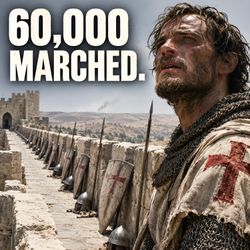
The First Crusade Took Jerusalem. Only 300 Knights Stayed to Hold It.
01:54:04|A child sat up on a sack of grain and asked whether the castle on the hill was Jerusalem.⟡ This narration features AI-assisted voice production, carefully crafted for consistency and clarity.─── ◈ ───THE FIRST CRUSADE TOOK JERUSALEM. ONLY 300 KNIGHTS STAYED TO HOLD IT.In 1096, tens of thousands of people sewed crosses onto their clothes and walked east, towards a city most of them knew only from sermons. Three years later, the army that stood beneath the walls of Jerusalem was a fraction of the one that had set out, and within weeks of its victory most of what remained had gone home. This is the story of the First Crusade, and of where all those people went.◈ A pope's sermon in a field at Clermont, and a crowd that cut crosses from whatever cloth it had◈ The Jewish families of Mainz, and the survivors who wrote down the names of every one of their dead◈ Eight months outside the walls of Antioch, where an egg cost two shillings and a servant dug a spearhead from a church floor◈ The assault on Jerusalem in July 1099, and the numbers both sides counted afterwardsAt Maarat, the chroniclers who had counted everything stopped counting.The First Crusade, 1095–1102: Clermont, the Rhineland, Constantinople, Nicaea, Dorylaeum, Antioch, Edessa, Maarat al-Numan, Arqa and the siege of Jerusalem.History told with space to breathe.─── ◈ ───✧ Support the project: https://linktr.ee/quietarchivum✧ Help keep these stories alive — quietly, consistently.─── ◈ ───✧ Subscribe for history told without noise.✧ New stories arrive when they're ready — and not before.✧ Leave a comment if this one stayed with you.Sources & further reading— Anonymous, Gesta Francorum et aliorum Hierosolimitanorum— Raymond of Aguilers, Historia Francorum qui ceperunt Iherusalem— Fulcher of Chartres, Historia Hierosolymitana— Albert of Aachen, Historia Ierosolimitana— Anna Komnene, The Alexiad— Stephen of Blois, letters to Adela of Blois (1097–1098)— The Hebrew chronicles of 1096 (Solomon bar Samson and the Mainz Anonymous)— Ibn al-Athir, The Complete History (al-Kamil fi'l-Ta'rikh)— Ibn al-Qalanisi, The Damascus Chronicle— S. D. Goitein, "Contemporary Letters on the Capture of Jerusalem by the Crusaders", Journal of Jewish Studies (1952)— Benjamin Z. Kedar, "The Jerusalem Massacre of July 1099 in the Western Historiography of the Crusades", Crusades (2004)— Thomas Asbridge, The First Crusade: A New History (2004)— Peter Frankopan, The First Crusade: The Call from the East (2012)— Jonathan Riley-Smith, The First Crusade and the Idea of Crusading (1986)— Christopher Tyerman, God's War: A New History of the Crusades (2006)#FirstCrusade #SiegeOfJerusalem #SiegeOfAntioch #Jerusalem1099 #PeterTheHermit #GodfreyOfBouillon #AnnaComnena #ByzantineEmpire #Crusades #CrusaderStates #MedievalWarfare #MedievalHistory #MiddleAges #HistoryPodcast #HistoryDocumentary
More episodes
View all episodes
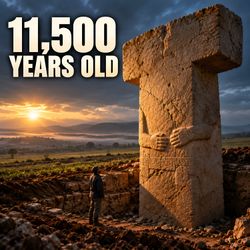
Göbekli Tepe Was Built Before Farming Existed. It Overturned How Civilisation Began.
01:52:01|Flint rasping on limestone, and a stone the length of three men lifting a finger's width off the bedrock.⟡ This narration features AI-assisted voice production, carefully crafted for consistency and clarity.─── ◈ ───GÖBEKLI TEPE WAS BUILT BEFORE FARMING EXISTED. IT OVERTURNED HOW CIVILISATION BEGAN.Eleven and a half thousand years ago, on a bare limestone ridge in south-eastern Turkey, people with no crops, no pottery and no metal cut stone pillars from the rock, carved them with foxes, snakes and vultures, and stood them upright in great rings. Six thousand years would pass before Stonehenge rose in Britain. And in the twentieth century, a farmer's plough would scrape across the tops of those same stones, and the men behind it would curse them as rock.This is the story of Göbekli Tepe, of the hunters who built it, and of the archaeologists who dug it up and found that the hill would not give them a simple answer.◈ A survey team in 1963 who mistook the pillars for Byzantine gravestones and moved on◈ Klaus Schmidt, the German archaeologist who called the rings the first temples on earth◈ Three human skulls carved and drilled by flint, and a hill with seven thousand grinding stones◈ Karahan Tepe and the Stone Hills, where a T-shaped pillar finally turned out to have a faceThe rings were full of earth. For years, everyone thought they knew who had put it there.A documentary narrative of Göbekli Tepe, Karahan Tepe and the Neolithic Stone Hills (Taş Tepeler) near Şanlıurfa, Turkey: the T-shaped pillars, the excavations from 1995 to today, and how the oldest monumental buildings on earth changed the debate over the origins of farming and civilisation.History told with space to breathe.─── ◈ ───✧ Support the project: https://linktr.ee/quietarchivum✧ Help keep these stories alive — quietly, consistently.─── ◈ ───✧ Subscribe for history told without noise.✧ New stories arrive when they're ready — and not before.✧ Leave a comment if this one stayed with you.─── ◈ ───Sources & further readingKlaus Schmidt, Göbekli Tepe: A Stone Age Sanctuary in South-Eastern Anatolia (ex oriente, 2012)Lee Clare, "Inspired Individuals and Charismatic Leaders: Hunter-Gatherer Crisis and the Rise and Fall of Invisible Decision-Makers at Göbeklitepe," Documenta Praehistorica 51 (2024)Laura Dietrich et al., "Cereal processing at Early Neolithic Göbekli Tepe, southeastern Turkey," PLoS ONE 14 (2019)Julia Gresky, Juliane Haelm and Lee Clare, "Modified human crania from Göbekli Tepe provide evidence for a new form of Neolithic skull cult," Science Advances 3 (2017)Julia Schönicke, "Towards a New Understanding of Abandonment Practices in the Neolithic Settlement of Göbekli Tepe"Necmi Karul, excavation reports on Karahantepe, Türk Arkeoloji ve Etnografya Dergisi (2021–)Manfred Heun et al., "Site of Einkorn Wheat Domestication Identified by DNA Fingerprinting," Science 278 (1997)German Archaeological Institute (DAI), The Tepe Telegrams — Göbekli Tepe research blog#GobekliTepe #KarahanTepe #TasTepeler #StoneHills #Neolithic #PrePotteryNeolithic #KlausSchmidt #OldestTemple #OriginsOfAgriculture #Sanliurfa #AncientTurkey #Prehistory #Archaeology #AncientHistory #HistoryDocumentary
Why Angkor, the Largest City of the Medieval World, Was Abandoned
01:48:42|A young man from China counts the stone giants on a bridge, fifty-four on each side, and keeps counting.⟡ This narration features AI-assisted voice production, carefully crafted for consistency and clarity.─── ◈ ───WHY ANGKOR, THE LARGEST CITY OF THE MEDIEVAL WORLD, WAS ABANDONEDIn 1296, a Chinese envoy walked into a city of golden towers, lotus-filled moats and reservoirs large enough to hold the rain of a whole season. He stayed eleven months, wrote down everything he saw, and sailed home. After he left, the stones of Angkor stopped speaking, and the greatest city of its age began to empty, one household at a time. This is the story of the city he walked through, and of the century in which its people slowly left it behind.◈ The stone giants, the golden window and the women who ran the markets, through the eyes of Zhou Daguan◈ The slaves beneath the houses and the hidden labour that kept the waterworks running◈ Two great droughts and the violent floods between them, read in the rings of a Vietnamese cypress◈ The army from Ayutthaya, and the court that moved south to the riverWhen the last inscription was carved in 1327, only the mud and the trees were left to keep the record.A historical narrative of Angkor, Angkor Wat and Angkor Thom in Cambodia, the Khmer Empire, Zhou Daguan's journey of 1296, and the abandonment of the Khmer capital in the fourteenth and fifteenth centuries.History told with space to breathe.─── ◈ ───✧ Support the project: https://linktr.ee/quietarchivum✧ Help keep these stories alive — quietly, consistently.─── ◈ ───✧ Subscribe for history told without noise.✧ New stories arrive when they're ready — and not before.✧ Leave a comment if this one stayed with you.─── ◈ ───Sources & further readingZhou Daguan, A Record of Cambodia: The Land and Its People, trans. Peter Harris (Silkworm Books, 2007)Buckley, B. M. et al., "Climate as a contributing factor in the demise of Angkor, Cambodia," PNAS (2010)Penny, D. et al., "Geoarchaeological evidence from Angkor, Cambodia, reveals a gradual decline rather than a catastrophic 15th-century collapse," PNAS (2019)Evans, D. et al., "Uncovering archaeological landscapes at Angkor using lidar," PNAS (2013)Fletcher, R. et al., "The water management network of Angkor, Cambodia," Antiquity (2008)Carter, A. K. et al., "Temple occupation and the tempo of collapse at Angkor Wat, Cambodia," PNAS (2019)Day, M. B. et al., "Paleoenvironmental history of the West Baray, Angkor (Cambodia)," PNAS (2012)Klassen, S. et al., "Diachronic modeling of the population within the medieval Greater Angkor Region," Science Advances (2021)#Angkor #AngkorWat #AngkorThom #KhmerEmpire #ZhouDaguan #Cambodia #SiemReap #Ayutthaya #LostCity #MedievalHistory #SoutheastAsia #AncientCivilizations #HistoryPodcast #HistoryDocumentary #TheQuietArchive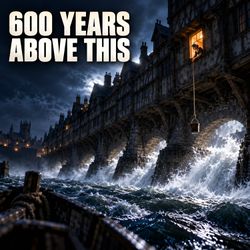
London Bridge Was a Death Trap. People Lived on It for 600 Years.
01:50:46|A bucket on a rope goes down past the shop window and comes back full of river.⟡ This narration features AI-assisted voice production, carefully crafted for consistency and clarity.─── ◈ ───LONDON BRIDGE WAS A DEATH TRAP. PEOPLE LIVED ON IT FOR 600 YEARS.For six centuries, the main road into London ran through a street of shops built over a river that could kill anyone who fell into it. Families ate supper above the rushing tide, fire ran through their houses more than once, and traitors' heads watched the traffic from the southern gate. This is the story of the people who lived on Old London Bridge, and of the bridge that outlived every one of them.◈ A priest who spent thirty years building a bridge, and was buried inside it◈ A duke's barge torn open against the arches, and thirty men lost in the current◈ A tub of hot ashes that burned a third of the bridge before morning◈ A frozen river where a king had his name printed on the iceWhen the last arch came down, the river went silent.The history of Old London Bridge (1209–1831) — from Peter of Colechurch to the frost fairs — across London, Southwark and the River Thames.History told with space to breathe.─── ◈ ───✧ Support the project: https://linktr.ee/quietarchivum✧ Help keep these stories alive — quietly, consistently.─── ◈ ───✧ Subscribe for history told without noise.✧ New stories arrive when they're ready — and not before.✧ Leave a comment if this one stayed with you.─── ◈ ───Sources & further reading— Patricia Pierce, Old London Bridge: The Story of the Longest Inhabited Bridge in Europe (2001)— Peter Jackson, London Bridge: A Visual History (1971, rev. 2002)— Gordon Home, Old London Bridge (1931)— Richard Thomson, Chronicles of London Bridge (1827)— John Stow, A Survey of London (1598)— The Diary of Samuel Pepys (September 1666)— The Diary of John Evelyn (January 1684)#OldLondonBridge #LondonBridge #LondonBridgeIsFallingDown #FrostFair #GreatFireOfLondon #NonsuchHouse #MedievalLondon #TudorLondon #RiverThames #LondonHistory #MedievalHistory #BritishHistory #HistoryDocumentary #AtmosphericHistory #TheQuietArchive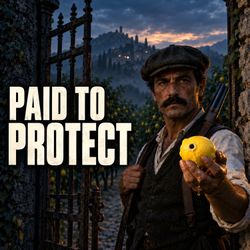
The Sicilian Mafia Was Born Guarding Lemons. Nobody Could Fire the Guards.
02:02:51|A lemon tree on the edge of Palermo, a guardian at the gate, and a letter that arrives polite and badly spelled.⟡ This narration features AI-assisted voice production, carefully crafted for consistency and clarity.─── ◈ ───THE SICILIAN MAFIA WAS BORN GUARDING LEMONS. NOBODY COULD FIRE THE GUARDS.In the 1860s, the citrus groves around Palermo were among the richest farmland in Europe, and every tree needed a man at the gate. Over forty years, those men learned that protection could be sold to the owner, and sold against him. This is the story of the lemon groves of the Conca d'Oro, and of the men who were paid to guard them.◈ A surgeon who dismisses his guardian in 1872, and the shots fired from behind a wall◈ A secret oath in Monreale, sworn over a burning image of a saint◈ A former mayor and bank director stabbed twenty-seven times on a train◈ A police chief who maps eight clans and arrests their bosses in a single nightThe law named them at last. The groves kept their guardians.The birth of the Sicilian Mafia, from Garibaldi's Palermo in 1860 to the Sangiorgi report and the trials of 1901–1904, across the Conca d'Oro, Uditore, Monreale and the Bank of Sicily.History told with space to breathe.─── ◈ ───✧ Support the project: https://linktr.ee/quietarchivum✧ Help keep these stories alive — quietly, consistently.─── ◈ ───✧ Subscribe for history told without noise.✧ New stories arrive when they're ready — and not before.✧ Leave a comment if this one stayed with you.─── ◈ ───Sources & further reading— John Dickie, Cosa Nostra: A History of the Sicilian Mafia (2004)— Salvatore Lupo, Il tenebroso sodalizio: Il primo rapporto di polizia sulla mafia siciliana (2011)— Salvatore Lupo, History of the Mafia (2009)— Diego Gambetta, The Sicilian Mafia: The Business of Private Protection (1993)— Leopoldo Franchetti & Sidney Sonnino, La Sicilia nel 1876 (1877)— Arcangelo Dimico, Alessia Isopi & Ola Olsson, "Origins of the Sicilian Mafia: The Market for Lemons," Journal of Economic History (2017)— Umberto Santino, "Giuseppa Di Sano: una donna alle origini dell'antimafia civile," Cross (2024)#SicilianMafia #Mafia #Palermo #Sicily #CosaNostra #ConcaDOro #SangiorgiReport #Notarbartolo #MafiaHistory #OrganizedCrime #ItalianHistory #19thCentury #HistoryPodcast #TrueCrimeHistory #History
America Feared Malcolm X. The Men Who Killed Him Called Him Brother.
01:20:05|A four-year-old stands in a November yard in his nightclothes, the heat of a burning house on his face.⟡ This narration features AI-assisted voice production, carefully crafted for consistency and clarity.─── ◈ ───AMERICA FEARED MALCOLM X. THE MEN WHO KILLED HIM CALLED HIM BROTHER.At twenty he was a burglar with eight to ten years ahead of him and barely enough words to write a letter. Within fifteen years, he was the voice white America feared most, and the most famous man in a movement that called him brother. Then he walked away from it. This is the story of Malcolm, and of every name he answered to.◈ A house in Lansing burns in 1929, and the town and the family tell two different stories◈ A prisoner copies a dictionary by hand, page by page, by the light from a corridor◈ A minister raises one hand outside a Harlem hospital, and a crowd of thousands disappears◈ A courtroom in 2021 clears two men convicted of a killing they were never part ofThen the people who called him brother began to call him something else.The life and assassination of Malcolm X, from Lansing and Boston to Harlem, Mecca and the Audubon Ballroom, 1925 to 1965.History told with space to breathe.─── ◈ ───✧ Support the project: https://linktr.ee/quietarchivum✧ Help keep these stories alive — quietly, consistently.─── ◈ ───✧ Subscribe for history told without noise.✧ New stories arrive when they're ready — and not before.✧ Leave a comment if this one stayed with you.─── ◈ ───Sources & further readingThe Autobiography of Malcolm X, as told to Alex Haley (1965)Manning Marable, Malcolm X: A Life of Reinvention (2011)Les Payne and Tamara Payne, The Dead Are Arising: The Life of Malcolm X (2020)Manhattan District Attorney's Office, review and vacatur of the Aziz and Islam convictions (November 2021)#MalcolmX #ElHajjMalikElShabazz #NationOfIslam #AudubonBallroom #ElijahMuhammad #BettyShabazz #Harlem #CivilRightsHistory #BlackHistory #1960sAmerica #AmericanHistory #HistoryPodcast #NarrativeHistory #AtmosphericHistory #TheQuietArchive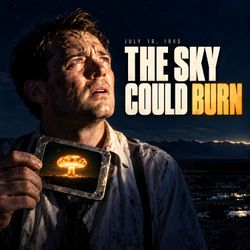
Oppenheimer's Team Feared the Bomb Could Ignite the Atmosphere. They Were Almost Sure It Wouldn't.
01:13:19|A man finishes writing on a blackboard, and the room stops talking.⟡ This narration features AI-assisted voice production, carefully crafted for consistency and clarity.─── ◈ ───OPPENHEIMER'S SCIENTISTS FEARED THE FIRST ATOMIC BOMB COULD END THE WORLD. THEY TESTED IT ANYWAY.In the summer of 1942, before a single atomic bomb existed, a handful of physicists in a locked office asked whether it might set the Earth's air on fire. For three years they calculated, checked and argued, and each answer came back reassuring, but never quite certain. This is the story of that question, and of the people who had to decide whether almost certain was certain enough.◈ A locked office in Berkeley, where the danger was first written down◈ A beach in Michigan, where a physicist demanded odds close to zero◈ A betting sheet at base camp, on the night before the first atomic test◈ A secret report, written a year later, still asking for further workAnd at 5:29 in the morning, the only experiment that could settle it began.The Trinity test of July 16, 1945 — the Manhattan Project, Los Alamos and the Jornada del Muerto desert in New Mexico, and the fear that the first atomic bomb could ignite the atmosphere.History told with space to breathe.─── ◈ ───✧ Support the project: https://linktr.ee/quietarchivum✧ Help keep these stories alive — quietly, consistently.─── ◈ ───✧ Subscribe for history told without noise.✧ New stories arrive when they're ready — and not before.✧ Leave a comment if this one stayed with you.─── ◈ ───Sources & further reading◈ E. J. Konopinski, C. Marvin & E. Teller, "Ignition of the Atmosphere with Nuclear Bombs" (Los Alamos report LA-602, 1946)◈ Arthur H. Compton, Atomic Quest (1956)◈ Leslie R. Groves, Now It Can Be Told (1962)◈ Richard Rhodes, The Making of the Atomic Bomb (1986)◈ John Horgan, "Bethe, Teller, Trinity and the End of Earth," Scientific American◈ "Manhattan Project Astrophysics," Physics Today◈ Atomic Heritage Foundation — Trinity test oral histories and site guide#TrinityTest #Oppenheimer #ManhattanProject #FirstAtomicBomb #LosAlamos #EdwardTeller #EnricoFermi #AtmosphericIgnition #CastleBravo #NuclearHistory #WW2History #HistoryOfScience #ColdWar #HistoryPodcast #TheQuietArchive