Share
Green Shift
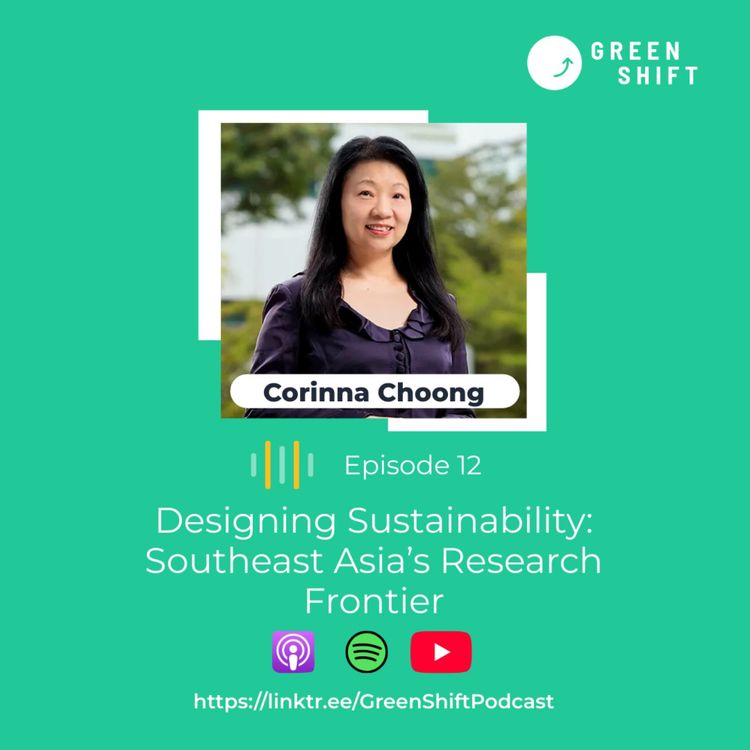
Designing Sustainability: Southeast Asia’s Research Frontier
At the Singapore University of Technology and Design (SUTD), sustainability by design isn’t a slogan — it’s a mission.
In this episode of Green Shift, hosts David Austin and Dr. Victor Nian speak with Ms. Corinna Choong, Chief Sustainability Officer and pioneer staff member at SUTD, about how the university is using design, technology, and research to drive sustainability impact — from AI-powered urban planning to biodiversity mapping and nature-based cooling on campus.
Ms Choong also reflects on how thoughtful design can transform Southeast Asia’s cities — citing examples from Bangkok and Malaysia that illustrate how architecture, materials, and community planning can all contribute to resilience and decarbonisation.
In this episode:
🌳 What “sustainability by design” means at SUTD
🤖 How AI, robotics, and research are reshaping urban systems
🏙️ Singapore’s role as a living lab for the region
💡 Real-world examples of sustainable design across Southeast Asia
💰 Breaking down barriers in green finance and policy
👩🎓 Advice for young innovators leading the next generation of change
🎧 Listen, learn, and be inspired to design boldly, act locally, and collaborate regionally.
#Sustainability #DesignThinking #GreenShift #Singapore #SUTD #EnergyTransition #SoutheastAsia #ClimateAction #UrbanDesign #Innovation #AI #SmartCities
More episodes
View all episodes
20. Unlocking Green Finance in Southeast Asia
49:19||Season 2, Ep. 20Ep. 20: Unlocking Green Finance in Southeast Asia with Nikki KempSoutheast Asia faces a $1.1 trillion annual climate funding gap — and the world is falling short by $800 billion every year. So what's actually blocking the flow of green capital into the region?David Austin and James Balzer sit down with Nikki Kemp, Executive Director of the Singapore Green Finance Centre at SMU, to break down the real structural barriers to sustainable finance in Southeast Asia — and what's being done to overcome them.They cover regulatory fragmentation across ASEAN, why blended finance hasn't scaled, Singapore's FAST-P structure, the struggles of the JETP and ETM coal transition programs, a new corporate finance model being developed for Indonesia's PLN and Vietnam's EVN, the "race to the bottom" problem with sustainability-linked loans, the region's growing insurance and adaptation finance gap, and why the GEMS default database needs to be opened up to the private sector.If you work in sustainable finance, climate policy, banking, or impact investing — or just want to understand how Southeast Asia is navigating the energy transition — this episode is essential listening.Green Finance Academy — a two-day in-person program covering energy transition financing, blended finance, carbon markets, AI and green finance, and more. Taking place 28-29 October 2026. Details and registration: https://www.singaporegreenfinance.com/sgfc-course/green-finance-academy/
19. Singapore’s Nuclear Turning Point?
22:59||Season 2, Ep. 19⚛️ Singapore has taken a major step toward a possible nuclear future.The country is beginning the IAEA’s Integrated Nuclear Infrastructure Review (INIR) process — a critical milestone used by countries considering nuclear energy for the first time.But what does that actually mean?And why are Small Modular Reactors (SMRs) suddenly becoming part of Southeast Asia’s energy conversation?In this episode of Green Shift, David Austin speaks with Dr. Victor Nian about:⚡ Singapore’s nuclear readiness process⚡ The IAEA milestone approach explained simply⚡ Why SMRs are NOT a shortcut around regulation⚡ The 19 infrastructure requirements needed for nuclear energy⚡ Energy security after the Ukraine War and Strait of Hormuz crisis⚡ Why philanthropic organizations are beginning to support nuclear energy⚡ How AI and hyperscaler data centers are changing future electricity demand⚡ Why public engagement matters in the transition to sustainability🎧 If you're interested in:sustainability conversationsclean energy policythe future of nuclear powerenergy securitySoutheast Asia’s energy transitionsustainability storytelling from Asia…this episode is for you.⏱️ Chapters00:00 Singapore begins the INIR process02:26 What the IAEA milestone approach actually means04:54 Are SMRs treated differently from traditional nuclear plants?07:25 The 19 nuclear infrastructure requirements explained11:18 When could Singapore reach milestone one?12:04 The three key organizations needed for a nuclear programme14:23 Why nuclear philanthropy is emerging globally19:59 How foundations could shape the future of nuclear energy20:12 AI, data centers, and rising electricity demand22:26 Why informed public discussion matters📩 Subscribe to Green Shift for more sustainability podcast episodes exploring clean energy, climate policy, and the transition to a sustainable economy in Asia.💬 What do you think?Should Singapore seriously pursue nuclear energy?#sustainability #sustainabilitypodcast #nuclearenergy #SMR #energytransition #cleanenergy #singapore #southeastasia #climatechange #energypolicy
18. Oil Shock: Can Sustainability Survive?
38:40||Season 2, Ep. 18The Strait of Hormuz crisis is exposing a hard truth about the global energy transition: the world is still deeply dependent on fossil fuels.In this episode of Green Shift, sustainability conversations collide with geopolitical reality as Rajiv Biswas, CEO of Asia-Pacific Economics and Dr. Victor Nian, Founding Co-chair of the Centre for Strategic Energy and Resources (CSER) examine how the US-Iran conflict and disruption to Middle East oil and gas supplies are reshaping Asia’s energy future.Find Asia-Pacific Economics online 🔗https://asiapacificeconomics.com/From rising oil prices and electricity shortages to renewed coal use, nuclear energy, and the long-term future of renewables, this sustainable podcast explores the difficult trade-offs governments and businesses now face between energy security, affordability, and environmental sustainability.Topics discussed include:⚡ The impact of the Strait of Hormuz crisis on Asia-Pacific economies⚡ Why countries are turning back to coal despite climate goals⚡ The growing role of nuclear power in the transition to sustainability⚡ Whether solar imports from Australia or India make economic sense⚡ How AI data centres are increasing electricity demand⚡ Why energy security is now a corporate boardroom issue⚡ The future of fossil fuels in a sustainable economyRead the CSER Policy Brief: "From Shock to Transformation: Rethinking Asia’s Energy Security PostHormuz Crisis" If you’re interested in sustainability storytelling, global energy markets, climate policy, or the realities of sustainable development, this episode is for you.Green Shift is a sustainability podcast exploring the struggles and successes of the global transition to sustainability, with a special focus on Asia.Subscribe for more sustainability conversations and expert analysis on energy, climate, economics, and the future of sustainable growth.#Sustainability #EnergyTransition #GreenShiftPodcast #ClimateChange #EnergySecurity #NuclearEnergy #OilCrisis #StraitOfHormuz #RenewableEnergy #Asia
17. SMRs in Southeast Asia: The Time is Now
01:10:45||Season 2, Ep. 17Is nuclear energy making a comeback—and could it power Southeast Asia’s sustainable future?In this episode of Green Shift, we dive into one of the most important (and controversial) topics in the global energy transition: Small Modular Reactors (SMRs). As energy demand surges—driven by AI, data centers, and economic growth—the region faces a critical question:👉 Can nuclear be the key to a reliable, low-carbon future?In this sustainability conversation, we cover:Why the AI boom is breaking traditional energy models.The difference between conventional nuclear and "Lego-like" SMR modularity.Financing the future: Why governments need to move fast on policy.Public perception: Moving from "Not In My Backyard" to "Why Not?"Geopolitics: The risks of locking into specific vendors and fuel supplies.🔔 Don't forget to subscribe for more sustainable storytelling and insights into the energy transition.🎙️ Featuring:Dr. Victor Nian (CSER)Graham Beal (Corporate Finance, Infrastructure)Sanjeev Gupta (Energy Strategy & Transactions)Hosted by David Austin📌 Timestamps:0:00 - Panic mode: Why reliance on fossil fuels is failing2:30 - Introducing the experts: Finance, strategy, and energy research6:00 - What is an SMR? Victor explains modular nuclear tech13:00 - Who is building SMRs? The global race (US, China, Europe)19:00 - The economics: SMR vs. LNG vs. Biofuels ($/MWh breakdown)25:00 - The "lock-in" effect: Choosing a vendor means choosing a country31:00 - Financing SMRs: Why the "First of a Kind" needs government help36:00 - Singapore’s luxury problem: Money vs. Space41:00 - Public perception: Explaining that a reactor is not a bomb46:00 - Space data centers? Elon Musk, nuclear batteries, and the future50:00 - The fuel crunch: Will we run out of uranium?58:00 - The Verdict: Time is running out for a 2050 deadline🎙️ About Green Shift:We are a sustainability podcast focused on real-world solutions and the transition to sustainability. Unlike other shows, we bring together finance, technical, and regional experts to discuss what actually works.Connect with us:Subscribe on Substack; https://substack.com/@greenshift💬 Comment below: Is nuclear the answer to AI’s energy crisis?#sustainabilitypodcast #energytransition #SMR #nuclearenergy #greenshift #sustainablepodcast #southeastasia #AIenergy #decarbonization
16. Decarbonising the Seas: Inside Shipping’s Energy Transition
40:48||Season 2, Ep. 16Shipping moves 80–90% of the world's trade—but it's also one of the hardest industries to decarbonise.In this episode of Green Shift, David Austin and Dr. Victor Nian sit down with Riccardo Barbiellini, maritime and energy transition specialist at Bureau Veritas' Future Shipping Team. Riccardo works at the intersection of shipping, regulation, and decarbonisation, helping one of the world's most essential sectors navigate the shift to a low-carbon future.We explore:• What a sustainable ASEAN port city looks like in 2040• The IMO's MEPC 83 meeting and why political risk is slowing investment• Ammonia as a fuel: safety, toxicity, and whether it's a real solution• Where investment is actually going right now (LNG, AI, and efficiency)• Why top-down regulation is essential for hard-to-abate sectors• Singapore's MPA grants and the "sandbox" approach to ammonia trials• Biofuels from palm oil: plug-and-play potential vs. traceability problems• Nuclear-powered commercial shipping: silver bullet or essential option?• Bureau Veritas' timeline for commercially viable SMR vessels (2040)• Floating nuclear power plants for island nationsResources mentioned in this episode:White paper on nuclear energy in shipping:https://marine-offshore.bureauveritas.com/newsroom/bureau-veritas-contributes-new-industry-white-paper-role-nuclear-energy-shippingTechnical review on maritime nuclear development:https://marine-offshore.bureauveritas.com/newsroom/maritime-nuclear-developmentRead the deeper dive:Prefer reading to listening? Each episode is turned into a rich, detailed blog post with additional analysis and context:https://greenshift.substack.comFollow Green Shift:YouTube: https://www.youtube.com/channel/[YOUR_CHANNEL_ID]?sub_confirmation=1About Green Shift:Green Shift makes sense of the energy transition—from net zero and carbon markets to nuclear, renewables, and the policies shaping our future. Hosted by David Austin and Dr. Victor Nian.
15. Carbon Without Borders: Harmonising CCS in Asia Pacific
34:49||Season 2, Ep. 15Can Asia-Pacific build a cross-border carbon capture system—and make it actually work?In this episode of Green Shift, host David Austin and co-host James Balzer sit down with Kevin Pang (SVP at FutureScaleX) to unpack one of the most complex—and potentially transformative—climate solutions: Carbon Capture and Storage (CCS).From Japan’s push to export CO₂, to Southeast Asia’s vast storage potential, this conversation explores the real-world challenges of turning CCS into a regional, scalable system.🎯 Key Topics Covered:What CCS actually is (pre-combustion, post-combustion, oxy-fuel explained simply)Why transport—not storage—is the biggest bottleneck in Asia-PacificThe geopolitics of cross-border CO₂ (Japan, Indonesia, Malaysia, Australia)The economics: can CCS ever be commercially viable?Carbon credits vs real costs—where’s the tipping point?The role of state-owned enterprises and government incentivesWhy ASEAN’s geography (ports + industry clusters) is a hidden advantageThe governance challenge: tracking CO₂ across borders (MRV systems)CCS as a transition solution, not a permanent fixAnd the big idea: could CO₂ become a valuable resource instead of waste?💡 Standout Insight:If CO₂ can be converted into products like ethylene, it could unlock real market demand—turning climate policy into economic opportunity.🌱 Why This Matters:Asia-Pacific is at the center of global growth—and emissions. Getting CCS right here could define whether the region can balance development with decarbonisation.🔗 Related Episodes:Check out our previous deep dive on CCS governance https://youtu.be/uH5R-8oSOW8?si=rbGnpAgd1p6O3KWz🔗Download James' policy brief, "Diagnosing Governance Dysfunctionsof CCS in Indonesia" https://img1.wsimg.com/blobby/go/ca134fed-3c95-42d1-bf19-decdd72df6d1/CSER_PB08_Diagnosing%20Governance%20Dysfunctions%20o.pdf👍 Like, subscribe, and follow Green Shift for more conversations on the transition to a sustainable economy—through an Asia-focused lens.#CarbonCapture #CCS #Sustainability #EnergyTransition #AsiaPacific #ClimateTech #Decarbonisation
14. Aloe Vera Batteries: Eco-friendly products
30:45||Season 1, Ep. 14♻️ Can Aloe Vera Power the Future? Inside the World’s First Aloe-Based Battery | Green Shift PodcastWhat if the batteries in your remote control, toys, or clocks were 100% eco-friendly, biodegradable, and even more powerful than regular alkaline batteries? 🌱🔋This episode of Green Shift welcomes Nimisha Varma, co-founder of Aloe E-Cell, and Kash Singh, founder of Primea.Earth, to explore one of the most intriguing sustainability innovations coming out of India: batteries powered by aloe vera.Aloe E-Cell has created a non-toxic, biodegradable alternative to traditional household batteries—designed not only to perform better, but also to eliminate the massive e-waste problem created by the 89 billion batteries thrown away globally every year.In this episode, you'll learn:Why aloe vera is surprisingly ideal as a battery materialHow Aloe E-Cell batteries deliver 1.5x more performance than conventional AAsWhat “100% eco-friendly” really means in the context of battery chemistryHow discarded batteries can be upcycled into fertilizer through their patented processThe challenges of setting up a circular economy system across IndiaWhy human behaviour is hard to change—but products can be redesigned to make sustainability effortlessThe founders' journey: the setbacks, breakthroughs, and unwavering belief behind the innovationTheir plans for AAA, button cells, rechargeable batteries, and future high-energy applicationsWhether you’re interested in sustainability, circular economy solutions, climate tech innovation, or the entrepreneurial stories behind world-changing ideas, this is a must-listen.🔋 About Aloe E-CellAloe E-Cell is the world’s first aloe vera–based battery company, offering biodegradable, non-toxic AA batteries that outperform conventional alkaline options. They are currently expanding across India, Singapore, Mauritius, and beyond.https://www.aloeecell.com/🌿 About Primea.EarthPrimea.Earth distributes sustainable products—including Aloe E-Cell batteries—in Singapore and Malaysia while promoting circular economy solutions.https://primea.earth/🎧 Listen to Green ShiftA sustainability podcast hosted by David Austin and Dr. Victor Nian, featuring innovators and leaders accelerating the transition to a greener economy.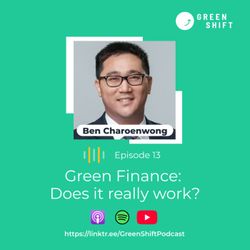
13. Green Finance: Does it really work?
49:29||Season 1, Ep. 13In this episode of Green Shift, we ask the hard questions behind Environmental, Social, and Governance (ESG), sustainable finance, and carbon disclosure with Professor Ben Charoenwong of INSEAD. His research digs into how markets, data, and politics shape what we call “sustainability” — and why the biggest challenge may not be money, but misaligned incentives and bad measurement.From greenwashing and carbon taxes to the role of sovereign wealth funds and banks in Asia’s energy transition, this wide-ranging conversation breaks down: ✅ Why the number one predictor of ESG scores is size, not sustainability ✅ How politics and policy distort what counts as “green” ✅ Why disclosure and rule of law matter more than PR ✅ And how the real challenge isn’t an abundance of capital — it’s allocation.🎙️ Hosted by David Austin, with co-hosts Dr. Victor Nian and Dini Sandys from the Centre for Strategic Energy and Resources (CSER).#GreenShift #SustainableFinance #ESG #Greenwashing #ClimateFinance #EnergyTransition #Singapore #INSEAD #CSER