Share
Clive's Great Reads
The Treasury of Quotes by Jim Rohn
Ep. 1
•
This podcast discusses Jim Rohn's book, The Treasury of Quotes. Jim Rohn is a renowned business philosopher, and his book is designed to offer a treasury of wisdom for personal and professional growth. The podcast is a deep dive into Rohn's quotes from his journals, seminars, and books. The Treasury of Quotes spans 39 years of experience and offers insights into various aspects of life, including personal responsibility, financial independence, leadership, and the importance of personal development. The Treasury of Quotes is intended to inspire readers to take charge of their lives, develop their skills, and create the future they desire. This is a great read!
More episodes
View all episodes
2. The 1% Rule by Tommy Baker
33:19||Ep. 2"The 1% Rule" by Tommy Baker, sets out a simple but highly effective method for achieving goals and achieving a fulfilling life. The book advocates for focusing on small, consistent daily improvements (the 1% Rule) and adopting a mindset of persistence, endurance, and accountability, rather than relying on fleeting bursts of motivation. It encourages readers to identify their core values and goals, break them down into smaller, actionable steps, and develop a structured approach to achieving them. The book emphasizes the importance of deep work, strategic disconnects, and managing distractions to ensure sustained progress. Ultimately, the book argues that true success comes not from overnight achievements but from a dedication to the continuous process of growth and development.
3. Atomic Habits by James Clear
15:17||Ep. 3James Clear's Atomic Habits outlines four key laws for building good habits and breaking bad ones: make it obvious, make it attractive, make it easy, and make it satisfying. Clear uses a variety of anecdotes and scientific research to illustrate these laws, focusing on the importance of identifying cues, understanding dopamine-driven feedback loops, and overcoming the temptation of immediate gratification. Atomic Habits also examines how personality and environment influence our habits, emphasizing the need to find a game that favors our strengths and design a life that makes good habits inevitable.
4. Stop Thinking Start Living by Richard Carlson
10:47||Ep. 4Stop Thinking Start Living by Richard Carlson is a self-help guide to achieving inner peace and happiness through understanding the nature of thought. Carlson argues that negative emotions and unhappiness stem from negative thinking, and that we can break free from this cycle by learning to recognize and dismiss these thoughts. The book provides a framework for understanding our own thought processes and developing a more positive outlook on life, focusing on techniques like recognizing choice points, cultivating gratitude, and living in the present moment.
5. The 5am Club by Robin Sharma
17:53||Ep. 5The 5am Club by Robin Sharma is a fictional story about a self-help guru known as "The Spellbinder" who teaches a group of people the importance of early rising and personal development. It is a self-help book that advocates for waking up at 5 AM to unlock potential and achieve extraordinary results in various aspects of life. Through the experiences of an entrepreneur, an artist, and their eccentric billionaire mentor, the book explores the transformative power of a disciplined morning routine and offers practical strategies for personal growth and success.The book's central premise is that "owning your morning" by rising at 5 AM creates a "Victory Hour" that can be used to cultivate the "4 Interior Empires": Mindset, Heartset, Healthset, and Soulset. This time allows individuals to focus on self-improvement before the demands of the day begin. It highlights the importance of persistence and commitment, noting that research suggests it takes a minimum of 66 days to form a new habit. It also highlights the idea that those who achieve legendary status often face significant hardships. The book advocates for embracing challenges and using them as opportunities for growth. It explores various aspects of personal growth, including habit formation, managing success, and achieving a fulfilling life. Further, it emphasizes the importance of introspection, self-discipline, and the power of the mind to overcome challenges and achieve personal excellence.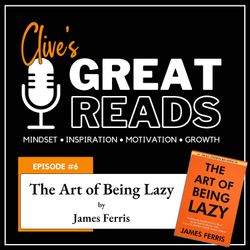
6. The Art of Being Lazy by James Ferris
21:15||Ep. 6"The Art of Being Lazy" by James Ferris is a guide to productive laziness, arguing that strategic inactivity and efficient methods can lead to greater success, well-being, and fulfilment. It challenges conventional notions of hard work, encouraging readers to embrace rest, simplify their lives, and focus on what truly matters. Ferris explores various techniques and philosophies from around the world, including the Japanese concepts of 'nagomi', 'Ma', and 'wabi-sabi' and the Greek idea of 'schole', demonstrating how embracing laziness can lead to a more balanced, intentional, and satisfying life.
7. The Monk Who Sold His Ferrari by Robin Sharma
21:11||Ep. 7Robin Sharma’s book, The Monk Who Sold His Ferrari, is a self-help novel presented as a fable. The book tells the story of Julian Mantle, a successful lawyer who experiences burnout and embarks on a journey to find meaning in his life. He travels to India, where he encounters a wise sage who teaches him valuable lessons about happiness, success and self-mastery. These lessons are presented as a series of ten rituals for radiant living: the Ritual of Solitude, the Ritual of Abundant Knowledge, the Ritual of Early Awakening, the Ritual of Personal Reflection, the Ritual of Willpower, the Ritual of Purpose, the Ritual of Gratitude, the Ritual of Living in the Now, the Ritual of Live Nourishment, and the Ritual of Opposition Thinking. Through these rituals, the book explores themes of personal development, mindfulness, self-discipline and finding meaning in life.
8. How to IKIGAI by Tim Tamashiro
10:32||Ep. 8How to Ikigai by Tim Tamashiro, explores the Japanese concept of Ikigai, which translates to "life’s worth" and describes finding your reason for getting out of bed every morning. Tamashiro uses anecdotes and examples to explain the importance of doing what you love, what you are good at, what the world needs, and what you can be rewarded for. He explores the significance of mindfulness, job crafting, and taking an Ikigap year, a year dedicated to personal growth and exploring new passions. The book uses the metaphor of karate belts to illustrate how Ikigai is a journey of self-discovery with multiple stages. Tamashiro encourages the reader to discover their own Ikigai through introspection, meditation, and experimenting with different passions.The concept of Ikigai, as presented in the book "How to Ikigai", contrasts sharply with traditional Western views on purpose and fulfillment. While Western societies often equate purpose with career success and financial stability, Ikigai offers a more holistic and intrinsic approach, focusing on finding joy and meaning in everyday life.Western societies typically emphasize a linear path to success: Get a good education, secure a stable job, work hard to climb the corporate ladder, and eventually achieve financial security, which is seen as the key to happiness and fulfillment. This approach prioritizes external markers of success and often delays personal gratification until retirement.Ikigai, originating from Okinawa, Japan, presents a contrasting perspective: It centers on the idea of "life's worth" and emphasizes finding joy and purpose in everyday activities. Ikigai is not about achieving a specific goal or reaching a certain financial milestone; it's about living a life filled with purpose and meaning, starting today.
9. The 7 Habits of Highly Effective People by Stephen Covey
12:47||Ep. 9The 7 Habits of Highly Effective People by Stephen Covey explores the concept of effectiveness and personal growth. Covey argues that true effectiveness stems from a principle-centered approach rather than a personality-driven one. The book outlines seven habits that contribute to personal and interpersonal effectiveness, emphasizing the importance of self-awareness, proactivity, setting priorities, and building strong relationships based on empathy and win-win solutions. Covey highlights the significance of developing a personal mission statement and effectively managing time, encouraging readers to shift their focus from urgent tasks to important ones, and promoting a paradigm shift from dependence to interdependence.Covey explains that a principle-centered paradigm is essential to living an effective life. He compares principles to a lighthouse in the fog, guiding a ship to safety. Principles are natural laws that are unchanging and unbreakable, serving as a foundation for security, guidance, wisdom, and power.People often operate based on paradigms centered around things like their spouse, family, money, work, possessions, pleasure, friends/enemies, church, or even themselves. However, all of these centers are flawed because they are based on external factors that are subject to change. For example, someone who is spouse-centered will base their security and sense of self-worth on how their spouse treats them, leaving them vulnerable to changes in the relationship.In contrast, a principle-centered paradigm provides a solid, unchanging core. This center empowers individuals to navigate the complexities of life with a sense of inner peace and security, knowing that principles are constant, regardless of external circumstances. This leads to:Security: Knowing that correct principles do not change provides a stable foundation for facing life's challenges.Guidance: Principles act as a compass, helping individuals to make decisions aligned with their values and see the bigger picture.Wisdom: Living by principles provides a true understanding of the world and the ability to make sound judgments.Power: A principle-centered individual possesses the power of self-awareness and independent will, enabling them to act effectively and interdependently.Covey emphasizes that a principle-centered paradigm is not about techniques or quick fixes but rather a fundamental shift in thinking. This shift requires examining and aligning one's paradigms with correct principles, which leads to a more accurate perception of the world and the ability to make effective decisions in all areas of life.