Share
Garlic & Pearls
An exploration of what makes the British so British and the French so French, with Suzanne Raine and Muriel Zagha.
Latest episode
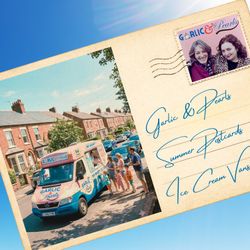
112. Summer Postcards: Ice Cream Vans
32:58||Season 1, Ep. 112Can you hear the clarion call of a tinny version of 'Green Sleeves'? That familiar cheery chime is calling us to the ice cream van, plying its way all over the UK in the summer. Suzanne explores its history, its British-American mash-up of creativity, crucial Italian connection, technical challenges and complex regulations. Who invented Mr Whippy? How did the 99 chocolate flake come to be? Who is best at converting an ordinary van into a magical driving machine that dispenses ice cream? And should Suzanne and Muriel consider an alternative career ? The Garlic & Pearls theme tune would make an irresistible chime for their van...
More episodes
View all episodes
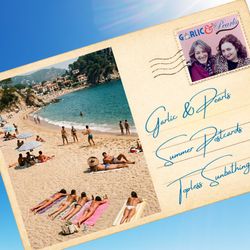
111. Summer Postcards: Topless Sunbathing
33:10||Season 1, Ep. 111The golden age of topless sunbathing in France lasted a little over a decade, from the 1970s to the tail end of the 1980s. French women pioneered it and were also first to abandon it. But how and why? Muriel retraces the story of a particular aspect of Gallic art de vivre which was highly codified and attempted to recast the social contract between women and society. How natural was it? How cultural? Did it have more to do with feminism – of the French kind – or with fashion? And what would Coco Chanel have made of it?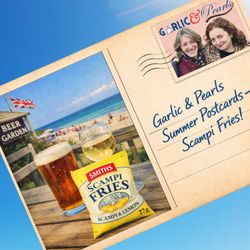
110. Summer Postcards: Scampi Fries
30:46||Season 1, Ep. 110Another case of Suzanne pinpointing the essence of Britain; another first-time taste experience for Muriel! What are scampi fries but fish and chips, pubs and the British seaside holiday all condensed into a tiny mouthful of fishy saltiness. Covering ground from Georgian recipes of Italianate dishes of langoustines to extruded snacks of the 1980s, Suzanne tells the story of how the whole of Britain was fitted into a small crunchy bag.
109. Summer Postcards: Pastis
29:52||Season 1, Ep. 109In the wake of the banning of absinthe in France in 1915, a new apéritif was born, redolent with aniseed and liquorice, a taste at once medicinal and full of the joie de vivre we associate with the South of France. But what does 'pastis' mean? Who invented it? In what way did it have political implications? And why is it so central to French apéritif culture?
108. Stripy Tops: From Devil's Cloth to Top French Icon
56:33||Season 1, Ep. 108Muriel tells the story of the stripy Breton top and wonders how a pattern – stripes – once considered sacrilegious and satanic gradually became the epitome of French elegance. We explore the evolving cultural history of a powerful symbol, the role of seaside holidays, of sailor suits as the preferred outfits of smart children, and the formalisation of the uniforms of the French Navy. Coco Chanel, Pablo Picasso, Jean Cocteau, Jean-Paul Gaultier and a lot of zebras put in an appearance. Are stripy tops a means of clothing oneself in maritime courage, freedom and adventure?
107. Pub Quizzes: The Nation's Favourite 'Brit of Fun'!
01:00:51||Season 1, Ep. 107Biros at the ready as Suzanne takes Muriel on a tour of a very British obsession: the pub quiz. Did it begin on a mythical night in Yorkshire in 1946? Is it one of the primary ways in which the British relate to each other socially? And if so, why? Can the Zoom quiz be credited for keeping the nation together during Covid? Are the best pub quizzes, Suzanne asks, ultimately where the British sense of terroir is located? Warning: this episode contains a veritable avalanche of punning. What's your team name, by the way? The Spanish Inquizzition? I Am Smartacus? Or simply: Quizzy McQuizface?
106. The Institut Français du Royaume-Uni: Britain's Official Portal into French Culture!
01:00:01||Season 1, Ep. 106With French historian Charlotte Faucher as her guide, Muriel explores the madly ornamental pink-brick Art Deco wonder that is the French Cultural Institute in South Kensington. Though the building dates from 1939, the idea of setting up a French Institute in Britain as a gateway to a better understanding between our two nations arose in 1910, the brainchild of Marie d'Orliac, an enigmatic figure who was also very good at reinventing herself. Nowadays South Kensington is a hub of French soft power, but how did it all begin, and what was the impact of the two World Wars on the project, especially the arrival in 1940 of an obscure officer called Charles de Gaulle and his 'certain idea of France'? Join us for a fascinating peek into a beguiling engine of soft power and the people that gave it meaning!