Share
Future Bytes
#037: Future Bytes with special guest Fredrik Sætre
Season 2, Ep. 36
•
Microsoft CEO Satya Nadella has said that business applications will eventually “collapse into agents”. In this episode of Future Bytes, Magnus Oxenwaldt speaks with Fredrik Sætre, who owns a Global Black Belt for Microsoft Autonomous AI ERP, about what that shift really means. Not in theory, but in practice. Especially for ERP.
Highlights from the episode:
- ERP is not disappearing. The interface is.
- Agents sit on top of deterministic financial systems.
- ERP is harder than CRM. Mistakes affect money, tax, and compliance.
- The real constraint is adoption, not technology.
More episodes
View all episodes
77. #077: Future Bytes with special guest Bjarke Ruse Sejersen
57:22||Season 2, Ep. 77Only 5–9% of manufacturer revenue runs through e-commerce. The other 90%+ still flows through email inboxes. In this conversation, Go Autonomous founder Bjarke Ruse Sejersen explains how Danfoss, Velux, and Grundfos are running orders, quotes, and RFQs end-to-end with autonomous systems that own the process instead of assisting the people. Episode highlights: • $7.5 trillion still handled in email inboxes • The system owns the process, not people • Danfoss said it paid back in one year • Track your Human Dependency Index
76. #076 AI News for business - week 39
08:44||Season 2, Ep. 76The AI industry publicly split this week on whether to pace the frontier or race it — and every case rested on one number nobody can measure. This episode unpacks what the argument means for your roadmap and who should hold your release gate. Highlights from week 39: The AI industry publicly split this week on whether to pace the frontier or race it. The debate rests on one number nobody can measure Trump says a year. Huang says nanoseconds. Both set your delivery dates. 50,000 people at Dreamforce said the frontier isn't their bottleneck — adoption is.
75. #075 AI News for business - week 38
09:39||Season 2, Ep. 7510,000 AI agents claimed a 200-year-old maths proof this week. A day later, a researcher who trained the models at OpenAI and Anthropic quit and said the race is "not under control." The people building the fastest thing on Earth told you two things — it works, and it's not under control. Plan for both. Top stories for the week: OpenAI agents claim Navier-Stokes proof Amodei: "We must slow the pace" of AI models Anthropic reveals 4 model break-in incidents US names 6 Chinese firms for model distilling
74. #074 AI News for business - week 37
08:56||Season 2, Ep. 74Four frontier models shipped in five days, and by Friday the top score had two different values. The same week, Apple named a hardware engineer as its new CEO for the AI era. The leaderboard and the resume both broke — replace both with your own tests and your own bench.Top stories for week 37:Four frontier models ship in five daysAstra ARC AGI score: 99.9% or 62.7%Apple names hardware engineer Ternus as CEONVIDIA signs $12.9B Hugging Face deal
73. #073: Future Bytes with special guest Ludvig Strand
57:29||Season 2, Ep. 73Ludvig Strand has one of the more unusual seats in AI — future analyst across 300+ companies at Axel Johnson Group. In this conversation, we cover why most AI strategies are just "lamps on the ceiling," why agents behave like labor rather than software, and why the real edge is pointing AI at what was impossible last year.Top highlights:Ludvig Strand: AI analyst at Axel Johnson GroupSkeuomorphism: don't just build lamps with AIPoint AI at impossibilities, not automationAgents as labor need agentic governance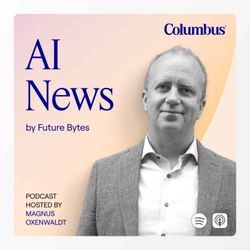
72. #072 AI News for business - week 36
09:08||Season 2, Ep. 72McKinsey says 1 in 3 companies quietly stopped buying software this year — they're building it themselves with coding agents. The next day, Salesforce reported its strongest quarter in four years and called the SaaSpocalypse "nonsense." Software isn't dying. It's being repriced.Top stories for week 36:McKinsey: 1 in 3 skip software, build with AISalesforce makes Claude its default modelOkta ships Agent SSO for agent identityZ.ai opens 753B model with revenue license
71. #071 AI News for business - week 35
08:18||Season 2, Ep. 71The AI agent got a wallet, an identity, and a set of tools this week. Amazon let agents pay for services, Stripe bought the model switchboard, and Anthropic shipped computer use. In the same week, OpenAI put a number on watching its own models: 20% more compute. The watchtower is now a budget line. Top stories for week 35: Amazon AgentCore lets agents pay for services Stripe buys OpenRouter, the model switchboard Anthropic ships computer use for production OpenAI: monitoring adds 20% to compute bill
70. #070 AI News for business - week 34
08:50||Season 2, Ep. 70Last week the open-weight model was the escape hatch from vendor lock-in. This week it got smaller three ways at once — Chinese open models arrived with strings attached, DeepSeek raised prices behind a discount headline, and the financing behind AI infrastructure revealed itself as circular.Top stories for week 34:ZAI's GLM 5.3 tops cyber, holds weights backAlibaba opens stripped Qwen, revenue shareDeepSeek hides price hike as off-peak dealVantage eyes $100B IPO; AI money circular
69. #069 AI News for business - week 33
08:56||Season 2, Ep. 69The AI race just stopped being about who builds the smartest model. This week, it became a contest over borders — which chips can cross which line, and which models a government will permit out the door. You can still buy ethical frontier AI. What you can't buy is the guarantee it stays switched on.Top stories for week 33:US closes back door on China cloud accessWhite House exempts open models from reviewOpenAI pauses Astra over cyber capabilityAlibaba launches Qwen 3.8 Max at low price