Share
FolknHell
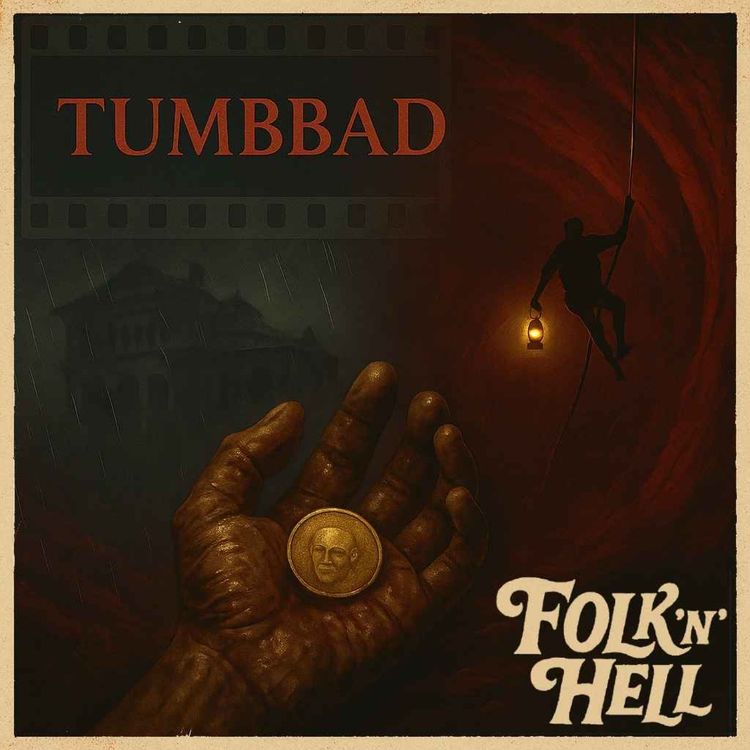
Tumbbad (2018)
Tumbbad turns an ancient god, a permanently rain-soaked village and a hidden hoard of gold into one extremely bad inheritance. FolknHell heads to India for a beautifully grubby tale of greed, family and what happens when somebody works out how to exploit the monster.
For our first trip into Indian horror, FolknHell descends into Tumbbad, Rahi Anil Barve's 2018 tale of buried gods, cursed treasure and one family's remarkable inability to leave well enough alone.
Vinayak Rao discovers that beneath the crumbling family estate lies something ancient, hungry and surrounded by gold. Better still, he discovers a method for getting at the money without being eaten. At which point an ancestral curse starts looking suspiciously like a reliable income stream.
We talk about the film's extraordinary rain-soaked production design, its womb-like descent into the earth, those wonderful ancient locks, the increasingly unpleasant Hastar and a story in which greed passes from one generation to the next with alarming efficiency.
There is also the important folk horror question. A threat tied to one place? Absolutely. Something literally living in the land? Very much so. An ancient power surviving into the modern world? This one barely makes us get the checklist out.
All three of us landed on 7/10. Not perfect, and the first section could perhaps move rather faster, but this is dark, strange, beautifully made horror that deserved to be much easier to find when we originally recorded the episode.
Spoilers throughout. Watch the film first unless you are happy having the treasure uncovered for you.
Yes, Tumbbad is folk horror, and unusually it barely requires an argument. The threat belongs to Tumbbad, comes from beneath its earth and reaches backwards into an ancient belief system that the Rao family really should have left alone.
More importantly, it is a very good film. Atmospheric, grotesque and visually terrific, with the pleasingly nasty idea that the monster can be managed right up until human beings decide they can improve the system.
Andy Davidson: 7/10
Dave Houghton: 7/10
David Hall: 7/10
Total: 21/30
🔗 Visit the FolknHell website for more episodes and blog posts
🔗 FolknHell Film Page for Tumbbad: https://www.folknhell.com/tumbbad-review
🔗 FolknHell Transcript Page: https://www.folknhell.com/blog/tumbbad-transcript
🔗 FolknHell Editorial Article: tbc
🔗 YouTube episode: https://youtu.be/ZjuhALyNgss?si=n7653UgX58hMl6Ej
🔗 IMDb: https://www.imdb.com/title/tt8239946
🔗 Rotten Tomatoes: https://www.rottentomatoes.com/m/tumbbad
🔗 Wikipedia: https://en.wikipedia.org/wiki/Tumbbad
Spoilers throughout, with discussion of child death, violence, body horror and flesh-eating.
Folknhell is the folk horror podcast where Andy Davidson, Dave Houghton and David Hall dig into strange cinema, argue about whether it really counts as folk horror, and score every film out of 30.
Add your own score and comments about the films at https://www.folknhell.com/scores
Find us on the socials:
See acast.com/privacy for info.
More episodes
View all episodes
31. Loner
01:11:33||Ep. 31Charlie Robb’s Loner (2025) drops a lonely, deeply unreliable vlogger into the Northumbrian woods and lets social-media fakery collide with something that may be older, hungrier and considerably less interested in Wi-Fi. FolknHell asks whether this is folk horror, horror-comedy, or folk horror about folk horror.Full Episode DescriptionThis week FolknHell heads into the Northumbrian woods with Loner (2025), Charlie Robb’s found-footage horror built around Angus, an aspiring influencer whose wilderness retreat very quickly exposes the gap between the man he performs online and the man actually standing in the trees.There is plenty to enjoy before the horror properly gets its boots muddy: fake fishing, emergency coffee supplies, hopeless survival skills and an influencer persona held together with optimism, denial and supermarket provisions. Then the woods start taking things from him. A terrified woman appears. Strange white stones, bones, a folklore book and a barely glimpsed presence push the film towards something much stranger.The argument becomes the episode. Is Angus encountering a genuine forest deity that demands sacrifice? Is he using folklore to construct an excuse for what he has done? Or does the film deliberately leave both possibilities breathing down each other’s necks?That ambiguity carries straight into the folk horror question. The place works. The outsider works. The belief system is much shakier. By the end, the phrase that sticks is "meta folk horror". Not straightforward folk horror so much as a film using folk horror itself as part of its story about storytelling, isolation and self-invention.FolknHell VerdictLoner is not comfortably traditional folk horror, but it is absolutely worth a folk horror conversation. Its Northumbrian landscape, outsider structure and folklore machinery pull strongly in that direction, while its unreliable narrator keeps threatening to reveal the whole thing as fabrication. Charlie Robb’s performance does much of the heavy lifting, and the film gets more interesting the longer the argument goes on.ScoresAndy Davidson: 8/10Dave Houghton: 6/10David Hall: 6.5/10LinksYouTube episodeFolknHell Film PageFolknHell Transcript PageTMDb: https://www.themoviedb.org/movie/1489999-loner/reviews?language=en-GBRotten Tomatoes: https://www.rottentomatoes.com/m/loner_2025IMDb: https://www.imdb.com/title/tt33298831/Content WarningSpoilers throughout, including discussion of death, blood, cannibalism, mental health, self-delusion and graphic meat imagery.
30. Rose Of Nevada
01:00:42||Ep. 30Mark Jenkin’s Rose of Nevada gives FolknHell a lost fishing boat, a thirty-year time slip, suspiciously dead fish and a surprisingly strong case for Cornish folk horror. Andy, David and Dave agree on the film. The timeline is another matter entirely. Spoilers throughout. Watch the film first unless you fancy sailing directly into the temporal fog.Full Episode DescriptionEpisode 30 takes Andy Davidson, David Hall and Dave Houghton back to Cornwall for Mark Jenkin’s Rose of Nevada (2026), a film in which a missing fishing boat returns after thirty years and immediately makes time everybody’s problem.With the speakers now properly attributed, the argument becomes even better. Andy brings his own Cornish background to the film’s portrait of fishing communities, second homes and local decline. Dave digs into the 16mm photography, square frames, static land and seasick movement at sea. David becomes increasingly convinced that tiny physical details, circular falls and a pile of very dead fish are telling us more than they first appear to be.Then comes the folk horror question. FolknHell’s current test is place, belief and the stranger. Rose of Nevada has all three, although Dave quite reasonably asks whether existential dread really makes it horror. Andy’s answer: absolutely.We also get Mogi as the Ancient Mariner, a pub that suddenly comes back to life, one magnificent hole in a roof, Mark Jenkin’s silent 27-second filming method and a continuity error involving a door that is promptly reclassified as a time slip.FolknHell VerdictFolk horror. Not pagan sacrifice or occult ritual, but a distinct Cornish place, a community sustained by belief and loss, outsiders entering an inherited world, and existential horror generated by time, identity and the return of a past that should have stayed past.FolknHell Score29 out of 30Give us your score and any other thoughts on the film Rose Of Nevada hereFor more review, discussions and ideas on which folk horror film to watch next visit folknhell.comLinks To MoreYouTube episodeFolknHell Film PageFolknHell Transcript PageRose of Nevada: Folk Horror Where The Past Comes Back To WorkTMDbRotten TomatoesWikipedia
29. The Texas Chain Saw Massacre
50:45||Ep. 29FolknHell tackles Tobe Hooper’s The Texas Chain Saw Massacre (1974), its still-shocking violence, suspicious barbecue and surprisingly solid claim to American folk horror. Also, this is Take Two because somebody forgot to press record. Spoilers throughout. Watch the film first if you would rather enter the farmhouse without knowing exactly where the hooks are.Full Episode DescriptionSome films age gracefully. The Texas Chain Saw Massacre (1974) still looks as though it has been left in the Texas sun beside a sack of bones, and that is very much a compliment.In Episode 29, Andy Davidson, David Hall and Dave Houghton revisit Tobe Hooper’s horror landmark and ask why its grainy, documentary-style nightmare remains so brutally effective more than fifty years later. The discussion gets into the first hammer blow, the meat-hook sequence, Marilyn Burns finding several entirely new levels of screaming, and Gunnar Hansen giving Leatherface a strange flicker of pathos beneath the mask.Then comes the FolknHell question: is this really folk horror? The answer involves an isolated patch of land, a family with its own inherited rituals, bone totems, slaughterhouse traditions and a group of outsiders who discover that the local rules include becoming barbecue. There is also a comparison with House of 1000 Corpses, a debate over whether the film refuses to glorify violence or is gleefully sadistic, and the mystery of a missing sound effect that one host had apparently been carrying in his head for decades.This is also the second attempt at recording the episode. The first version, which nobody recorded, was obviously the greatest podcast ever made.FolknHell VerdictThe Texas Chain Saw Massacre is American folk horror as well as a proto-slasher. The isolated landscape, closed family community, inherited slaughterhouse customs, ritualised bones and doomed outsiders fit the genre with alarming neatness. It is not an enjoyable film in the cosy sense, but it remains an essential and astonishingly powerful horror experience.FolknHell Score25 out of 30🔗 Give us your score and share your thoughts on The Texas Chain Saw Massacre here🔗 Visit folknhell.com for more review, discussions and ideas on which folk horror film to watch next
28. His House
47:06||Ep. 28Bol and Rial escape South Sudan, enter the British asylum system and discover that trauma has followed them into the wallpaper. FolknHell debate Remi Weekes's His House, its terrifying apeth and whether travelling folklore still counts as folk horror.A grim English house, a Dinka night witch and three men immediately making the folk horror definition everybody's problem.In Episode 28, Andy Davidson, Dave Houghton and David Hall discuss Remi Weekes's His House (2020), starring Wunmi Mosaku, Sope Dirisu and Matt Smith. Bol and Rial have survived war, displacement and a lethal crossing, only to be placed in a decaying home where the walls are noisy, the dead are restless and the asylum rules make moving out rather awkward.The conversation gets into the film's refugee trauma, survivor's guilt and low-level bureaucratic nightmare, plus Bol's desperate push to assimilate and Rial's refusal to treat the past like unwanted luggage. There is plenty of admiration for the performances, the labyrinthine council estate, the watery footprints and one light-switch sequence that could have gone on all night, in the nicest possible appalling way.Then comes the apeth in the room. Is His House folk horror because its terror grows from Dinka folklore and inherited belief? Or is it a psychological ghost story that happens to contain a witch? Dave and David say not quite folk horror. Andy says yes, then accepts defeat under protest and begins considering restraints!Spoilers throughout. Watch the film first unless you enjoy having your moral devastation efficiently pre-delivered.FolknHell VerdictHis House is not traditional, land-bound folk horror, but it has strong folkloric bones and makes a compelling case for folk horror that travels with displaced people. Whatever shelf it ends up on, all three hosts agree it is concise, intelligent, frightening and well worth watching, then arguing about long after the walls have stopped whispering.FolknHell Score28 out of 30🔗 Give us your score and share your thoughts on this film here🔗 Visit folknhell.com for more review, discussions and ideas on which folk horror film to watch next🔗 IMDb: https://www.imdb.com/title/tt8508734/🔗 TMDb: https://www.themoviedb.org/movie/575774-his-house🔗 Rotten Tomatoes: https://www.rottentomatoes.com/m/his_house🔗 Wikipedia: https://en.wikipedia.org/wiki/His_HouseContent Warning: Spoilers throughout, with discussion of war, displacement, racism, refugee trauma, child death, drowning, grief, violence and disturbing supernatural imagery.
27. The Witch
01:02:22||Ep. 27FolknHell enters Robert Eggers’ The Witch (2016) with special guest Ian Winterton. Is this the perfect modern folk horror film, or does its Christian Devil complicate the usual ancient-threat rules? Expect Puritan pride, phenomenal performances, baby mush and Black Phillip at full gallop.Full Episode DescriptionIn Episode 27, Andy Davidson, Dave Houghton and David Hall are joined by writer, lecturer and former film critic Ian Winterton to discuss Robert Eggers’ feature debut, The Witch.The family is isolated, the corn is rotting and the goat is considerably more articulate than anyone would like. The group digs into William’s pride, Thomasin’s place inside a collapsing patriarchal household, Eggers’ obsessive historical research, the period dialogue and a cast firing at frankly indecent levels.Then Ian throws a crooked branch into the usual FolknHell criteria. If the threat is Christianity, Satanism and European witchcraft carried into New England by settlers, does it really count as an older force rising from the land? The answer leads into ergot theories, folktale logic, the Unholy Trinity and a firm final verdict on the film’s folk horror credentials.There is also admiration for Harvey Scrimshaw’s extraordinary death scene, the almost invisible appearance of the Devil’s red boot, the ecstatic final flight and the early sequence that has made many unsuspecting viewers quietly decide they have somewhere else to be.Spoilers throughout. Watch the film before listening unless you are happy to meet Black Phillip contractually unprepared.FolknHell VerdictThe Witch is unequivocally folk horror, even if it makes the checklist squirm. Isolation, inherited belief, landscape, accusation and religious terror do the heavy lifting, while the supernatural gives the family’s collapse a beautifully wicked shove. It is severe, meticulous and one of the defining horror films of its era. Watch it, then listen to the argument.FolknHell Score28 out of 30🔗Give us your score and share your thoughts on this film here🔗Visit folknhell.com for more review, discussions and ideas on which folk horror film to watch next🔗 Ian Winterton: https://www.imdb.com/name/nm3410151/🔗 IMDb: https://www.imdb.com/title/tt4263482/🔗TMDb: https://www.themoviedb.org/movie/310131-the-witch
26. The Blood On Satan's Claw
49:11||Ep. 26FolknHell dig up The Blood On Satan’s Claw, Piers Haggard’s 1971 folk horror classic, originally released as Satan’s Skin, and ask, "Is it one of the true pillars of the genre, or just a disjointed rural nightmare with excellent eyebrows?" Spoilers throughout, obviously. If you have not seen the film, consider this your warning from the edge of the field.Full DescriptionThis episode, Andy Davidson, Dave Houghton and David Hall head into the furrows for The Blood On Satan’s Claw, Piers Haggard’s 1971 tale of rural panic, possessed children, suspiciously hairy patches and authority figures making one terrible decision after another.Often named as part of folk horror’s so-called Unholy Trinity alongside The Wicker Man and Witchfinder General, this is a film with impeccable credentials: an isolated village, something nasty unearthed from the land, old evil pushing up through the soil, and a community that reacts to crisis with all the calm restraint of a mob holding rope.The chaps discuss the film’s odd portmanteau origins, its brilliant but bumpy structure, Angel Blake’s alarming rise as the leader of the village children, the deeply uncomfortable mix of sex, violence and moral panic, and whether this is actually the most openly supernatural member of the Unholy Trinity. There is also time for Anthony Ainley’s excellent priest, Patrick Wymark’s magnificently unpleasant judge, the skull with the living eye, Satan being assembled like a rural occult flat-pack, and the heroic return of the wobbly sword.Scores are cast, claws are counted, and the big question is asked: is The Blood On Satan’s Claw a great folk horror film, or just a flawed but essential one?FolknHell VerdictThe Blood On Satan’s Claw is absolutely folk horror. Rural isolation, threat from the land, old evil, corrupted youth, religious authority, mob justice and deeply strange local behaviour all come bundled together in one filthy little 1971 package.It is also messy, abrupt and sometimes baffling, but that is part of its strange power. The FolknHell score: 19 out of 30.FolknHell Score out of 30🔗Give us your score and share your thoughts on this film here🔗Visit folknhell.com for more review, discussions and ideas on which folk horror film to watch nextTMDbRotten Tomatoes
25. Hokum
50:09||Ep. 25A remote hotel. A haunted honeymoon suite. A chalk circle that really should have been finished properly. Hokum gives us scares, screams and one very busy dumbwaiter, but does it give us folk horror?Full DescriptionIn this episode the FolknHell trio check into Hokum, Damien McCarthy’s 2026 horror about a cynical, suicidal writer retreating to a remote Irish inn to scatter his parents’ ashes, finish his book, and generally be horrible to almost everyone he meets. Before long, there are rumours of a witch, a locked honeymoon suite, a missing hotel worker, magic mushrooms, a terrifying cellar, and a plot that starts behaving like a locked-room mystery after several pints.The good news: the film is genuinely scary. Andy and Dave both found it tense, jumpy and effective in the cinema, while David admits it made him scream “like a lemon”. The bad news: the more they talk, the more Hokum starts to wobble. Om Bauman is hard to care about, the backstory arrives far too late, the police apparently cannot search a building properly, and the folk horror elements feel less woven in than nailed on.The big debate lands on whether Hokum is folk horror at all. There is an isolated setting, a witch, folklore, chalk protection and a buried basement, but the real threat is human panic, cowardice and Mel making every possible wrong decision.Final verdictScary once, flawed on reflection, and probably folk horror adjacent rather than the real thing.ScoresFolknHell score: 15 out of 30Give us your score and any other thoughts on the film Hokum hereFor more review, discussions and ideas on which folk horror film to watch next visit folknhell.com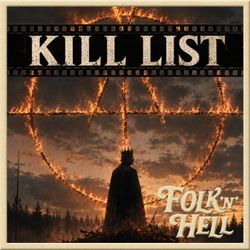
24. Kill List
41:03||Ep. 24A hitman thriller that slowly mutates into something ancient, ritualistic and deeply disturbing. The more we watched Kill List, the less certain we became about what we were actually seeing.Ben Wheatley's Kill List has built a reputation as one of the most important British horror films of the 21st century, and after revisiting it the FolknHell crew found themselves just as fascinated, confused and impressed as ever. What begins as the story of two ex-soldiers turned contract killers gradually unfolds into something much stranger. Jay and Gal take on a lucrative assignment, only to discover a trail of ritualistic murders, grateful victims, occult symbols and a conspiracy that stretches far beyond a simple kill contract.The conversation explores the film's claustrophobic handheld style, its brutal realism, and its portrait of male alienation and trauma. Andy, Dave and David discuss how the film seems to reveal new layers on every viewing, yet somehow becomes more puzzling at the same time.Naturally, the big question is whether Kill List belongs in the folk horror canon. Despite its modern setting and lack of traditional folk horror imagery, the hosts ultimately conclude that its secretive cult, ritual sacrifice, ancient symbols and collision between modern life and older belief systems firmly earn it a place in the genre.The verdict? A rare moment of complete agreement. Andy, Dave and David all awarded the film 8/10, praising its ambition, rewatch value and willingness to leave audiences unsettled long after the credits roll.FolknHell Score24 out of 30🔗Give us your score and share your thoughts on this film here🔗Visit folknhell.com for more review, discussions and ideas on which folk horror film to watch next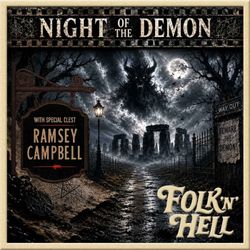
23. Night Of The Demon
58:10||Ep. 23Stone circles, satanic runes and one of the greatest horror performances in British cinema. Andy, Dave and David are joined by legendary horror author Ramsey Campbell to dig into Night of the Demon, a film that helped shape folk horror decades before the genre even had a label. The demon gets debated, the atmosphere gets worshipped, and scepticism does not fare especially well.Full DescriptionThis very special FolknHell episode with the legendary horror writer Ramsey Campbell joining the boys to talk about his all time favourite horror film, Jacques Tourneur’s Night of the Demon. Before getting to the film itself, the conversation detours through folk horror’s literary roots, The Hungry Moon, Arthur Machen, Lovecraft, Penda’s Fen, and why British landscapes still feel uniquely suited to supernatural dread.Once the film begins, things get gloriously obsessive. The hosts get stuck into the film’s extraordinary atmosphere, Ted Scaife’s cinematography, Ken Adam’s production design, and Neil McGinnis’ astonishing performance as Julian Karswell, a charming occultist who might genuinely have summoned something infernal. There is plenty of debate around the decision to show the demon so early, with David arguing it weakens Holden’s sceptical arc while Dave and Ramsey defend the dramatic irony it creates.The folk horror question turns out to be surprisingly complicated. By the FolknHell criteria, Night of the Demon only partially fits, yet everybody agrees it absolutely belongs in the canon. Ancient belief systems, witchcraft, isolated rituals, haunted landscapes and old forces bleeding into modern Britain are all over this thing. It may not sit comfortably inside the so called “Unholy Trinity”, but nobody here is arguing against its place at the table.The final scores land high. Dave and Andy both land on 9, while David comes in as the resident harsher marker with a 7.FolknHell Score25 out of 30🔗Give us your score and share your thoughts on Night Of The Demon here🔗Visit folknhell.com for more review, discussions and ideas on which folk horror film to watch next