Share

Evolution Exchange Nordics Podcast
Discussing Leadership Perspectives And Strategies
🎇Selma Hosni Engineering Manager at EasyPark Group
“How to find a balance between the company work culture and the country culture -example: Swedish culture?”
✨Niklas Arbin CTO at BookBeat
“Do you think it’s necessary for tech leaders to step away from their area of experience to lead effectively?”
🎆Mikael Baros Head of Technology at Storytel
"Scaling trust and autonomy in an expert-driven organization - Important for any company as they grow rapidly. All of you come from companies that have experienced rapid growth, and it is something we have worked extensively on as well. What are your thoughts on this, and how do you work with it today?"
🎉Fredrik Broman Engineering Director Tink
"A concept often talked about in leadership discussions is Employee Engagement and perhaps not very well defined, it is easy to relate to and understand why it is very important. The question is, how do you increase the Employee Engagement in a given team? What are some of the principles or tools you would use?"
More episodes
View all episodes

Evo Nordics #757 - How Do You Build a Data Platform That Actually Scales?
48:21|Today’s episode is hosted by Bex Halpin and she is joined on the podcast by Tugce Ozdeger, Lead Data Architect & Scrum Master, Daniel Saada, CEO & Co-Founder at Data Lemon, and Mattias Ramstrand, Head of Data & AI at Infiniteria Sweden AB.The conversation explores what it takes to build a data platform that can scale as organisations grow, looking beyond technical infrastructure to the importance of data governance, clear ownership and collaboration between central data teams and business departments. The speakers discuss how to establish shared architectural standards while giving domain teams the flexibility to manage their data, and why involving business stakeholders from the beginning helps build trust, accountability and better data quality.The discussion also examines the warning signs of a platform that may struggle to scale, including increasingly complex pipelines, inconsistent metrics, poor performance and high dependency on individual team members. The panel considers when organisations should rely on existing managed services and when custom-built components make sense, highlighting the importance of understanding business needs, testing ideas through proof of concepts, and accounting for long-term maintenance, ownership and cost.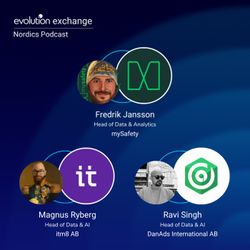
Evo Nordics #756 - Is Your Data Actually Ready for AI?
41:53|Today’s episode is hosted by Bex Halpin and they are joined on the podcast by Fredrik Jansson, Head of Data & Analytics at mySafety, Magnus Ryberg, Head of Data & AI at itm8 AB and Ravi Singh, Head of Data & AI at DanAds International AB.The conversation explores what it really means for organisational data to be ready for AI and why having established data infrastructure and reporting systems does not necessarily mean that data can support AI-driven insights. The speakers discuss the importance of providing AI models and agents with the business context that people often hold in their knowledge and experience, including business rules, definitions, relationships and operational processes. They also highlight the need for clear data ownership, governance, documentation and version control to ensure that this context remains accurate, consistent and accessible.The discussion also examines why organisations should approach AI readiness through practical business use cases rather than attempting to connect AI to every dataset or process. The speakers emphasise the importance of assessing data quality, addressing hidden complexities and starting with areas that offer the greatest business impact, while considering the costs and infrastructure required to scale AI solutions. Looking ahead, they explore how reporting and AI-driven insights are likely to coexist, with faster development and more accessible data interaction changing how businesses make decisions. Ultimately, successful AI adoption requires more than new technology or clean data. It depends on strong foundations, shared responsibility, adaptable teams and organisational leadership that can keep pace with change.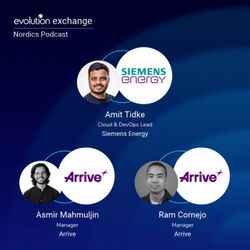
Evo Nordics #755 - Leading Through Change
40:16|Today’s episode is hosted by Alvin Boampong and they are joined on the podcast by Amit Tidke, Cloud & DevOps Lead at Siemens Energy, Asmir Mahmuljin, Manager at Arrive and Ram Cornejo, Manager at Arrive.The conversation explores how leaders can navigate constant organisational and technological change while balancing innovation, speed and risk. Drawing on their experiences with AI adoption, cloud operations, cybersecurity and business transformation, the speakers discuss the importance of taking a measured approach to innovation. They highlight the value of testing AI initiatives through controlled pilots, defining clear objectives and understanding risk appetite before scaling solutions into production. The discussion also emphasises the need for human oversight, particularly in critical operations where reliability, security and accountability remain essential.The speakers also examine how leaders can ensure AI empowers employees rather than making them feel replaceable. They discuss using AI to automate repetitive tasks, improve productivity and create more opportunities for meaningful work, while recognising the importance of human judgment, critical thinking and problem-solving. The conversation further explores how organisations should measure AI adoption through tangible outcomes, such as problems solved, time saved, business value and improved work-life balance, rather than simply tracking prompts or agents created. Ultimately, successful transformation requires more than adopting new technology. It depends on building an adaptable culture, investing in employee training and helping people embrace change with confidence.
Evo Nordics #754 - Building AI-First Engineering Organisations
35:43|Today’s episode is hosted by Alvin Boampong and features Luciano Alves, Tech Lead at Nokia, and Tobias Sunnanangs, Technical Director at Humblebee.The conversation explores how organisations can become AI-first by integrating artificial intelligence into engineering processes, breaking down organisational silos and improving collaboration across different teams. It examines how AI can accelerate software development, streamline workflows and connect traditionally separated functions such as engineering, infrastructure, networking and security. The discussion also highlights the importance of measuring AI's impact through productivity, delivery efficiency and reduced organisational bottlenecks.The discussion further examines how AI is reshaping engineering team structures, responsibilities and the way digital products are developed. Key themes include cross-functional collaboration, smaller and more autonomous teams, continuous learning, evolving technical skill sets and the importance of maintaining human oversight in AI-driven environments. It also considers how engineering leaders can balance automation with accountability, ensuring that AI adoption delivers meaningful business value while maintaining security, quality and technical excellence.
Evo Nordics #753 - Balancing Innovation and Reliability in Modern Engineering
29:20|Today’s episode is hosted by Alvin Boampong and features Cristian Andreola, Engineering Manager at Electrolux AB, and Mohamed Moulay, Engineering Manager at Signicat AS.The conversation explores how engineering teams can balance innovation with reliability when modernizing complex systems that customers already depend on. The speakers discuss the challenges of introducing new technologies and architectural changes while maintaining performance, stability and compatibility across existing devices and platforms. They highlight the importance of modular architecture, clear interfaces, backward compatibility and gradual implementation to reduce disruption and ensure sustainable innovation.The episode also examines how engineering teams can make informed decisions when evolving legacy systems. Key discussion points include using baseline performance indicators, customer feedback, comprehensive testing strategies and end-to-end observability to evaluate the impact of changes before wider deployment. The speakers also explore how AI can support legacy system analysis, automate repetitive tasks and give engineers more time to focus on meaningful problem-solving. Ultimately, they emphasize that successful innovation requires evidence-based decisions, clear accountability and a continued focus on customer value.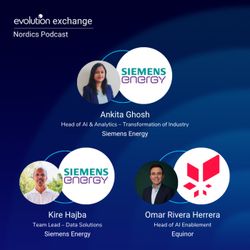
Evo Nordics #752 - How Will Data Shape the Energy Sector in the Coming Years?
47:04|Today’s episode is hosted by Sam Russell and features Ankita Ghosh, Head of AI & Analytics, Transformation of Industry at Siemens Energy, Kire Hajba, Team Lead, Data Solutions at Siemens Energy, and Omar Rivera Herrera, Head of AI Enablement at Equinor.The conversation explores how artificial intelligence is transforming the energy sector and the challenges of moving AI solutions from experimentation into production. It examines how organizations can use generative AI and agentic AI to optimize business processes, improve operational efficiency and create measurable business value while maintaining trust, security and human oversight.The discussion also highlights the importance of data quality, responsible AI adoption and effective change management in high-risk industrial environments. Key themes include AI integration, cybersecurity, workforce upskilling, production readiness and measuring the impact of AI on business performance and safety.
Evo Nordics #751 - Leading Data Engineering Through the AI Era
38:40|Today’s episode is hosted by Louis Wright and features Hélder Russa, Director of Engineering at H&M Group.The conversation explores how data engineering is evolving in the AI era and the importance of building strong data foundations to support business innovation. It examines how organizations can approach cloud transformation, standardize engineering practices and develop effective operating models while maintaining team autonomy and improving delivery.The discussion also highlights how AI is transforming data engineering roles, workflows and productivity. Key themes include AI adoption, data governance, human judgment, technical leadership and developing the skills needed to build reliable, scalable and future-ready engineering teams.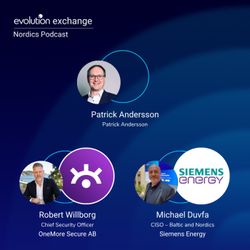
Evo Nordics #750 - The Importance of Product Security
50:12|Today’s episode is hosted by Chris Hackett and he is joined on the podcast by Patrick Andersson, Robert Willborg, Chief Security Officer at OneMore Secure AB, and Michael Duvfa, CISO - Baltic and Nordics at Siemens Energy.The conversation explores the importance of product security and the impact of the EU Cyber Resilience Act (CRA). It examines why organizations must build security into products from the design stage and maintain it throughout their entire lifecycle, including managing vulnerabilities, updates and third-party components.The discussion also highlights supply chain security, risk management, security awareness and the responsibilities of manufacturers, suppliers and customers. Other key themes include the impact of regulation on innovation, product costs and functionality, as well as the role of AI in software development and the growing importance of making informed security decisions.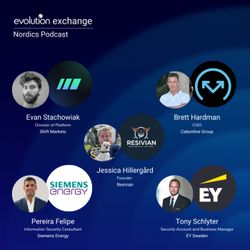
Evo Nordics #749 - Shifting Left - Enabling Security Sooner
56:23|Today’s episode is hosted by Chris Hackett and they are joined on the podcast by Evan Stachowiak, Director of Platform at SHIFT New York, Brett Hardman, CISO at Cabonline Group, Pereira Felipe, Information Security Consultant at Siemens Energy, Tony Schlyter, Security Account and Business Manager at EY Sweden and Jessica Hillergård, Founder at Resivian.The conversation explores shifting left in cybersecurity and the importance of integrating security earlier into software development and engineering processes. It examines how organisations can move beyond theory by addressing security risks from the beginning, improving collaboration between development and security teams, and building a stronger culture of awareness and accountability.The discussion also highlights the role of leadership, governance, developer education and regulatory requirements in making security by design part of everyday operations. Key themes include secure software development, risk management, procurement, organisational responsibility and balancing security tools with practical implementation.