Share
Euronews Tech Talks
How to track a spy satellite
The first time our podcast producer met Marco Langbroek in September 2025, he told her always to carry cash. That’s because financial transactions, which rely on satellites, could be disrupted by what he is seeing in space.
A lecturer of space situational awareness at TU Delft in the Netherlands, Langbroek is an expert in tracking spy satellites.
Six months on, is he more worried or less? In this episode, we find out.
Do you want to reach out to Euronews Tech Talks? Email alice.carnevali@euronews.com.
Euronews Tech Talks goes beyond discussions to explore the impact of new technologies on our lives. With explanations, engaging Q&As, and lively conversations, the podcast provides valuable insights into the intersection of technology and society.
More episodes
View all episodes
73. How much do we really know about microplastics?
23:31||Season 1, Ep. 73The word “microplastics” appeared for the first time in 2004, coined by Richard Thompson, now a marine biology professor at the University of Plymouth. Over the past 22 years, microplastics have gained increasing attention, but questions about them still seem to outnumber what we actually know.In this Q&A episode of Euronews Tech Talks, we pose your questions to Heather Leslie, an independent scientist from Amsterdam, and Francesco Regoli, vice rector for research at the Polytechnic University of Marche.Do you want to reach out to Euronews Tech Talks? Email alice.carnevali@euronews.com.Exploring Everyday Microplastic Exposures - Leslie DOI 10.5281/zenodo.19360361
72. How AI and satellites can help protect our oceans
12:27||Season 1, Ep. 72On the occasion of World Oceans Day (8 June), Euronews Tech Talks explores how satellites and artificial intelligence can contribute to ocean monitoring and protection with Alain Arnaud, director of the digital ocean programme at the French-based organisation Mercator Ocean International. Mercator’s flagship product is the European Digital Twin Ocean (EDITO), a virtual replica of the ocean, accessible online and free of charge. The project is set to become fully operational by 2030, but how does it work?Do you want to reach out to Euronews Tech Talks? Email alice.carnevali@euronews.com.The European Digital Twin Ocean: https://dive.edito.eu/71. Can social media be safer?
19:15||Season 1, Ep. 71What are digital rights? How does content moderation work on social media platforms? Is GDPR truly holding Big Tech companies accountable? To answer these and more of your questions, Euronews Tech Talks sits down with Gloria González Fuster, research professor at Vrije Universiteit Brussel, specialising in digitalisation and rights, and Silvia Semenzin, a researcher at AI Forensics with a background in digital sociology. Do you want to reach out to Euronews Tech Talks? Email alice.carnevali@euronews.com.70. Should under-16s be banned from social media?
23:43||Season 1, Ep. 70After Australia became the first country in the world to ban social media for under-16s, debates over similar measures have spread across Europe. Euronews Tech Talks explores this strategy with European teenagers and two experts: neuropsychiatrist and member of the supervisory board of the Belgian association Kids Unplugged, Theo Compernolle and sociologist and vice-coordinator of the research network EU Kids Online, Giovanna Mascheroni. Do you want to reach out to Euronews Tech Talks? Email alice.carnevali@euronews.com.69. Are there alternatives to mainstream social media platforms?
23:53||Season 1, Ep. 69Privacy, political, and ethical concerns are pushing people to look for alternative social media platforms. Are there other options to mainstream platforms?Euronews Tech Talks explores this and more questions with Michael Bossetta, associate professor of communication at Lund University, Christos Floros, founder and CEO of Monnet and Sandra Wachter, professor of technology and regulation at the University of Oxford and the Hasso Plattner Institute in Potsdam.Do you want to reach out to Euronews Tech Talks? Email alice.carnevali@euronews.com.68. Artemis II: Why should we care?
22:23||Season 1, Ep. 68The Artemis II mission brought four astronauts farther from Earth than humanity had ever ventured before.To discuss its importance, Europe’s role and what comes after, Euronews Tech Talks speaks with UK journalist Kate Arkless Gray and Belgian science reporter Senne Starckx.Do you want to reach out to Euronews Tech Talks? Email alice.carnevali@euronews.com.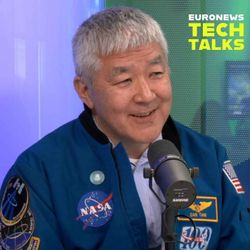
67. What’s it like to be an astronaut, with former NASA astronaut Daniel Tani
20:44||Season 1, Ep. 67Daniel Tani spent over 130 days in space, most of which were on the International Space Station (ISS), and he conducted six extra-vehicular activities, also known as space walks. As a child, he did not want to become an astronaut, but life and career choices got him into orbit as a NASA astronaut. Tani sits down with Euronews Tech Talks to share his experience as an astronaut, his thoughts on the current situation in space, the future of the ISS and how to enter the space sector. Do you want to reach out to Euronews Tech Talks? Email alice.carnevali@euronews.com.66. Is Europe’s space infrastructure ready for threats?
27:03||Season 1, Ep. 66There’s momentum in Europe toward space defence, but are European space systems advanced enough to counter cyber threats? To answer this and more of the questions you submitted to us, Euronews Tech Talks speaks with Giulia Pavesi, lead of security and defence at the European Space Policy Institute (ESPI), and Jean‑Luc Trullemans, head of the European Space Security and Education Centre at the European Space Agency (ESA). Do you want to reach out to Euronews Tech Talks? Email alice.carnevali@euronews.com.