Share
Economic Security Watch
What does economic security mean in today’s rapidly shifting global economy?
Latest episode
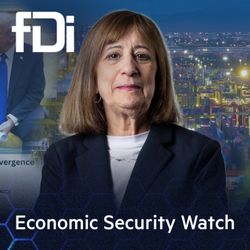
7. Trump's tariffs and the future of global trade
19:45||Season 1, Ep. 7Are Donald Trump's tariffs changing global trade for good? As the US and China compete for economic influence, former US trade negotiator Wendy Cutler explains what the new global trade order means for businesses, investors and governments.In this episode of Economic Security Watch from fDi Intelligence, host Danielle Myles speaks to Wendy Cutler, former acting deputy US trade representative and senior vice-president at the Asia Society Policy Institute.They explore how US trade policy is shifting away from traditional free trade agreements towards tariffs, economic security and investment commitments and whether the international trading system can adapt.The conversation covers the future of US-China trade relations, the USMCA agreement between the US, Mexico and Canada, China's industrial overcapacity, South Korea's investment pledges and the growing pressure to reform World Trade Organisation rules.Cutler also examines whether Trump's tariffs could outlast his administration, how the 2026 US midterm elections might affect trade policy, and why countries are increasingly looking beyond Washington to build new economic partnerships.Timestamps00:00 - US Trade Policy & North America06:57 - US-China Trade & WTO Challenges11:31 - New Investment Strategies & Tariffs14:53 - Modernising US Trade Laws17:46 - Congressional Influence on Policy
More episodes
View all episodes
6. Europe’s Defence Boom Has a Funding Problem
20:09||Season 1, Ep. 6Russia’s war in Ukraine and the Trump administration’s warnings over the reliability of US security guarantees have created a new paradigm for European defence start-ups and capital.Calls have grown for regional unity and softer intra-EU borders to help scale early-stage ventures making the technologies that underpin modern warfare. But funding and defence being constrained within national borders are causing inevitable bottlenecks.In the latest Economic Security Watch podcast, fDi’s Danielle Myles speaks with Stanislaw Kastory, co-founder and general partner at defence venture capital firm Expeditions, about how geopolitics is changing the economics of European security.00:00 - European Defence Ambitions08:51 - European Self-Reliance11:52 - Munich Warning from JD Vance17:50 - Hybrid war threats
5. Weaponised interdependence: How the US, China and AI are rewriting economic statecraft
22:13||Season 1, Ep. 5Economic security has become one of the defining forces shaping global business, foreign investment and international trade. But where did it really begin?In this episode of Economic Security Watch, host Danielle Myles speaks with Professor Abraham Newman of Georgetown University, one of the world's leading experts on economic statecraft and co-author of Underground Empire: How America Weaponized the World Economy.Newman argues that today's era of tariffs, sanctions, export controls and technology restrictions did not begin with Donald Trump or China's rise. Instead, its roots lie in the aftermath of 9/11, when governments discovered they could use global financial systems, supply chains and digital networks as powerful tools of geopolitical influence.You can order Abraham's latest book on Amazon.Timestamps:00:00 - Why weaponised interdependence has become central to global politics09:12 - How the US pioneered modern economic statecraft and why China is now adopting similar tactics13:04 - Europe's push for digital sovereignty16:26 - The future of AI, semiconductors and export controls
4. "It's Gloves Off": Tina Fordham on the New Era of Superpower Competition
24:22||Season 1, Ep. 4Geopolitical strategist Tina Fordham joins Economic Security Watch to explain why businesses, investors and governments are entering a fundamentally different world.From the weaponisation of trade and investment to US-China rivalry, the war in Iran, Europe's rearmament and the future of globalisation, Tina, founder of Fordham Global Foresight and the former Chief Global Political Analyst at Citi, argues that we're living through a geopolitical supercycle and there is no return to the old normal.In this episode:• Why business leaders must think differently about risk• The new era of superpower competition• How trade, technology and investment are becoming geopolitical weapons• Why resilience is replacing optimisation• What boards should do nowTimestamps00:00 - Why business leaders must think differently04:44 - Geopolitical Supercycle Framework10:13 - Global Power Dynamics & Emerging Risks16:44 - Bottom-Up Changes & Anxiety19:46 - The Geopolitical Officer RoleThe battle for Europe's digital sovereignty
00:57|In June's edition of the Economic Security Watch newsletter, Danielle Myles guides you through the fight for Europe's digital sovereignty. The bloc is looking to reduce its reliance upon US big tech companies, culminating in the EU presenting its Tech Sovereignty package, following increasing concerns over killswitches, privacy and data ownership. Find out in the newsletter what it all means and where it may lead European companies next.Alongside the analysis of Europe's tech future, plus links to our latest podcast episode and the data spotlight that keeps you on top of the economic security agenda.Sign up for the Economic Security Watch newsletter from fDi Intelligence, a publication from the Financial TimesAnd check back soon for the next episode of this podcast.
3. Europe's competitiveness challenge: Energy, rare earths and industrial sovereignty
19:04||Season 1, Ep. 3Europe's industrial model is under pressure. High energy costs, geopolitical tensions and growing competition from China and the US are forcing policymakers and businesses to rethink economic security.In this episode of Economic Security Watch, Danielle Myles speaks with Philippe Kehren, CEO of Belgian chemicals group Solvay, about what Europe must do to remain competitive. Kehren argues that energy security, industrial sovereignty and resilient supply chains are now inseparable.He discusses the role of rare earths, the need for local production of strategic materials, Europe's energy transition, and why policymakers must work more closely with industry to secure the continent's industrial future.Timestamps00:00 - Welcome to Economic Security Watch01:26 - Solvay's Global Operational Challenges05:17 - Europe's Industrial Competitiveness08:37 - Policy for re-industrialisation & energy16:25 - Europe's decisive economic moment18:33 - How to contact Economic Security WatchHow China’s takeover of Kuka helped transform Europe’s investment rules
01:20|Ten years after China’s Midea acquired German robotics company Kuka, Europe’s approach to economic security has fundamentally changed. Danielle Myles explains how the deal changed European thinking in the latest Economic Security Watch newsletter, available from 26th May 2026. Alongside Midea's acquisition and the effect it had on Europe, this month's newsletter also takes a look at the US's strategy towards biotechnology, which is fast becoming one of the key areas of economic security.Sign up for the Economic Security Watch newsletter from fDi Intelligence, a publication from the Financial TimesAnd check back soon for the next episode of this podcast.