Share
Dying To Know
The Long Goodbye: Early-Onset Alzheimer’s and Losing Her Mum Twice with Keri Kitay
What does it mean to lose someone twice?
Keri Kitay was in her late twenties when her mum, Terry, was diagnosed with early-onset Alzheimer’s at just 54. In the years that followed, Keri and her family faced the slow, painful process of losing her. Memory by memory, function by function, until her death nearly a decade later.
In this episode, Keri joins Belinda to talk about what that looked like up close. She shares how her family navigated the early signs, the diagnosis, and the brutal logistics of care. You’ll hear what helped, what hurt, and what we all need to understand about dementia…especially when it shows up young.
Keri also shares why she chose not to get tested for the Alzheimer’s gene, what she’s doing instead, and how writing The Long Goodbye helped her process her grief.
You can purchase Keri’s book here: https://www.kkprojects.co/thelonggoodbye
Dying to Know is created by Leaving Legacies. To learn more, visit leavinglegacies.co.nz or follow us on Instagram or Facebook.
More episodes
View all episodes
12. Grief and Leaving the Funeral Industry with Andrew Blanche
01:40:49||Season 2, Ep. 12Andrew Blanche spent years working as a funeral director and celebrant. He sat with families in the early days of grief, helped them navigate decisions, and witnessed what happens when people are given space to show up honestly in the middle of loss.In this conversation with Belinda, Andrew reflects on what led him into the funeral industry and why he eventually chose to leave it. They speak about burnout, emotional labour, and the reality of holding space for others when you're not fully holding space for yourself.Andrew also shares what he’s learned about grief, ritual and silence. This episode is steady, thoughtful, and grounded in lived experience. It offers a rare, honest look behind the scenes of an industry most people never get to see.Dying to Know is created by Leaving Legacies. To learn more, visit leavinglegacies.co.nz or follow us on Instagram or Facebook.
11. Energy, Intuition, and Letting Grief Move Through You with Kathryn Gordon
47:04||Season 2, Ep. 11Kathryn Gordon is an energy healer and the founder of Soul Activation. In this conversation with Belinda, she shares how grief shaped her work. And how she helps others process the emotions they’ve stored away.They talk about how emotion shows up in the body, how to move through grief without bypassing it, and why trusting your intuition can bring clarity when logic can’t. Kathryn explains what happens in an energy healing session, how she supports people with unresolved emotion, and why she always tells clients they’re the ones doing the healing..not her.This episode is about slowing down, listening to what your body already knows, and letting emotion do what it’s meant to do.Dying to Know is created by Leaving Legacies. To learn more, visit leavinglegacies.co.nz or follow us on Instagram or Facebook.
9. What Is Water Cremation? A Cleaner, Gentler Option with Debbie Richards
40:25||Season 2, Ep. 9Water cremation is now available in Aotearoa, and Debbie Richards is the reason why.In this episode, Belinda speaks with Debbie, a former nurse and midwife who spent nearly seven years working to bring water cremation to New Zealand. After witnessing the impact of traditional funeral care, Debbie became determined to offer something more sustainable, affordable, and dignified.She explains how water cremation works, what actually happens to the body, and how this process compares to flame cremation and burial. Debbie also shares the personal story behind why she mortgaged her house to make this happen, and what it meant to open the doors of her Christchurch facility.This conversation explores legacy, climate impact, cultural change, and the importance of offering families real choice at the end of life.Dying to Know is created by Leaving Legacies. To learn more, visit leavinglegacies.co.nz or follow us on Instagram or Facebook.
8. Death Without Debt: What You Need to Know with Gaylene Delaney
39:57||Season 2, Ep. 8Funerals in Aotearoa can cost more than $13,000. Half of the people planning one this week won’t be able to afford it.In this episode, Belinda speaks with end-of-life doula Gaylene Delaney about the Death Without Debt movement. Gaylene is one of several volunteers running workshops across the country to teach people how to care for their dead, plan ahead, and avoid unnecessary financial stress.You’ll learn what costs are essential, what the law allows, and how to take care of a loved one at home. From legal paperwork to shroud boards to registering a death online, this episode lays out the practical steps most people don’t know they’re allowed to take.Death care doesn't need to be outsourced. This conversation is about reclaiming your choices, reducing harm, and making grief more human.Dying to Know is created by Leaving Legacies. To learn more, visit leavinglegacies.co.nz or follow us on Instagram or Facebook.
7. Living With Grief after Suicide: Love, Loss, and Letting People in with Katy Mandeno
53:28||Season 2, Ep. 7Go With Grace is a platform built from the hardest kind of knowing. After losing her daughter, her father, and then her partner Chris to suicide, Katy didn’t try to fix her grief. She chose to hold it, and then she chose to help others do the same.This conversation moves through the raw terrain of grief, suicide loss, end-of-life planning, and what it means to live in a world that rarely prepares us for any of it. Katy shares what it was like to be in shock and still have to make decisions. She talks about what helped, what didn’t, and how we can better show up for people when everything falls apart.You’ll also hear about Dying Matters Week, compassionate communities, and why your village matters more than ever.This episode is full of emotional clarity, practical insight, and the quiet reminder that showing up, even with soup or silence, matters more than we think.Dying to Know is created by Leaving Legacies. To learn more, visit leavinglegacies.co.nz or follow us on Instagram or Facebook.Where to get help1737, Need to talk? Free call or text 1737 to talk to a trained counsellor.Anxiety New Zealand 0800 ANXIETY (0800 269 4389)Depression.org.nz 0800 111 757 or text 4202Lifeline 0800 543 354Rural Support Trust 0800 787 254Samaritans 0800 726 666Suicide Crisis Helpline 0508 828 865 (0508 TAUTOKO)Yellow Brick Road 0800 732 825thelowdown.co.nz Web chat, email chat or free text 5626If it is an emergency, click here to find the number for your local crisis assessment team.In a life-threatening situation, call 111.
6. Lynnie Phillips was Never Meant to get Motor Neurone Disease
01:01:40||Season 1, Ep. 6https://leavinglegacies.co.nz/Lynnie Phillips was never meant to get motor neurone disease. Despite her dad and aunty both being diagnosed and losing their lives to it, she was never going to get it. At least that’s what she told herself up until earlier this year when she was diagnosed. She was told motor neurone disease wasn’t genetic. But that didn’t stop her from getting it. In this episode you’ll hear about Lynnie’s journey to enjoy the time she has left, rather than mourning what she won’t get to do. She also talks about her plans to have a living funeral and celebrate her life while she is still alive.
5. What Victim Support Does (..It's a lot)
44:46||Season 1, Ep. 5https://leavinglegacies.co.nz/What would you do if you suddenly lost a loved one and your life changed forever? Part of Melissa Gordon’s role at Victim Support is guiding people through just that. In this episode Melissa, general manager of service delivery at Victim Support, talks about what the service provider offers and how they help people through trauma.Melissa talks about why she is so passionate about normalising people’s experience, why she’s let go of the pressure of trying to fix everything, and getting comfortable with uncomfortable situations. You’ll also hear about how Melissa protects her own mental health in this line of work.“I could walk out my door and get hit by a truck tomorrow but I’m still going to walk out my door.”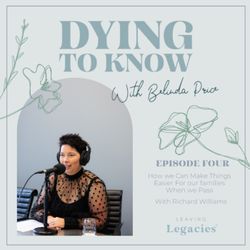
4. Making Things Easier For Our families When we Pass and The Legalities of Death
30:44||Season 1, Ep. 4https://leavinglegacies.co.nz/Nearly half of New Zealanders don’t have a will. It’s not the nicest conversation to have with loved ones, but lawyer Richard Williams wants people to think about it differently. In this episode of Dying to Know I talk to lawyer Richard Williams about wills, trusts, what the heck probate means, and all the other legalities involved with dying. As Richard wisely put it: “Don't think about a will as something relating to your death, think about it in terms of you making the lives of the people you leave behind much easier.”In this episode Richard will discuss what you need to create a will, if and how it can be contested, and what happens when you don’t have one. He dives into what a trust is and how they are managed after someone dies. You’ll hear about estates taking almost a decade to settle after someone has passed, how ideally you should have a will set up when you turn 18 and how when Richard dies he hopes to be remembered for kindness, empathy and integrity.The material contained in this podcast is not intended to be a comprehensive statement on the law, nor is it intended to be legal advice.