Share
Doc Talk with Monument Health
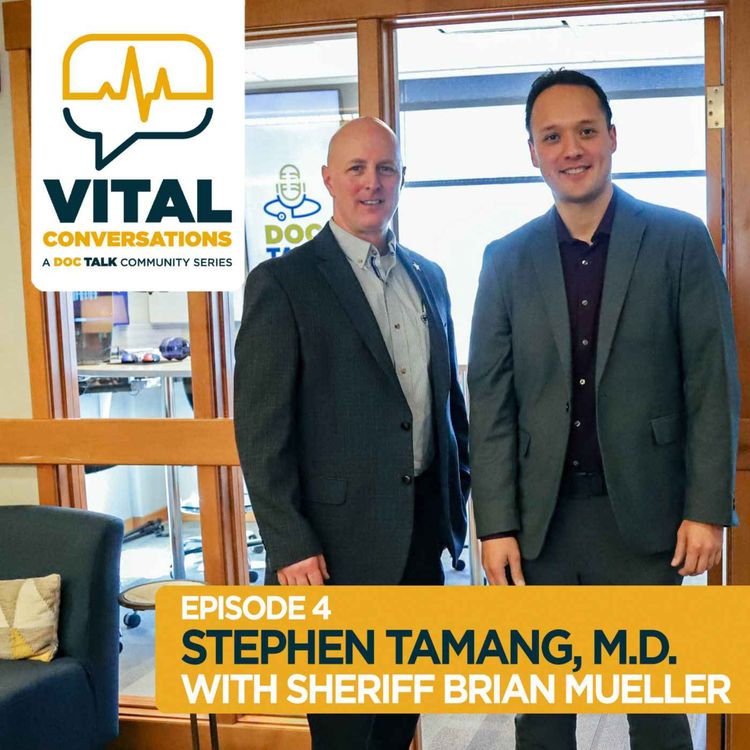
Part 4: Vital Conversations with Dr. Stephen Tamang and Pennington County Sheriff Brian Mueller
•
This is a conversation between Dr. Stephen Tamang, Monument Health physician and Director of Addiction Medicine and Community Health Services—and Brian Mueller, the Pennington County Sheriff. They go deep into the role the Sheriff’s Office plays in shaping public policy, tackling controversial topics ranging from magnet services to ICE enforcement. They take a hard look at homelessness, exploring the services available in our community, the gaps that still exist, and what real solutions might look like. Expect an unfiltered, thought-provoking discussion about the intersection of law enforcement, public health, and the systems that shape our community’s most pressing challenges.
More episodes
View all episodes
195. Episode 195: Listeners Ask About the New Rapid City Emergency location with Brook Eide, M.D.
19:33||Ep. 195“When you have an emergency, nothing’s fast enough.” The goal of Rapid City Hospital Emergency Services is to see each patient as fast as possible. As Brook Eide, M.D., Medical Director of Emergency Services, explains in this episode of listener questions, the new Mall Drive Emergency location, open on June 10, will help Rapid City area patients by giving them another emergency room supported by Rapid City Hospital in a convenient location — particularly for patients living east of the city. Dr. Eide clarifies the main differences between the two emergency locations, when a patient should go to which location and how transfers to the hospital will work.Listen or watch for information on this exciting new development in the Rapid City area that has been long-needed and will give the surrounding communities a new solution when immediate health care troubles arise.
194. Episode 194: A First Look Inside the New East Mall Emergency Room with Brook Eide. M.D.
17:33||Ep. 194Dr. Brook Eide takes Mark Houston on a walk-through of Monument Health's brand new emergency room on East Mall Drive. From the Saint Barbara Chapel near the entrance to the trauma bay steps from the ambulance doors, Dr. Eide shows what the new facility can do, how it's designed to move patients quickly, and where it fits alongside the main hospital downtown. A first look inside a space built for the growing east side of Rapid City.
193. Episode 193: A Walking Tour of the Rapid City Hospital ER with Brook Eide, MD
26:17||Ep. 193Step inside the Rapid City Hospital Emergency Department for a walking tour with Brook Eide, M.D., an ER physician with twenty-one years of experience. From the ambulance bay, rooftop helicopter pad, vertical care and trauma resuscitation rooms, Dr. Eide pulls back the curtain on what actually happens behind those sliding doors. Learn what makes Monument Health a Level II Trauma Center, how this ER is able to care for a five-state region, and how the team manages patient care while keeping patients calm during the worst day of their lives. Whether you've ever wondered what happens after a helicopter lands or what "vertical care" really means, this episode offers a rare, behind-the-scenes look at emergency medicine in action.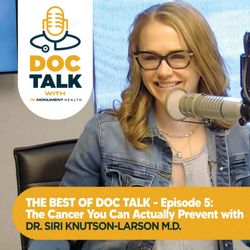
192. BEST OF DOC TALK Episode 5: The Cancer You Can Actually Prevent with Dr. Siri Knutson-Larson
19:18||Ep. 192We're replaying this one for Skin Cancer Awareness Month. Dr. Siri Knutson-Larson of Monument Health Dermatology joins Mark Houston to cover what every South Dakotan should know before summer hits. She walks through basal cell, squamous cell, and melanoma, the ABCDEs of checking your moles, why altitude in the Black Hills ramps up UV exposure, and why redheads need to be extra careful. A good one to have on before sunscreen season.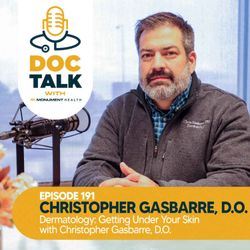
191. BEST OF DOC TALK Episode 92: Dermatology: Getting Under Your Skin with Dr. Christopher Gasbarre
26:31||Ep. 191It's May, which means it's Skin Cancer Awareness Month, and we're bringing back one of our most important episodes. This is a replay of Episode 92.Dr. Christopher Gasbarre, a board-certified dermatologist and Fellow of the American College of Mohs Surgery, joins us to talk about skin cancer, how to protect yourself, and the Mohs procedure, a highly effective technique for removing skin cancer. If you missed it the first time around, now's a good time to catch up.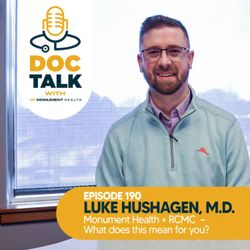
190. Episode 190: Merging RCMC and Monument Health with Luke J. Hushagen, M.D.
17:16||Ep. 190Luke J. Hushagen, M.D., Internal Medicine Physician at Mt. Rushmore Road Clinic debuts on the Doc Talk podcast to discuss the Rapid City Medical Center Merger with Monument Health. Dr. Hushagen has an established practice in Rapid City and he intends to make the transition as smooth as possible for his patients. He’s eager to continue collaborating with local colleagues while having the continuity of care that working with Monument Health can provide.Listen in to hear Dr. Hushagen’s take on why this is a positive change for patients, who will still get the best care possible.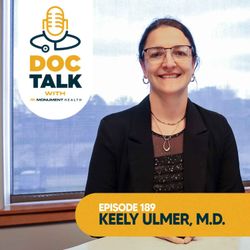
189. Episode 189: Women’s Reproductive Cancers with Keely Ulmer, M.D.
24:50||Ep. 189Cervical cancer often goes undetected simply because the patient had never been screened before. Keely Ulmer, M.D., Gynecologic Oncologist at Monument Health's Cancer Care Institute is aiming to change that, especially for rural and native people. Dr. Ulmer joins Mark Houston to talk about what kinds of cancer are most common for women and how she’s working towards improving access to care. Increasing HPV vaccination rates and removing systemic barriers that prevent access reduce cancer deaths dramatically. With these goals in mind, Dr. Ulmer joined the Walking Forward program which aims to help rural get people screened for cancers, especially cervical cancer.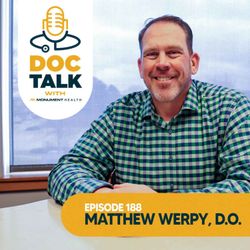
188. Episode 188: What is a Hospitalist? with Matthew Werpy, D.O.
29:09||Ep. 188When you are hospitalized, it’s likely that a Hospitalist will be the “quarterback” physician of your care team. Matthew Werpy, D.O., is a Hospitalist andMedical Director for Hospital Medicine at Rapid City and Spearfish Hospitals. In this episode, Dr. Werpy shares his background and training. He outlines how the relatively recent specialty of hospitalist came to be and how they function at Monument Health. As the fastest growing specialty in the United States, hospitalists must have a broad medical knowledge so they can treat any number of the illnesses they encounter. This is especially important in rural areas because of the comparative lack of specialists. Hospitalists must also be able to gain the trust of a patient quickly through individual connection, especially with those who may be unfamiliar with the recent introduction of these physicians to inpatient care.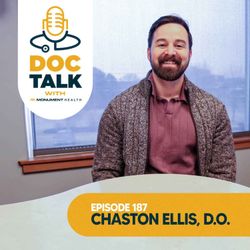
187. Episode 187: Psychiatry in the Black Hills with Chaston Ellis, D.O.
26:36||Ep. 187In this episode of Doc Talk, Chaston Ellis, D.O., Psychiatrist at Behavioral Health in Rapid City, speaks on Monument Health’s efforts to increase access to psychiatric treatment and mental health care in the Black Hills. Dr. Ellis shares a bit about his background and motivations for pursuing psychiatry and gives perspective on how social media might be complicating anxiety disorders, while simultaneously helping to destigmatize mental health care. The most important message Dr. Ellis would like to share is that mental health care is now more accessible in the area than it has ever been before and that simply showing up and staying optimistic is one of the biggest steps you can take toward improvement.