Share
Dispersion
Dinner Conversations and Fluid Identities
Season 2, Ep. 3
•
In this episode Randal and Dilmurat discuss the inseparable nature of their cultural and religious identities, and how histories of persecution based on religion have contributed to a strong sense of peoplehood within their religious diaspora communities. This episode explores fluid and intersecting identities, and cross generational education.
More episodes
View all episodes
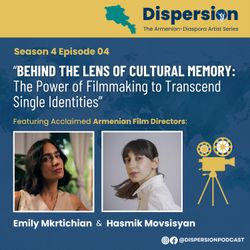
4. Behind the Lens of Cultural Memory: The Power of Filmmaking to Transcend Single Identities
54:22||Season 4, Ep. 4Guests: Award-winning filmmaker, interdisciplinary artist, and curator Emily Mkrtichian, and acclaimed filmmaker and director Hasmik Movsisyan.In this episode, our guests reflect on how their connections to Armenia have shifted over time, and how film becomes a way of holding onto and passing down memory. They discuss how storytelling has the power to reach people in ways that feel both personal and universal, transcending the boundaries of any singular identity. Along the way, they consider how culture is carried forward, and what it means, as filmmakers, to take on the responsibility of preserving and sharing those stories.Biographies:Emily Mkrtichian is an award-winning filmmaker and interdisciplinary artist whose work explores alternative archives and visionary futures across the SWANA region. Working across documentary, fiction, and expanded media, her practice is grounded in collaborative ethics and care-centered methodologies. Her feature documentary There Was, There Was Not premiered at True/False Film Festival and went on to screen internationally, earning the Audience Award and Special Mention at the Mar del Plata International Film Festival, the FIPRESCI Prize at the Golden Apricot International Film Festival, and a North American release with Watermelon Pictures. Her earlier work has screened at festivals including Full Frame and BFI Flare. Mkrtichian has been recognized as a Creative Capital awardee (2025), an LA Arts Activation Fund recipient, and a DocX Fellow at Duke University and is an alum of the Sundance Institute Mkrtichian’s projects center diasporic memory, intergenerational storytelling, and collective world-building. She is also a curator, educator, and facilitator. Hasmik Movsisyan was born in Yerevan, Armenia, in 1991. At the age of 11, she moved with her family to St. Petersburg, Russia, where she grew up. She received amedical degree from St. Petersburg State University, but after graduation, she decided to pursue her true passion for filmmaking. Hasmik was accepted into the Directing Department of the Gerasimov Institute of Cinematography (VGIK), where she studied under the guidance of Alexander and Vladimir Kott and Anna Fenchenko in the fiction film workshop. During her time at VGIK, Hasmik’s films (Apnea 2019, Side by Side 2021, Harisa 2022) were recognized at various student film festivals and received numerous awards. Her short film 250 KM, which originally began as a student project, developed into a full-fledged independent film and went on to participate in more than 40 international film festivals, earning around 20 awards. In 2025, Hasmik completed her Master’s degree in Film Directing at ESCAC (Escola Superior de Cinema i Audiovisuals de Catalunya) in Spain, where she wrote and directed her first European short film, Barceloneta.Find us on all your favourite social media platforms:Instagram: https://www.instagram.com/dispersionpodcast/?hl=enSpotify: https://open.spotify.com/show/3YnJI7YEgyyxVXn4qJWeIfApple Podcasts: https://podcasts.apple.com/ca/podcast/dispersion/id1604466506Acast: https://shows.acast.com/dispersionAmazon Music: https://music.amazon.ca/podcasts/be249e46-4f77-41f9-8c41-9c62cfc1ecd6/dispersion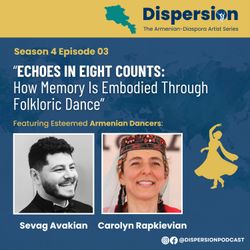
3. Echoes in Eight Counts: How Memory is Embodied Through Folkloric Dance
56:02||Season 4, Ep. 3Guests: Dance researcher, teacher, and director, Carolyn Rapkievian, and artistic director and choreographer of Sassoun Dance Ensemble, Sevag Avakian.In this episode, our guests reflect on their personal journeys and the evolution of Armenian dance across the diaspora. They explore efforts to preserve traditional forms alongside the emergence of new, diaspora-born dances, and how performance and teaching actively reshape Armenian historical memory. The conversation highlights dance as both a practice of preservation and celebration, one that carries history forward in exciting ways. Biographies:Carolyn Okoomian Rapkievian has been researching, teaching, and performing dance in a professional capacity for more than 30 years. She grew up dancing at Armenian family and social functions. Her directing highlights include the Washington D.C. Arev Armenian Dance Ensemble and the Arax Armenian Dance Ensemble. Her performance experience includes AGBU’s Antranig Dance Ensemble in New York, and Dancefolk and the Palamakia (Greek) Dancers in Nashville. She has studied Russian, Polish, and Hungarian dancing and continues to study ballet. In addition to Armenian dance, she has taught character ballet and ballroom dancing for dance companies, universities, and public folk festivals. She teaches Armenian dancing and international folk dancing with the Kotwica Band at monthly dances and at festivals in Maine.Carolyn has held leadership positions in museums for over 50 years including 26 years at the Smithsonian’s National Museum of the American Indian. She has lectured internationally about genocides, understanding history, and the politics of cultural acknowledgement in museums. In 2018 she curated the Armenian Dance Showcase at the Smithsonian Folklife Festival. She currently works to document and preserve historic Western Armenian village dances in collaboration with the Houshamadyan project: https://www.houshamadyan.org/themes/dance.htmlSevag Avakian developed a passion for Armenian dance at a young age, growing up in a family deeply rooted in dance and cultural tradition. Beginning his training at the age of six, he was immersed in music and movement early on, a constant influence throughout his life. As he matured, his natural curiosity and dedication led him to independently study traditional Armenian folkloric dances, exploring their techniques and cultural and historical significance.He is now the Artistic Director and Choreographer of the Sassoun Dance Ensemble, established in 2004 under the auspices Toronto’s Holy Trinity Armenian Church by Reverend Archpriest Father Zareh Zargarian and now operating under the Canadian Armenian Community Services Centre (Barev Centre). Over the past 22 years, the group has welcomed hundreds of members and presented annual performances featuring traditional and contemporary Armenian dances. The ensemble has performed at multicultural festivals, theatrical productions, and music videos, represented Armenian heritage at an NBA game, and appeared on major local stages including Dundas Square, the Canadian National Exhibition, and David Pecaut Square.Find Dispersion on all your favourite social media platforms:Instagram: https://www.instagram.com/dispersionpodcast/?hl=enSpotify: https://open.spotify.com/show/3YnJI7YEgyyxVXn4qJWeIfApple Podcasts: https://podcasts.apple.com/ca/podcast/dispersion/id1604466506Acast: https://shows.acast.com/dispersionAmazon Music: https://music.amazon.ca/podcasts/be249e46-4f77-41f9-8c41-9c62cfc1ecd6/dispersion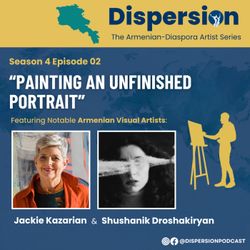
2. Painting an Unfinished Portrait
51:23||Season 4, Ep. 2Guests: Chicago-based painter and visual artist Jackie Kazarian, and Armenian-Dutch biodesigner and artist Shushanik Droshakiryan.In this episode, our guests explore how their art emerges from personal curiosities and lived experiences engaging with Armenian narratives, rather than representing a singular collective view. They reflect on how Armenian identity is a continuously reconstructed phenomenon that is shaped through their evolving relationships between art, homeland, and themselves across time and different mediums.Biographies:Jackie Kazarian is a Chicago-based visual artist working primarily in painting, installation and video. She received a BS in Zoology from Duke University and a MFA in Painting and Drawing from the School of the Art Institute of Chicago. She has held numerous solo exhibitions, including New York, Chicago, Miami, Spain, Syria and Kuwait. Her work is in many private and public collections, including Illinois State Museum, Rockford Art Museum, Metropolitan Pier and Exposition Authority, Chicago Public Library, and the United States Embassy, Armenia. In 2019, Jackie received the Lifetime Achievement Award from the Armenian Behavioral Science Association. She is a 2008 fellow of the Ellen Stone Belic Institute for the Study of Women & Gender in the Arts & Media at Columbia College Chicago and has served two tours as an art envoy for the U.S. State Department, presenting workshops, lectures and exhibitions in Kuwait and Syria. In 2015, Kazarian created a monumental painting to commemorate the 100-year anniversary of the Armenian genocide. Shushanik Droshakiryan is an Armenian-Dutch biodesigner and artist based in Amsterdam. Her creative journey began with traditional Armenian carpet weaving at the National Centre for Aesthetics in Yerevan, where the material and ornamental logic of Armenian carpets formed her artistic thinking. Today, that foundation drives her biodesign practice in which Armenian cultural heritage is not preserved but activated as regenerative design intelligence. Her biomaterial systems do not merely reference Armenian identity — they are rooted in it, drawing from the logic of Armenian landscape,material memory, and cultural form.She is the founder of Venus in Fury, an Amsterdam-based biodesign lab, working at the intersection of material science, craft, and next-generation biomaterial systems. Her signature materials, SUF, a translucent seaweed-based bio-garment inspired by G.I. Gurdjieff, and ARTSAKH, a carbon-based bio-leather registered under EU trademark droshakiryan ®, each draw their identity from the Armenian land, memory, and heritage.Find us on all your favourite social media platforms: Instagram: https://www.instagram.com/dispersionpodcast/?hl=enSpotify: https://open.spotify.com/show/3YnJI7YEgyyxVXn4qJWeIfApple Podcasts: https://podcasts.apple.com/ca/podcast/dispersion/id1604466506 Acast: https://shows.acast.com/dispersionAmazon Music: https://music.amazon.ca/podcasts/be249e46-4f77-41f9-8c41-9c62cfc1ecd6/dispersion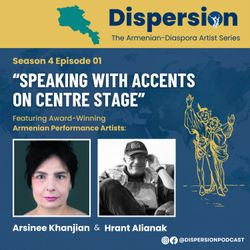
1. Speaking with Accents on Centre Stage
01:24:34||Season 4, Ep. 1Guests: Award-winning international film and stage actress, Arsinee Khanjian and esteemed playwright, director, and stage actor, Hrant Alianak. In this episode, our guests share their journeys as diasporan Armenians from Lebanon and Sudan, respectively, to reflect on how their distinct upbringings shape their Armenian storytelling. They discuss how diaspora challenges traditional notions of Armenianness, the role of accents as markers of otherness, and their shared history navigating Canada’s film and theatre scenes as young performance artists from the 1970s onward.Biographies:Hrant Alianak (Writer/Director/Actor/Producer) made his debut as a writer in 1972 at Theatre Passe Muraille in Toronto with his play TANTRUMS. He is best known for his plays LUCKY STRIKE, THE BLUES and THE WALLS OF AFRICA which was nominated for 8 Dora Awards and received 3, including Best Production. Alianak started producing in 1992 and formed his company ALIANAK THEATRE PRODUCTIONS. Amongst the plays he has produced and directed, were several Armenian themed plays including A CROOKED MAN and BEAST ON THE MOON, starring Arsinee Khanjian. He has also completed two feature films, A TRIP TO THE ISLAND and BURNING, BURNING, both of which he wrote, directed and co-produced.Arsinee Khanjian was born in Lebanon to Armenian parents in Beirut, and has lived in Canada since 1975. Khanjian grew up speaking Armenian at home, Arabic and French in school. Her family moved to Montreal when she was seventeen, where she studied theatre at the Conservatoire Lasalle, earned her B.A. in Spanish and French from Concordia University, then subsequently graduated with a Masters in Political Science from University of Toronto. She has starred in numerous Canadian and European films (including The Lark Farm by the Taviani brothers and Ararat by Atom Egoyan), performed on stage and has directed her own work in Berlin. In 2006 she was awarded the »Genie Award« for best actress Ararat and the Gemini Award previously for her role in the CBC production of More Tears in 1999.Find us on all your favourite social media platforms: Instagram: https://www.instagram.com/dispersionpodcast/?hl=enSpotify: https://open.spotify.com/show/3YnJI7YEgyyxVXn4qJWeIfApple Podcasts: https://podcasts.apple.com/ca/podcast/dispersion/id1604466506 Acast: https://shows.acast.com/dispersionAmazon Music: https://music.amazon.ca/podcasts/be249e46-4f77-41f9-8c41-9c62cfc1ecd6/dispersion
Welcome to Dispersion Season 4!
01:10||Season 4, Ep. 0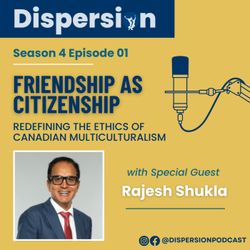
Friendship as Citizenship
51:07|In this special episode of Dispersion, host Jen Haddow speaks with Dr. Rajesh C. Shukla, Associate Professor at Saint Paul University and guest editor of the upcoming Diaspora journal issue, titled Immigrant Diaspora and the Changing Dimensions of Canadian Multiculturalism about reimagining Canadian multiculturalism through the lens of social connections. Reflecting on his own migration journey and academic work, Dr. Shukla explores how belonging and identity shape the immigrant experience in Canada. This conversation offers a first look into Season 4 of Dispersion and its focus on the evolving realities of Canadian multiculturalism. Tune in for an inspiring discussion on how civic life in Canada can be redefined through sympathy, community, and friendship.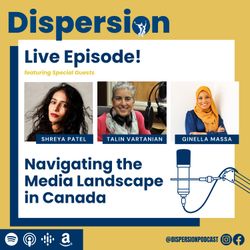
Dispersion Live Event: Navigating the Media Landscape in Canada
49:07||Season 0, Ep. 0This special live episode of Dispersion, recorded at the Toronto Reference Library on March 28, 2025, brings together three distinguished voices from the Canadian media industry. Through candid storytelling and thoughtful reflection, each guest offers a personal lens on navigating the media landscape—unpacking how their identities have shaped both the challenges they've faced and the opportunities they've found. Though their paths differ, their shared experiences of self-discovery and professional growth will resonate with many. Tune in as they explore what it means to move through the world of media while negotiating questions of identity, representation, and belonging.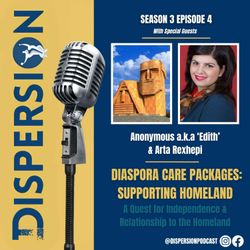
4. Diaspora Care Packages: Supporting Homeland
36:14||Season 3, Ep. 4In this episode, guests will explore their relationship with their own identity in relation to their home state. What sets this apart from other episodes, is that their homeland was not, or still hasn’t been, recognized as an independent state. We explore how this fight for independence and recognition has shaped the guests into who they are today, and why they may have a different relationship with their homeland than other Diaspora groups. The two cases represented in this episode are Nagorno-Karabakh and Kosovo.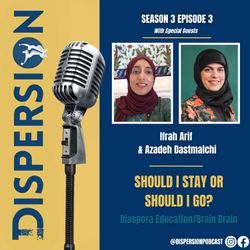
3. Should I Stay or Should I Go?
01:03:36||Season 3, Ep. 3This episode explores the push and pull factors of immigration in the lives of our guests as well as the notion of brain drain. Joining us for this episode are Azadeh Dastmalchi and Ifrah Arif. Dastmalchi is the CEO and Co-Founder of VitalTracer, a medical startup that designs smart wearable medical devices. Arif currently works as a Senior Policy and Program Advisor at Immigration, Refugees and Citizenship Canada.