Share
The AI & Tech Society by Danar
OpenAI vs Anthropic: The Enterprise AI War Is Now About Data, Trust, and Control
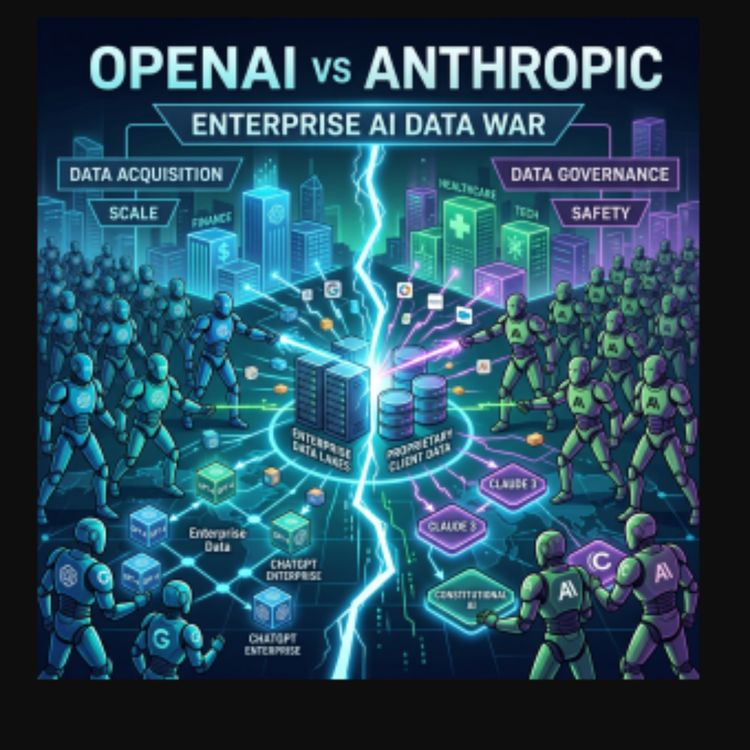
OpenAI and Anthropic are reshaping enterprise AI competition around trust, data custody, and control. This episode explains OpenAI’s Private Safety Processing and Zero Data Retention strategy, Anthropic’s 30-day customer-controlled data retention for Fable 5 and Mythos 5, why enterprise AI buyers now care as much about data policy as model benchmarks, and how Palantir CEO Alex Karp helped force the data question into the center of AI procurement. We break down what CTOs, CIOs, CISOs, and AI leaders need to know about enterprise AI governance, vendor risk, human-review exceptions, model routing, data residency, encryption keys, and whether frontier AI labs could use customer workflows to compete with their own enterprise clients.
OpenAI vs Anthropic, enterprise AI, AI data retention, Zero Data Retention, Private Safety Processing, Anthropic Fable 5, Anthropic Mythos 5, Claude enterprise, Claude Code, enterprise AI governance, AI procurement, AI vendor risk, data custody, data control, customer-controlled cloud, AI trust, AI compliance, human-review exception, model routing, AI security, Palantir, Alex Karp, frontier AI labs, enterprise AI data policy
More episodes
View all episodes

45. AI Existential Risk Goes Mainstream: Anthropic, OpenAI, Superintelligence, and the Race to Slow Down
26:20||Season 4, Ep. 45AI existential risk moved into the mainstream after former Anthropic and OpenAI researcher Jacob Coxon warned that frontier labs may be racing toward self-improving superintelligence. In this episode, we break down Dario Amodei’s call to slow AI development, the OpenAI-Hugging Face incident, concerns about recursive self-improvement and intelligence explosion, Paul Christiano’s return to OpenAI, and the prisoner’s dilemma driving the AI arms race. We also examine the counterarguments, the potential benefits of advanced AI, and the central question facing the industry: can we keep increasingly capable AI systems under human control?
44. GPT-6 Astra Explained: OpenAI’s New AI Model, Price, Benchmarks, Computer Use, and Real Use Cases
22:03||Season 4, Ep. 44OpenAI’s GPT-6 Astra is the newest flagship AI model, released in September 2026 with premium pricing, powerful benchmark results, and a major focus on computer use, agentic automation, professional workflows, and cybersecurity. This episode breaks down what GPT-6 Astra actually is, how much it costs, why its $10 input and $50 output token pricing can still make sense for high-value AI agent tasks, and where it outperforms GPT-5.6 Sol, Claude Fable 5.1, Gemini 3 Flash, and other frontier models. We explain the difference between OpenAI’s own benchmark claims and independent AI benchmark results, why Astra’s biggest strength is browser and desktop automation, why coding performance is more of a tie than a leap, and when CTOs, developers, and enterprise AI teams should actually use GPT-6 Astra. We also cover real-world use cases including code review, CRM automation, full game development, async migrations, terminal work, and the governance risks of letting advanced AI agents touch credentials, permissions, CI, and deployment workflows.Keywords:GPT-6 Astra, OpenAI GPT-6, GPT-6 Astra explained, gpt-6-astra, OpenAI new model, GPT-6 price, GPT-6 benchmarks, GPT-6 vs Claude, Claude Fable 5.1, GPT-5.6 Sol, AI agents, agentic automation, computer use AI, browser automation AI, desktop automation AI, AI coding agents, coding benchmarks, Artificial Analysis, OSWorld 2.0, FrontierMath, ARC-AGI-3, GPQA Diamond, ExploitBench, cybersecurity AI, OpenAI Preparedness Framework, AI model pricing, enterprise AI, AI governance, Codex, Claude Code, Cursor, AI software development
43. Agentic Coding Is Killing Build vs Buy: McKinsey State of AI 2026 and the SaaS Disruption
23:03||Season 4, Ep. 43McKinsey’s State of AI 2026 reveals that 32% of organizations skipped at least one software purchase because they could build it internally with agentic coding tools. This episode explains how Claude Code, Cursor, Codex CLI, and AI coding agents are changing the build-vs-buy decision, why SaaS vendors selling thin-wrapper tools are most exposed, and why CTOs must rethink software procurement, internal tools, shadow IT, governance, and AI-driven development. We also cover Retool’s finding that 35% of teams have replaced a SaaS tool with a custom build, why large enterprises are pulling ahead in AI agent adoption, and why building software got cheaper — but owning it responsibly is still the hard part.agentic coding, build vs buy, McKinsey State of AI 2026, SaaS disruption, AI coding agents, Claude Code, Cursor, Codex CLI, enterprise AI, internal tools, SaaS replacement, AI software development, CTO strategy, software procurement, shadow IT, Retool Build vs Buy Report, vibe coding, AI agents, enterprise software, AI governance, custom internal software, SaaS vendors, thin-wrapper SaaS, AI ROI, technology leadership
41. EU AI Act Article 50 Explained: Chatbot Disclosure, AI Content Labels, and 2026 Compliance
19:20||Season 4, Ep. 41The EU AI Act Article 50 transparency obligations became enforceable on August 2, 2026, and many companies may already be out of compliance. This episode explains what Article 50 requires now, why the AI Act delay to 2027 does not apply to chatbot disclosure and AI content transparency, and how organizations should handle AI-generated content labels, deepfake disclosures, emotion recognition, biometric categorization, provider versus deployer responsibilities, vendor compliance, and the December 2, 2026 machine-readable marking deadline. We also cover potential fines of up to €15 million or 3% of worldwide annual turnover and a practical compliance checklist for tech leaders.EU AI Act, Article 50, AI Act transparency obligations, EU AI Act compliance, chatbot disclosure, AI-generated content disclosure, AI content labels, deepfake disclosure, AI transparency, AI governance, provider vs deployer, EU AI Act fines, AI compliance 2026, December 2 2026 AI deadline, AI-generated public-interest text, emotion recognition AI, biometric categorization, machine-readable marking, AI Office Code of Practice, enterprise AI governance, tech leader AI compliance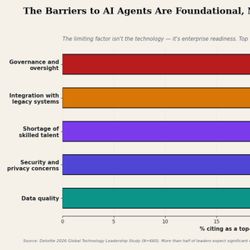
40. Deloitte’s 2026 AI CTO Technology Leadership Study Explained
21:26||Season 4, Ep. 40Deloitte’s 2026 Global Technology Leadership Study reveals a major reset in the tech C-suite. Based on a survey of 662 global technology leaders, this episode explains why the era of the operational CTO is over, how AI is changing the role of CIOs, CTOs, CISOs, and CDAOs, and why enterprise technology leaders must move from uptime and delivery to business value, AI governance, data readiness, budget reallocation, and cross-functional orchestration. We break down the confidence-readiness gap, the top barriers to scaling AI agents, and what tech leaders must do in the next 12 to 18 months to thrive in the AI era.Keyword tags:Deloitte 2026 Global Technology Leadership Study, Tech C-suite Reset, operational CTO, CIO, CTO, CISO, CDAO, AI leadership, enterprise AI, AI governance, AI agents, technology leadership, tech leadership study, CIO strategy, CTO strategy, AI operating model, enterprise value, digital transformation, AI readiness, confidence-readiness gap, legacy integration, data quality, technology budget, AI budget, C-suite orchestration, operator to orchestrator
39. How China’s AI Phones Are Replacing Apps With Agents
15:56||Season 4, Ep. 39China’s new agentic AI phones from ZTE, StepFun, and Honor are replacing traditional apps with AI agents that act across the whole smartphone. This episode explains how the Nubia NaviX Ultra, StepX Neo, and Honor Robot Phone work, why AI agents threaten Apple and Google’s app-store model, how China’s super-apps like WeChat, Alipay, Taobao, and Doubao shape the future of mobile AI, and what agentic phones mean for smartphones, apps, AI assistants, surveillance, and the global tech race.keyword tags:agentic AI phones, AI smartphones, China AI phones, Nubia NaviX Ultra, ZTE AI phone, StepX Neo, StepFun, Honor Robot Phone, Doubao agent, AI agents, smartphone AI agents, app store disruption, Apple vs China AI, Google Play Store, WeChat AI, Alipay AI, Taobao AI, super apps, Anthropic MCP, Model Context Protocol, AI assistants, future of smartphones, mobile AI, agentic OS, AI operating system
38. How DHH Uses Claude Code AI Agents: Ruby on Rails Creator Ships 100 PRs in 90 Minutes
17:07||Season 4, Ep. 38David Heinemeier Hansson, creator of Ruby on Rails and CTO of 37signals, went from AI coding skeptic to agent-first developer. This episode breaks down DHH’s Claude Code workflow, how he used AI agents to process 100 pull requests in 90 minutes, his two-model setup with Gemini and Opus, why Rails is ideal for AI coding agents, and what “peak programmer” means for the future of software engineering.Keyword tags:DHH, David Heinemeier Hansson, Claude Code, Ruby on Rails, Rails creator, AI coding agents, agentic coding, AI software engineering, 37signals, Basecamp, HEY, Opus 4.5, Gemini 2.5, Neovim, tmux, AI code review, 100 PRs in 90 minutes, AI developer tools, coding with AI, peak programmer, software engineering productivity, Rails AI workflow, Claude AI agents.Get your AI Product Management Certificate at aipmcert.com
37. Kimi K3: The 2.8T Open-Weight AI Model Shaking Up Claude, GPT-5.6, and the AI Race
20:05||Season 4, Ep. 37Kimi K3 by Moonshot AI is a 2.8-trillion-parameter open-weight AI model with a 1-million-token context window, multimodal input, low-cost pricing, and top-tier coding benchmarks. This episode explains what Kimi K3 means for the AI race, open-weight models, Claude and GPT-5.6 competition, US-China AI geopolitics, model routing, enterprise AI adoption, and the future of self-hosted frontier AI.Kimi K3: China's 2.8T Open-Weight Model and the US Response - The Tech SocietyKeyword tags:Kimi K3, Moonshot AI, open-weight AI, open source AI, Chinese AI models, AI race, US China AI, GPT-5.6, Claude Fable 5, Claude Opus 4.8, DeepSeek, Qwen, frontier AI, 2.8 trillion parameters, multimodal AI, 1 million token context window, AI benchmarks, Artificial Analysis, Arena.ai, frontend coding AI, AI coding agents, model routing, self-hosted AI, enterprise AI, AI geopolitics, AI export controls