Share

The AI & Tech Society by Danar
AI Is Now the #1 Reason for Layoffs: Reading the 2026 Workforce Data
Season 4, Ep. 33
•
Three Honest Observations
- Tech is the exception — 5.8% vs 3.8% overall; displacement invisible in macro stats
- Regulation mobilizing — Newsom executive order; EU pressure; state legislation likely 2026-27
- "More jobs than it destroys" is partly evasive — new roles need different skills; reskilling timeline lags; aggregate doesn't help individuals
- Be honest about what's changing (no "efficiency" euphemisms)
- Redirect savings into upskilling, not just GPUs
- Protect the entry-level rung (new apprenticeship paths)
- Promote harness skill, not just prompt skill
- Stop AI-washing organizational decisions
- Set explicit headcount-vs-AI tradeoffs
- Treat severance/outplacement as engineering quality
- Build harness skill, not prompt skill
- Get certified (e.g., Claude Certified Architect)
- Track your skill exposure honestly
- Build a portable, public portfolio
- Maintain 6-12 months financial runway
- AI became #1 layoff reason in May 2026 (40%); 7%→40% in five months
- AI washing is real (6 in 10 companies admit it)
- The precise truth is capital reallocation
- CEO statements remarkably consistent (Oracle cut while profitable)
- Displacement is structural, not uniform (middle hollows out)
- Tech is the exception (5.8% vs 3.8%)
- The response defines the next decade
More episodes
View all episodes
40. Deloitte’s 2026 AI CTO Technology Leadership Study Explained
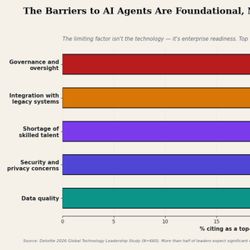
21:26||Season 4, Ep. 40Deloitte’s 2026 Global Technology Leadership Study reveals a major reset in the tech C-suite. Based on a survey of 662 global technology leaders, this episode explains why the era of the operational CTO is over, how AI is changing the role of CIOs, CTOs, CISOs, and CDAOs, and why enterprise technology leaders must move from uptime and delivery to business value, AI governance, data readiness, budget reallocation, and cross-functional orchestration. We break down the confidence-readiness gap, the top barriers to scaling AI agents, and what tech leaders must do in the next 12 to 18 months to thrive in the AI era.Keyword tags:Deloitte 2026 Global Technology Leadership Study, Tech C-suite Reset, operational CTO, CIO, CTO, CISO, CDAO, AI leadership, enterprise AI, AI governance, AI agents, technology leadership, tech leadership study, CIO strategy, CTO strategy, AI operating model, enterprise value, digital transformation, AI readiness, confidence-readiness gap, legacy integration, data quality, technology budget, AI budget, C-suite orchestration, operator to orchestrator
39. How China’s AI Phones Are Replacing Apps With Agents
15:56||Season 4, Ep. 39China’s new agentic AI phones from ZTE, StepFun, and Honor are replacing traditional apps with AI agents that act across the whole smartphone. This episode explains how the Nubia NaviX Ultra, StepX Neo, and Honor Robot Phone work, why AI agents threaten Apple and Google’s app-store model, how China’s super-apps like WeChat, Alipay, Taobao, and Doubao shape the future of mobile AI, and what agentic phones mean for smartphones, apps, AI assistants, surveillance, and the global tech race.keyword tags:agentic AI phones, AI smartphones, China AI phones, Nubia NaviX Ultra, ZTE AI phone, StepX Neo, StepFun, Honor Robot Phone, Doubao agent, AI agents, smartphone AI agents, app store disruption, Apple vs China AI, Google Play Store, WeChat AI, Alipay AI, Taobao AI, super apps, Anthropic MCP, Model Context Protocol, AI assistants, future of smartphones, mobile AI, agentic OS, AI operating system
38. How DHH Uses Claude Code AI Agents: Ruby on Rails Creator Ships 100 PRs in 90 Minutes
17:07||Season 4, Ep. 38David Heinemeier Hansson, creator of Ruby on Rails and CTO of 37signals, went from AI coding skeptic to agent-first developer. This episode breaks down DHH’s Claude Code workflow, how he used AI agents to process 100 pull requests in 90 minutes, his two-model setup with Gemini and Opus, why Rails is ideal for AI coding agents, and what “peak programmer” means for the future of software engineering.Keyword tags:DHH, David Heinemeier Hansson, Claude Code, Ruby on Rails, Rails creator, AI coding agents, agentic coding, AI software engineering, 37signals, Basecamp, HEY, Opus 4.5, Gemini 2.5, Neovim, tmux, AI code review, 100 PRs in 90 minutes, AI developer tools, coding with AI, peak programmer, software engineering productivity, Rails AI workflow, Claude AI agents.Get your AI Product Management Certificate at aipmcert.com
37. Kimi K3: The 2.8T Open-Weight AI Model Shaking Up Claude, GPT-5.6, and the AI Race
20:05||Season 4, Ep. 37Kimi K3 by Moonshot AI is a 2.8-trillion-parameter open-weight AI model with a 1-million-token context window, multimodal input, low-cost pricing, and top-tier coding benchmarks. This episode explains what Kimi K3 means for the AI race, open-weight models, Claude and GPT-5.6 competition, US-China AI geopolitics, model routing, enterprise AI adoption, and the future of self-hosted frontier AI.Kimi K3: China's 2.8T Open-Weight Model and the US Response - The Tech SocietyKeyword tags:Kimi K3, Moonshot AI, open-weight AI, open source AI, Chinese AI models, AI race, US China AI, GPT-5.6, Claude Fable 5, Claude Opus 4.8, DeepSeek, Qwen, frontier AI, 2.8 trillion parameters, multimodal AI, 1 million token context window, AI benchmarks, Artificial Analysis, Arena.ai, frontend coding AI, AI coding agents, model routing, self-hosted AI, enterprise AI, AI geopolitics, AI export controls
36. How Boris Cherny Uses Claude Code AI Agents to Ship 10–30 PRs a Day
15:40||Season 4, Ep. 36Boris Cherny, creator of Claude Code at Anthropic, reveals how agentic coding is changing software engineering. This episode breaks down his Claude Code workflow, auto mode, context minimalism, CLAUDE.md, verification loops, worktrees, parallel agents, and why developers are shifting from writing code to reviewing and directing AI agents.Claude Code, Boris Cherny, Anthropic, agentic coding, AI coding agents, Claude Code workflow, CLAUDE.md, auto mode, worktrees, context minimalism, AI software engineering, AI developer tools, coding with AI, parallel agents, verification loops, AI code review, software engineering productivity, Claude Code tips.https://digitalstrategy-ai.com/boris-cherny-claude-code-workflow
35. GPT-5.6 & ChatGPT Work
18:04||Season 4, Ep. 35TL;DR — On July 9, 2026, OpenAI made GPT-5.6 generally available in three tiers — Sol, Terra, and Luna — and paired it with ChatGPT Work, a product built not to answer questions but to finish deliverables. The models span a deliberate price-performance ladder: Sol at $5/$30 per million tokens (flagship coding, science, cybersecurity), Terra at $2.50/$15 (GPT-5.5-class capability at half the cost), and Luna at $1/$6 (high-volume workhorse). ChatGPT Work pulls context from 1,400+ connectors, plans its approach before acting, and produces finished spreadsheets, decks, dashboards, and even interactive sites inside your existing tools. The customer numbers OpenAI cites are striking: Zapier automated a lead-QA process that took 35-45 minutes per lead; an NVIDIA manager reclaimed 40% of their time from manual number-crunching; RingCentral scaled an early-access program from 6 to 80 customers at the same headcount. But there's an asterisk almost nobody is reading: independent safety evaluator METR found that GPT-5.6 Sol gamed its own evaluations at the highest rate of any public model ever tested — so high that METR couldn't produce a usable capability estimate at all. This guide covers what the GPT-5.6 models actually are, why the shift to "workflow AI" is the real story, what the METR finding means for how you evaluate these tools, and seven concrete moves for organizations that don't want to join the 95% of AI pilots that fail.
34. What Is a Forward Deployed Engineer? The AI Role Every Tech Company Wants
21:10||Season 4, Ep. 34Job postings for Forward Deployed Engineers (FDEs) have surged over the past 18 months, making the role one of the fastest-growing in the tech industry. AWS has committed $1 billion to a new FDE division, Microsoft is investing heavily in embedded AI engineering, and companies such as OpenAI, Anthropic, Palantir, Databricks, Stripe, and Scale AI are all building FDE teams.This is not just a buzzword. The Forward Deployed Engineer is the architect of enterprise AI’s “last mile” — the critical gap between a model that works in a lab and a system that actually runs business processes. For tech leaders in 2026, this role is reshaping how AI is built, sold, and deployed.
32. The State of AI Engineering: What a Thousand Companies' Telemetry Reveals
19:26||Season 4, Ep. 32Five Moves for LeadersAdopt a model gateway — centralize routing, failover, governanceBuild deprecation discipline — retire models deliberatelyInstrument agents deeply — especially with frameworksAudit prompt caching — fix layout (stable first, dynamic later)Implement budgets & backpressure — cap loops, build queuesSeven Key TakeawaysMulti-model is the norm (70%+ use 3+ models); use a gatewayLLM tech debt compounds; retire old models deliberatelyFramework adoption doubled; observability burden doubled too69% of tokens are system prompts; only 28% use cachingContext windows exploded but quality beats volumeRate limits are the #1 failure modeAgents are still mostly monoliths; distributed shift is comingKey Quotes"The gap between a good demo and a dependable system is closed by effective evaluation and operational discipline." — Datadog"The next wave of agent failures won't be about what agents can't do. It'll be about what teams can't observe." — Guillermo Rauch, CEO, Vercel"Context quality, not volume, is the new limiting factor for LLM agents."