Share
Curious Canadian History
S11E1 Canadian Punk Rock Takes Over the World
After punk found commercial success in the ’90s, with bands like Green Day, the Offspring, and Blink-182, a new wave of punk bands emerged, each embodying the DIY spirit of the movement in their own way. While Southern California remained the spiritual home of punk rock in the early 2000s, an unexpected influx of eager punks from Canada took the world by storm, changing the genre forever.
This incredible period of music is explored by authors Matt Bobkin and Adam Feibel in their book In Too Deep: When Canadian Punks Took Over the World . Both authors are Toronto-based music journalists whose work has appeared in Exclaim!, Bandcamp, VICE, the National Post, and the Toronto Star. In Too Deep is their first book. I began our conversation by asking Adam and Matt what exactly is punk rock music?
In Too Deep playlist:
Don’t forget! You can purchase a copy of Punching Above Our Weight: The Canadian Military at War Since 1867 right now at the below links:
More episodes
View all episodes
S11E13 Red River Reflection: The Myth of François Guilmette
42:13|In the heart of the Red River Settlement, a vibrant Métis community forged a distinct identity shaped by kinship, trade, and resistance. The latter half of the 19th century was a time of profound upheaval, when the Red River Resistance challenged Canadian expansion into the region. Yet history is not always what it seems. Alongside real leaders and lived struggles, one figure—long woven into the story—was never real at all. How did a ghost of the past become accepted as truth? And what does that reveal about the way history is remembered, recorded, and retold? In this episode we separate myth from memory on the Red River.Derrick M. Nault is an assistant professor in the Department of Indigenous Studies at the University of Winnipeg and a citizen of the Red River Métis Nation. His research examines Métis history, with particular attention to how kinship networks, political resistance, and collective memory have shaped Métis identity over time. This focus is grounded in his family’s long-standing involvement in Métis political and cultural life. His direct ancestors include André Nault, Louis Riel’s cousin and a captain during the Red River Resistance; Jean-Baptiste Parenteau and Damase Carrière, councillors in Riel’s 1885 provisional government; Marie Pélagie (Dumont) Parenteau, sister of Gabriel Dumont; and Antoine Vermette, a noted Métis buffalo hunter and founding member of l’Union Nationale Métisse Saint-Joseph du Manitoba. Check out Canyon Entertainment’s newest podcast hosted by David Borys, The Conflict and Culture Podcast, here!Don’t forget! You can purchase a copy of Punching Above Our Weight: The Canadian Military at War Since 1867 right now at the below links:AmazonIndigoDundurnGoodreadsIndiebookstores.ca
S11E12 Rise and Rise Again - The Life and Times of Mary Ann Shadd Cary
44:44|Born free in a slaveholding nation and unafraid to confront it, Mary Ann Shadd Cary carved out a life defined by intellect, defiance, and relentless public action. A teacher, lawyer, and the first Black woman in North America to publish a newspaper, she challenged both American slavery and Canadian complacency. Through the pages of The Provincial Freeman, she argued for self-reliance, integration, and equal rights at a time when such demands invited hostility. Her story moves across borders—from the United States to Canada and back again—tracing a 19th-century struggle for freedom that still echoes today. Dr. Nneka D. Dennie is a Black feminist scholar with specializations in nineteenth- and twentieth-century African American history. Her research examines Black intellectual thought with an emphasis on nineteenth-century African American history. Dr. Dennie is an Assistant Professor of History, core faculty in the Africana Studies Program, and affiliate faculty in the Women’s, Gender, and Sexuality Studies Program at Washington and Lee University. Check out Canyon Entertainment’s newest podcast hosted by David Borys, The Conflict and Culture Podcast, here!Don’t forget! You can purchase a copy of Punching Above Our Weight: The Canadian Military at War Since 1867 right now at the below links:AmazonIndigoDundurnGoodreadsIndiebookstores.ca
S11E11 The Frontier Regime of New France under Louis XIV
44:08|In the 17th century, across an ocean and a continent, the will of Louis XIV stretched deep into New France. This episode examines how an absolutist monarchy governed a fragile colonial frontier. How did royal officials impose order on distant settlements along the St. Lawrence? What roles did intendants, governors, and bishops play in enforcing law, regulating trade, and structuring society? From seigneurial land grants to military defense and missionary ambition, we explore the administrative machinery that bound colony to crown—and the tensions that emerged when metropolitan authority met colonial reality in a vast, unforgiving world. Colin Coates is professor of Canadian Studies and chair of the Department of Global and Social Studies at Glendon College, York University. He is currently president of the Canadian Historical Association. His book, Political Culture in Louis XIV’s Canada: Majesty, Ritual, and Rhetoric was published by McGill-Queen’s University Press in 2024. It won the Prix de l’Assemblée nationale for the best political history book from the Institut d’histoire de l’Amérique française. Check out Canyon Entertainment’s newest podcast hosted by David Borys, The Conflict and Culture Podcast, here!Don’t forget! You can purchase a copy of Punching Above Our Weight: The Canadian Military at War Since 1867 right now at the below links:AmazonIndigoDundurnGoodreadsIndiebookstores.ca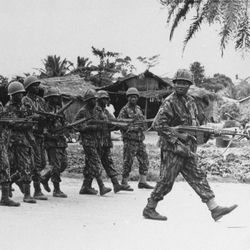
S11E10 Canair Relief and the Nigerian Civil War
47:33|The Nigerian Civil War (1967–1970) produced widespread famine, particularly in Biafra, prompting an unprecedented humanitarian response from abroad. Canadian churches helped found CANAIRELIEF, an ecumenical coalition that raised funds, mobilized volunteers, and supported clandestine airlifts of food and medical supplies. Motivated by moral urgency and graphic media coverage, these churches sought to bypass political paralysis. Yet the effort was deeply complicated: relief flights risked prolonging the conflict, aid was entangled with Biafran propaganda, and questions arose over neutrality, sovereignty, and whether humanitarian action inadvertently sustained the war’s machinery.Dr. Taiwo Bello is an Assistant Professor of African History and an affiliate faculty member of the Africana Studies Centre at Oklahoma State University. He serves on the Editorial Review Boards of the African Studies Association journal, History in Africa, published by Cambridge University Press; and the Canadian Association of African Studies journal, the Canadian Journal of African Studies, published by Taylor & Francis. He is the current President of the African Military Studies Association (AMSA), a coordinate organization of the African Studies Association.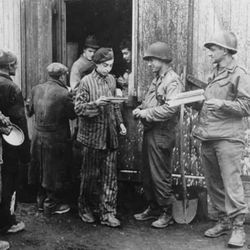
S11E9 The Liberation of Bergen Belsen
51:54|Names like Auschwitz, Dachau, and Bergen Belsen immediately bring to mind the horrors of the Nazi concentration camp system. At the liberation of Bergen Belsen in particular, Canadian forces contributed medical staff, engineers, and relief supplies to Allied efforts after that camp was liberated and in the dramatic weeks that followed. They helped treat survivors, bury the dead, and restore sanitation. Governing the camp meant managing disease, displaced persons, trauma, and justice while transforming a site of atrocity into emergency refuge amid shortages, chaos and reckoning. Dr. Mark Celinscak is the Louis and Frances Blumkin Professor of Holocaust and Genocide Studies in the Department of History and the Executive Directo of the Sam and Frances Fried Holocaust and Genocide Academy at the University of Nebraska at Omaha. He is the author of Distance from the Belsen Heap: Allied Forces and the Liberation of a Nazi Concentration Camp, winner of a Vine Award for Non-Fiction, and Kingdom of Night: Witnesses to the Holocaust, winner of a Canadian Jewish Literary Award for Holocaust literature. He is the co-editor of the forthcoming Two Roses: A Story of Deception and Determination in Nazi Germany (University of Toronto Press). He is an elected Fellow of the Royal Historical Society and is the Editor-in-Chief of the Journal of History. Please note that this episode will be dealing with some very graphic realities, so trigger warning! Check out Canyon Entertainment’s newest podcast hosted by David Borys, The Conflict and Culture Podcast, here!Don’t forget! You can purchase a copy of Punching Above Our Weight: The Canadian Military at War Since 1867 right now at the below links:AmazonIndigoDundurnGoodreadsIndiebookstores.ca
S11E8 Curious Canadian History presents: Canadian Time Machine | The Furry Gold of Canada: The Beaver’s 50-Year Legacy
32:47|In this episode, we step back in time with the Canadian Time Machine podcast to explore the 50th anniversary of the beaver becoming an official national symbol. For more than 50 years, this small but mighty animal has shaped rivers, driven trade, and quietly transformed the land. Wildlife ecologist Dr. Glynnis Hood and Jan Kingshott, director of animal welfare at Aspen Valley Wildlife Sanctuary, take us inside the beaver’s world—from its role in the fur trade to its work as an ecosystem engineer today—and reveal why it remains one of Canada’s most remarkable and resilient symbols.More episodes are available at https://lnkfi.re/canadian-time-machine. To read the episode transcripts in French and English, and to learn more about historic Canadian milestones, please visit thewalrus.ca/canadianheritage. There is also a French counterpart of this show called Voyages Dans L’Histoire Canadienne so if you’re bilingual and want to listen to more, visit https://lnkfi.re/Voyages-dans-lhistoire-canadienne. Check out Canyon Entertainment’s newest podcast hosted by David Borys, The Conflict and Culture Podcast, here!Don’t forget! You can purchase a copy of Punching Above Our Weight: The Canadian Military at War Since 1867 right now at the below links:AmazonIndigoDundurnGoodreadsIndiebookstores.ca
S11E7 Cigarette Nation: The History of Cigarettes in Canada
45:30|Cigarette smoking in Canada is a fascinating look at how consumer products, social rituals, and corporate misinformation interact. While widespread cigarette use began in the 1930s it was in the 1950s where a causal link between smoking and lung cancer surfaced in medical journals and mainstream media. Yet the best years for the Canadian cigarette industry were still to come, as per capita cigarette consumption rose steadily in the 1960s and 1970s. The persistence of smoking owes to such factors as product development, marketing and retailing innovation, public relations, sponsored science, and government inaction. Domestic and international tobacco firms worked to furnish Canadian smokers with hope and doubt: hope in the form of reassuring marketing, as seen with light and mild cigarette brands, and doubt by means of disinformation campaigns attacking medical research and press accounts that aligned cigarettes with serious disease.Helping us dive into this historical smoke pit is Daniel J. Robinson. Daniel is a Professor in the Faculty of Information and Media Studies at the University of Western Ontario, where he teaches courses on media history, advertising and marketing. He is the author of Cigarette Nation: Business, Health, and Canadian Smokers, 1930-1975, (McGill-Queen’s University Press, 2021), and has served as an expert witness for two provinces suing tobacco companies involving health-care costs recovery lawsuits. Check out Canyon Entertainment’s newest podcast hosted by David Borys, The Conflict and Culture Podcast, here!Don’t forget! You can purchase a copy of Punching Above Our Weight: The Canadian Military at War Since 1867 right now at the below links:AmazonIndigoDundurnGoodreadsIndiebookstores.ca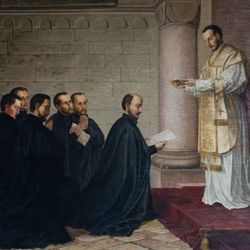
S11E6 Letters from the Frontier – The Jesuit Relations and Old World Understandings of New France
48:15|The Jesuit Relations, a series of annual reports produced between 1632 and 1673 detailing the experiences of Society of Jesus missionaries in what is now Eastern Canada, have long been an influential source on the history of New France and encounters between European settlers and Indigenous Peoples. The question of what exactly the Relations are, and who had a hand in composing the versions that circulated, has been given far less attention. Recent research has shown that they were in fact shaped by a diverse array of contributors, including Indigenous people, lay settlers, nuns, editors in Paris, and readers in France.To shine a new light on the Jesuit Relations we have invited on historian Micah True. Micah reveals a richer and more complex picture of a primary source that has played a major role in public understanding of the colonial history of North America. Micah True is Professor of French and Folklore at the University of Alberta, where he also serves as Associate Dean of the Faculty of Graduate and Postdoctoral Studies. He is the author of Masters and Students: Jesuit Mission Ethnography in Seventeenth-Century New France, published by McGill-Queen's University press in 2015, and the translator of the Jesuit Pierre-François-Xavier de Charlevoix's 1744 account of his voyage through North America, published in Brill's Jesuit Studies series in 2019. His new book, published this year by McGill-Queen's University Press, is The Jesuit Relations: A Biography. Check out Canyon Entertainment’s newest podcast hosted by David Borys, The Conflict and Culture Podcast, here!Don’t forget! You can purchase a copy of Punching Above Our Weight: The Canadian Military at War Since 1867 right now at the below links:AmazonIndigoDundurnGoodreadsIndiebookstores.ca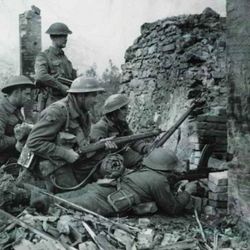
S11E5 Canada at War with Angus Wallace
01:06:52|Recently our very own David Borys had the pleasure of having a long chat with Angus Wallace of The WW2 Podcast to explore Canada's military legacy from confederation to the Second World War. Angus and David start at the very beginning with Canada’s military (or lack there-of) in 1867 and trace its development through the next near-century all the way to the start of the Second World War. They then cover the incredible expansion of the Canadian military from 1939-1943 and detail the unbelievable contribution the Canadian military made to that global conflict into 1945. Check out Angus’ podcast here! Check out David’s newest podcast, The Conflict and Culture Podcast, here!Don’t forget! You can purchase a copy of Punching Above Our Weight: The Canadian Military at War Since 1867 right now at the below links:AmazonIndigoDundurnGoodreadsIndiebookstores.ca