Share
Coffee House Shots
Britain can learn from France on migration
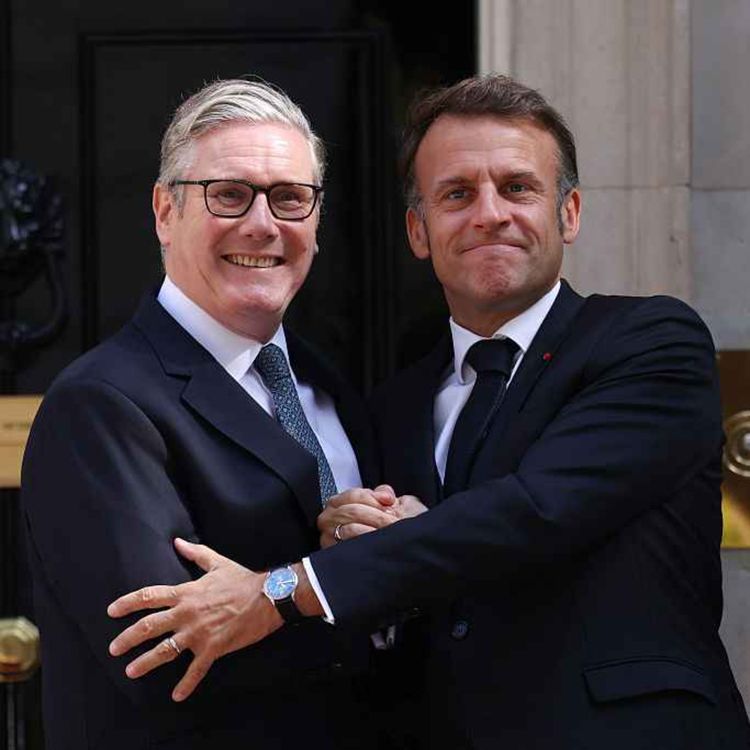
It’s the big day for Starmer’s one-in, one-out migrant deal with France. The scheme, which was agreed during the state visit last month, comes into effect today – but Yvette Cooper and other figures in Whitehall remain suspiciously evasive when it comes to putting a number on returns to France. Immigration is, of course, the problem of highest salience across the country, and made even more pressing by recent riots at migrant hotels, giving far-right opposition parties plenty of ammunition. Polling shows that 40 per cent of Reform supporters would consider voting for Labour next time if the number of small boat arrivals fell. So, will it work? Will it prove a better deterrent than, say, the Rwanda deal?
This is undoubtedly a landmark agreement with France, and puts us in closer alliance with the French. Are there areas where we should be taking lessons from them – perhaps when it comes to our dealings with overseas terrorists, for example?
Oscar Edmondson speaks to Tim Shipman and Madeline Grant.
Produced by Oscar Edmondson.
Become a Spectator subscriber today to access this podcast without adverts. Go to spectator.co.uk/adfree to find out more.
For more Spectator podcasts, go to spectator.co.uk/podcasts.
Contact us: podcast@spectator.co.uk
More episodes
View all episodes

Does Burnham have a foreign policy?
15:11|As Andy Burnham rolls out the red carpet for Volodymyr Zelensky in Downing Street, he has publicly sided with Kyiv against the Trump administration, days after the US President called for Zelensky to be replaced. Noa Hoffman is joined by James Heale and Tim Shipman to weigh up the politics, and to ask whether Ed Miliband’s desire to be seen as a saviour over Israel-Palestine has backfired, with friends of Jonathan Powell, the National Security Adviser, now saying he is likely to quit. Produced by Patrick Gibbons and Henry Lloyd
Ed Davey sees off a coup
12:46|After last night’s botched coup against the Liberal Democrat leader, Sir Ed Davey, and a rather temperate Prime Minister’s Questions in the House of Commons today, James Heale is joined by Isabel Hardman and Tim Shipman to review the events of the last 24 hours.Produced by Henry Lloyd
Where are all the ‘Waitrose women’?
13:40|The IMF has upgraded its forecast for UK growth – but is the good news all it seems? Michael Simmons explains why the assumptions underpinning Britain’s economic outlook may be far shakier than they first appear, as the government prepares for another difficult Budget.Meanwhile, a new YouGov poll puts the Conservatives ahead of Reform. Is Kemi Badenoch finally beginning to turn the tide – and has the Tory strategy of targeting the ‘Waitrose woman’ started to pay off?Oscar Edmondson speaks to Michael Simmons and Noa Hoffman.Produced by Oscar Edmondson.
Russian interference: what really happened with Brexit
23:04|On this episode of Coffee House Shots, James Heale and Tim Shipman examine claims of Russian interference in the Brexit referendum. What do we actually know about Moscow’s attempts to influence the vote – and did they make any difference to the result?Plus: they discuss Andy Burnham’s foreign policy, Labour’s plans for a reset with the EU and Nigel Farage’s latest attempt to put migration back at the centre of the political debate.Produced by Oscar Edmondson & Abigail Brierley
LIVE: Why aren't Britain's young people working? | with Laura Trott
39:02|For this special edition of Coffee House Shots, economics editor Michael Simmons hosts a panel from Conservative Party conference on Britain’s growing NEETs crisis: the hundreds of thousands of young people not in education, employment or training. He is joined by shadow education secretary Laura Trott, the CBI’s Megan Bulford, Spectator commissioning editor Lara Brown and the CPS's Daniel Herring.Why are so many young people struggling to enter the labour market, and is the problem education, welfare, the cost of hiring or something deeper? The panel debate the value of university compared with apprenticeships, whether tax and employment regulation are shutting younger workers out, and whether Britain’s welfare system is making it too easy for young people to fall out of work altogether. Plus: are rising anxiety and poor mental health driving the crisis or are they symptoms of a labour market that is failing the young?Produced by Patrick Gibbons and Oscar Edmondson.
Is Polanski finished? – Labour crushes Green challenge in North London
20:09|Labour has held Holborn and St Pancras in the first major electoral test of the post-Starmer era – but what does the result tell us about the state of the left?James Heale is joined by Tim Shipman and More in Common’s Luke Tryl to discuss Andy Burnham’s appeal, Zack Polanski’s problems and whether the Greens have already missed their moment. Plus: are the Conservatives beginning to squeeze Reform, and is two-party politics making a comeback?Produced by Oscar Edmondson.
What makes a great politician? | Thérèse Coffey & Michael Gove
22:56|What does it take to become a successful political leader – and are Britain’s politicians getting the training they need?At Conservative Party Conference, Michael Gove was joined by former deputy PM Thérèse Coffey to ask how Britain can develop politicians fit for the future.The conversation was organised in collaboration with the Institute for Government and was chaired by director of the IfG Academy, Vicky Elliott.
REACTION: Kemi’s conference speech – has she found ‘the right way’?
15:32|Kemi Badenoch has just delivered her conference speech, bringing Conservative Party Conference 2026 to a close.She very nearly almost announced the inheritance tax policy many had expected – instead beefing up the Tory offer to homeowners with a pledge to abolish inheritance tax on the family home. Beyond that, it was relatively light on new announcements: Kemi could hardly be accused of ‘policymaxxing’.What was clear from the Leader of the Opposition’s rhetoric, however, was that there is now plenty of clear blue water between the main parties – setting British politics up for an intriguing run-in. Has Kemi finally found ‘the right way’?Oscar Edmondson speaks to Tim Shipman, James Heale and Lara Brown.Produced by Oscar Edmondson.
A bonfire of regulations & Kemi's iron dome
12:49|James Heale is joined by Tim Shipman, Michael Simmons and Lara Brown from the second day of Conservative Party conference in Birmingham. They discuss shadow chancellor Andrew Griffith’s pitch for a low-tax, low-regulation economy, Kemi Badenoch’s new ‘Britannia Shield’ defence proposal and whether the Tories are starting to recover some confidence. As Kemi seeks to assemble a more credible frontbench team, to what extent is this conference the beginning of a genuine Tory revival? Produced by Patrick Gibbons.