Share
The Climate Gap
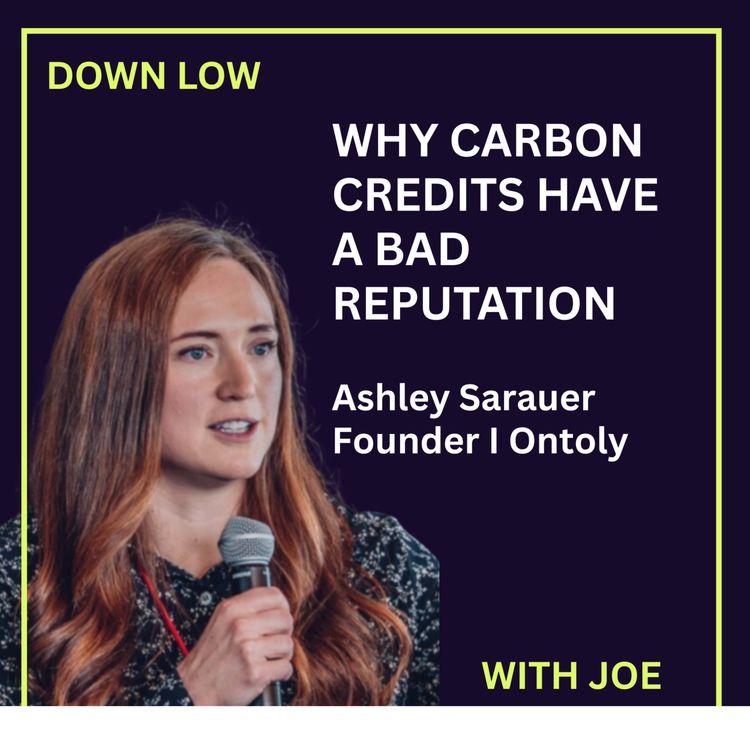
Why Carbon Credits Have a Bad Reputation
Carbon credits are confusing until you anchor them in data.
Most portfolios juggle policy, paperwork, and risk while hoping the math adds up. Ashley Sarauer breaks it down. She explains how to turn real building upgrades into verified, bankable carbon credits that buyers trust and owners can model into cash flow.
In this episode of The Down Low with Joe, Ashley shares what makes a carbon credit high-quality, why building data beats guesswork, and how a platform approach can transition projects from pilot to portfolio.
We discuss:
- The simple definition of a carbon credit and why title and transfer matter
- Turning building projects into verified credits using utility data and third party checks
- Additionality, permanence, leakage, and double counting explained in plain English
- Why buyers want local, tangible credits and how portfolios can keep a portion in house
- Ex post issuance, pre purchase contracts, and where banks fit in
- How credits change underwriting, ROI, and cash flow for deep retrofits
About Ashley Sarauer:
Ashley is the founder of Ontoly and a veteran of the carbon markets. She studied climate econometrics and worked on climate legislation in Alberta and British Columbia, then led initiatives at Verra in the voluntary market. At Ontoly, she focuses on certifying financial-grade, data-backed credits for real estate decarbonization.
Subscribe for weekly conversations at the intersection of data, buildings, and climate.
The Climate Gap is powered by Element Six.
Element Six specializes in addressing talent challenges across the built environment and climate technology sectors. Partnering with technology vendors and solutions providers delivering decarbonization solutions, helping them find the leaders and teams they need to scale.
Decarbonizing the built environment takes bold ideas and brilliant people. Element Six brings them together.
More episodes
View all episodes
Smart Building Reality Check: how AI is really showing up in FM, and what’s changing across real estate ops with Drew DePriest
58:04|AI won’t transform facility management with moonshots, it’ll transform it with thousands of tiny wins.McKesson’s Drew DePriest joins The Down Low with Joe to break down what AI actually looks like inside a Fortune 10 real estate organisation, far from the hype, and deeply rooted in the realities of FM, data, and operations.Most AI conversations in smart buildings revolve around flashy pilots, giant platforms, or “intelligent buildings” that never escape the pitch deck.Drew shares a very different viewpoint: the future is being shaped by incremental, practical AI adoption, small efficiency gains that compound across portfolios.In this live episode from NexusCon 2025, we dig into:How McKesson uses AI for everyday “roof shots,” not moonshotsWhy unstructured data (emails, decks, tribal knowledge) is the real bottleneckThe challenge of building an AI agent that understands both structured and unstructured dataWhy FM teams need consistency before they need “intelligence”How AI is already solving problems we never thought to automateThe fragmentation problem: why innovation in smart buildings moves slower than it shouldThe shift toward open-source tools, ontologies, and end-user configurabilityWhat the next 5 years of AI + smart buildings could realistically look likeAbout Drew DePriestDrew is the Director of Real Estate Operations Technology at McKesson, one of the world’s largest healthcare logistics organisations. With a background spanning startups, controls, workplace tech, and enterprise operations, he brings a rare, grounded perspective on how AI and smart building solutions succeed and fail in real-world environments.Watch if you are:A facility management or real estate leader navigating AI adoptionA smart building vendor trying to understand what enterprise buyers actually needA technologist interested in agentic AI, ontologies, and FM automationAnyone curious about how AI is changing the day-to-day reality of buildings
From Engineer to Executive: Tyler Smith on Building Smarter Spaces
44:55|In this In The Weeds episode of The Climate GAP, Lewis sits down with Tyler Smith, Vice President of Global Lifecycle Solutions at Johnson Controls. Tyler is one of the most experienced voices driving the healthy buildings movement, and his 20-year career tells the story of an industry in transformation.From engineering grad to executive, his journey tracks directly with the evolution of building tech. Smart systems. Indoor air quality. Fault detection. Decarbonisation. And now, AI.In this conversation, they unpack:What healthy buildings actually mean in 2025How Johnson Controls built OpenBlue into its digital backboneWhat it takes to lead at scale and still move with speedCareer advice for emerging talent in the spaceWhere the future is headed with AI, automation, and connected assetsWhether you’re building a product, managing assets, or growing a career in this space, this episode brings perspective that matters.🎧 Available on Spotify, Apple, and YouTube📌 Hosted by Lewis Martin, Co-Founder of Element Six📣 Follow for more episodes at the intersection of growth, adoption, product & climate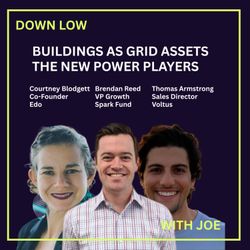
Buildings as Grid Assets. The New Power Players.
59:05|Buildings aren’t just consuming energy.They’re becoming part of the grid.In this panel edition of The Down Low with Joe, we bring together three leaders who are reshaping how distributed energy resources (DERs) and virtual power plants actually work at scale:Courtney Blodgett — Co-Founder, EdoFocused on building-level load flexibility, automated pre-cooling/pre-heating, and unlocking value with minimal impact on occupants.Brendan Reed — VP Growth, SparkfundDriving utility-scale DER deployment, storage programs, and new ways for utilities to plan around distributed capacity.Thomas Armstrong — Director of Sales, VoltusConnecting buildings to wholesale markets, monetising load flexibility, and turning portfolios into revenue-generating grid assets.We discuss:• How DERs are becoming a faster source of capacity than new power plants• The shift from emergency-only demand response to daily, dynamic flexibility• Why so much load flexibility in commercial buildings is still stranded• The policy barriers preventing DERs from scaling nationwide• How facilities can earn revenue, reduce load, and improve reliability• Whether VPPs can replace peaker plants over the next decade• The convergence of building tech, utilities, and market operators• What “grid-interactive” buildings actually look like in practiceSubscribe for weekly conversations on buildings, data, and the future of the grid.
Building Smart Companies, Not Just Smart Buildings
56:00|Smart buildings aren’t broken.. their data is.From inconsistent BAS naming to years of legacy config, most buildings struggle not because they lack sensors, but because the underlying data model is impossible to trust.In this episode of The Down Low with Joe, Nick Gayeski, Co-CEO and Co-Founder of Clockworks, breaks down what a decade of FDD deployments has taught him about data quality, ontologies, and why XETO and ontologies matter more than any dashboard or AI feature.We discuss:• Why bespoke naming kills scale, speed, and ROI• How Clockworks thinks about FDD, optimisation, and (eventually) write back• The real-world state of ontology adoption and where XETO fits in• Why integrations and metadata need the same investment as hardware• How partnerships and skilled labour shortages shape building performance• What’s actually slowing down digital transformation in the built worldAbout Nick Gayeski:Nick is the Co-CEO and Co-Founder of Clockworks, one of the most established analytics platforms in the industry, helping owners, operators, and service teams detect faults, optimise performance, and get value from building data at scale.Subscribe for weekly conversations at the intersection of data, buildings, and climate.
The weakest link in smart buildings isn't what you think, with Andrew Rodgers, Co-Founder of ACE IoT Solutions
25:01|Smart buildings depend on data, but the operational networks carrying that data are often the weakest and most overlooked part of the entire system.In this episode of Quick Cuts, Ben Muwoki sits down with Andrew Rodgers, Co-Founder of ACE IoT Solutions, to expose the hidden fragility inside OT networks and explain how it impacts analytics, energy optimisation, controls integration and digital building projects.Andrew shares insights from his background in industrial automation, IT and software, and breaks down why so many smart building deployments stall or fail due to network issues that no one is monitoring. From BACnet complexities to organisational silos between IT and FM, this episode uncovers the root causes and offers practical guidance on how to build healthier, more resilient building networks.What we cover:Why OT networks are often under-provisioned and over-burdenedHow network blind spots lead to delays in analytics, optimisation and digital projectsWhat observability means in an OT environmentHow BACnet muddies the separation between network and application layersWho should own network health in an organisationBetter models for designing and maintaining building networksHow network visibility can de-risk major software and analytics investmentsAbout Andrew RodgersAndrew Rodgers is the Co-Founder of ACE IoT Solutions LLC. A company working at the intersection of industrial automation, software and IT. With years of hands-on experience in manufacturing and smart buildings, Andrew helps organisations uncover the operational network risks that often undermine analytics, optimization smart building performance.About Quick Cuts:Quick Cuts is part of The Climate Gap, a series exploring the people and ideas shaping the future of climate technology, smart buildings and decarbonisation.Subscribe and follow The Climate Gap to be the first to listen to all of our content across our interview and podcast formats. Quick Cuts: Short episodes, sharp insights, no filler Pop Up: Chats from the floor The Down Low with Joe: Insider views and industry shifts Into the Weeds: Where complexity meets clarityhttps://www.youtube.com/@elementsixco
The Missing Link Between the Grid and Buildings
43:53|Energy data shouldn’t be this hard to get, but across 10,000+ utilities, it still is.In this episode of The Down Low with Joe, Udit Garg, SVP of R&D at Arcadia, joins Joe Aamidor and Lewis Martin to unpack how the “Plaid for Energy” is finally making energy data usable.. at scale.Udit explains why every clean energy or smart building solution depends on the same two things: usage and rates. He shares how Arcadia’s acquisitions of Urjanet and Genability are powering a unified data platform for the energy transition, and what that means for corporate decarbonization, bill management, and AI-driven optimization.We discuss:Why utilities remain the biggest bottleneck for clean energy innovationHow Urjanet and Genability together solved “quantity × price” for 10,000 utilitiesData normalization and rate modeling: the hard, unglamorous layer that enables AIHow fragmentation across vendors and internal teams limits ROI on energy programsThe “hierarchy of needs” for energy management — from bill pay to decarbonizationWhy ESG is cooling off, but cost volatility is heating upThe shift from reporting to real action: saving money first, cutting carbon nextAbout Udit Garg:Udit leads technology at Arcadia, where he oversees the platform that connects distributed energy assets, utilities, and corporates through unified data and APIs. He previously led energy product development at C3.ai and began his career at SunEdison, giving him a unique view of how data, software, and hardware must converge to enable the clean energy future.Subscribe for weekly conversations at the intersection of data, buildings, and climate.
Rethinking Smart Building Intelligence with Gary Chance, CEO of Nantum AI
15:21|In this episode of The Climate Gap: Quick Cuts, Ben Muwoki sits down with Gary Chance, CEO of Nantum AI, to explore how AI and human operators can work together to transform building data into measurable, portfolio-wide outcomes.Every year, new technologies promise to revolutionize the real estate industry. Every year, most of them fail to stick. Gary explains why adoption—not technology—is the most challenging part of innovation and how operators can transition from awareness to action.We dig into:From awareness to action. How large action models and human-AI collaboration will shape the next five years of building performance.The 80/20 rule of impact. Why a few interventions deliver most of the results and how to measure what’s left on the table.Transparency drives trust. How data visibility and proof of results accelerate collaboration between sustainability, asset, and operations teams.AI as a companion. Why operators who work alongside AI gain the edge, and why automation is about partnership, not replacement.Breaking platform paralysis. How to connect AI to a business case that proves ROI and scales across portfolios.About Gary ChanceGary Chance is the CEO of Nantum AI, where he leads product and strategy for one of the leading AI platforms in real estate operations. With over 20 years in digital transformation and data-driven building performance, he focuses on making AI practical, measurable, and operator-friendly.Watch if you are:A real estate or FM leader struggling to move beyond pilots and dashboardsA portfolio operator or energy manager trying to quantify real ROI from smart building techAnyone focused on AI adoption, change management, and operational excellence in the built environment
Connecting the Disconnect: Merging CRE and FM Tech
49:55|From silos to systems: in this bonus episode of The Down Low with Joe, Lewis and Joe sit down with Richard Reyes, Digital Strategy Lead at ConnexFM and CEO & Executive Director of OSCRE International, to unpack how the built world finally starts speaking a common language.Richard shares how his journey from enterprise architecture, data science, and financial services led him into the built environment, and why he now sees his role as a “bridge builder” between CREtech and FM tech. Together, they break down how ConnexFM as the FM community “heartbeat” and OSCRE as a long-standing data standards body are converging to create a practical digital foundation for owners, operators, occupiers, and service providers.They get into:Why CRE and FM have operated in silos for decadesHow data standards, ontology, and AI can unlock real value for portfolios and multi-site operatorsThe reality of data readiness, governance, and culture inside real organisationsTalent, trades, and the urgent risk of losing 30 years of institutional knowledgeWhy now is the moment for collaboration, not just more tech logos on a slideHow FutureBuild aims to convene CRE, FM, tech, and investors to move the industry forwardIf you care about smart buildings, facilities, data, or the future of the built environment, this one is a blueprint for where it is all heading next.