Share
Citizen Science Show
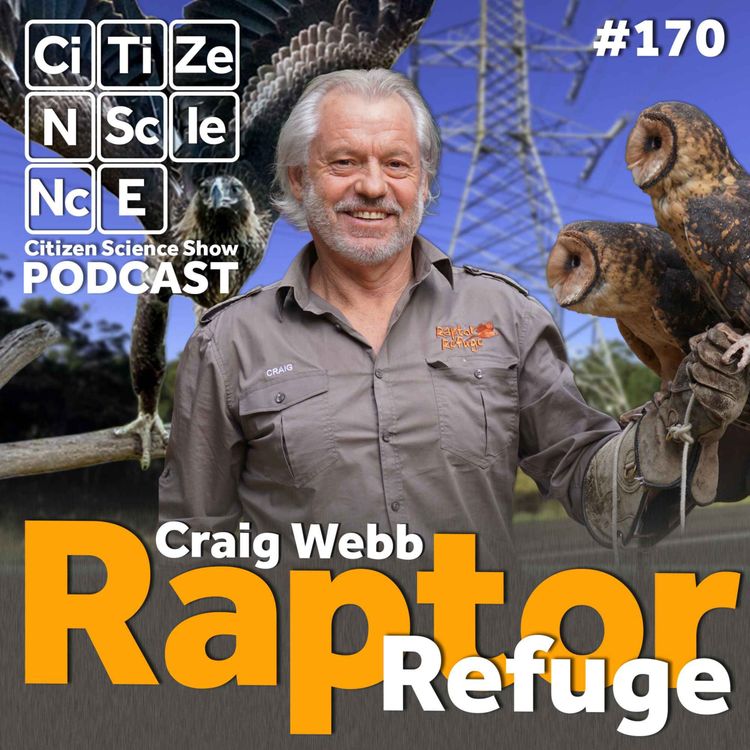
#170 Wings of Defiance: How Craig Webb Built Tasmania's Raptor Refuge from the Ground Up
What does it take to rescue, rehabilitate, and release Tasmania's most powerful birds of prey for 27 years, with no government support?
In this episode of the Citizen Science Show, host Dani Lloyd-Prichard sits down with Craig Webb, founder of Raptor Refuge in Kettering, Tasmania, and recipient of the Medal of the Order of Australia. Craig shares the unlikely story of how a backpacking trip up the west coast of Australia, a joey named Nigel, and a fortuitous few years working with a remote outback vet set him on a path to building one of the world's most remarkable raptor conservation facilities.
We hear about the four threatened raptor species Craig works with, the silent crisis of eagle electrocutions on power lines, and the global lessons he's brought back from South Africa's Endangered Wildlife Trust.
Craig also tells the extraordinary story of Cupid, a Wedge-tailed eagle found with a crossbow arrow through its leg, whose five-week rescue and Valentine's Day release captured the hearts of hundreds of thousands of people around the world.
And he shares a secret. The birds in the display area at Raptor Refuge who are too injured to ever be released. They don't know they are doing something remarkable. But Craig does.
If you've ever looked up at a soaring eagle and felt something shift inside you, this episode is for you.
🦅 To support Raptor Refuge: become a member, book a tour, or stay at Eagle Ridge Retreat.
📞 Report a dead or injured raptor anywhere in Tasmania: 1800 RAPTOR
📱 Follow Cupid's story and more on the Raptor Refuge Facebook and Instagram pages.
More Information
https://www.facebook.com/raptorrefuge
https://www.youtube.com/c/RaptorRefuge
https://www.instagram.com/raptor_refuge/
If you enjoy this podcast, please like and subscribe to our show wherever you get your podcasts.
Leave us a review and share this show with your friends.
It really helps us to reach more citizen scientists, like you.
Contact the Show
We are always looking for more guests to tell us about interesting citizen science projects, research and events.
You can email us at: info@citizenscienceshow.com
More episodes
View all episodes
189. #189 Why Killing Sharks Won't Make Our Beaches Safer with Jessica Meeuwig
22:30||Season 4, Ep. 189After a number of shark bites on Australian beaches, the calls for a cull are growing louder. But does killing sharks actually make us safer?Marine ecologist Dr Jessica Meeuwig (UWA) joins Sarah Han-de-Beaux to separate fact from fear with the data:Why Hawaii's 1950s cull of over 5,000 sharks did nothing to reduce bites.Why Western Australia's $1.3 million drumline program caught zero white sharks.Why “shark numbers are exploding” is biologically impossible.Jessica unpacks the real ecological role sharks play, from protecting coral reefs to keeping seagrass beds intact, and lays out the evidence-based alternatives actually proven to reduce risk: drones, citizen science spotter programs, deterrent technology and serious investment in research.A clear-eyed, compassionate, and urgently needed conversation for anyone who loves the ocean.More Informationhttp://www.meeuwig.org/https://www.youtube.com/watch?v=-bMn7RuW3Qchttps://sharkspotters.org.za/https://www.youtube.com/watch?v=ysa5OBhXz-Qhttps://www.nps.gov/yell/learn/management/wolf.htmhttps://www.aims.gov.au/information-centre/news-and-stories/sharks-increase-reef-resilience? https://conbio.onlinelibrary.wiley.com/doi/pdf/10.1111/conl.12185If you enjoy this podcast, please like and subscribe to our show wherever you get your podcasts.Leave us a review and share this show with your friends.It really helps us to reach more citizen scientists, like you.Contact the ShowWe are always looking for more guests to tell us about interesting citizen science projects, research and events.You can email us at: info@citizenscienceshow.com
180. #180 From a Lone Shark in a Dubai Aquarium to Byron Bay's Leopard Shark Capital: The Unlikely Career of David Robinson
37:06||Season 4, Ep. 180A leopard shark in a Dubai aquarium gave birth without ever meeting a male. That moment of virgin birth, parthenogenesis, kicked off a remarkable career for Dr David Robinson, now owner of Sundive in Byron Bay and a researcher of leopard sharks at the world-renowned Julian Rocks.In this episode, David takes us from curating Dubai's first aquarium to rehabilitating over 1,800 sea turtles, discovering one of the world's largest whale shark aggregations off Qatar (thanks to a sick turtle named Pearl), and finally landing, almost by accident, in one of the only places on Earth where leopard sharks still gather in healthy numbers.We talk genetic curiosities, record-breaking turtle migrations, shark mating behaviour caught on camera for the first time, and why citizen scientists with cameras are doing some of the most important work in marine research today.More Informationhttps://www.sundive.com.au/https://www.nationalgeographic.com/travel/article/120106-virgin-birth-shark-dubai-sciencehttps://www.sharkbook.ai/If you enjoy this podcast, please like and subscribe to our show wherever you get your podcasts.Leave us a review and share this show with your friends.It really helps us to reach more citizen scientists, like you.Contact the ShowWe are always looking for more guests to tell us about interesting citizen science projects, research and events.You can email us at: info@citizenscienceshow.com
174. #174 From the Weather Map to Mill Creek: Graham Creed's Second Act in Science
41:02||Season 4, Ep. 174What happens when a weatherman trades the studio for the bush? In this episode, Dani talks with Graham Creed – former ABC weather presenter and author of The Weatherman Goes Bush – about a life shaped by science, community, and a deep love of the natural world.Graham shares the journey from watching Cyclone Tracy on the news as a nine-year-old in Melbourne, to twenty-one years as a broadcast meteorologist, to a tree change on a flower farm near Stroud, NSW. He talks proteas, platypus, and the unexpected flourishing of native bees after Varroa wiped out his thirteen honeybee hives.But this episode is as much about community as it is about the land. Graham co-founded the Stroud Community River Care Group, working to restore Mill Creek in the Karuah River catchment – pulling invasive weeds, replanting riparian vegetation, detecting platypus with environmental DNA, and building an indigenous history walk in a town celebrating its 200th European anniversary.He also takes us inside the world of weather modelling – from AI tools that predicted the 2025 Taree floods days ahead of every other model, to a CSIRO/Bureau of Meteorology tool that can tell you what your local climate will feel like in 90 years. And in a town that broke a 135-year rainfall record in 2025 before swinging straight into drought, those tools feel more urgent than ever.This is a story about observation, adaptation, and finding hope in the people quietly doing good work that rarely makes the news.More Informationhttps://www.grahamcreed.com.au/aboutIf you enjoy this podcast, please like and subscribe to our show wherever you get your podcasts.Leave us a review and share this show with your friends.It really helps us to reach more citizen scientists, like you.Contact the ShowWe are always looking for more guests to tell us about interesting citizen science projects, research and events.You can email us at: info@citizenscienceshow.com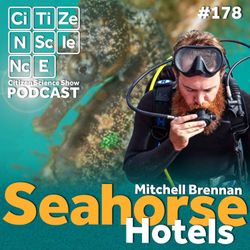
178. #178 Building Hotels for an Endangered Icon: Inside Sydney's Seahorse Conservation Project with Mitch Brennan
27:03||Season 4, Ep. 178Sydney's iconic White's seahorse is in trouble. Habitat loss has pushed this endemic species, found nowhere else on Earth onto Australia's endangered list.But at the Sydney Institute of Marine Science, marine scientist Mitch Brennan and his team are fighting back with one of the most charming solutions in conservation: the seahorse hotel.In this episode, Mitch explains how these metal reef structures work, why male seahorses give birth, and how a three-pronged strategy of captive breeding, artificial habitat, and natural restoration is giving White's seahorses a fighting chance in Sydney Harbour.He also shares how school kids are designing their own hotels, complete with rope disco balls, and how you can contribute sightings from your next dive to help monitor these incredible animals.If you've ever wanted to check in to a seahorse hotel, this is the episode for you.Get InvoledSydney Seahorse Project: https://sims.org.au/research/flagship-programs/the-gamay-initiative/project2-4-5/Project Humble School Group: https://projecthumble.com.au/Hong Kong Seahorse Project: https://www.lcf.gov.hk/filemanager/content/conservation/RE-2024-07-ENG.pdfHandfish Project: https://handfish.org.au/NSW DPIRD logging: https://www.dpi.nsw.gov.au/fishing/species-protection/report-a-threatened-species-formIf you enjoy this podcast, please like and subscribe to our show wherever you get your podcasts.Leave us a review and share this show with your friends.It really helps us to reach more citizen scientists, like you.Contact the ShowWe are always looking for more guests to tell us about interesting citizen science projects, research and events.You can email us at: info@citizenscienceshow.com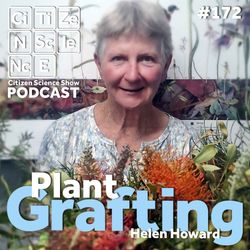
172. #172 The Art of the Graft: How Helen Howard Is Saving Australia's Rarest Plants One Splice at a Time
37:58||Season 4, Ep. 172What if you could save a plant from extinction and have it flowering in your garden within eighteen months? In this episode, Dani sits down with Helen Howard, horticulturist and nursery manager at the Hunter Region Botanic Gardens in NSW, to explore the remarkable world of plant grafting.With over thirty years of experience and a career that spans Ireland, England, and across Australia, Helen has dedicated herself to grafting Australian native plants from grevilleas and brachychitons to rare species teetering on the edge of disappearance. She explains how grafting works, why it matters for conservation, and how backyard gardeners can try it themselves.Along the way, we hear about Frankenstein trees, the mummy graft technique, near-extinct grevilleas brought back from the brink, and why hygiene is the one thing every grafter must never skip.If you've ever wondered why native plants can be so expensive, why grafted citrus fruits grow so much better, or what it takes to actually save a species — this episode is for you.🌷 Find Helen and the Hunter Region Botanic Gardens🪷 Search "Botanic Gardens Heatherbrae"🌼 Grafting workshops run every two months, limited to 6 participants.More Informationhttps://www.huntergardens.org.au/https://www.facebook.com/helen.howard.108152https://austplants.com.au/https://anpsa.org.au/study_group/grevillea-study-group/If you enjoy this podcast, please like and subscribe to our show wherever you get your podcasts.Leave us a review and share this show with your friends.It really helps us to reach more citizen scientists, like you.Contact the ShowWe are always looking for more guests to tell us about interesting citizen science projects, research and events.You can email us at: info@citizenscienceshow.com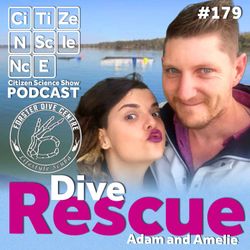
179. #179 Slow Down and Look: How Adam and Amelie Are Turning Forster's Waters Into a Living Classroom
32:17||Season 4, Ep. 179What does it actually take to save a whale? Not the twenty-second clip you see on the news — the full story, from the Sunday afternoon phone call through to the night run home in the dark, 22 kilometres south of where you started.In this episode of the Citizen Science Show, host Sarah Han-de-Beaux sits down with Adam and Amelie from Forster Dive Centre on the NSW mid coast — a couple who have turned their dive shop into a community conservation hub, and who spend their days off responding to marine rescues, removing hooks from Grey Nurse Sharks, and teaching people that the ocean is worth protecting because they finally understand what's in it.Amelie brings a marine biology background and a gift for translating science into something anyone can feel. Adam brings deep local knowledge, a boat, and a willingness to spend seven and a half hours on the water on Father's Day.Together they share the full behind-the-scenes stories of:🐋 The entangled humpback whale whose pod tail-slapped to show them where the line was and who breached at sunset after she was freed🐋 The juvenile humpback stranded in the Wallis Lake system in just 60cm of water, which made the New York Times and needed two separate rescue operations over three days🦈 Ten Grey Nurse Sharks rescued from fishing hooks over a single weekend🤿 The 'Diving with Challenges' program and the diver who taught them that underwater, there is only one languagePlus: their top three tips for citizen scientists, their hopes for their kids' ocean, and the local motto that says it all. There's no hurry in Tuncurry.🐬 To report a marine animal in distress: contact ORRCA (Organisation for the Rescue and Research of Cetaceans in Australia)🦈 To contribute to shark citizen science: Spot-A-Shark🤿 To dive with Adam and Amelie: Forster Dive Centre, NSW mid coastMore Informationhttps://www.orrca.org.au/https://seaworldfoundation.com.au/https://spotashark.com/https://ladyelliot.com.au/sustainability/project-manta/https://www.forsterdivecentre.com.au/If you enjoy this podcast, please like and subscribe to our show wherever you get your podcasts.Leave us a review and share this show with your friends.It really helps us to reach more citizen scientists, like you.Contact the ShowWe are always looking for more guests to tell us about interesting citizen science projects, research and events.You can email us at: info@citizenscienceshow.com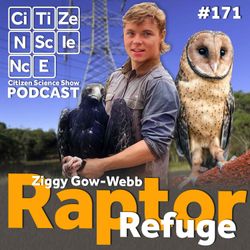
171. #171 Born Into It: Ziggy Gow-Webb and a Lifetime Among Birds of Prey
08:41||Season 4, Ep. 171He was practically born in a nest. At just 22 years old, Ziggy Gow-Webb has spent his entire life surrounded by birds of prey at Raptor Refuge in Kettering, Tasmania — the facility his father, Craig Webb, built from the ground up over 26 years.In this special short episode of the Citizen Science Show, host Dani Lloyd-Prichard sits down with Ziggy to hear his story: what it's like to grow up among eagles and owls, how raptors develop individual personalities, and what it feels like when a wild bird finally decides to trust you.Ziggy also opens up about the refuge's 30–40% rehabilitation success rate, the reality of loss in wildlife care, and how every setback only strengthens his drive to return more birds to the wild.And as a bonus, Ziggy reveals he's been living a double life. After just three months of posting social media videos about his daily work with raptors, he was approached to appear on The Floor Australia (Channel 9), a high-pressure game show where his expert category was nocturnal animals. Did he make it to the grand final? You'll have to tune in to find out.This episode pairs beautifully with Episode #170, featuring Craig Webbn, the father behind the refuge, and together they tell a remarkable story of a family devoted to protecting Tasmania's most powerful birds.🦅 To support Raptor Refuge: become a member or book a private tour at raptorrefuge.com.au📞 Report a dead or injured raptor anywhere in Tasmania: 1800 RAPTOR📱 Follow Ziggy's raptor videos on social media and keep an eye out for him on The Floor Australia, Channel 9.More Informationhttps://raptorrefuge.com.au/https://www.facebook.com/raptorrefugehttps://www.youtube.com/c/RaptorRefugehttps://www.instagram.com/raptor_refuge/If you enjoy this podcast, please like and subscribe to our show wherever you get your podcasts.Leave us a review and share this show with your friends.It really helps us to reach more citizen scientists, like you.Contact the ShowWe are always looking for more guests to tell us about interesting citizen science projects, research and events.You can email us at: info@citizenscienceshow.com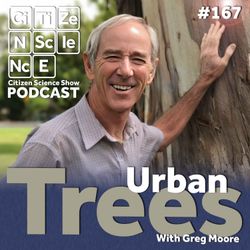
167. #167 Roots of the Matter: Why Australia's Urban Trees Are Fighting for Their Lives with Greg Moore
50:19||Season 4, Ep. 167They cool our streets, shelter our wildlife, boost our property values, and quietly keep us sane. So why are we cutting them down for $500?Dr. Greg Moore has spent nearly six decades championing urban trees — as a researcher, as principal of Melbourne's Burnley College, and as one of Australia's most respected voices in arboriculture. In this episode, he makes the case that trees aren't a nice-to-have. They are essential infrastructure. And we are losing them at a rate we will deeply regret.From the 3-30-300 rule to love letters written to Melbourne street trees, from cockatoo citizen science to the surprising power of a significant trees register with zero legal force — Greg covers it all with the calm authority of someone who has been right about this for a very long time.Plus: a simple way to measure your neighbourhood's canopy cover using nothing but your eyes and a clear day at noon.Because the trees around you are worth far more than you think. And so is your voice in protecting them.More Informationhttps://treenet.org/https://www.trees.org.au/https://www.isa-arbor.com/If you enjoy this podcast, please like and subscribe to our show wherever you get your podcasts.Leave us a review and share this show with your friends.It really helps us to reach more citizen scientists, like you.Contact the ShowWe are always looking for more guests to tell us about interesting citizen science projects, research and events.You can email us at: info@citizenscienceshow.com