Share
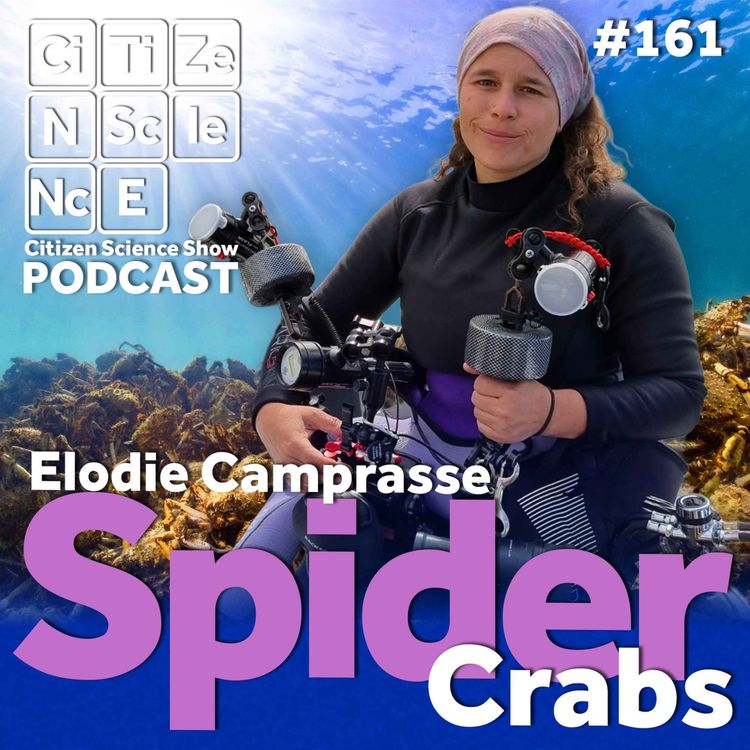
Citizen Science Show
#161 The Enigma of the Great Spider Crab with Elodie Camprasse
The Enigma of the Great Spider Crab
Australia’s great spider crab is hard to miss. With a leg span reaching up to a metre, these arthropods gather in extraordinary numbers along the seafloor. Each winter, tens of thousands converge in Port Phillip Bay in a phenomenon that has featured in global documentaries. Yet, as Elodie Camprasse discovered, scientific understanding of the species is surprisingly thin. “We know almost nothing,” she explains.
What researchers do know is tied to a vulnerable moment in the crab’s life cycle. Like all arthropods, spider crabs must shed their hard shells to grow. During this moulting phase, they are soft and exposed—easy targets for predators. 4The mass gatherings are believed to offer safety in numbers. Beyond that, much remains uncertain: How often do they moult? Where do they come from? Why do they choose specific locations?
More Information
https://www.inaturalist.org/projects/spider-crab-watch
If you enjoy this podcast, please like and subscribe to our show wherever you get your podcasts.
Leave us a review and share this show with your friends.
It really helps us to reach more citizen scientists, like you.
Contact the Show
We are always looking for more guests to tell us about interesting citizen science projects, research and events.
You can email us at: info@citizenscienceshow.com
More episodes
View all episodes
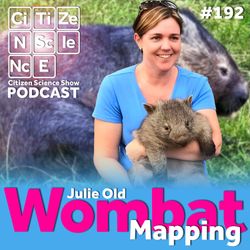
192. #192 Meet the Wombat Warriors: Inside Julie Old's Citizen Science Mission to Save Australia's Underrated Marsupial
39:33||Season 4, Ep. 192Wombats might be Australia's most underrated marsupial, and Associate Professor Julie Old has spent over a decade making sure they get the attention they deserve.In this episode, Dani talks with Julie about founding WomSAT, the citizen science project that's logged more than 25,000 wombat sightings, burrows and scat records since 2015.They cover the devastating impact of sarcoptic mange, how everyday Australians can train to treat wild wombats, the real science behind those famous cube-shaped droppings, and why wombat burrows are both an ecological treasure and, occasionally, a farmer's headache.Plus: how you can become a wombat warrior yourself, and why World Wombat Day (22 October) deserves a spot on your calendar.More Informationhttps://womsat.org.au/womsat/If you enjoy this podcast, please like and subscribe to our show wherever you get your podcasts.Leave us a review and share this show with your friends.It really helps us to reach more citizen scientists, like you.Contact the ShowWe are always looking for more guests to tell us about interesting citizen science projects, research and events.You can email us at: info@citizenscienceshow.com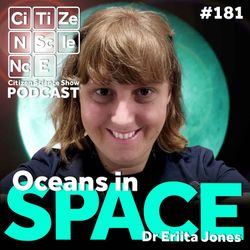
181. #181 From Mars to Bushfires: Dr Eriita Jones Brings Planetary Science Back Down to Earth
38:43||Season 4, Ep. 181This episode leaves Earth's oceans behind, almost.Planetary scientist Dr Eriita Jones from Curtin University joins Sarah to explore what it really takes for a planet to support life, from deep-sea hydrothermal vents to supercooled microbes floating in Earth's stratosphere.Eriita explains why Europa, Enceladus and Mars remain the solar system's most tantalising candidates for extraterrestrial oceans, shares the ethical questions she believes should come before any human mission to Mars, and reveals how her Mars-hunting techniques are now helping predict bushfires and floods right here at home.Plus: how accurate is *The Martian*, really, and how you can get involved in real space science through citizen projects like the Desert Fireball Network.More Informationhttps://science.nasa.gov/citizen-science/https://science.nasa.gov/citizen-science/impact-flash/https://science.nasa.gov/citizen-science/planet-hunters-tess/If you enjoy this podcast, please like and subscribe to our show wherever you get your podcasts.Leave us a review and share this show with your friends.It really helps us to reach more citizen scientists, like you.Contact the ShowWe are always looking for more guests to tell us about interesting citizen science projects, research and events.You can email us at: info@citizenscienceshow.com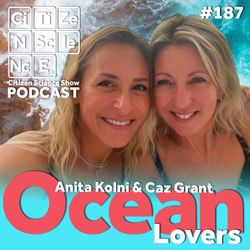
187. #187 Science in Your Swimmers: How Anita Kolni and Caz Grant Built Australia's Ocean Culture Movement
32:14||Season 4, Ep. 187What started as one mum's idea to make ocean science fun has become Australia's leading celebration of the sea.In this episode, Sarah sits down with Anita Kolni and Caz Grant, founders of the Ocean Lovers Festival, to talk about building a platform that connects scientists, conservationists, artists and everyday ocean lovers, from a Trashion parade made of beach litter to a citizen science BioBlitz spanning the length of the Sydney coastline. They share the surprising discovery that even leading marine scientists weren't talking to each other, how the festival's Sydney Coast Hope Spot came to be with the support of Mission Blue's Sylvia Earle, and why hope, not fear, has become their guiding philosophy for ocean conservation.More Informationhttps://www.oceanloversfestival.com/http://washedup.us/https://www.inaturalist.org/projects/sydney-coast-hope-spot-marine-bioblitz-march-2025If you enjoy this podcast, please like and subscribe to our show wherever you get your podcasts.Leave us a review and share this show with your friends.It really helps us to reach more citizen scientists, like you.Contact the ShowWe are always looking for more guests to tell us about interesting citizen science projects, research and events.You can email us at: info@citizenscienceshow.com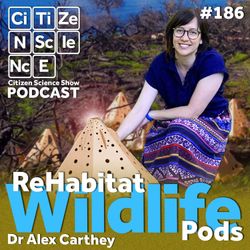
186. #186 Cardboard Teepees for Wildlife: How Dr Alex Carthey Is Rebuilding Shelter After the Fires
33:36||Season 4, Ep. 186After the Black Summer megafires, wildlife ecologist Dr Alex Carthey saw a gap no one was filling: the critical weeks after a fire, when surviving animals have no cover and predators move in.In this episode, Dani talks with Alex about founding ReHabitat, a profit-for-purpose start-up making biodegradable cardboard shelter pods that give ground-dwelling animals somewhere to hide while the bush regrows.Alex walks us through the pyramid-shaped pod design, the surprising range of species turning up on camera traps (including a wallaby that ate one), the logistics of rapid post-fire deployment, and where citizen scientists and wildlife carers could fit into the response.She also shares ReHabitat's newest product, the Plant Pod, and the accelerator program that turned a lockdown-era idea into a growing Australian business.More Informationhttps://rehabitat.au/If you enjoy this podcast, please like and subscribe to our show wherever you get your podcasts.Leave us a review and share this show with your friends.It really helps us to reach more citizen scientists, like you.Contact the ShowWe are always looking for more guests to tell us about interesting citizen science projects, research and events.You can email us at: info@citizenscienceshow.com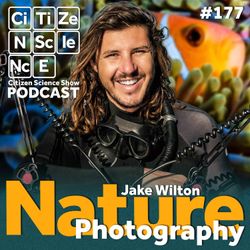
177. #177 From Dive Guide to Nikon Ambassador: Jake Wilton's Camera-Eye View of Nature
38:53||Season 4, Ep. 177From dive guide to Nikon Ambassador: in this episode, Sarah reconnects with wildlife photographer Jake Wilton, whose lens has taken him from the grey nurse shark caves of Fish Rock, NSW, to the manta ray waters of Ningaloo, WA, and the rainforests of Far North Queensland.Jake shares the extraordinary story of freeing a hooked manta ray named Freckles, a rescue that made international news, and the rare cassowary foraging behaviour he was the first to photograph.Along the way, he opens up about what repeated encounters with intelligent wildlife have taught him, how his photography has contributed to real scientific research, and the citizen science projects any listener can join today.Jake also shares his biggest wish: permanent marine park protection for the reef that started it all.More Informationhttps://www.jakewiltonphoto.com/https://www.youtube.com/@jakewiltonphoto579If you enjoy this podcast, please like and subscribe to our show wherever you get your podcasts.Leave us a review and share this show with your friends.It really helps us to reach more citizen scientists, like you.Contact the ShowWe are always looking for more guests to tell us about interesting citizen science projects, research and events.You can email us at: info@citizenscienceshow.com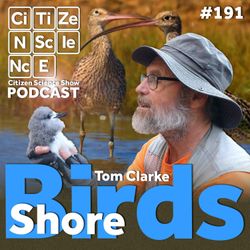
191. #191 Fifty Years of Mud, Sweat and Cheers: How One Volunteer Is Fighting to Save the Hunter's Shorebirds with Tom Clarke
36:21||Season 4, Ep. 191For more than 40 years, Tom Clarke has been on the front line of shorebird conservation in the Hunter estuary, NSW. One of the most significant migratory shorebird habitats in the world.In this episode, Tom joins Dani to talk about decades of hands-on restoration work with the Hunter Bird Observers Club, the alarming decline in shorebird numbers over the past 20 years, and the mangrove-clearing program that's brought birds back to sites they'd long abandoned.Tom also shares how the club navigated early conflict with the fishing industry, the surprising conservation wins for threatened beach-nesting birds, and what volunteers are doing to prepare for the arrival of avian influenza on Australian shores.Plus, a look ahead to the Australasian Shorebird Conference, coming to Newcastle in September 2026.More Informationhttps://www.hboc.org.au/Far Eastern Curlew Photo Credit: Rod Warnock (2017)If you enjoy this podcast, please like and subscribe to our show wherever you get your podcasts.Leave us a review and share this show with your friends.It really helps us to reach more citizen scientists, like you.Contact the ShowWe are always looking for more guests to tell us about interesting citizen science projects, research and events.You can email us at: info@citizenscienceshow.com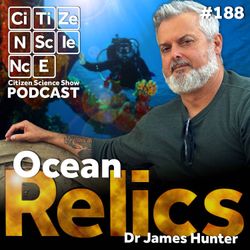
188. #188 Ocean Relics. The Indiana Jones of Australia's shipwrecks: Dr James Hunter
43:23||Season 4, Ep. 188There are an estimated **3,000* shipwrecks still undiscovered on Australia's ocean floor and up to 300 of them could be sitting in a single 3km stretch off Newcastle, NSW.In this episode, host Sarah sits down with Dr James Hunter, Manager of Maritime Archaeology at the Australian National Maritime Museum, for a deep dive into the science, history and heartbreak of shipwreck discovery. James takes us from a candle that survived 136 years inside a Civil War submarine, to the commercial salvage operation that gutted the war grave of HMAS Perth, to his own long-held theory that a centuries-old Spanish or Portuguese wreck may still be hiding in the Torres Strait.Along the way, James explains how everyday divers, boaters and beachgoers are already helping professional archaeologists find, monitor and protect these underwater time capsules and exactly what to do if you ever stumble across one yourself.In This Episode • How maritime archaeologists search for wrecks in shallow and deep water• the identification of Captain Cook's HMB Endeavour• the extraordinary preservation of the H.L. Hunley submarine• why human interference is more destructive than nature• treating wrecks as gravesites• the rise of 3D photogrammetry• how to get trained as a citizen maritime archaeologist• and the undiscovered wreck James hopes someone finds next.More Informationhttps://www.citizen-science-reisen.de/en/marine-archaeologyhttps://www.aima-underwater.org.au/shop/category/courseshttps://www.sunken.media/https://www.girtsd.org/BooksCitizen Science in Maritime Archaeology: The Power of Public Engagementedited by Della A. Scott-Ireton, Jennifer E. Jones, Jason T. RauppIf you enjoy this podcast, please like and subscribe to our show wherever you get your podcasts.Leave us a review and share this show with your friends.It really helps us to reach more citizen scientists, like you.Contact the ShowWe are always looking for more guests to tell us about interesting citizen science projects, research and events.You can email us at: info@citizenscienceshow.com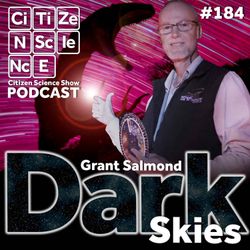
184. #184 How a Small Outback Town Became One of the Darkest, and Brightest, Places in Australia with Grant Salmond
30:09||Season 4, Ep. 184What if the thing we most need to conserve isn't a place, but darkness itself?In this episode, Sarah speaks with Grant Salmond, Education and Astronomy Manager at the Australian Age of Dinosaurs Museum, about how the small Queensland town of Winton became one of only eight internationally accredited Dark Sky places in Australia.Grant explains how a plague of insects led to a town-wide lighting overhaul, how the Gondwana Stars Observatory links the fossil record to the night sky, and how the First Nations "Dark Emu" constellation has guided seasonal knowledge for tens of thousands of years.Along the way: citizen science through Globe at Night, an opera performed beneath the stars, and a simple lightbulb swap that could help bring the stars back to your own backyard.More InformationDark sky international - https://darksky.org/https://www.australianageofdinosaurs.com/https://www.winton.qld.gov.au/Community/Dark-Sky-Communityhttps://globeatnight.org/https://australasiandarkskyalliance.org/https://www.scienceweek.net.au/https://darksky.org/what-we-do/events/dark-sky-week/If you enjoy this podcast, please like and subscribe to our show wherever you get your podcasts.Leave us a review and share this show with your friends.It really helps us to reach more citizen scientists, like you.Contact the ShowWe are always looking for more guests to tell us about interesting citizen science projects, research and events.You can email us at: info@citizenscienceshow.com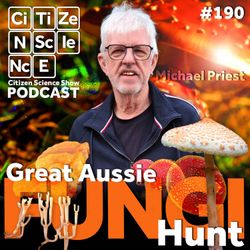
190. #190 The Great Aussie Fungi Hunt with Dr. Michael Priest
40:20||Season 4, Ep. 190This July, Australia goes on a fungi hunt. In this episode, Dani sits down with Dr Michael Priest, president of Fungimap, to explore the hidden kingdom beneath our feet.With an estimated 50,000 fungal species across Australia, and only 10% of them named. Michael explains why the Great Aussie Fungi Hunt needs citizen scientists more than ever.From mycorrhizal partnerships and the "wood wide web" to introduced species threatening native fungi and the truffle-dependent diet of the potoroo, this conversation is a crash course in why fungi matter and how anyone with a phone camera can help map them.Tune in to learn how to get involved, what to photograph, and why you really shouldn't eat what you find.More Informationhttps://fungimap.org.au/https://www.facebook.com/fungimapIf you enjoy this podcast, please like and subscribe to our show wherever you get your podcasts.Leave us a review and share this show with your friends.It really helps us to reach more citizen scientists, like you.Contact the ShowWe are always looking for more guests to tell us about interesting citizen science projects, research and events.You can email us at: info@citizenscienceshow.com