Share
Citizen Science Show
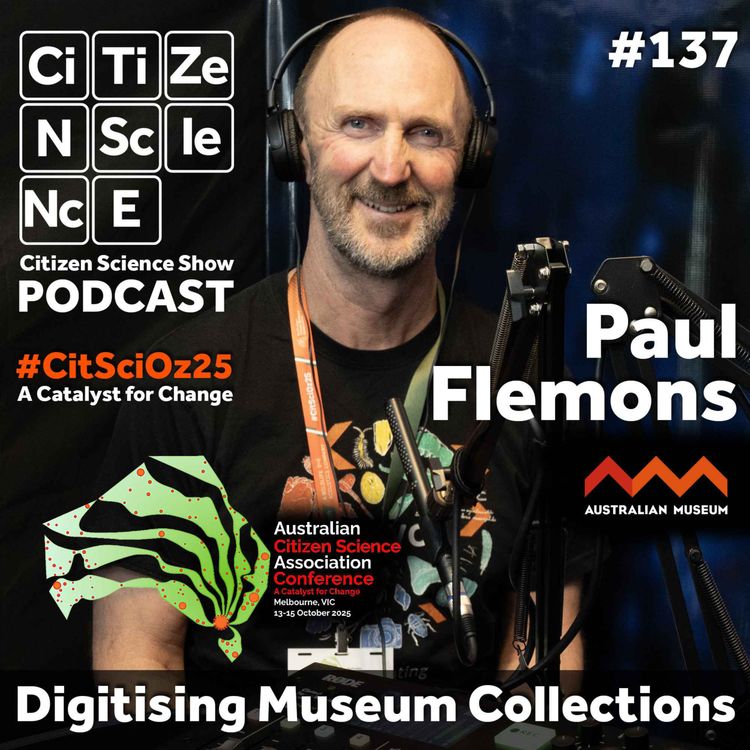
#137 Australian Museum Champions Citizen Science Through Innovative Programs with Paul Flemons
At the Australian Museum, citizen science has grown from a niche concept into a vibrant, community-driven force.
Managing the Centre for Citizen Science, Paul Flemons oversees three major programs that have transformed how the public engages with scientific research.
Frog ID is perhaps the most familiar, inviting thousands to record and monitor frogs across Australia.
DigiVol allows volunteers to digitize invaluable collections from institutions worldwide, including natural history, cultural artifacts, and council libraries, from the comfort of their homes.
Australasian Fishes collects data on fish distributions, helping to track environmental changes and shifts in ocean temperatures.
More Information
https://australian.museum/get-involved/citizen-science/volunteer-with-us/
https://citizenscience.org.au/citscioz25/
About The Citizen Science Show Podcast
This episode of the Citizen Science Show podcast is coming to you from CitSciOz25 the Australian Citizen Science Association conference, in Melbourne Connect, a world-class innovation precinct at The University of Melbourne.
If you enjoy this content, please like and subscribe to our show wherever you get your podcasts. It really helps us to reach more citizen scientists, like you.
Contact the Show
We are always looking for more guests to tell us about interesting citizen science projects, research and events.
You can email us at: info@citizenscienceshow.com
More episodes
View all episodes
160. #160 Tracking Giant Mantas Beneath the Surface with Asia Armstrong
36:25||Season 4, Ep. 160In 2008, the scientific community believed there was only one species of manta ray. That assumption quickly shifted when new research identified a second species, and more recently, a third. These are not small or hidden creatures—they are enormous animals, some stretching up to seven meters across—yet for years they remained largely misunderstood.One of the most powerful tools used to study them is deceptively simple. Each manta ray has a unique pattern on its belly, much like a fingerprint. These markings allow researchers to identify individuals from photographs, many of which are submitted by members of the public. A single image can reveal where a manta ray has been seen before, how often it returns, whether it is reproducing, and even provide insights into its lifespan. This form of citizen science has become central to the work.Asia Armstrong has spent years studying manta rays, yet they continue to surprise her in ways that feel both humbling and urgent. Her path into this work was not predetermined. Although she had always been drawn to the ocean, it was a single dive nearly two decades ago that changed everything. Encountering a manta ray for the first time left her captivated, and what struck her even more was how little was known about them. That realization led her back to university and eventually to Project Manta, where she has spent over a decade working to close those knowledge gaps.More Informationhttps://www.unisc.edu.au/project-mantahttps://ladyelliot.com.au/sustainability/project-manta/https://sharkrayareas.org/https://www.iucnredlist.org/https://www.cbd.int/gbf/targetsIf you enjoy this podcast, please like and subscribe to our show wherever you get your podcasts.Leave us a review and share this show with your friends.It really helps us to reach more citizen scientists, like you.Contact the ShowWe are always looking for more guests to tell us about interesting citizen science projects, research and events.You can email us at: info@citizenscienceshow.com
158. #158 Stories from Kayaking the Wild Waters of the Macquarie Marshes with Bron Powell
23:31||Season 4, Ep. 158Bron Powell has spent years paddling through the winding channels of the Macquarie Marshes, drawn again and again to the raw wildness of the wetlands. The turning point came during the floods between 2020 and 2022, when the Marshes burst into life. What had always been a special place suddenly became extraordinary. Guiding a group of birdwatchers through the flooded landscape, Bron watched birdlife fill every corner of the water. One moment that stayed with her was a great crested grebe gliding past with a chick riding on its back while another chick struggled to keep up behind, pulled along in the parent’s wake because it had grown too big to fit on board. Scenes like that convinced Bron she wanted to bring more people into the Marshes by kayak.More Informationhttps://www.facebook.com/MarshesToursIf you enjoy this podcast, please like and subscribe to our show wherever you get your podcasts.Leave us a review and share this show with your friends.It really helps us to reach more citizen scientists, like you.Contact the ShowWe are always looking for more guests to tell us about interesting citizen science projects, research and events.You can email us at: info@citizenscienceshow.com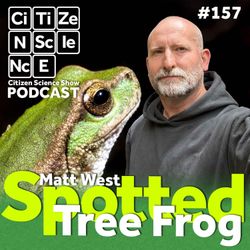
157. #157 Saving the Spotted Tree Frog with Matt West
37:11||Season 4, Ep. 157Matt West has spent much of his life wading through the cold mountain streams of northeast Victoria in search of a frog few Australians will ever encounter. The spotted tree frog, Litoria spenceri, is small enough to sit on a thumb, yet its survival has become one of the most complex conservation challenges in the country.The spotted tree frog inhabits granite boulder streams stretching from Lake Eildon in Victoria to Kosciuszko National Park in New South Wales, breeding in fast-flowing waterways between 300 and 1,100 metres elevation. Males grow to about 35 millimetres, females to 50. Their colouring ranges from bright green with gold flecks to mottled brown. In stable environments they can live for well over a decade. Stability, however, has become increasingly rare.Photography Credit: Michael Williams. It's a Wildlife.More Informationhttps://wildresearch.com.au/https://findanexpert.unimelb.edu.au/profile/768810-matt-westhttps://www.zoo.org.au/https://australiantroutfoundation.com.au/https://www.nativefish.asn.au/https://taungurung.com.au/https://www.ddac.net.au/If you enjoy this podcast, please like and subscribe to our show wherever you get your podcasts.Leave us a review and share this show with your friends.It really helps us to reach more citizen scientists, like you.Contact the ShowWe are always looking for more guests to tell us about interesting citizen science projects, research and events.You can email us at: info@citizenscienceshow.com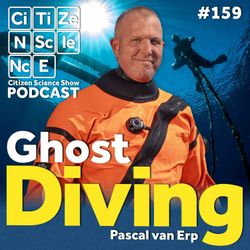
159. #159 Diving Into the Silent Threat Beneath Our Oceans with Pascal van Erp
36:47||Season 4, Ep. 159Pascal van Erp has spent years descending into waters most people will never see, uncovering a hidden layer of destruction far removed from the image of pristine marine environments. Beneath the surface, he regularly encounters lost fishing gear—nets, lines, and cages that continue to trap and kill marine life long after they have been abandoned. This reality led him to establish Ghost Diving, an organisation that has grown into a global network of seventeen chapters and more than five hundred volunteer divers.The organisation’s expansion has never been forced. Instead, technical diving teams from around the world approach Ghost Diving, motivated to apply their advanced skills to environmental work. This organic growth has led to strong chapters in countries such as Korea, Germany, the United States, and the Netherlands. Other regions, including Australia, remain without a chapter simply because no local team has yet stepped forward.The work itself demands a high level of expertise. Pascal emphasises that removing ghost nets is both complex and dangerous, requiring divers trained in deep diving, decompression, and managing multiple tasks simultaneously. In these operations, diving must become second nature so that the focus can remain entirely on the removal of hazardous debris.More Informationhttps://www.ghostdiving.org/https://www.ghostdiving.org/our-mission/https://www.ghostdiving.org/chapters/global/https://www.ghostdiving.org/chapters/https://www.ghostdiving.org/partners/https://www.ghostdiving.shop/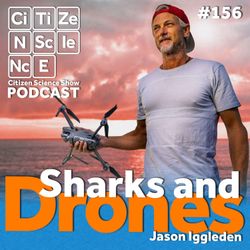
156. #156 From Builder to Beach Guardian: How a Drone Changed Jason’s Life Above Bondi
30:36||Season 4, Ep. 156Eight years ago, Jason Iggleden was working as a builder, swinging tools and searching for something that would make him want to jump out of bed each morning. He still works in construction today, but back then he was looking for a shift in direction. Almost on impulse, he bought a drone and decided to create an app. There was no detailed business plan, just a desire to build something meaningful and help people along the way. That decision would end up reshaping his life.He launched what became known as the Drone Shark app. It was expensive to develop and eventually too costly to maintain, and it is no longer available in the App Store. In the early days, Jason flew drones each morning with a couple of his carpenters, trying to capture footage for the app. Progress was slow until someone suggested Instagram. He barely knew what the platform was at the time. Once he began posting there, momentum built quickly. Audiences connected with the footage, his live commentary evolved naturally, and a global community began forming around his aerial view of Bondi.What started as simple ocean filming soon became something more detailed. Jason began noticing individual animals and recurring behaviours. He gave them names—Alex the seal, Homer the hammerhead, Nelly the grey nurse shark with scoliosis, Sunny the sunfish, and Dolly the dolphins. Naming them helped audiences form emotional connections. Instead of seeing an anonymous shark, viewers saw a character. That shift, Jason believes, encourages people to care.More Informationhttps://www.youtube.com/@DroneSharkApphttps://www.facebook.com/dronesharkapp/https://www.instagram.com/stories/dronesharkapp/https://www.mdpi.com/about/journalshttps://sarahhatherley.com/portfolio_page/shark-bait-teaser/If you enjoy this podcast, please like and subscribe to our show wherever you get your podcasts.Leave us a review and share this show with your friends.It really helps us to reach more citizen scientists, like you.Contact the ShowWe are always looking for more guests to tell us about interesting citizen science projects, research and events.You can email us at: info@citizenscienceshow.com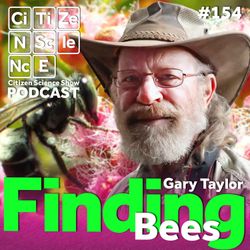
154. #154 The Bush Naturalist Who Gave Australia a New Bee: Gary Taylor
28:48||Season 4, Ep. 154Gary Taylor has always felt most at home in the bush. Long before native bees became his focus, he was a child wandering through scrub and creek beds, watching everything that moved. His father shaped that way of seeing. He spoke about trees, spiders and insects as if they were old friends. Nothing was to be squashed or dismissed. Every creature simply wanted to get back to its companions. That quiet respect settled into Gary early and never left.In a patch of bush he calls his bee paradise, Gary noticed a large male Stenotritus with a reddish tuft at the end of its abdomen. Australia’s Stenotritidae are found nowhere else in the world, and with only a small number of known species, the difference stood out. After sharing photographs with Dr Megan Halcroft, he was connected with entomologist Terry Houston. The following season, specimens were collected and subjected to months of detailed measurement and description. The result was confirmation of a new species: Stenotritus taylori. Having an Australian native bee named in his honour remains one of Gary’s proudest achievements.More Informationhttps://ausemade.com.au/blog/If you enjoy this podcast, please like and subscribe to our show wherever you get your podcasts.Leave us a review and share this show with your friends.It really helps us to reach more citizen scientists, like you.Contact the ShowWe are always looking for more guests to tell us about interesting citizen science projects, research and events.You can email us at: info@citizenscienceshow.com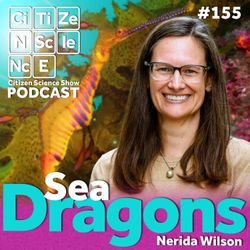
155. #155 Seadragons, DNA and the Power of Citizen Science
32:48||Season 4, Ep. 155Dr Nerida Wilson has dedicated much of her career to understanding some of Australia’s most unusual marine life. As manager of Seadragon Search, she has brought together genetics, photography and citizen science to reveal new insights into one of the country’s most iconic underwater species.Although seadragons are displayed in aquariums around the world, they are found only in Australian waters. Nerida’s research even led to the extraordinary discovery of a new species, the ruby seadragon. The first evidence did not come from a diver’s sighting but from an unusual string of DNA letters that failed to align with known species. That anomaly proved to represent an entirely new seadragon.Seadragon Search emerged from genetic fieldwork. While collecting small tissue samples, Nerida and her team photographed each animal to ensure they did not resample the same individual. They realised that every seadragon carries unique markings. Weedy seadragons can be identified by their spot patterns, while leafy seadragons display distinctive bars and stripes. Today, artificial intelligence helps narrow down possible matches, but a human reviewer makes the final confirmation.More Informationhttps://seadragonsearch.org/If you enjoy this podcast, please like and subscribe to our show wherever you get your podcasts.Leave us a review and share this show with your friends.It really helps us to reach more citizen scientists, like you.Contact the ShowWe are always looking for more guests to tell us about interesting citizen science projects, research and events.You can email us at: info@citizenscienceshow.com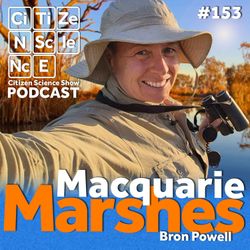
153. #153 Paddling for the Marshes: Standing Guard Over an Inland Wetland with Bron Powell
33:23||Season 4, Ep. 153Each spring, Bron Powell returns to a vast inland wetland in north-west New South Wales, drawn by reeds taller than a person, restless bird colonies and the quiet pulse of water spreading across flat country. The Macquarie Marshes have become both her workplace and her teacher, a place where kayaking and conservation meet in practical and purposeful ways.Bron first discovered the Marshes nineteen years ago after moving from the Blue Mountains to Dubbo. She had only vaguely heard of them. With almost no public access, she could glimpse little more than reeds from the roadside, yet even that partial view was enough to spark something deeper. She had always considered herself an environmentalist. Once kayaking entered her life, the connection felt inevitable. Through volunteering and later working with National Parks, she began exploring further, building knowledge season by season until guiding others through the wetlands became the natural next step.The site was Ramsar-listed in 1986 for its international importance. In flood years, tens of thousands of Straw-necked Ibis nest shoulder to shoulder in extraordinary colonies. Spoonbills, egrets and herons join them. Migratory birds arrive from as far as Russia and Japan, while nomadic Australian species track water across the continent. Even outside major floods, Magpie Geese and Brolga breed here when conditions allow. It is a system that expands and contracts with rainfall, usually retaining a semi-permanent watery core, though the 2017 to 2019 drought pushed it to the brink.More Informationhttps://www.macquariemarsheskayaktours.com.au/https://www.nature.org.au/https://healthyriversdubbo.com/https://www.flow-mer.org.au/area-pages/macquarie-river-and-marshesIf you enjoy this podcast, please like and subscribe to our show wherever you get your podcasts.Leave us a review and share this show with your friends.It really helps us to reach more citizen scientists, like you.Contact the ShowWe are always looking for more guests to tell us about interesting citizen science projects, research and events.You can email us at: info@citizenscienceshow.com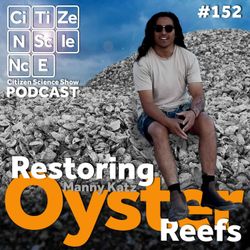
152. #152 Restoring Australia’s Lost Oyster Reefs with Manny Katz
27:44||Season 4, Ep. 152Two hundred years ago, South Australia’s coastline was edged not just by sandy beaches and rocky headlands, but by vast shellfish reefs stretching for thousands of kilometres. In South Australia alone, native oyster beds extended roughly 1,500 kilometres. Nationally, they spanned an estimated 8,000 kilometres—almost twice the length of the Great Barrier Reef. Today, less than one percent of those ecosystems remain intact.Manny Katz is working to bring them back.Manny serves as Director of EYRE Lab, an environmental charity focused on restoration ecology, and he runs a dive shop in Whyalla. Through tourism, diving, and the Reef Ramble podcast, he connects communities with marine science. At the centre of his work is a commitment to rebuilding reefs that once filtered the sea, sheltered marine life, and stabilised coastlines.More Informationhttps://www.eyrelab.org/https://www.facebook.com/eyrelabIf you enjoy this podcast, please like and subscribe to our show wherever you get your podcasts.Leave us a review and share this show with your friends.It really helps us to reach more citizen scientists, like you.Contact the ShowWe are always looking for more guests to tell us about interesting citizen science projects, research and events.You can email us at: info@citizenscienceshow.com