Share
Citizen Science Show
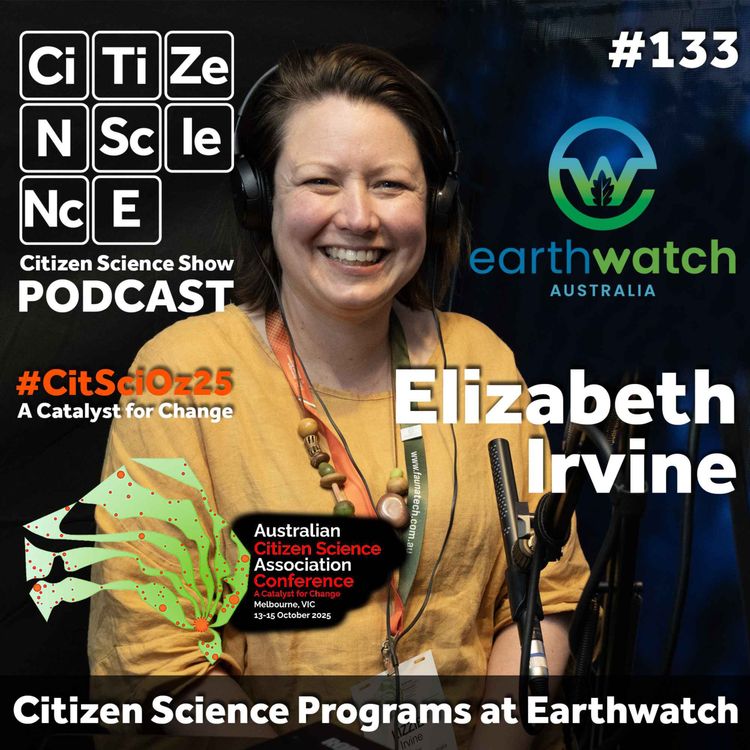
#133 Connecting Communities With Science Through Earthwatch Australia | Elizabeth Irvine
Speaking with Elizabeth Irvine at CitSciOz25 revealed just how much energy is driving the next chapter of citizen science in Australia.
Even midway through the conference the enthusiasm was palpable, and hearing her perspective on Earthwatch Australia’s programs showed why so many people feel inspired.
As Head of Programs, she sees firsthand how community engagement shapes the organisation’s work and how citizen scientists help tackle major environmental challenges.
More Information
https://citizenscience.org.au/citscioz25/
About The Citizen Science Show Podcast
This episode of the Citizen Science Show podcast is coming to you from CitSciOz25 the Australian Citizen Science Association conference, in Melbourne Connect, a world-class innovation precinct at The University of Melbourne.
If you enjoy this content, please like and subscribe to our show wherever you get your podcasts. It really helps us to reach more citizen scientists, like you.
Contact the Show
We are always looking for more guests to tell us about interesting citizen science projects, research and events.
You can email us at: info@citizenscienceshow.com
More episodes
View all episodes
139. #139 Restoring Coral Reefs Through Collective Action with Alicia McArdle
45:59||Season 3, Ep. 139Alicia McArdle’s work in conservation has been shaped by community from the beginning.Early in her career, not long after university, she was employed by Save Our Waterways in Brisbane, helping coordinate a project to restore an entire creek system. Local residents carried deep knowledge of their waterways, and working alongside them showed her how powerful citizen-driven stewardship can be.That experience stayed with her, just as her first sight of the Great Barrier Reef at age twelve on Green Island did.The colours, marine life and the fleeting shock of spotting a moray eel set her on a path toward marine biology.More Informationhttps://citizensgbr.org/If you enjoy this content, please like and subscribe to our show wherever you get your podcasts.Leave us a comment and share this show with your friends.It really helps us to reach more citizen scientists, like you.Contact the ShowWe are always looking for more guests to tell us about interesting citizen science projects, research and events.You can email us at: info@citizenscienceshow.com
138. #138 Exploring Breathing Caves that Preserve in Stone, Charcoal and Silence.
44:32||Season 3, Ep. 138Clare Buswell’s career weaves together political science, cultural history, and speleology in a way that makes perfect sense once she begins to explain it.Her early academic work on colonial gender dynamics in Kenya led her to examine cultural interpretations, dreamings and social relationships—perspectives that later helped her understand the significance of Australia’s karst landscapes and the First Nations stories etched into them.For Clare, the subterranean world reflects the same human and environmental connections found above ground, only preserved in stone, charcoal and silence.More Informationhttps://caves.org.au/If you enjoy this content, please like and subscribe to our show wherever you get your podcasts.Leave us a comment and share this show with your friends.It really helps us to reach more citizen scientists, like you.Thumbnail Photo Credits:Mr Neville SkinerClare BuswellContact the ShowWe are always looking for more guests to tell us about interesting citizen science projects, research and events.You can email us at: info@citizenscienceshow.com
137. #137 Australian Museum Champions Citizen Science Through Innovative Programs with Paul Flemons
19:28||Season 3, Ep. 137At the Australian Museum, citizen science has grown from a niche concept into a vibrant, community-driven force.Managing the Centre for Citizen Science, Paul Flemons oversees three major programs that have transformed how the public engages with scientific research.Frog ID is perhaps the most familiar, inviting thousands to record and monitor frogs across Australia.DigiVol allows volunteers to digitize invaluable collections from institutions worldwide, including natural history, cultural artifacts, and council libraries, from the comfort of their homes.Australasian Fishes collects data on fish distributions, helping to track environmental changes and shifts in ocean temperatures.More Informationhttps://australian.museum/get-involved/citizen-science/volunteer-with-us/https://citizenscience.org.au/citscioz25/About The Citizen Science Show PodcastThis episode of the Citizen Science Show podcast is coming to you from CitSciOz25 the Australian Citizen Science Association conference, in Melbourne Connect, a world-class innovation precinct at The University of Melbourne.If you enjoy this content, please like and subscribe to our show wherever you get your podcasts. It really helps us to reach more citizen scientists, like you.Contact the ShowWe are always looking for more guests to tell us about interesting citizen science projects, research and events.You can email us at: info@citizenscienceshow.com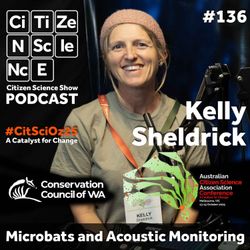
136. #136 Listening to Bats in the Night: Citizen Scientists Reveal the Lives of Perth’s Microbats with Kelly Sheldrick
21:33||Season 3, Ep. 136Kelly Sheldrick has been working with communities across Perth to uncover the hidden world of the region’s tiny microbats—animals so small and quiet that most people never realise they are part of the local landscape.Through her projects with the Conservation Council of Western Australia, volunteers use active acoustic detectors along transects in City of Wanneroo bushland, watching echolocation calls appear on screens while listening to slowed-down chirps.This real-time sensory experience often transforms how participants think about bats, shifting them from distant concepts to lively nocturnal neighbours.More Informationhttps://www.ccwa.org.au/bat_monitoring_programhttps://citizenscience.org.au/citscioz25/About The Citizen Science Show PodcastThis episode of the Citizen Science Show podcast is coming to you from CitSciOz25 the Australian Citizen Science Association conference, in Melbourne Connect, a world-class innovation precinct at The University of Melbourne.If you enjoy this content, please like and subscribe to our show wherever you get your podcasts. It really helps us to reach more citizen scientists, like you.Contact the ShowWe are always looking for more guests to tell us about interesting citizen science projects, research and events.You can email us at: info@citizenscienceshow.com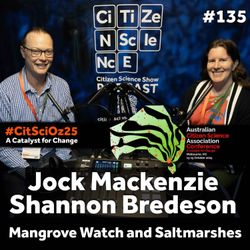
135. #135 Community Power Driving New Momentum for Australia’s Mangroves with Jock Mackenzie and Shannon Bredeson
22:48||Season 3, Ep. 135I met Jock Mackenzie at the CitSciOz25 conference in Melbourne, where he spoke about Mangrove Watch and his role as Senior Program Manager for wetlands, coastal and marine environments at Earthwatch Australia.He founded Mangrove Watch in 2008 in response to declining mangrove and saltmarsh health, and he explained how these tidal-zone trees protect fisheries, store carbon, filter water and shield the reef, all while remaining extremely vulnerable to climate change.Australia hosts about forty-six mangrove species, more than half the global total, and citizen scientists continue to make surprising discoveries, including the critically endangered Bruguiera hainesii found in Cairns—one of only about two hundred individuals in the country.Later I spoke with Shannon Bredeson from CAFNEC, who explained how the local action plan model emerged in 2022 after communities asked for ways to act on the problems they were documenting.Workshops brought together scientific findings and community knowledge, and participants voted on which threats to address first. Some projects are simple to launch, such as the Mulgrave catchment’s education program linking students with the mangroves that surround them.Others are more complex, like the Hinchinbrook plan using drone surveys and coastal engineers to design erosion control structures along the Cardwell foreshore. Initial seed funding of about seven thousand dollars helped early projects take off, and additional support comes through the Great Barrier Reef Foundation.More Informationhttps://earthwatch.org.au/research/mangrovewatch-community-eventshttps://citizenscience.org.au/citscioz25/About The Citizen Science Show PodcastThis episode of the Citizen Science Show podcast is coming to you from CitSciOz25 the Australian Citizen Science Association conference, in Melbourne Connect, a world-class innovation precinct at The University of Melbourne.If you enjoy this content, please like and subscribe to our show wherever you get your podcasts. It really helps us to reach more citizen scientists, like you.Contact the ShowWe are always looking for more guests to tell us about interesting citizen science projects, research and events.You can email us at: info@citizenscienceshow.com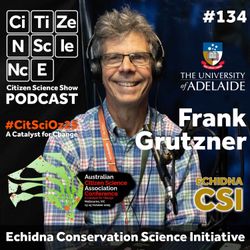
134. #134 Echidna CSI and the Expansion of Citizen Science in Australia with Professor Frank Grutzner
24:21||Season 3, Ep. 134At CitSciOz25, Frank Grutzner reflected on how far echidna research has progressed and how crucial community involvement has become to that progress.As a genetics professor at the University of Adelaide, Frank focuses on the DNA of Australia’s native species.When he arrived in the country 25 years ago, he quickly became fascinated by the platypus and echidna.Their biology is unlike that of any other mammals, yet studying them in the field is notoriously difficult.Frank often jokes that he could spend an entire day searching without success, only to find an echidna digging up his backyard when he returned home.More Informationhttps://www.adelaide.edu.au/environment/research/diversifying-citizen-science-and-public-engagment/echidna-csihttps://citizenscience.org.au/citscioz25/About The Citizen Science Show PodcastThis episode of the Citizen Science Show podcast is coming to you from CitSciOz25 the Australian Citizen Science Association conference, in Melbourne Connect, a world-class innovation precinct at The University of Melbourne.If you enjoy this content, please like and subscribe to our show wherever you get your podcasts. It really helps us to reach more citizen scientists, like you.Contact the ShowWe are always looking for more guests to tell us about interesting citizen science projects, research and events.You can email us at: info@citizenscienceshow.com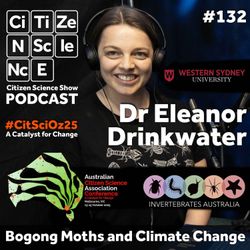
132. #132 Following the Amazing Flight of the Bogong Moth with Dr Eleanor Drinkwater
22:07||Season 3, Ep. 132At CitSciOz25, I found myself immersed in the world of bogong moths with Dr Eleanor Drinkwater, whose enthusiasm for these small, unassuming insects is contagious.She explained how these moths, despite their size, undertake one of the longest insect migrations on the planet.They emerge in northern New South Wales and travel hundreds or even thousands of kilometres to the Snowy Mountains, where they crowd into caves and aestivate through the hottest months before returning as temperatures fall.More Informationhttps://www.bogong.org/https://www.eleanordrinkwater.com/https://invertebratesaustralia.org/https://mothtracker.swifft.net.au/https://citizenscience.org.au/citscioz25/About The Citizen Science Show PodcastThis episode of the Citizen Science Show podcast is coming to you from CitSciOz25 the Australian Citizen Science Association conference, in Melbourne Connect, a world-class innovation precinct at The University of Melbourne.If you enjoy this content, please like and subscribe to our show wherever you get your podcasts. It really helps us to reach more citizen scientists, like you.Contact the ShowWe are always looking for more guests to tell us about interesting citizen science projects, research and events.You can email us at: info@citizenscienceshow.com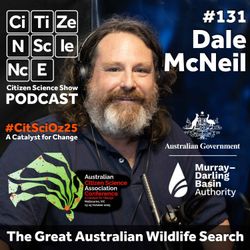
131. #131 Mapping the Hidden Life of the Murray–Darling Through Community Hands | Dale McNeil
20:42||Season 3, Ep. 131Presenting at CitSciOz25 gave me the chance to share a project that has reshaped how I think about science, trust and the way people connect with their local environment.The Great Australian Wildlife Search began as a collaboration between the Murray–Darling Basin Authority, the Odonata Foundation and EnviroDNA, but it quickly grew into something far bigger once communities stepped in.Our aim was simple: gather a broad biodiversity snapshot across the vast Murray–Darling Basin using environmental DNA and the enthusiasm of people who know their waterways best.More Informationhttps://www.mdba.gov.au/https://citizenscience.org.au/citscioz25/About The Citizen Science Show PodcastThis episode of the Citizen Science Show podcast is coming to you from CitSciOz25 the Australian Citizen Science Association conference, in Melbourne Connect, a world-class innovation precinct at The University of Melbourne.If you enjoy this content, please like and subscribe to our show wherever you get your podcasts. It really helps us to reach more citizen scientists, like you.Contact the ShowWe are always looking for more guests to tell us about interesting citizen science projects, research and events.You can email us at: info@citizenscienceshow.com