Share
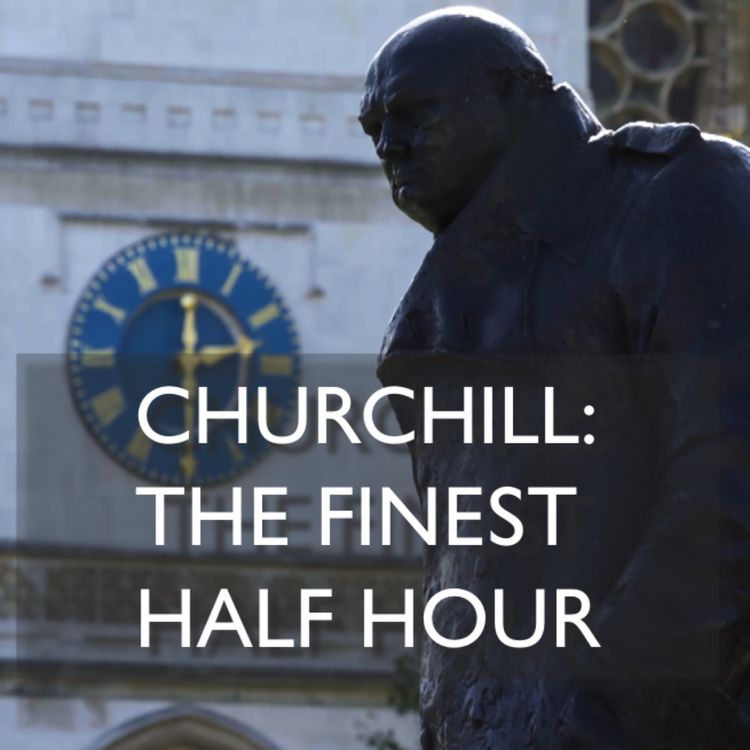
Churchill: The Finest Half Hour
Series 2: Disaster and Defiance Episode 4
Season 2, Ep. 4
•
It's early June 1940. Though the Nazi invasion of France continues to progress at speed, Winston Churchill remains determined to keep France in the war.
Professor Richard Toye and Dr. Warren Dockter discuss whether, when Churchill said "We shall never surrender", he was actually referring to Britain and France.
And they explore Churchill's frantic efforts to sustain morale within the French government, making two dramatic flights o France in 48 hours.
More episodes
View all episodes
4. Series 15: Churchill and the Navy Episode 4
27:51||Season 15, Ep. 4The dramatic fall of France in the summer of 1940 did not only upend the balance of power in Europe. It transformed the global war at sea.With the French navy out of the war and the Italians joining the conflict, the Axis powers controlled the Mediterranean.German U-boats could operate from French coastal ports.And the Nazis might seize the impressive French fleet and turn it against Britain.Professor Richard Toye and Dr. Warren Dockter discuss all the naval consequences of the fall of France and how it led to what Winston Churchill called "a hateful decision...the most unnatural and hateful in which I have ever been concerned."
3. Series 15 Churchill and the Navy Episode 3
31:42||Season 15, Ep. 3A fiscally orthodox Chancellor anxious to balance the British budget, who resisted the demands of navy chiefs for more ships with bigger guns?A prophet crying in the wilderness, calling for rearmament and fiercely criticising agreements which accomodated the naval ambitions of Nazi Germnany?Or a returning hero, back in post in control of the world's largest fleet?As Professor Richard Toye and Dr. Warren Dockter explain in this episode, in the space of 15 years, Winston Churchill was all three.
2. Series 15: Churchill and the Navy Episode 2
30:05||Season 15, Ep. 2In not much more than 18 months, Winston Churchill experienced disappointment, success and disaster as the political head of the Royal Navy.Professor Richard Toye and Dr. Warren Dockter explore this dramatic period and how Churchill took the blame for a plan he hoped would alter the course of the war but instead changed the course of Churchill's career. And not in a good way...
1. Series 15: Churchill and the Navy Episode 1
28:40||Season 15, Ep. 1In 1911, Winston Churchill was appointed First Lord of the Admiralty. The minister in charge of the Royal Navy, the most powerful sea force on Earth.Professor Richard Toye and Dr. Warren Dockter explain how Churchill threw himself into the task, modernising the fleet and the conditions of its servicemen, challenging naval traditions which he dismissed as "rum, sodomy and the lash".And they show how Churchill's efforts meant that when war came in 1914, the navy was ready.
2. Series 14: Churchill and The Bomb Episode 2
30:32||Season 14, Ep. 2What strategic and political potential did Churchill see in America possessing the atomic bomb when the Soviet Union did not?Did he really raise the idea of a nuclear attack on Moscow?How did his views change once the Russians created their own nuclear weapons?And why did he come to accept the idea of mutually assured destruction , that security must be "the twin brother of annihilation".Join Professor Richard Toye and Dr. Warren Dockter for some explosive answers.
1. Series 14: Churchill and The Bomb Episode 1
28:32||Season 14, Ep. 1Professor Richard Toye and Dr. Warren Dockter explore the dramatic and fascinating story of Winston Churchill's invovlement in the development and deployment of the atomic bomb.How in the 1920s, reflecting his interest in science and science fiction, Churchill speculated on the possibilities of a super weapon which could destroy whole cities.Churchill's backing for the creation of an atomic device by British scientists as early as 1941.His decision to cede control of the manufacture of the bomb to the United States given its vastly greater industrial capacity.But how Churchill also obtained US agreement that the bomb was a joint project. And therefore was required to give his permission before the bomb was used against Japan in 1945.
2. Series 13: Churchill and Europe Episode 2
29:25||Season 13, Ep. 2In September 1946 in Zurich, Winston Churchill delivered one of the most resonant speeches of even his long career.He called for the creation of "a kind of United States of Europe". A new Europe founded on the partnership of France and Germany, two nations which had been enemies in two brutal wars in Churchill's adult life. And he concluded with the rousing words: "Let Europe arise!"Professor Richard Toye and Dr. Warren Dockter delve into the background to the speech and assess its impact, while asking what role Churchill saw for Britain in the new Europe he aspired to see come into being.
3. Series 13: Churchill and Europe Episode 3
32:15||Season 13, Ep. 3Professor Richard Toye and Dr. Warren Dockter look at how Churchill's government of 1951-55 handled relations with post-war Europe - and then offer some informed speculation on what remains a hot topic.When the British people voted to Leave or Remain in the European Union in the referendum of 2016, what would Winston have done?
1. Series 13: Churchill and Europe Episode 1
27:37||Season 13, Ep. 1Winston Churchill's views on Europe remain highly contested. In referenda on Britain's relationship with Europe in 1975 and 2016, both opposing sides claimed to be following Churchill's outlook.Now Professor Richard Toye and Dr Warren Dockter explore the long and evolving story of Churchill and Europe, taking in his formative years in the heyday of the British Empire, the aftermath of the Great War and the creation of the League of Nations, the rise of Nazism - and even Churchill's support for uniting Britain and France in the very darkest days of 1940.