Share

Chatting GPT
The Web Is Being Componentised
In January 2026, Google was granted a patent that lets it read your website, break it into components, and serve searchers an AI-generated page assembled from your content. Visitors may never see your actual site. Joe Toscano — former Google designer, one of the voices in The Social Dilemma, and founder of Service Stories — saw this coming.
Joe left Silicon Valley in 2017, before Cambridge Analytica broke, because of what he was being asked to build. He now runs Service Stories, which helps small and mid-size service businesses get found by AI search engines by converting their existing work orders and job data into content — automatically. Early results from their pilots show direct web traffic growth of 228% within 90 days, and over 400% across longer periods.
The shift that makes this possible: search is moving from "plumber near me" to "why is my HVAC system creating complications in my house?" Topical authority — specific, question-answering content — is now the edge, and AI makes it viable to produce at scale for the first time.
He also just returned from two months in China — and his account of robots delivering room service in three minutes, seamless phone-based identity and payments, and a level of operational fluency the West hasn't reached yet is genuinely uncomfortable for anyone who assumes Europe's regulatory caution is the only sensible posture.
A sharp, grounded episode on where search is going, what China is building, and what AGI actually looks like when it arrives.
Find Joe and a step-by-step guide to doing this yourself at servicestories.com.
More episodes
View all episodes

9. Stop Redacting. Switch to Claude Teams.
15:38||Season 8, Ep. 9If you are on Claude Pro and you have been stripping client details out of every document before you paste it, this one is for you.Emma Marlow and Beau Warren are both on the AI Institute team and today they came on to reflect with Maryrose about their experience moving the organisation off Pro. In August they moved the whole organisation off individual Pro accounts and onto a Claude Teams account, in four weeks, while everybody carried on working. Asked for one word on how the redacting had felt, the answers were "slow", "a burden" , and "made me nervous".They tell Maryrose Lyons why they treated it as a change project rather than an IT one, and set out the three roles they say you need before you move anything: ideas from the bottom, a named product owner at the top, and champions in the middle.Plus the button that does not exist, and the one thing a Teams account will not let you do.HOW THEY DID IT• Name a product owner on day one. Emma's rule: somebody owns that tool for its whole life in the organisation. Ideas come from the bottom, scaling responsibly comes from the top, and the product owner is how the second half actually happens.• Champions in the middle. Beau's third role, and the one most organisations skip.• Three people, one word each. Asked how redacting every sensitive document by hand felt: slow, so burdened, actually nervous. Nobody had raised it, because nobody thought it was wrong.• Treat it as a change project, not an IT one. Project plan, a responsibility matrix, one channel for the whole conversation, and personalisation settled before any data moved. Four weeks, in August, alongside the day job.LINKSAnthropic's trust centre, where the compliance documents live: https://trust.anthropic.com/Claude AI Skills, our course for people who moved across and never got shown the good bitsAll AI Institute coursesEmma Marlow LinkedlnBeau Warren LinkedlnABOUT CHATTINGGPTHosted by Maryrose Lyons, founder of AI Institute, talking to people actually implementing AI in their work.
8. They Hired you for your Taste
33:04||Season 8, Ep. 8Everyone hired you for your taste and experience. You just forgot that, and started believing the job was knowing the software.Kevin Surace holds 95 worldwide patents and built the first human-like virtual assistant in the late 1990s, decades before Siri or Alexa. His new book, The Joy-Success Cycle, carries a foreword from Goldie Hawn and argues that joy comes before success rather than as its reward.He tells Maryrose Lyons why he does not open Excel to build a spreadsheet, what happened when he pointed a model at a folder of raw video and it offered to edit the film itself, and why he thinks software interfaces disappear once a model has learned the file format underneath them.For architects, engineers, and anyone whose value feels bound up in a tool they spent years learning.ABOUT KEVINInventor and entrepreneur with 95 worldwide patents. Built the first human-like virtual assistant in the late 1990s, decades before Siri or Alexa. His book The Joy-Success Cycle has a foreword by Goldie Hawn.WHAT YOU GET OUT OF IT• They hired you for your taste. Describe a building in natural language and the drawings, measurements and fire requirements come back done. Kevin's point is that this was never where an architect's value sat. 'Nobody cares how long it takes you to get that hallway right in AutoCAD.'• One complaint a day. Count every negative thought tomorrow from the moment you get up. Most people reach 60 or 80. From the day after, you get one, and that is your lot.• Joy comes first, not after. We are taught that joy arrives once you are successful. Kevin argues it runs the other way, and that joy is what produces the curiosity the success comes out of.• He does not open Excel. For a spreadsheet he goes to Claude or Gemini first, and opens Excel only because he has to share the file. That is what he means by AI first.• It edited the video on its own. He pointed a model at a folder of raw footage and asked for a storyline. It came back with the storyline, then offered to edit the film, music and voiceover included.LINKSKevin on LinkedIn, where he posts daily.The Joy-Success Cycle bookKevin's siteAI Institute courses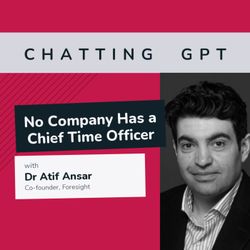
7. No Company Has a Chief Time Officer
32:28||Season 8, Ep. 7Every company has a CFO. Almost none has anyone whose job is time.Dr Atif Ansar has spent fifteen years at Oxford measuring what happens to the world's biggest projects between the promise and the ribbon cutting. Dams that double their budget. Rail lines that spend four years building a schedule and open four years late. And an uncomfortable finding: the countries famous for building well suffer the same overruns as everyone else.His argument is that we have built an entire profession around controlling cost while leaving time almost ungoverned. There is no double-entry accounting for time. Nobody invoices for it. Yet time is the scarcer commodity, and it is far easier to measure than money.He talks about where AI genuinely changes this and where it is still a slide in a pitch deck, why he thinks contracts should guarantee a maximum time rather than a maximum price, and what that would do to professional indemnity.Plus a question from an architect in Dublin that almost nobody in the industry wants to answer out loud.Guest BioDr Atif Ansar is co-founder and executive chairman of Foresight, an Oxford-based platform that uses AI to forecast and accelerate delivery on major capital projects. He is also an academic at the University of Oxford's Saïd Business School, where he has worked since 2006. For fifteen years he and his colleagues have studied why megaprojects, anything costing roughly a billion euros or more, come in late and over budget.Show NotesThe most expensive belief in the built environment: that your estimate at final investment decision is what you will actually payHow the Oxford team measures overruns, using approved budgets at the start and national audit reports at the endWhy dams double their budgets, rail runs about thirty per cent over, and the Olympics almost never run lateWhy being good at building does not save you, from Berlin Airport to Stuttgart stationTactical AI, which is everywhere, against strategic AI, which takes executive courageThe Hong Kong rail line that spent four years building a schedule and opened four years lateThink slow, act fast, and why organisations that intend to think slowly still fail at itThe chief time officer: no double-entry accounting for time, no invoicing for it, no governance around itGuaranteed maximum time contracts instead of guaranteed maximum price, and what that does to professional indemnityA Dublin architect's question: if AI halves the hours, does the fee drop?The semiconductor fab leader who stopped design at 30, 60 and 90 per cent, and what AI would change about itWhere to start on Monday: find your time data, index it weekly, and take small variances seriouslyGuest LinksDr Atif Ansar on LinkedIn: https://uk.linkedin.com/in/dr-atif-ansar-940bab1Foresight: https://www.foresight.worksAtif Ansar at Oxford Saïd Business School: https://www.sbs.ox.ac.uk/about-us/people/atif-ansarResources MentionedDaniel Kahneman, Nobel Prize in Economic Sciences 2002: https://www.nobelprize.org/prizes/economic-sciences/2002/kahneman/facts/Bent Flyvbjerg, How Big Things Get Done, where think slow, act fast is set out: https://sites.prh.com/how-big-things-get-done-bookKathleen Eisenhardt, Stanford, on information intensity and velocity: https://profiles.stanford.edu/kathleen-eisenhardtClayton Christensen, Harvard Business School: https://www.hbs.edu/news/releases/Pages/clayton-christensen-obituary.aspxUK National Audit Office: https://www.nao.org.ukOracle Primavera P6: https://www.oracle.com/construction-engineering/primavera-p6/Toyota Production System, covering the and on cord: https://global.toyota/en/company/vision-and-philosophy/production-system/index.html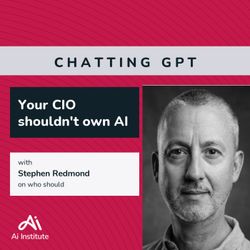
6. Your CIO Shouldn't Own AI
20:28||Season 8, Ep. 6Handing the AI programme to the CIO is the obvious move, and Stephen Redmond thinks it is the wrong one. AI is more than a technology rollout. It changes decision rights, it crosses every function from supply chain to sales, and it does not give the same answer twice, none of which sits comfortably inside IT.Stephen founded Straitéis AI and has written two books on AI leadership. He makes the case for a Chief AI Officer reporting to the CEO, and explains why a fractional appointment often beats a permanent hire.We get into what that person should tackle first, the three skills the job needs, why the chief data officer matters more once your own documents are in play, and what paving a cow path has to do with any of it.Stephen is only the second guest this show has had back.SHOW NOTES:About StephenStephen on LinkedInHis books: Both titlesAI Bowling Bumpers, on governance, was still in final edit at recordingWhy giving AI to the technology lead is the natural mistakeThe three reasons AI does not belong in ITWhat a chief data officer actually does · The case for a chief AI officer ·Why fractional often beats a permanent hireThe first task is working out what the tasks arePaving a cow path · Why the outsider often sees it betterThe three skills a fractional AI leader needsHow the roles sit togetherThree books in under a yearThe EU AI Act, and why enforcement is not only a big-company problemResearch cite: BCG AI Radar 2026Regulation : EU AI Act, Regulation (EU) 2024/1689Transparency obligations discussed are Article 50, in effect since 2 August 2026Webinar, Thursday 17 September, lunchtime, 45 min : RegisterAI Institute
5. Shadow AI and the fine for panicking
33:35||Season 8, Ep. 5What actually happens when your team uses AI to write a blog post, a tender or a report, and does the law now care? Alan Thornton, founder of the AI governance platform Tipcan Solutions, joins Maryrose Lyons to make the EU AI Act genuinely usable for built environment professionals.Alan walks us through the the latest requirement in EU AI Act compliance that is labelling. If you're using AI and sharing certain types of text content now you must label it, but not all content. A general design blog is fine. A glowing piece about a local councillor is not, unless a named human takes responsibility for it. That idea, that every firm must have real accountability runs through the whole conversation.From there: shadow AI and where the risk really hides, how to properly inventory your AI use cases, and the fines that now apply, including a sneaky second one for handing a regulator incomplete information in a panic. Alan and Maryrose also get into what 'high risk' means once CE marks and national sandboxes enter the picture, and why Ireland's oddly fragmented approach to enforcement is worth watching.Practical, occasionally very funny, and refreshingly free of scaremongering.Show notes:Shadow AI, and why the biggest risk is often the staff member you least suspectThe four risk levels, and why most firms sit in the "limited risk" transparency bandThe public-interest test: one blog post needs an AI label, a near-identical one does notThe release valve, how genuine human oversight makes the labelling duty easeHow to properly inventory your AI use cases, and why a spreadsheet will not cut itThe fines that now apply, including a second, sneakier one for panicking under pressureWhat "high risk" really means, once CE marks and national sandboxes enter the pictureWhy Ireland's fragmented approach to enforcement is worth watchingThe one thing every firm can do this week to get on the right side of the ActAlan Thornton on LinkedIn: https://www.linkedin.com/in/alan-thornton/Tipcan SolutionsEU AI Act · Article 50, transparency · Article 99, penaltiesISO/IEC 42001 (AI management systems)CE marking (EU)RICS AI standard (in force 9 March 2026)UK Data (Use and Access) Act 2025Ireland's EU AI Act implementationWe are AI InstituteJoin us o 17 September for a webinar on: The EU AI Act, your staff, your risk: ignorance is no defenseRegister now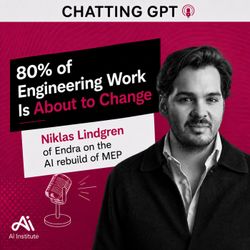
4. 80% of Engineering Work Is About to Change
19:48||Season 8, Ep. 4Andreessen Horowitz has a thesis that every building is still designed by software from the 1990s. Niklas Lindgren agrees, and he is building the company to change it. His claim is blunt: AI is about to change how 70 to 80% of the hours on an engineering project get done.Niklas is the founder and CEO of Endra, a Stockholm-based AI platform built specifically for mechanical, electrical and plumbing (MEP) engineers. While we don't normally have vendors on the podcast, we made an exception in this case because Endra looks like the Revit killer everyone's been waiting for after all these years. Andreessen Horowitz certainly seems to think so, having invested in the Swedish based AI start up. In this episode, Niklas walks Maryrose through why MEP has been so slow to change, why jobs are not disappearing even as the work transforms, how firms can build entirely new services on the back of AI, and why outsourced teams are the most exposed. He closes with the one practical step every engineering firm should take this week.A sharp, grounded conversation about the AI rebuild of the built environment, from someone doing it inside the largest firms in the industry.In this episodeWhy MEP engineering has barely changed since the 1990s, and the three layers of complexity that kept it stuckWhy Autodesk is a partner, not a competitorWhat Endra has learned from working with world-class engineering teamsWhy AI will change 70 to 80% of project hours, and why jobs are going nowhereThe new products and pricing firms can build on the back of AIWhy outsourced, commoditised work is the most exposedThe one practical step every engineering firm should take this weekWhy this is a people game that takes real time, not a quick pilotLinksEndra WebsiteNiklas Lindgren on LinkedIn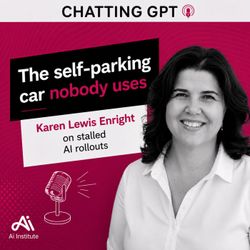
3. The self-parking car nobody uses
26:03||Season 8, Ep. 3Karen Lewis Enright is a change management professional with over 20 years of transformation experience across global organisations including Johnson & Johnson and Wipro. She holds a Masters in organisational psychology, but what makes her stand out is two decades spent helping leaders turn strategy into meaningful change. She specialises in AI strategy and is the first change management professional to join ChattingGPT.In this conversation, Maryrose and Karen get into the human side of AI adoption: how to lead when you're uncertain yourself, using the image of a slipping cup of coffee to explain where people's attention goes under stress, why the sceptics belong in the room alongside the enthusiasts, and how to build trust by being honest with people about what AI changes in how they work. Karen tells the story of a self-parking car that never gets used, a miniature version of every stalled AI rollout, and makes the case for celebrating the curious champions most organisations try to shut down.She talks through the change management tools she reaches for, from change agent networks on-site to reverse mentoring between graduate engineers and senior partners, to knowing when to pause a BIM rollout or a new tender process and let a stretched team catch up. She closes on the advice she keeps returning to: start with the why, and get the data, the governance and the change management right before you scale the technology across the practice.Connect with Karen Lewis Enright on LinkedIn.
2. RICS Says AI Literacy Isn't Optional
30:20||Season 8, Ep. 2Most of the AI conversation is a numbers game: licences bought, people "using AI", whether the firm has a strategy yet. James Garner thinks that is the wrong number to watch. The money is flowing and the strategies are written, but the thing almost no one is funding is capability — whether ordinary professionals can actually use the tools well. That gap, he argues, is widening, and it is where the real risk now sits.James is Head of AI at Gleeds, a Fellow of RICS, and co-founder of the Project Flux podcast. He has been a quantity surveyor since 1998, a profession he jokes you could pull someone into from 1890, give a day's training, and they would manage fine today — which is exactly what makes this moment different. He sat on the RICS working group behind its new responsible-AI standard, in force since March, which for the first time makes baseline AI literacy a requirement for every chartered surveyor, not a nice-to-have.James walks Maryrose through why an "AI strategy" that is not a business strategy powered by AI will fail, the difference between transparency and explainability (and why he prefers "bookending" to "human in the loop"), the model-cost reckoning coming for anyone on a flat monthly plan, and the eight Claude files every professional should set up to get real value from Claude Code. Along the way, the habit that keeps him ahead: half an hour, every Friday, to do nothing but experiment.A practical, clear-eyed and genuinely useful conversation about closing the gap between owning AI and actually using it, before it widens any further.James Linkdln
1. The Race To Super Intelligence Has Already Started
31:23||Season 8, Ep. 1Most of the AI conversation is fixated on AGI: when machines will match human intelligence, and which lab gets there first. Dr. Craig Kaplan thinks that is the wrong thing to watch. The real story is what comes seconds later artificial super intelligence, systems a thousand times, or even a trillion times, smarter than the smartest human alive. And he believes it is arriving faster than almost anyone is prepared for.Craig has been working on this since the 1980s. He earned his doctorate at Carnegie Mellon alongside Nobel laureate Herbert A. Simon, one of the scientists who named the field of AI, and he has spent decades building collective intelligence systems — including ones that traded billions of dollars on Wall Street and beat the best hedge funds. That track record is the foundation of his core argument in this episode: the widely held belief that safer AI must mean slower AI is simply wrong. You do not need to slow down, he says. You need a smarter design.That design is a democratic "society" of cooperating AI agents — millions of them, each carrying the values of a separate human checking one another in the open, rather than a single monolithic black box no one can see inside. Craig walks Maryrose through why this is both more powerful and far safer, what Pope Leo's first encyclical gets right and wrong about treating AI as a mere tool, and why the values we hand these systems now, in their "childhood," will shape everything that follows. He also makes the case for sovereign AI and the Global South, where cultures like Nigeria's Yoruba risk being erased by models trained overwhelmingly on Western data. And the pace is staggering: some AI capabilities, he notes, are now doubling in as little as 1.3 months.A sharp, grounded, and surprisingly optimistic conversation about getting the most important technology in human history right before it arrives.Find Craig's white papers and free designs at superintelligence.comHere's you can see Craig's Linkdln