Share
Carole Taylor's Journal
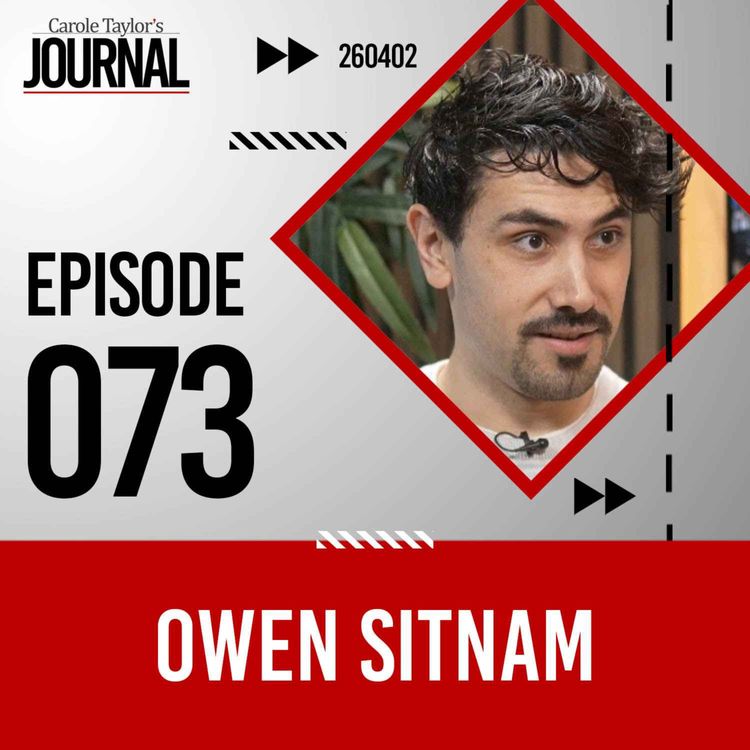
73 | Help From Above (w/ Owen Sitnam, Helicopters Without Borders)
On this edition of Journal, we open our eyes to the challenges and needs of those living in some of British Columbia’s most remote communities.
We have highlighted the crisis in healthcare that many of our cities face every time their local ER is unexpectedly closed, or the maternity ward, or the pediatric unit.
But imagine if you lived in a community where there may be limited road access – or no access at all. How do you get food supplies? Medications? Medical attention?
Owen Sitnam, a helicopter pilot and whose father Danny Sitnam founded and built Helijet, saw a need and set out to fill it. In 2021, he formed a non-profit called Helicopters Without Borders to ensure there is a method for marginalized communities and people in distress in British Columbia to access health and wellness services.
For Owen, he didn’t believe it was right that there are children in our province who had never seen a dentist or a doctor. So Helicopters Without Borders started to fly in medical and support teams.
Imagine being excited to see a dentist – the joy and smiles on the faces of these little ones tells you all you need to know.
Last year, they transported health professionals to over 700 clinical sessions, meeting with over 3000 individuals across BC.
By partnering with others, they also support a travelling team of pediatric specialists. And believing food security to be a major issue, they work with charities and food banks across the province, flying in these essentials.
We meet the man behind this wonderful initiative, Owen Sitnam.
---
Carole Taylor's Journal is a public affairs dialogue that digs deep into the most pressing issues of our times. For more, see our website at http://www.caroletaylorsjournal.ca.
More episodes
View all episodes

30. 76 | What’s Happening at the Legislature? (w/ Alec Lazenby, Vancouver Sun)
22:38||Season 3, Ep. 30On this edition of Journal, we lift the curtain on the chaos of the NDP in British Columbia.If you are shaking your head in disbelief at some of the stunning flip-flops and bad policy choices of our current provincial government, you are not alone.Decriminalization: a disastrous policy now abandoned.How about the infamous Land Act, which would have given First Nations co-control with the government of all the Crown land in the province? It was so controversial that it disappeared.Premier David Eby loudly and repeatedly said that private property wouldn’t be affected by the aboriginal title agreements being negotiated – until a judge ruled in the Cowichan decision that maybe private property could be affected after all.Another court has now ruled that the provincial system for mineral claims staking violates their own act, saying that all BC laws and regulations MUST be consistent with the Declaration of the Rights of Indigenous Peoples (DRIPA).Interesting that David Eby was the Attorney General at that time, who helped draft those very words – “MUST be consistent.”Realizing that the act would now have to be rewritten, Premier Eby presented changes that he said were urgent and non-negotiable – until they weren’t, and instead there would just be a 3-year pause on the troublesome phrases.Then the Premier declared even this pause motion to be a matter of confidence, meaning the government would fall if it didn’t pass. Then lo and behold, he changed his mind yet again and announced it wouldn’t be a confidence vote.Then the 3-month pause became 1-month and now it's completely off the table for this legislative session.What is going on in Victoria? To help make sense of it all, Alec Lazenby, one of the top reporters covering the provincial government for the Vancouver Sun, joins us.---Carole Taylor's Journal is a public affairs dialogue that digs deep into the most pressing issues of our times. For more, see our website at http://www.caroletaylorsjournal.ca.
29. 75 | State of Forestry in British Columbia (w/ Shannon Janzen)
22:38||Season 3, Ep. 29On this edition of Journal: a closer look at the recently released forestry report that says we have to abandon the old ways of managing our forests because the status quo is not working.That statement won’t be a surprise to anyone touched by this industry, be it municipalities, First Nations, the provincial government, or the workers and their families. More than two dozen mills have closed in the past four years, laying off more than 8,000 workers. Many companies have decided to do their capital investments elsewhere, in the US or Europe, but not in British Columbia.The report called, “From Conflict to Care,” acknowledges that currently in forestry, “we have a complex system of legislation that is hard to comprehend, combined with bureaucratic inefficiencies such as Ministries working in silos and sometimes at cross purposes with opposing mandates. Adding to this challenge is the instability caused by election cycles which drive frequent shifts in priorities and mandates.”That brutal assessment is not from opposition literature – it is taken word-for-word from this new report compiled by the Provincial Forestry Advisory Council done for the BC government. One of the chairs, Garry Merkel, calls it “another freakin’ review of BC forest policy.”So, the table is set:What can be done to save this important resource industry that used to be such a major player in our province?Shannon Janzen, Merkel’s co-chair, a forester, and former vice-president of Western Forest Products, believes there is a way. First of all, we must accept the status quo is broken; then, after broad consultations, come up with a radical new model that works in 2026.---Carole Taylor's Journal is a public affairs dialogue that digs deep into the most pressing issues of our times. For more, see our website at http://www.caroletaylorsjournal.ca.
28. 74 | Less Ribbon-Cutting, More Action (w/ Brad West, Port Coquitlam mayor)
22:31||Season 3, Ep. 28On this edition of Journal, mayor Brad West of Port Coquitlam walks us through some of the failures we are seeing in our governments at all levels and some of the solutions.Brought up by his mother after his father died, Brad remembers the importance to the family when she finally got a union job, good wages, and good hours. Brad went on to study at the University of Victoria before taking a job in communications with the United Steelworkers.You can see with his personal experience he would be a natural fit with the NDP of British Columbia, a social democratic party. So how surprising was it when, last year, Brad West took a swing at the NDP government by saying they were more interested in pronouns than jobs?In other words, ideology over workers.Recently in another op-ed, the mayor elaborated. This time, about how governments in general are failing and frustrating their citizens.People, he says, want results not announcements. Service, not ribbon cutting.Based on his successful time in municipal government – elected as a councillor in 2008, the youngest mayor elected in Port Coquitlam’s history in 2018, then re-elected by acclamation, meaning no one chose to run against him. Based on that alone, his ideas are worth listening to.For instance:Less high school behaviour in the legislature, more listening to citizens and their needs.Fewer studies and more action.And stop overspending taxpayer’s hard-earned dollars.Mayor Brad West joins us to outline a road to recovery and a way for politicians to regain the public trust.---Carole Taylor's Journal is a public affairs dialogue that digs deep into the most pressing issues of our times. For more, see our website at http://www.caroletaylorsjournal.ca.
26. 72 | Supporting Arts in the City (w/ Christopher Gaze, Bard on the Beach)
22:27||Season 3, Ep. 26On this edition of Journal: the role arts and culture play in our lives.My premise is they are essential to a vibrant community. They lift us up out of our daily worries. They help form our identity. Think of New York: Broadway. Think of Paris: galleries. Italy: opera.So, why are they constantly underfunded here, especially since they are also economic engines providing jobs, not just for the actors, the singers, the painters, and directors, but for the people who build the sets, write the words, the music, and design the makeup and costumes?I found it incredibly ironic to see politicians proudly celebrating the work of so many Canadian artists honoured at the Oscar, when government funding and support has been unreliable for years. Go Canada!One man who has worked in the arts around the world all his life is Christopher Gaze, founding artistic director of Bard on the Beach.I mean, honestly, who would have believed that anyone could inspire 88,000 people each year to sit out on a warm summer evening to listen to the words of Shakespeare?But not one day of his journey has been easy. He has had to wiggle and squirm every day to make ends meet.I loved the story of his early days as a penniless actor. He could be seen hauling a bag of his meager belongings to yet another audition. Ah, but the secret was, in his battered bag was one beautiful, well-pressed tux, always ready for showtime.Make no mistake – for 37 years, Bard on the Beach, one of Canada’s largest theatre companies, has only been possible because of Christopher Gaze’s ingenuity.---Carole Taylor's Journal is a public affairs dialogue that digs deep into the most pressing issues of our times. For more, see our website at http://www.caroletaylorsjournal.ca.
25. 71 | Protecting Vancouver (w/ Steve Rai, Chief Constable, Vancouver Police)
22:45||Season 3, Ep. 25On this edition of Journal, Chief Constable Steve Rai. It’s almost a year since he was chosen to lead the Vancouver Police Department into the future – the first South Asian Chief for the VPD.His story is so interesting: born in Punjab, India, he came with his family to Canada at age 5. A boy who lived next door to him in Kitsilano was unable to pronounce his name, Satwinder Singh, so he named him Steve. So, Steve it is.A new immigrant, his dad found work in maintenance at the Vancouver Police Department and loved it, perhaps influencing his son’s decision to join the VPD at the age of 23.When the Chief talks about his first assignment, walking the streets of East Vancouver 36 years ago, his amazement and enthusiasm boils over. “Remember that?” he says to a Business in Vancouver reporter. “Gun violence every day. Open warfare with machine guns out the back windows of cars, shooting each other on Kingsway.”Sometimes we think we are the only ones living in dangerous times.Steve Rai has always believed in hard work, education, and learning. While he was carrying out his policing duties on the streets of Vancouver, he was also learning by taking many additional courses, including being the only Canadian police officer accepted for the US International Leadership Development program in 2006.And now, Chief Rai can put all that experience to work, starting with his dream of Vancouver having its own police academy. Steve once said that about 40% of his time is spent lobbying and, for sure, that has paid off with the province and city officially blessing this new academy.---Carole Taylor's Journal is a public affairs dialogue that digs deep into the most pressing issues of our times. For more, see our website at http://www.caroletaylorsjournal.ca.
24. 70 | Musqueam: What Does it Mean? (w/ Thomas Isaac, Cassels, Brock & Blackwell LLP)
22:38||Season 3, Ep. 24On this edition of Journal, we try to untangle the evermore confusing issues surrounding aboriginal title in British Columbia and what it means for private property owners.My head is spinning with all the contradictory information that is out there. Private property is not affected, says our premier. Oh, maybe it is, says a judge.One pattern is emerging – decisions are being made by governments in negotiations with First Nations in private, then grandly announced as a fait accompli to the broader public, businesses, and property owners. That’s no way to build support or buy-in.To whit, the proposed-then-withdrawn Land Act giving First Nations a 50% say on all the province’s Crown land, the Haida title agreement, the dispute on the Sunshine Coast, the Cowichan court case, and then the federal signing of a deal with the Musqueam claiming vast sections of Metro Vancouver and surrounding municipalities as their hereditary land.It is a fact that when you lose trust, you lose trust. So now, when any of these players say, “Oh, trust us. We won’t touch private property,” it’s a hard sell, especially since the judge in the Cowichan case said her decision may give rise to some uncertainty for private property owners. Indeed.A final irony is that some of the agreements are now being challenged by other First Nations: the Musqueam and Tsawwassen First Nations are appealing the Cowichan decision, Squamish First Nation said it wasn’t consulted on the Musqueam decision, and even the Cowichan First Nation is appealing its own successful court case because they only were awarded half of what they asked for!Thomas Isaac, one of Canada’s top lawyers in the field of aboriginal law, joins us to say what worries him about the BC situation.---Carole Taylor's Journal is a public affairs dialogue that digs deep into the most pressing issues of our times. For more, see our website at http://www.caroletaylorsjournal.ca.
23. 69 | The Good, The Bad, and The Ugly of Governing Metro Vancouver (w/ Mike Hurley, Chair Metro Vancouver)
22:35||Season 3, Ep. 23On this edition of Journal, a subject that is near and dear to me – governance. I know, I know. Your heart is beating faster at just the thought of this topic, but bear with me.If you are a government or a nonprofit or a business of any size, if you get the governance right, then you are on your way to success.Sadly, it is often in government that we find problems. The example that is glaring in its unmanageability is Metro Vancouver.Imagine: you are the Chair of this organization with 41 members, many mayors sitting around a very large table representing 21 municipalities, Tsawwassen First Nations, and Electoral Area A. Every single one of them has their own priorities and problems they want addressed.How can you ever make that work?Importantly, how are decisions made? Like for the overdue, vastly over-budget wastewater project that went from $700 million to $3.6 billion? Is it by consensus or by accepting a staff recommendation?In part because of this dollar shock for taxpayers, Deloitte was asked to have a look. Their report highlighted many challenges with the Metro Vancouver model, including the obvious fact that the Board is just too large to manage, that directors’ expenses should be trimmed, and perhaps the Chair should not be a politician.With all these problems, why would anyone willingly take on the near-impossible task of reorganization? Well, fortunately, mayor Mike Hurley of Burnaby has stepped into the fray and is serving as Chair. He calls himself a person of action and warns that possibly big changes are coming.---Carole Taylor's Journal is a public affairs dialogue that digs deep into the most pressing issues of our times. For more, see our website at http://www.caroletaylorsjournal.ca.
22. 68 | Death By a Thousand Taxes (w/ David Williams, VP Policy at Business Council of BC)
22:33||Season 3, Ep. 22On this edition of Journal, we join the chorus of voices repudiating British Columbia’s new budget.To be charitable, Premier Eby is having a terrible, horrible, no good, very bad day (to borrow from a children’s book).Even before the actual numbers were released, one headline from Business in Vancouver magazine stated: “Eby may go down as the worst fiscal manager in BC history.”Another said, “The stunning deterioration in BC’s fiscal health during Premier Eby’s tenure will not soon be reversed.”Vaughn Palmer said, “NDP’s fiscal credibility shredded.”And on and on.The facts are these – during Premier Eby’s time, the province has gone from a $6-billion surplus to a deficit of $13.3 billion dollars.Our debt in the 3 year budget will be up 200% since 2021/22 – and the cost of paying interest on that debt will have gone up 220% during that time, making interest charges the fastest-growing line in the budget.As we all know, money going to the bank to pay for past borrowing excesses means less money for health, seniors, and our kids.As if that weren’t bad enough, in a time of economic stress for many, taxes are going up on everything from basic cable and land lines to shoe repair, accounting services, and – oh yes – on security costs that many small businesses have been forced to absorb because of retail crime and street disorder.As columnist Rob Shaw says: all pain, no gain.To make sense of all this is David Williams, vice-president of policy at the Business Council of BC.---Carole Taylor's Journal is a public affairs dialogue that digs deep into the most pressing issues of our times. For more, see our website at http://www.caroletaylorsjournal.ca.