Share
The Capitalist
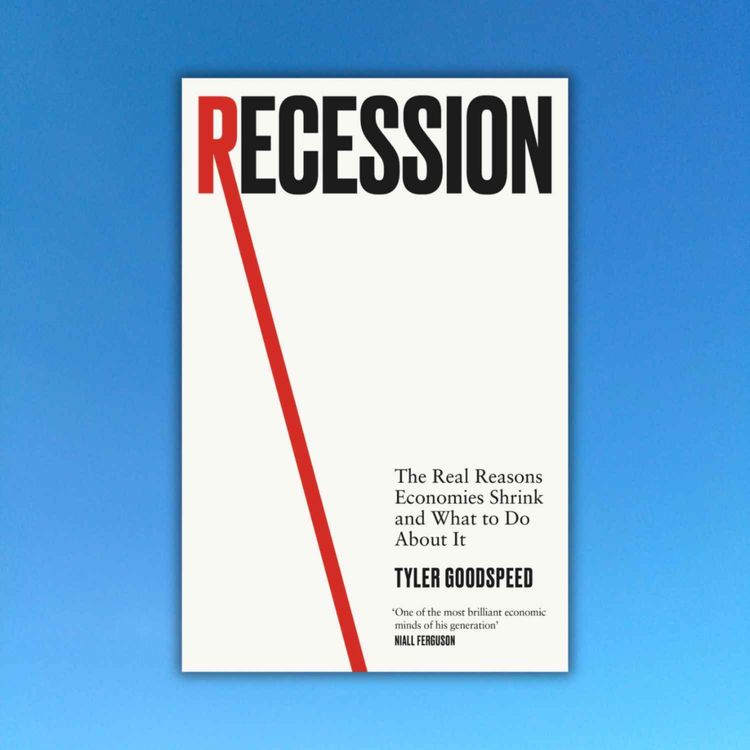
Tyler Goodspeed: You're wrong about recessions
We have been telling ourselves the wrong story about recessions for four centuries. And the consequences of that error are bigger than you might think.
Dr. Tyler Goodspeed, former chair of the White House Council of Economic Advisers and author of the new book Recession, joins CapX editor Marc Sidwell to dismantle one of the most seductive myths in economics: that booms cause busts. Drawing on 132 recessions spanning four centuries of British and American history, Goodspeed makes a forensic and devastating case that economic expansions don't die of natural causes — they are murdered by shocks that nobody saw coming and nobody could have hedged against.
Yield curve inversions, inventory cycles, towering skylines, the ghost of Kondratiev — none of it actually predicts the next downturn. We are, Goodspeed argues, pattern-seeking mammals in a world that doesn't always offer patterns, and our hunger for moral narratives — the roaring twenties, the reckless bankers, the inevitable correction — tells us more about human psychology than it does about economic reality.
Despite our current gloom, recessions are actually getting rarer. But the greatest threat to long-run prosperity may not be the downturns themselves, but the paralysing stories we tell about them.
Stay informed with CapX's unmissable daily briefings from the heart of Westminster. Go to capx.co to subscribe.
More episodes
View all episodes

71. Mel Stride on the cost of instability
46:18||Season 1, Ep. 71Britain is paying more to borrow than any other major Western economy. So why is Labour preoccupied with internal power struggles? In a special live address, Shadow Chancellor Mel Stride delivers his account of Britain's fiscal predicament and the Conservative Party's plan to fix it.Our borrowing costs are the highest in the G7, higher even than Portugal, Spain and Greece – not primarily because of the deficit or the debt stock, but because Britain has become an inflation outlier, and markets are pricing in the risk that the situation gets worse. When Josh Simons stepped aside for Andy Burnham on a single Friday, yields jumped 18 basis points. Stride puts a number on it: Burnham penalty that if sustained would cost the equivalent of £300 per working household.The broader charge sheet against the current government includes: a deficit that ran 75% above inherited plans in Labour's first year and again in its second; a quarter of a trillion pounds in additional borrowing across a single Parliament; fiscal rules changed to permit more borrowing the moment they became inconvenient; and a Prime Minister too weakened by his own MPsto make the welfare reforms even his Chancellor admits are needed.Against this, Stride sets out the Conservatives' golden rule – for every pound of savings identified, at least half goes to deficit reduction – and makes the case that the Tories' plan is the only serious fiscal commitment on offer. Reform's numbers don't add up, he argues, and its representatives have said so themselves on air. Labour's leadership contenders are, in their different ways, each a version of the same problem.Following his speech, the Shadow Chancellor takes questions on quantitative tightening, the triple lock, the OBR's limitations, defence investment and the EU.
Despatch: Andy Burnham is overrated
05:37|Andy Burnham is heading for a leadership bid, and he's arrived with a big idea: Manchesterism. Apparently a form of business-friendly socialism, it's built on borrowing, backed by the Manchester skyline, and presented as a credible alternative to both austerity and the hard left. There is just one problem: it doesn't add up.Mani Basharzad of the Institute of Economic Affairs argues that the Manchester model rests on borrowing that bond markets are already pricing with suspicion, a council that is among the most indebted in the country, and a breezy confidence that infrastructure debt is categorically different from any other kind. (It isn't.) Then there is the welfare question: Burnham has shown no appetite for restraint. And the wealth taxes he has quietly signalled would do to capital what rent controls do to housing.The deepest problem is one of logic. Burnham wants growth and expanded welfare. He wants business confidence and more borrowing. He wants reform and the preservation of every existing structure. As Ludwig von Mises observed, you cannot split the difference between the government and the market. There is no third solution – only planned chaos.Despatch brings you the best writing from CapX's unrivalled daily newsletter from the heart of Westminster.
70. Kallum Pickering: The bond markets will decide Britain's PM
35:23||Season 1, Ep. 70Keir Starmer is fighting for his political life. The bond markets are watching — and they have a long memory.Kallum Pickering, chief economist at Peel Hunt and columnist for The Telegraph, joins CapX editor Marc Sidwell for a lucid diagnosis of what is really going wrong with the British economy, why the markets are spooked, and what a change of Labour leadership could mean for the country's already precarious fiscal position.Pickering's central argument: Britain's borrowing costs are the highest in the G7 not because of its deficit or its debt, but because of its inflation record. And that inflation, he contends, is not bad luck — it is the predictable consequence of two decades of policy choices that have systematically rationed Britain's own factors of production. Land, labour, energy, commodities: each has been constrained in turn, shrinking the economic pie even as demand has grown. The result is an economy that borrows to fund current consumption while steadily eroding the private sector's productive potential.Even as the predictable leadership tension rolls on, the underlying problem, Pickering argues, will not change with the occupant of Number Ten. His prescription is neither complicated nor politically fashionable: deregulate land, labour and planning; cut government spending by three to five percentage points of GDP; let taxes follow. But above all, fix energy. Britain has 25 per cent less electricity available to it than in 2005. Until that changes, every other reform is working against the tide.
Despatch: Why the old parties aren't dead
06:44|From fractured local elections to the rise of Reform and the Greens, British politics increasingly feels unstable, fragmented and unpredictable. Yet in this essay, Lee David Evans of the Mile End Institute argues that while the old political order may be gone, the old parties are proving harder to kill than many assume. Drawing comparisons with Harold Wilson, John Major and Margaret Thatcher’s Conservatives, Evans suggests that beneath the chaos of five-party politics, Labour and the Conservatives still retain deeper institutional resilience than their critics admit.Despatch brings you the best articles from CapX’s unrivalled daily newsletter.
69. Why aren't we investing our money?
28:33||Season 1, Ep. 69When a business raises capital, it buys equipment, expands its operations, and hires people. That’s how investment becomes jobs. But the United Kingdom has ranked in the bottom quartile of advanced economies for private capital investment every year since 1995.The gap with our peers runs to roughly £100 billion annually. A new report from the Jobs Foundation makes for uncomfortable reading, but it also offers concrete proposals for what to do about it.Marc Sidwell is joined by Andrew Allum, international strategist and one of the report's authors, to discuss what it will take to close the investment gap – and whether Britain still has the political will to try.
68. Live: Palantir and the AI race
45:43||Season 1, Ep. 68Britain may have stumbled almost accidentally into one of the best positions in the world to win the AI race. The question is whether it has the wit and will to press on.Recorded live at the Margaret Thatcher Conference in London, Charlotte Crosswell OBE chairs a conversation with Louis Mosley, Executive Vice Chair and Head of Palantir Technologies UK, and Tom Westgarth, Head of Growth at Fractile, on what it would take for Britain to translate its genuine and underrated AI advantages into lasting national prosperity.The case for optimism is more concrete than you might think. Palantir employs one in five of its global workforce in Britain. Google DeepMind, builder of one of the world's three serious frontier AI models, is headquartered here. ElevenLabs, now valued at $11 billion, was spun out of Palantir's NHS team by Polish engineers who came to London for university and stayed. UK AI startups raised £7.8 billion in the first quarter of 2026 alone.As for jobs: anyone claiming certainty is, as Mosley puts it bluntly, lying. But the collar flip – where the barista outlasts the barrister – may be closer than comfortable.
Despatch: Should the government run supermarkets?
06:49|As grocery prices rise and political pressure mounts, radical solutions are back on the table – including state-owned food stores. In this essay, Jimmy Nicholls, writer of Poke the Bear and host of The Right Dishonourable podcast, examines New York’s experiment under mayor Zohran Mamdani, arguing that public supermarkets are a costly illusion. With razor-thin margins and global supply chains driving prices, Nicholls suggests that even the most ambitious politicians cannot outmaneuver basic economics – and that taxpayers may end up footing the bill for a policy destined to disappoint.Despatch brings you the best articles from CapX’s unrivalled daily newsletter.
67. The left stole feminism – let’s take it back
17:55||Season 1, Ep. 67The feminist case for capitalism is one of the most powerful arguments nobody seems to be making. Zoe Strimpel has decided to make it anyway.A columnist for The Telegraph and author of Good Slut: How Money, Sex and Power Set Women Free, Zoe joins CapX editor Marc Sidwell to make the conservative case for winning over feminists at the next election. Her argument is simple and unfashionable: throughout history, the ability to earn money and keep it has been the most reliable route to female autonomy — more so, in many contexts, than legislation or social movements alone. The reflexive anti-capitalism of contemporary feminism, she contends, is not just intellectually confused but actively harmful to the women it claims to represent.Zoe traces how feminism, born from the socialist left of the 1970s, was briefly hijacked by the Sheryl Sandbergs of the early 2000s before swinging back hard against so-called neoliberal feminism — leaving young women with a politics that discourages ambition, pathologises wealth and mistakes destruction for progress. The polling bears it out: young women are now among the most enthusiastic supporters of anti-capitalist parties.Nobody, right or left, is making much of an economic argument at all: cultural questions are more vivid, more emotionally compelling and considerably easier than engaging seriously with how prosperity is actually created. But Zoe thinks that style of politics might be reaching its use by date.
Despatch: A smarter path to Net Zero
09:17|War in Iran. Energy bills set to spike again this summer. Electricity prices that have gone from among the lowest in Europe to among the highest. And a Government that appears to believe the answer is simply to press on.But Dr Gerard Lyons, research fellow at the Centre for Policy Studies, isn't arguing for abandoning the green transition. Instead, he says the way Britain is pursuing Net Zero is making the country poorer, less competitive, and more exposed to exactly the kind of international shocks that good energy policy is designed to absorb.The problem is substitution over addition — replacing fossil fuels before the renewable system is ready to carry the load, and loading the cost of transition directly onto household and business bills. The fix, Lyons argues, requires treating the energy transition as long-term infrastructure, financed through borrowing and repaid over generations. It requires nuclear — urgently, and at scale. It requires a stable tax regime for the North Sea. And it requires fixing a market design that means consumers pay gas prices even when the wind is blowing.Britain led the world in cutting emissions, and it could yet lead the world in doing so affordably. But Lyons warns that the current path risks making the green transition synonymous with economic pain — and that is a political and economic failure the country cannot afford.Despatch brings you the best writing from CapX's unrivalled daily newsletter from the heart of Westminster.