Share

The Capitalist
Despatch: Thatcher's ownership revolution isn't over
As younger voters grow disillusioned with a housing system that denies them real control over their homes, the battle over leasehold has become a test of whether capitalism still delivers on its promises. In this essay, Harry Scoffin, founder of Free Leaseholders, argues that reforming — and ultimately replacing — leasehold with commonhold is not a left-wing cause, but the logical continuation of Thatcher’s popular capitalism. From Randolph Churchill to Margaret Thatcher, Conservatives once championed mass ownership as a bulwark against socialism. Scoffin makes the case that finishing that project could restore faith in markets, revive homeownership and prevent a new generation from turning away from the system altogether.
Despatch brings you the best articles from CapX’s unrivalled daily newsletter.
Stay informed with CapX's unmissable daily briefings from the heart of Westminster. Go to capx.co to subscribe.
More episodes
View all episodes

68. Live: Palantir and the AI race
45:43||Season 1, Ep. 68Britain may have stumbled almost accidentally into one of the best positions in the world to win the AI race. The question is whether it has the wit and will to press on.Recorded live at the Margaret Thatcher Conference in London, Charlotte Crosswell OBE chairs a conversation with Louis Mosley, Executive Vice Chair and Head of Palantir Technologies UK, and Tom Westgarth, Head of Growth at Fractile, on what it would take for Britain to translate its genuine and underrated AI advantages into lasting national prosperity.The case for optimism is more concrete than you might think. Palantir employs one in five of its global workforce in Britain. Google DeepMind, builder of one of the world's three serious frontier AI models, is headquartered here. ElevenLabs, now valued at $11 billion, was spun out of Palantir's NHS team by Polish engineers who came to London for university and stayed. UK AI startups raised £7.8 billion in the first quarter of 2026 alone.As for jobs: anyone claiming certainty is, as Mosley puts it bluntly, lying. But the collar flip – where the barista outlasts the barrister – may be closer than comfortable.
Despatch: Should the government run supermarkets?
06:49|As grocery prices rise and political pressure mounts, radical solutions are back on the table – including state-owned food stores. In this essay, Jimmy Nicholls, writer of Poke the Bear and host of The Right Dishonourable podcast, examines New York’s experiment under mayor Zohran Mamdani, arguing that public supermarkets are a costly illusion. With razor-thin margins and global supply chains driving prices, Nicholls suggests that even the most ambitious politicians cannot outmaneuver basic economics – and that taxpayers may end up footing the bill for a policy destined to disappoint.Despatch brings you the best articles from CapX’s unrivalled daily newsletter.
67. The left stole feminism – let’s take it back
17:55||Season 1, Ep. 67The feminist case for capitalism is one of the most powerful arguments nobody seems to be making. Zoe Strimpel has decided to make it anyway.A columnist for The Telegraph and author of Good Slut: How Money, Sex and Power Set Women Free, Zoe joins CapX editor Marc Sidwell to make the conservative case for winning over feminists at the next election. Her argument is simple and unfashionable: throughout history, the ability to earn money and keep it has been the most reliable route to female autonomy — more so, in many contexts, than legislation or social movements alone. The reflexive anti-capitalism of contemporary feminism, she contends, is not just intellectually confused but actively harmful to the women it claims to represent.Zoe traces how feminism, born from the socialist left of the 1970s, was briefly hijacked by the Sheryl Sandbergs of the early 2000s before swinging back hard against so-called neoliberal feminism — leaving young women with a politics that discourages ambition, pathologises wealth and mistakes destruction for progress. The polling bears it out: young women are now among the most enthusiastic supporters of anti-capitalist parties.Nobody, right or left, is making much of an economic argument at all: cultural questions are more vivid, more emotionally compelling and considerably easier than engaging seriously with how prosperity is actually created. But Zoe thinks that style of politics might be reaching its use by date.
Despatch: A smarter path to Net Zero
09:17|War in Iran. Energy bills set to spike again this summer. Electricity prices that have gone from among the lowest in Europe to among the highest. And a Government that appears to believe the answer is simply to press on.But Dr Gerard Lyons, research fellow at the Centre for Policy Studies, isn't arguing for abandoning the green transition. Instead, he says the way Britain is pursuing Net Zero is making the country poorer, less competitive, and more exposed to exactly the kind of international shocks that good energy policy is designed to absorb.The problem is substitution over addition — replacing fossil fuels before the renewable system is ready to carry the load, and loading the cost of transition directly onto household and business bills. The fix, Lyons argues, requires treating the energy transition as long-term infrastructure, financed through borrowing and repaid over generations. It requires nuclear — urgently, and at scale. It requires a stable tax regime for the North Sea. And it requires fixing a market design that means consumers pay gas prices even when the wind is blowing.Britain led the world in cutting emissions, and it could yet lead the world in doing so affordably. But Lyons warns that the current path risks making the green transition synonymous with economic pain — and that is a political and economic failure the country cannot afford.Despatch brings you the best writing from CapX's unrivalled daily newsletter from the heart of Westminster.
66. Is Britain really broken?
36:47||Season 1, Ep. 66Britain's reputation for decline has taken on a life of its own online. But how much of it is real — and what would it actually take to fix?Sam Dumitriu, head of policy at Britain Remade, joins CapX editor Marc Sidwell for a forensic tour through the structural problems dragging on the British economy — and some surprisingly tractable solutions. The broken Britain narrative, he argues, isn't simply noise: there are genuine, self-inflicted wounds here, and they all tend to lead back to the same place.The planning system runs like a thread through almost every conversation about British decline, and this one is no exception. Energy bills are high in part because building the infrastructure to bring them down has been made absurdly expensive. Housing is unaffordable thanks to layers of regulation.But perhaps the sharpest insight concerns supermarkets. Since 1996, a Town Centre First policy has nudged Britain's retail sector away from large out-of-town stores towards cramped urban formats — smaller, less productive, and more expensive to run. The result, backed by rigorous comparative evidence from Scotland, is lower productivity, higher prices, and a planning system that lets established supermarkets block cheaper rivals from opening at all. The overarching diagnosis is uncomfortable: politicians reach for sticking plasters precisely when structural reform is needed most, and the reforms that would work tend to require a political courage that has been conspicuously absent.
Despatch: Get Britain off the benefits treadmill
06:18|Labour's benefits reforms are now law. Ministers say they will cut poverty. Critics say they will simply transfer money from people who work to people who don't. Both sides are missing the point – because Britain's welfare state isn't just poorly calibrated. It is built on a fundamental misunderstanding of what poverty actually is.John Penrose, Chair of the Conservative Policy Forum, makes a quietly radical argument: that the official definition of poverty is itself the problem. By measuring poverty as anything below 60% of median earnings, the system embeds a permanent wealth-redistribution ratchet into the heart of the welfare state – one that treats the symptom, not the cause, and ensures that reported poverty barely shifts regardless of how many billions are spent.Despatch brings you the best writing from CapX's unrivalled daily newsletter.
65. Adrian Wooldridge: How centrists fight back
48:53||Season 1, Ep. 65Liberalism is under its greatest threat since the 1930s. The question is whether its defenders have the nerve to admit why – and the ideas to fight back.Adrian Wooldridge, Bloomberg columnist and author of "Centrists of the World Unite!", joins CapX editor Marc Sidwell for an unsentimental diagnosis of liberalism's crisis — and an unexpectedly combative case for its recovery. The liberal tradition that defeated totalitarianism and built the modern world is not, he argues, exhausted. It has been betrayed: hollowed out by a self-satisfied establishment on one side and captured by identitarian collectivism on the other, while the intellectual energy of the age flows freely to the post-liberal right.But the book's argument is ultimately one of recovery. Liberalism has reinvented itself before — in the 1890s, a dying Gladstonian creed gave way to a new liberalism that produced Keynes, Beveridge and a generation that rebuilt the post-war world. The genius is latent. The question, as Wooldridge puts it, is whether today's liberals can sound something other than a faltering trumpet.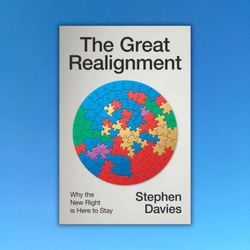
64. Steve Davies: The Great Realignment
31:18||Season 1, Ep. 64The political map we grew up with is obsolete. What comes next could be far more turbulent than anything we've seen so far. Historian Stephen Davies, author of The Great Realignment, joins CapX editor Marc Sidwell to make the case that the upheavals of recent years – Brexit, Trump, the rise of Reform – are not aberrations to be waited out, but symptoms of something far more structural: a once-in-a-century shift in the organising principle of politics itself. For a hundred years, the central divide was economic. Now, he argues, it is existential – a clash between rooted national identity and open cosmopolitanism that is scrambling every alliance, every assumption, and every party's electoral map.The term "populism", Davies contends, is not merely inaccurate but dangerous – a label that allows established institutions to patronise and persistently underestimate the movements they most need to understand. And to those who believe economic recovery will drain the energy from nationalist politics: he is unsparing. The voters driving the realignment are not, at root, angry about stagnation. They are angry about identity. Those are not the same thing, and no growth strategy will make them so.The show looks at where free marketeers fit in a world reorganised around culture rather than capitalism – and Davies' answer is bracing. The nationalist right's actual agenda, he argues, is functionally incompatible with limited government. Mass deportations, reindustrialisation, reshored supply chains: none of it can be delivered without a very large state indeed.And then comes the prediction that may prove most provocative of all: that the Brexit divide in British politics will flip – with the nationalist right eventually embracing a Europeanist identity defined in civilisational terms, and the cosmopolitan left recoiling from what that Europe would actually become.
Despatch: Driven to blackouts
07:24|In the winter of 1973, Britain ran on three days a week. Candles lit homes, shops shut early, and a Prime Minister insisted everything was under control — right up until it wasn't. Half a century later, the warnings are sounding again.Dr Lawrence Newport, Director of Looking for Growth, draws a stark and unsettling parallel between the energy crisis that brought Edward Heath's government to its knees and the fragility of Britain's power supply today. The numbers are not reassuring: North Sea output at historic lows, gas storage a fraction of what it once was, and an import dependency that leaves the country acutely exposed to the kind of international shocks that, history suggests, are a matter of when rather than if.The failure, Newport argues, is not one government's alone. Successive governments chose dependency over resilience — allowing a labyrinth of reviews, consultations, and legal challenges to strangle domestic energy production while quietly decommissioning the reserves that might have offered protection. Hinkley Point C, the most expensive nuclear plant ever built, stands as the monument to decades of political drift.The Government insists Britain has one of the most reliable energy systems in the world. Newport is less sure. And the cost of being wrong, he warns, will not be felt in Westminster.Despatch brings you the best writing from CapX's unrivalled daily newsletter from the heart of Westminster.