
Latest episode
537. The Parkdale Murder Mystery Part 2
57:18||Ep. 537A mysterious Toronto murder, a disputed confession, and a trial that captivated the city, welcome back to Canada Is Boring for part two of the Parkdale murder mystery.In 1894, 18-year-old Frank Westwood was shot and killed, and Clara Ford, a Black woman who made her living as a seamstress, was arrested for the crime. Ford reportedly confessed to detectives, but later claimed her confession was fabricated under hours of police questioning. Her alibi fell apart, the physical evidence was inconclusive, and the case became as much a spectacle about Ford’s race, gender expression, and reputation as it was a search for the truth.Rhys walks Jesse through Clara Ford’s arrest, the sensational press coverage, the courtroom drama, and the role of a very famous visitor to Toronto: Sir Arthur Conan Doyle, creator of Sherlock Holmes. Ford was acquitted by an all-male jury, but did she really shoot Frank Westwood, or did the case turn an unconventional woman into the perfect suspect? The murder remains unresolved, and the truth is still uncertain.After the murder mystery, step into the Small Talk Dimension for Jesse’s stories from Tuscany, including painting the countryside and discovering an underground garage in a tiny Italian village. Rhys also tells the story of seeing Jeremy Clarkson, James May, and Richard Hammond at a Top Gear recording, and helping Tom Cruise when someone in the audience fainted.Plus, a preview of next week’s episode: a bold, clever gentleman thief with an unusual accomplice.
More episodes
View all episodes
536. The Parkdale Murder Mystery - Part 1
47:48||Ep. 536On October 6, 1894, 18-year-old Frank Westwood answered the door of his family's Toronto mansion, Lakeside Hall in Parkdale. Someone standing outside shot him through the gap left by the door chain. In part one of this two-part Victorian true crime story on Canada Is Boring, Rhys Waters takes Jesse Harley through the Parkdale Mystery, the Toronto murder that caused a newspaper frenzy in 1890s Canada. Before Frank died of his stomach wound, he described the gunman as a man in dark clothes with a thin mustache. The only name he gave police was Gus Clark, a "stone hooker" his family had chased off their shoreline for digging out shale. We cover the crowded funeral and the chaotic inquest. We meet amateur sleuth W. H. Hornberry, whom the papers mocked as "Parkdale's Sherlock Holmes." We also look at how newspapers begged Sir Arthur Conan Doyle, the creator of Sherlock Holmes, to solve the case. Then there's the Listowel Horror, the murder of 13-year-old Jessie Keith, which set off rumours that Jack the Ripper had moved to Canada. Part one ends on a cliffhanger: police arrest a surprising new suspect, a 32-year-old woman. After the story, the Small Talk Dimension Zone covers Jesse's Tuscany wine festival trip, inspired by The Witcher 3: Blood and Wine. Jesse also shares a trick for quitting smoking with ice-cold ginger ale. Rhys helps elderly nuns at Rome's Ciampino airport, and the two trade TIFF celebrity sightings, including Jay Baruchel at the Ken Carter film Stuntman. It closes with Danny Elfman's story of writing the Batman theme in an airplane bathroom. If you like Canadian history, historical true crime, unsolved mysteries and a comedy podcast, subscribe so you don't miss part two.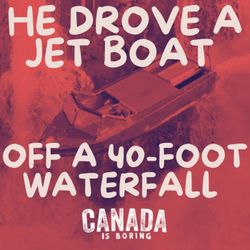
535. He Drove a Jet Boat Off a 40-Foot Waterfall
34:51||Ep. 535Canadian stuntman Dusty Friesen didn't just drive his jet boat off a 40-foot waterfall, he spent over a year researching whether it was legal first. Which is possibly the most Canadian thing that has ever happened.On May 25, 2026, Dusty (aka Dusty Dozer) of Dawson Creek, BC took his battered jet boat Dent down the Crowsnest River in southern Alberta and straight over Lundbreck Falls, landing upright in front of a hollering crowd and simply carrying on downstream. He's calling it the highest naturally flowing waterfall ever descended in a jet boat, an unofficial world record, since Guinness doesn't have a category for it. The RCMP and conservation officers investigated. The maximum penalty? A $350 fine for careless operation of a small vessel. There was no warrant, and Dusty says he's just getting started: he wants to jump bigger than Niagara.Rhys and Jesse break down the jump, the legal loophole, the ocean-cleanup fundraising angle, and why Canadian history deserves better movies. Plus a Small Talk Dimension segment featuring a terrified golden retriever, a noisy roof flap, and the worst rental bike in Montreal.
534. The Intergalactic Politics of Count Binface (Premium)
12:34||Ep. 534Rhys and Jesse dive into the surreal and surprisingly inspiring story of Count Binface, the intergalactic space warrior with a bin for a head who keeps showing up on UK ballot papers. Starting from the obscure 1984 sci‑fi film Hyperspace and the original character Lord Buckethead, they trace how a low‑budget movie villain evolved into a viral political figure who has stood against multiple UK prime ministers and, most recently, Nigel Farage.Along the way, they unpack the darker side of UK politics—anti‑immigrant sentiment, media manipulation, and shady political donations—contrasted with the joyful absurdity of a “joke candidate” who ends up uniting voters, humiliating extremists, and actually outperforming some serious far‑right parties at the polls.
533. How a Tiny Canadian Community Took on a Drug Dealer
50:00||Ep. 533In this episode of Canada Is Boring, Rhys Waters and Jesse “Two Cups” Harley dive into the wild true story of Grand Manan Island, a tiny community in New Brunswick, Canada, that lost faith in the RCMP and carried out its own brand of mob justice.Discover how a small coastal island (population < 3,000) went to war with local crack dealer Ronnie Ross—from escalating harassment and arson to gunfire, a burned-down “drug house” on Cedar Street, and the infamous “Grand Manan Five” who became local heroes.
532. Eccentric Millionaire’s Bizarre Baby Contest in Depression-Era Canada
51:37||Ep. 532Eccentric Millionaire’s Bizarre Baby Contest in Depression-Era CanadaIn this episode of Canada Is Boring, Rhys Waters and Jesse Harley dive into the unbelievable true story of Charles Vance Miller, a wealthy and eccentric Toronto lawyer whose bizarre will triggered one of the strangest competitions in Canadian history: The Great Stork Derby.Miller, a successful Toronto lawyer, O’Keefe Brewery investor, and racehorse owner, used his fortune to play elaborate pranks that tested people’s greed, morality, and hypocrisy. But his greatest “joke” came after his death in 1926, when his will offered a massive cash prize to the married couple in Ontario who had the most children over a ten-year period—during the Great Depression, when families were already struggling to survive.
531. Bigfoot on Trial
38:05||Ep. 531In this final episode of the Tinfoil Tuque series, Rhys and Jesse dive into the bizarre true story of Todd Standing, a filmmaker and wilderness guide from Alberta who actually took the British Columbia government to court over Sasquatch. Todd claims to have encountered Bigfoot in the Rocky Mountains and even filmed a large bipedal creature back in 2005. That blurry, shaky video, along with his documentary “Discovering Bigfoot” and his guided Sasquatch tours, form the backbone of his argument that Bigfoot is real, endangered, and in need of government protection.Rhys and Jesse dissect Todd’s evidence, the tone and structure of his documentary, and the way he has built a business around Bigfoot encounters. They walk through his lawsuit against the BC government, where Todd alleged a dereliction of duty and claimed his Charter rights were being violated because the province refused to recognize Sasquatch or issue an official statement on its existence. The hosts then unpack the BC Supreme Court’s response, including the judge’s conclusion that the court is not the place to decide on unproven scientific facts and that belief in Sasquatch is not an immutable personal characteristic protected by the Charter. They also discuss the infamous hair sample that turned out to be human, and the ultimate outcome: Todd’s claim was dismissed and he was ordered to pay the government’s legal costs.Along the way, the conversation veers into Bigfoot churches, dudist ministers inspired by The Big Lebowski, early-2000s-style websites, and the broader way conspiracy-flavoured thinking from the 90s and 2000s has seeped into mainstream culture. Rhys and Jesse close out the Tinfoil Tuque summer experiment by reflecting on podcast listening habits in summer, why “everyone stops listening” is mostly a production myth, and why some of their own cryptid episodes felt more hit-and-miss.They finish by teasing their return to regular Canada Is Boring programming with a wild story about a wealthy Canadian whose will turned his fortune into a series of outrageous contests designed to mess with people’s ethics from beyond the grave. If you’re into Bigfoot, weird lawsuits, or just want to hear two podcasters roast a Supreme Court–level Sasquatch case, this episode is for you.