Share
Cambridge Tech Podcast
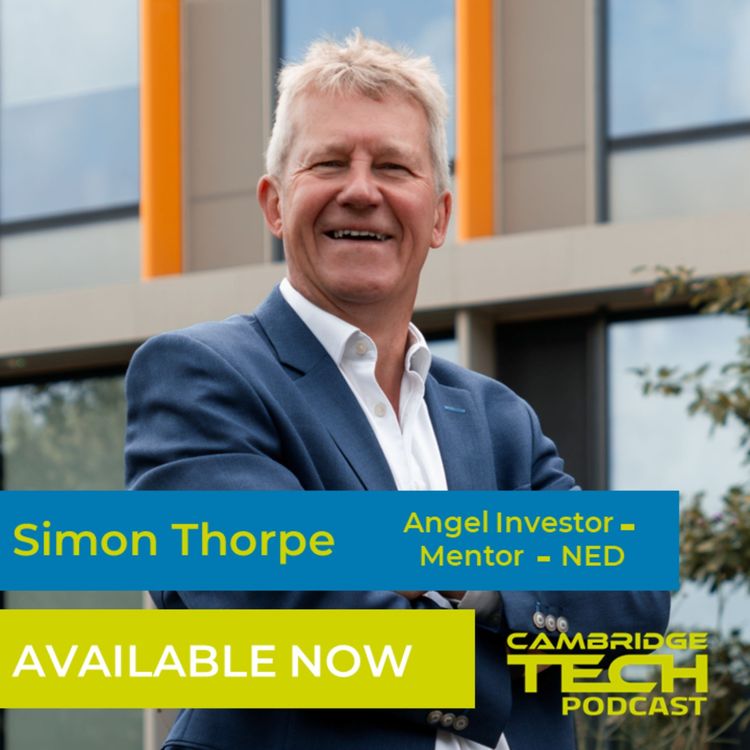
Team, Tech and Traction – insights from renowned Angel Investor Simon Thorpe
For our first anniversary 🎂🎉, we are joined by UK Angel Investor Simon Thorpe.
Simon talks to us about his portfolio and what he looks for in an investment. With 150-200 rounds in 60 companies and 10 successful trade exists under his belt, Simon discusses identifying investments and managing risk, advising his investments, and building relationships with his portfolio companies.
We discuss some interesting topics – does the UK sell tech companies too early? Should start-ups have revenue or not? And much more including some of the top themes from the first year of the podcast.
In this first episode of Series 2, we also have our first FOC charity advert at the end of the podcast, so stay listening to hear from this week’s charity – Form the Future CIC /Cambridge LaunchPad
Produced by Carl Homer
More episodes
View all episodes
185. Open source office productivity and how Collabora is leading the charge
27:32||Season 4, Ep. 185Michael Meeks joins us the week to talk about competing with Microsoft, and why Open Source Wins. Some of the highlights of our conversation include: On organic growth: "Unlike many VC-backed companies, we're organic, we're profitable and we have a mission which is to drive open source."The business model is counterintuitive but brilliant. By giving away free software, Collabora builds massive brand recognition and deployment. Users try it at home, fall in love with it, and when they need enterprise support, they know exactly who to call.On digital sovereignty: In an increasingly geopolitical world, Michael argues open source is the only path to true sovereignty. "The only way to have true digital sovereignty...is to use open source because then it is for the world. It is both local and a collaboration internationally."One of the most interesting technical insights: Collabora keeps documents on the server rather than downloading them to clients. This enables server-side policy enforcement - no copy-paste, no printing, no downloads, plus watermarking for traceability.Michael's remote-first approach is worth noting: rather than have some staff in an office and others remote (which creates two-tier communication), Collabora went fully distributed globally. They do maintain a Cambridge base with internships at Hills Road sixth form college, giving back to the community that shaped him.Whether you're a founder wrestling with funding strategy, a VC evaluating open source investments, or simply curious about how to build a profitable, mission-driven company without VC pressure, this episode delivers real insights.Ready to dive deeper? Download Collabora Office from your app store and listen to the full conversation on the Cambridge Tech Podcast. You'll leave thinking differently about competition, sovereignty, and what sustainable growth actually looks like.Headline sponsor Holden Polestar#CamTechPod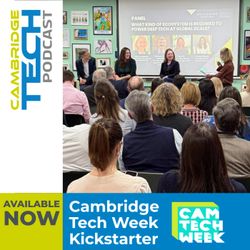
184. CamTechWeek: Why Deep Tech is Britain's Next Industrial Revolution
35:03||Season 4, Ep. 184Welcome to Cambridge Tech Week Kickstarter, the event that's putting Cambridge firmly on the global innovation map. This year's theme? How Deep Tech Changes the World. If you're a founder, investor, or tech enthusiast, tune in to find out more about the week, and to hear the panel discussion at the kickstarter event.The episode starts with updates from Kathryn Chapman (Innovate Cambridge), Rob Bridge (Cambridgeshire and Peterborough Combined Authority), Mike Short and Michaela Eschbach (Cambridge Wireless).We then cover the highlights of the panel discussion that asks “What Does a World-Class Deep Tech Ecosystem Actually Look Like?” Kathryn Chapman hosts, with panelists Professor Sir John Aston (University of Cambridge), Jo Slota-Newson (Almanac Ventures) and Lucy Yu (CEO, Centre for Net Zero, Octopus Energy Group). Cambridge isn't just another tech hub. It's a deliberate ecosystem where world-class research, creative thinking, and bold partnerships converge. The government is backing it. The talent is there. Will you be there to hear more during Cambridge Tech Week this September?
183. The Ryse Flow Story: Why Startups Must Go AI-Native
38:41||Season 4, Ep. 183The latest Cambridge Tech Podcast episode packed a punch with exciting announcements from the Cambridge ecosystem, followed by an in-depth conversation with Jean Michel Van, founder of Ryse Flow, a company building the next generation of AI-powered sales automation.The real gem of this episode is Jean Michel's journey from corporate product management to founding Ryse Flow. His story is refreshingly honest about the fears and decision-making that come with entrepreneurship.Jean Michel's background is unconventional. Born in Paris to parents who fled the Cambodian genocide, he spent 15 years in pharma and tech before making the leap to entrepreneurship. His early career in pharmaceutical finance eventually led him into tech through a pivotal acquisition role, where he discovered his passion for product management.After 15 years climbing the corporate ladder, Jean Michel reached a turning point. Rather than waiting for the ‘perfect idea’. he decided to take the leap.Ryse Flow's premise is compelling: AI won't simply be bolted onto existing software, it will fundamentally reshape how sales automation works."AI is going to disrupt most of the legacy players in the market in the same way cloud disrupted client-server implementations in the early 2000s."Jean Michel's strategy is pragmatic:· Currently leveraging 70% existing tools while building proprietary IP· Only pursuing paid pilots - ensuring customer commitment and real feedback· Maintaining a lean, self-funded team to preserve long-term decision-making autonomy· Already profitable despite being early-stageThis episode captures the real tension between corporate comfort and entrepreneurial ambition. Jean Michel's willingness to discuss both his fears and his conviction offers genuine insight for founders considering the leap. Tune in on your preferred podcast platform, and subscribe to join the weekly conversation. Headline sponsor Holden Polestar#CamTechPod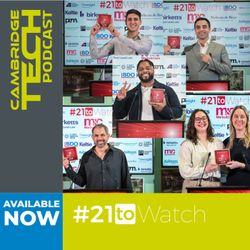
182. Cambridge's Next Generation of Deep Tech Innovators: Meet the #21toWatch Top21.2026
50:13||Season 4, Ep. 182Episode 182 features five of this year's #21toWatch winners - and if you're in the startup ecosystem, this one's unmissable.For those unfamiliar, for the last eight years #21toWatch has been high on the regions innovation showcase, and the numbers speak for themselves. Over eight cohorts, 168 companies have landed on the list and collectively raised a staggering £721 million. This year marks a particularly poignant milestone: its Faye's final year running the programme after creating it back in 2018. But we think you’ll agree, she's gone out with a bang.In this episode we talk to five of the winning companies:Cyclana Bio is tackling drug discovery from first principles, focusing on the extracellular matrix (the "biological dark matter" comprising 90% of your tissue). Lea Wenger explains how their multidisciplinary approach spanning Cambridge and Manchester is already attracting serious attention, with £5 million raised so far.Obasense is developing ultra-sensitive gas sensors for indoor air quality monitoring -particularly timely given the UK's new mould regulations. Founder, Osarenkhoe Ogbeide, is also building African mythology comics on the side!Myonerv is creating wearable neurostimulators for stroke rehabilitation. Sam Kourali's personal story - inspired by his cousin's stroke - drives a compelling business model targeting the US market's $60 billion opportunity.NANOPLUME just announced £2.2 million in funding for their bio-based aerogel thermal insulation. Three times more insulating than conventional materials, 60% lighter, and fully circular. Co-founder Tara Love says they're eyeing product launch within 18 months.Polytecks is mapping bioelectricity through flexible electrode arrays - starting with veterinary cardiology (dog heart disease affects over 80% of dogs) before moving to human diagnostics. Ruben Ruiz-Mateos Serrano tells us more.This episode captures something essential about where UK deep tech innovation is heading. These aren't incremental improvements - they're fundamental reimagining’s of how we solve problems in healthcare, climate tech, and industrial systems.Subscribe now and join the conversation. Because the next unicorn might just be one of these five.Headline sponsor Holden Polestar#CamTechPod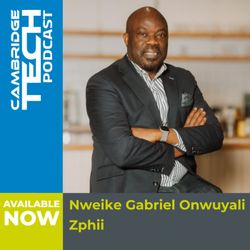
181. Reimagining the Creator Economy with Nweike Onwuyali, founder of Ziphii
32:30||Season 4, Ep. 181In this week’s episode, Nweike Onwuyali founder of Ziphii, suggests that technology companies are "fundamentally flawed" in their approach. They build tools for customers and their employees but often exclude the actual end-users who need to interact with the solution. Nweike proposes that most players either have advertising-centric DNA or remain stuck in the "tool mindset."Nweike wants to do something different with Ziphii which launches this month. The product "Webb" offers a unified digital home for individuals, solopreneurs, and creators. It integrates four pillars:1. Presence - your digital identity and portfolio2. Experiences - booking, blogging, contact management3. Commerce - built-in monetisation4. Community - owned audience managementIn addition to introducing “Webb”, the real heart of this episode is Nweike's journey and his vision for Ziphii. His story is compelling: from building websites in Nigeria in 2000 to scaling a 60-person enterprise software company, Nweike brings genuine perspective on how technology evolves.Headline sponsor Holden Polestar#CamTechPod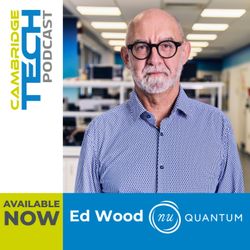
180. NuQuantum - The Missing Piece in Quantum Computing's Networked Future
40:12||Season 4, Ep. 180This episode reveals why quantum computing's next big breakthrough might not be about building better qubits, it's about connecting them together. NuQuantum's journey is a masterclass in pivoting based on market reality. "Quantum computing is reassuringly hard," Ed explains. "Whatever technique you pursue, there are different limits of scale. But pretty much every modality hits a point where you can't physically assemble enough qubits in a monolithic machine to solve valuable problems."The solution? Apply classic computing. Just as data centres rely on networking to make distributed computing work, quantum computers need interconnection to scale beyond their physical limits."No one company, probably no one country is going to dominate this. This is going to be a collective endeavour, woven together to make highly valuable, highly resilient solutions."With Series A funding secured, NuQuantum is on an aggressive expansion trajectory.Ready to dive deeper? Listen to the full episode on the Cambridge Tech Podcast to hear Ed's insights on scaling quantum systems, building diverse teams, and why decent coffee matters more than you'd think.Headline sponsor Holden Polestar#CamTechPod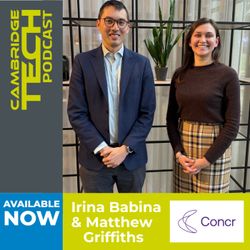
179. How Concr is Revolutionising Cancer Treatment Prediction
31:34||Season 4, Ep. 179Episode 179 hosts Faye Holland and James Parton sit down with Irina Barbina (CEO) and Matthew Griffiths (CTO) to unpick how Concr is using predictive modelling and digital twins to transform cancer drug development.Cancer data is fragmented. Clinical trials, pre-clinical research, and real-world patient data exist in silos. There's no unified way to predict how individual patients will respond to specific therapies, until now.Concr's technology borrows from astrophysics, specifically, how scientists model dark matter using gravitational lensing. The parallel is striking: Astrophysicists can't directly observe dark matter, so they build complex simulations to infer its distribution. Concr can't directly know why a drug worked for a patient, so they build digital twin simulations to predict outcomes.Key innovations:· Bayesian inference at scale to handle messy, incomplete cancer data· Hierarchical modelling that learns from shared biology across cancer types· 94% prediction accuracy on retrospective clinical trial data· Prospective validation underway with NHS partners and pharma companiesConcr dramatically reduces the cost and complexity of clinical trials. This episode brilliantly illustrates why Cambridge is a global innovation hub. It's not just about brilliant science, it's about brilliant people from different disciplines colliding, recognising patterns, and building companies that matter.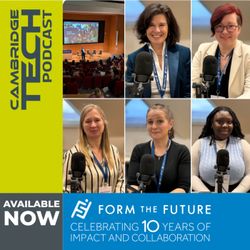
178. Young People and the Future of Work in the Age of AI, with Form the Future
38:18||Season 4, Ep. 178The latest Cambridge Tech Podcast episode tackles one of the most pressing challenges facing the tech industry today: how do we prepare the next generation for a world fundamentally reshaped by artificial intelligence? The Problem Is RealThe statistics are sobering. The UK has 700,000 unemployed graduates struggling to gain a foothold in the labour market. Young people aren't just worried about AI - they're confused and increasingly anxious about their futures. What makes this episode essential listening is the nuanced, multi-stakeholder perspective it brings, including Liz Tolcher, Associate Partner, PA Consulting; Ayeisha Kone-Massouma, Degree Apprentice Project Manager, Bidwells; and those noted below. The podcast brings together educators, employers, policymakers, and AI experts to explore three critical themes:1. Self-Knowledge Over SpecialisationAnne Bailey, CEO & Co-Founder, Form the Future emphasises that young people's greatest asset is self-awareness:"Your uniqueness, your humanity, your curiosity, your interest, your values - these are the things that should be the driving factors in thinking about what work you want to do in the future."2. Foundational Skills Matter MostAgnieszka Iwasiewicz-Wabnig FRSA, Director, Maxwell Centre, University of Cambridge, argues that critical thinking, ethical discernment, and mental agility are non-negotiable:"Invest in foundational skills, invest in exercising your mental capabilities and you will be competitive against any AI."Aga also raises an important tension: over-optimisation for productivity might actually stifle innovation. Without room for experimentation, there's no space for human creativity to thrive.3. Responsible AI Development for ChildrenMaria Luciana Axente, Founder & CEO, Responsible Intelligence, highlights that most technology isn't built with young people in mind. The UK's "age-appropriate design" legislation represents a breakthrough, but urgent action is needed to prioritise children in AI policy and design.Tune in on your chosen podcast platform to subscribe and listen. Headline sponsor Holden Polestar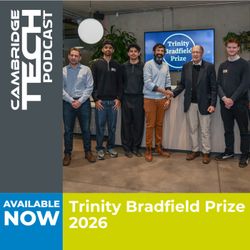
177. Trinity Bradfield Prize 2026: How Cambridge's Best Young Founders Are Solving Climate and Quantum
33:30||Season 4, Ep. 177The Trinity Bradfield Prize is back, and this year's cohort of winners is nothing short of brilliant. If you're a founder, investor, or simply someone who gets excited about deep tech solving real problems, this episode is essential listening.We’ll hear from this year's winners: GreenMixes, Maricene and Phase Shift. And also, from Pinepeak – a returning winner who this year won the Angel Prize.This isn't a feel-good competition recap. It's a masterclass in how rigorous evaluation, technical depth, and genuine community support can nurture founders solving the world's hardest problems. You'll hear directly from founders grappling with real challenges - resource constraints, market uncertainty, and the pressure of scaling - with refreshing honesty.The Trinity Bradfield Prize represents what's possible when universities, investors, and mentors work together to support deep tech innovation.Headline sponsor Holden Polestar