Share

Cambridge Tech Podcast
From Aerospace to Impact: How Rob Walden Built Ventures That Save Lives
Season 4, Ep. 187
•
This week we meet Rob Walden, co-founder of Euthasafe, and discuss his journey from aerospace engineering to the life-saving technology his team is developing right now.
More episodes
View all episodes
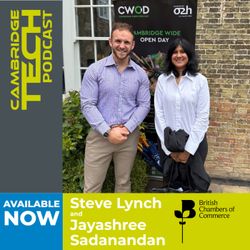
202. Breaking Into Asia: How UK Life Sciences Companies Are Finding Their Next Growth Market
33:34||Season 4, Ep. 202The latest episode of the Cambridge Tech Podcast features a fascinating panel discussion on international trade recorded live at this year’s Cambridge Wide Open Week.Steven Lynch, Director of International Trade at the British Chambers of Commerce (BCC), opens with a sobering statistic: whilst only 10% of British businesses export, the BCC's network achieves a remarkable 45%. This disparity represents a significant untapped opportunity. As Lynch points out, "If we increased UK exports by 2%, we could improve UK GDP by 0.6%."The problem isn't a lack of innovation or ambition; it's a delivery gap. UK founders and scientists often lack the business expertise and market clarity needed to confidently enter international markets. This is where the new trade accelerator comes in.Rather than offering generic webinars about exporting, the BCC has created something fundamentally different: an end-to-end, process-driven accelerator specifically targeting life sciences companies interested in Singapore.Singapore might not be the obvious first choice for UK startups - the US typically dominates - but it's positioned as a strategic gateway to Southeast Asia. With a population of 6 million, Singapore punches well above its weight as a hub for healthcare innovation and life sciences.Jay Sadanandan, a Singapore life sciences expert, highlights the market's unique advantages:The Health Sciences Authority recently launched a close collaboration with the UK's MHRA, enabling regulatory expediency for innovative technologiesAccess to world-class clinical research infrastructure and patient populationsSingapore's ambitious government vision to solve prevention through treatment across healthcareThe 10 selected companies span pre-seed to Series C stages and focus on areas where UK strength aligns with Singapore opportunity: genomics, molecular diagnostics, advanced therapeutics, and enabling technologies like biologic stabilisation. Importantly, companies aren't required to relocate or abandon UK operations. Instead, they use Singapore as a commercial testbed, a lower-risk environment to validate their business model before scaling across Asia Pacific, the US, or beyond.What's Next?The pilot launches in September 2026, but the ambitions extend far beyond Singapore. Lynch reveals plans to scale to Hong Kong, the Gulf, and other strategic markets. The ultimate goal? Moving from 15 businesses entering one market annually to 15 businesses entering different markets each month.For UK startup founders and investors watching the export opportunity, this episode offers genuine insight into how the next generation of British life sciences companies might achieve global scale, and why Singapore might be the launchpad you haven't considered yet.Listen to the full episode on the Cambridge Tech Podcast to hear the complete discussion, including audience Q&A and practical advice for companies considering international expansion.Headline sponsor Holden Polestar Produced by Cambridge TV #CamTechPod
201. Weekly News Drop – 17 July 2026
07:30||Season 4, Ep. 201Welcome to our new weekly news segment available on both our audio feed and a video version on our YouTube channel.Regular updates included Tech.uk and Cambridge Wireless, David Roach at Allia, the Internet Watch Foundation, and Unit M, Innovate Cambridge and podcast friend, Simon Thorpe.Headlines from this week’s news include: Erin Meryl McGurk and co-founder David Khachaturov, two founders from the University of Cambridge who are being backed by Y Combinator in Silicon Valley to build Egoist Machines. Cambridge video games company Infinity Fiction are raising cash and broadening their UK team from a local base under the guidance of a brother-founder team of Alex and Alastair Chamorro.Companies with locations in Cambridge, Milton Keynes and Stevenage are among the beneficiaries of the UK's escalating defence programme, backed by European allies. Cambridge Aerospace, Frankenburg Technologies and Greenjets have been awarded £3 million by the UK Ministry of Defence (MoD) to develop low‑cost interceptors designed to shoot down drones.ZeroAvia, a transatlantic leader in hydrogen-electric aviation, and Cambridge-based engineering company Marshall Aerospace are collaborating to develop hydrogen-electric capability for defence platforms.The Kings Award for Enterprise application window is now open until 8 September, and you can put in for one of four categories - international trade, innovation, sustainable development, or promoting opportunity through social mobility. There is also a fifth category of you’re an 18-25 year old entrepreneur. Tune in on Tuesday as normal for our next interview – this time recorded during Cambridge Wide Open Week with the British Chambers of Commerce as they shared details of a trade mission to Singapore.Produced by Cambridge TV #CamTechPod
200. Pragmatic Semiconductor's Vision in Britain's Tech Future
56:07||Season 4, Ep. 200Cambridge Tech Podcast hits a significant milestone this week with its 200th episode, and they marked the occasion by revisiting Pragmatic Semiconductor, the company that featured in their very first show. This time, co-founder and CTO Richard Price joined hosts Faye Holland and James Parton to discuss how the company has evolved from a scrappy six-person startup in a Cambridge shoebox office to a 300-strong powerhouse reshaping the semiconductor industry.Richard Price's journey is a masterclass in deep tech entrepreneurship. Starting with a chemistry kit that "ruined a number of carpets" as a child, he progressed through organic light-emitting diode research before co-founding Pragmatic in 2011 with Scott White and four other talented founders.Richard shared with us details of some of their key innovations:Thin-film semiconductor layers on flexible substrates (not silicon-based)Manufacturing cycle times measured in days, not monthsLower temperatures, less water, fewer chemicals = genuine sustainability benefitsCurrent applications in RFID smart labels for anti-counterfeiting and EU digital product passport complianceThe roadmap is ambitious. Generation 3 chips launch this year, followed by a CMOS platform at the end of next year, the first complementary metal oxide semiconductor offering from the company. Beyond that lies the "fab as a service" model, potentially deploying manufacturing facilities globally to compress supply chains and boost resilience.For founders and VCs, Pragmatic's story offers valuable lessons: the importance of finding the right co-founder (Richard and Scott have been together 15 years), the critical role of ecosystem and location, and the patience required to build deep tech companies.Headline sponsor Holden Polestar Produced by Cambridge TV #CamTechPod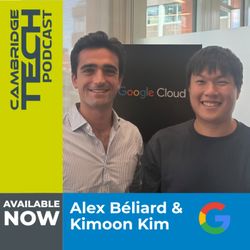
199. How Google supports the Cambridge Tech Ecosystem
39:35||Season 4, Ep. 199The latest episode of the Cambridge Tech Podcast reveals a fascinating trend in the tech ecosystem: some of the most impactful people supporting startups today are themselves former founders who've made the leap into major tech companies. In this week's episode, hosts James Parton and Faye Holland speak with Alexandre Béliard and Kimoon Kim from Google who are transforming how early-stage companies access world-class technical and financial support.Whether you're bootstrapping or scaling with serious funding, this conversation will show you exactly where to find the support you need.Listen to the full episode on the Cambridge Tech Podcast and find Alex and Kim on LinkedIn to explore how Google can support your startup's growth.And for aspiring Googlers, the pair offered refreshingly honest insights into the notoriously competitive interview process.Headline sponsor Holden Polestar Produced by Cambridge TV #CamTechPod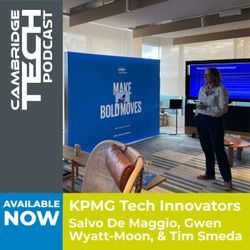
198. Inside KPMG's Tech Innovator Competition
34:54||Season 4, Ep. 198This week's show features Salvatore DiMaggio from KPMG, alongside the Tech Innovators East of England’s competition winners Gwen Wyatt Moon (Prospectral) and runner-up Tim Smeda (Hypergen).Prospectral is transforming industrial computer vision by bringing material inference to production lines in real-time - they've already secured paid pilots with Rio Tinto and the Singapore government.Hypergen is solving a different problem entirely, making micro gas turbines viable for industrial power generation by running them 300-400°C hotter than competitors. Both founders credit Cambridge and Cranfield's startup ecosystems with accelerating their learning curves. Key takeaways:Accelerators work best for mentorship and training, not just capitalUniversity connections unlock validation resources (Hypergen used Cranfield's Innovation Voucher to validate their concept)The ecosystem is bidirectional - founders benefit from and contribute back to their communitiesWhat Happens NextProspectral is closing a £3.3M funding round and hiring business development talent who understands camera ecosystems.Hypergen is securing corporate manufacturing partnerships to avoid capital-heavy production and hiring electronics engineers before their pilot launch by year-end.The competition itself continues to the London final where Gwen will pitch again, and the UK winner advancing to the global KPMG Tech Innovator event in Portugal in November.Headline sponsor Holden Polestar Produced by Cambridge TV #CamTechPod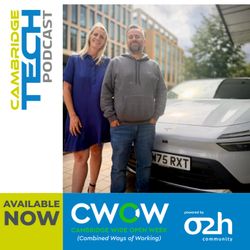
197. CWOD on the road with Holden Polestar
38:23||Season 4, Ep. 197The long-awaited on-the-road-in-a-Polestar episode is finally here! Tune in as normal - but this time, check out our YouTube channel - there's video too. We took you behind the scenes of CWOD: Prashant Shah opens the day with us, navigating the Cambridge innovation landscape as we drive through the city. He also reveals the launch of the Cambridge Stock Exchange - find out more about Pisces on their LinkedIn page. Martin Frohock (Aveva) tells us about the development of 101 Cambridge Science Park as their new global HQ. Who knew Aveva was the first spinout from the University of Cambridge? David Roach explains why Allia gets involved in CWOD, showcasing their tenants to the wider community. Including a catch-up with Hayden Salway (Clarity Sensors) on their progress since The Trinity Bradfield Prize, and Tim Hill (Orca Scan) updates us on their impressive growth. Jonathan Goodacre (Keltie) rounds things out - he was involved in all five days of CWOD and is a great demonstration of how the broader ecosystem supports innovation. And there’s a little more insight into your co-hosts too Listen (and watch) now on all major platforms. Headline sponsor Holden Polestar – The car! The car!Produced by Cambridge TV#CamTechPod
196. Cambridge Tech Growth at a Pivotal Moment
32:56||Season 4, Ep. 196This week on Cambridge Tech Podcast, we sit down with Dan Thorp, CEO of Cambridge Ahead, to dig into the freshly published Cambridge Economic Overview (CamEO) Report - and the picture is more complicated than the headlines suggest.The positives are real: 281 equity deals between 2020–2024 (the highest of any UK location outside London), three of the five biggest UK biotech VC deals in Q1 2026 from Cambridge companies, and meaningful government commitments - the Development Corporation, and the AI Hardware plan featuring ARM and Common AI.But the data has a sting. New company formation has dropped nearly 50% - from an average of 1,129 companies a year (2013–2019) to just 620 in 2024–2025. Knowledge-intensive employment recorded its first annual decline since Cambridge Ahead began tracking in 2011. And businesses are increasingly citing access to scaling capital - not just talent, housing, and transport - as a real constraint.What makes the CamEO distinctive is its insistence that success shouldn't be measured in GDP alone. Housing access, employment pathways, and mental health support for young people matter too. Programmes like Form the Future and Included are doing important work - but need sustained, coordinated funding to deliver at scale.Dan's bottom line? "There is no other place quite like Cambridge to innovate and to scale tech companies." The fundamentals hold. 🎧 Listen now on all major platforms.Headline sponsor Holden Polestar Produced by Cambridge TV #CamTechPod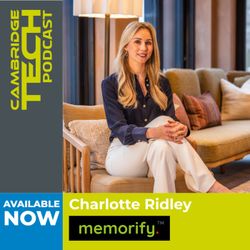
195. Memorify: How Charlotte Ridley Is Building the Home for Your Digital Memories
38:43||Season 4, Ep. 195What happens to your photos, videos, and digital memories when you die? If you're storing them with Apple, Google, or any of the major tech platforms, the answer may surprise, and disturb, you. This week, Faye sits down with Charlotte Ridley, founder and CEO of Memorify Technologies, for one of the most personal and purpose-driven founder stories the Cambridge Tech Podcast has featured. It's a conversation about grief, parenthood, AI, wellbeing, and the very human need to feel connected to the moments that shape us.Charlotte's story begins in 2021, when her father passed away unexpectedly while she was four months pregnant. In the time that followed, she found herself battling Apple and Google for access to his digital memories, and losing. The experience didn't just break her heart. It planted the seed for an entirely new category of technology.Memorify is an AI-powered memory platform - "the home for your digital memories." The app monitors your camera roll with your permission, identifies meaningful photos and moments, curates the best of them, and writes rich narrative summaries of your experiences. Memories are then stored securely, with guaranteed access for up to 100 years after death. Memorify is private, intentional, and rooted in authenticity everything social media has moved away from.Three failed Innovate UK grant applications before winning the fourth, for ethical and impactful novel AI. The pre-seed round was oversubscribed - raising over £420,000 against an initial target of £200,000 - backed by Sheffield Angels, Anglia Capital Group, and FundmyPitch. Memorify is also supported by the London Stock Exchange Group and Innovate UK's high-growth business programme. The seed round opens in early September 2026."Humanity has never documented so much of its life, yet never felt so disconnected from its memories."Listen to the full episode on the Cambridge Tech Podcast and subscribe for weekly updates on the region's most exciting founders and innovations - available on all major platforms.Headline sponsor Holden PolestarProduced by Cambridge TV#CamTechPod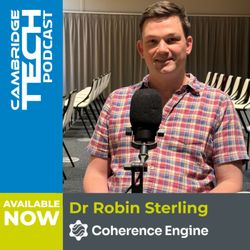
194. Inside Coherence Engine with Founder, Robin Sterling
24:56||Season 4, Ep. 194Robin Sterling started his PhD 20 years ago when useful quantum computers were "at least 10 years away." He's seen the field go from academic curiosity to venture-backed race - with companies like Quantinuum and Riverlane demonstrating things that once felt like pipe dreams. But he's candid: today's systems are still orders of magnitude smaller than what's actually useful.Right now, quantum systems are just small enough that engineers can manage complexity with Python scripts and intuition. Make them 100x bigger - which is what the industry needs - and that stops working entirely. Robin talks about how we’re at the same wall classical computing hit in the 1980s, when CPU design had to be automated. Enter Coherence Engine: The company builds system-level simulation and validation software for quantum hardware. The goal: let quantum engineers design, simulate, and validate their next-generation systems before buying a single piece of hardware. Think of it as CAD tools for quantum computers.Founded in August 2024, with pre-seed funding secured in January 2025, Coherence Engine was built with the support of Cambridge Future Tech (CFT) - the deep tech venture builder based at the Bradfield Centre. Robin credits CFT as instrumental in turning his idea into a fundable, scalable company, particularly as a solo founder coming off the back of a previous unsuccessful startup.Tune in to hear this and more, and subscribe on all major podcast platforms. If you enjoyed this episode, a five-star review goes a long way - it helps more people discover the show.Headline sponsor Holden PolestarProduced by Cambridge TV#CamTechPod