Share

Cambridge Tech Podcast
UK Government Spin Out Review with Andrew Williamson, Cambridge Innovation Capital
In this week’s episode, Andrew Williamson, Managing Partner of Cambridge Innovation Capital (CIC), shares his insights on the UK government’s spin-out review and the evolving landscape of venture capital in Cambridge.
Some standout moments include:
• The importance of proof-of-concept funding: Andrew highlights the critical need for proof-of-concept funding to bridge the gap between fundamental research and commercialisation. He states, “Proof of concept funding is essential for advancing technology far enough to attract both large corporations and investors.”
• Evolving equity terms: The conversation touches on the need for universities to adopt more founder-friendly equity terms. Andrew notes, “The sentiment in the sector has improved, and we’re starting to see equity allocations fall, which is encouraging for founders and investors alike.”
• Celebrating entrepreneurship: Andrew emphasises the importance of promoting entrepreneurship as an aspirational career path. He reflects, “We need to do a better job of celebrating our entrepreneurs and the breakthroughs they achieve.”
Produced by Cambridge TV
More episodes
View all episodes

236. Weekly News Drop - 20 November 2026
02:34||Season 5, Ep. 236Cambridge Tech Podcast Weekly News Drop - 20 November 2026The weekly Tech news roundup from in and around the Cambridge Tech cluster. Featuring Sqwish Labs, Cambridge Enterprise Ventures, University of Cambridge, Parkwalk, Innovate UK, Global Inkjet Systems, QTREX Quantum, St John’s Innovation Park, St8, HoriZn, Cambridge Tech Week, Amali de Alwis.Produced by Cambridge TV #CamTechPod
235. Building Entrepreneurs with I/E Cambridge
26:02||Season 5, Ep. 235Helen Alexander from I/E Cambridge Innovation & Entrepreneurship is back on #CamTechPod. Last time we talked about the recent postdoc competition, which had its final last week. This time we look at the bigger picture.We start with Helen’s career path and how she got into entrepreneurship. Then we get an overview of I/E Cambridge, and how it works with Cambridge Enterprise to support founders across the University.With Global Entrepreneurship Week on this week, we talk about how the University is using it to show the full range of support for would-be entrepreneurs.That leads to the new “At Cambridge I can” campaign. The idea is simple: people come to Cambridge for academic excellence, but they can also build entrepreneurial skills or start a venture while they’re here. The campaign grew out of an I/E workshop. We cover how it was put together and look at a couple of case studies. The point is that there isn’t just one route.So what makes entrepreneurship at Cambridge different? We talk about having a safe space to take risks, the networks and mentors, and the infrastructure: programmes, competitions, and hubs like Innovate Cambridge’s The Glasshouse, St John’s Innovation Centre, and of course, The Bradfield Centre.To finish, we talk about how Cambridge works with other universities and shares best practice. We also cover the entrepreneurship programmes open to people outside the University, and give a plug for the I/E Expo taking place next week.Oh, and ginger nut biscuits, which side are you taking?Headline sponsor Holden Polestar Produced by Cambridge TV #CamTechPod
234. Weekly News Drop - 13 November 2026
02:18||Season 5, Ep. 234Cambridge Tech Podcast Weekly News Drop - 13 November 2026The weekly Tech news roundup from in and around the Cambridge Tech cluster. Featuring The UK Quantum SuperConnector, Imperial College London, University of Bristol, University of Cambridge, Glasgow University, Oxford University, UK Research and Innovation, The Maxwell Centre, Dr Aga Iwasiewicz-Wabnig, Professor Mete Atature, The Cavendish Laboratory, Luminance, Anthropic, Delta-T Devices, Senceive, Network Rail, Helen Alexander, i/e cambridge, Entrepreneurship Week.Produced by Cambridge TV #CamTechPod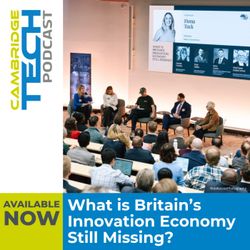
233. What is Britain's Innovation Economy Still Missing?
44:45||Season 5, Ep. 233What does it take to build a world class innovation ecosystem? More than brilliant research, ambitious founders and a fresh strategy. It takes connections that help ideas, capital and talent move where they can make the biggest difference.In this episode of the Cambridge Tech Podcast, Faye Holland and James Parton introduce a candid panel recorded at The Cambridge x Manchester Partnership Innovation Summit held at the start of October 2026. The Partnership brings the two cities together to accelerate growth, help companies scale and make sure the benefits of innovation reach more communities.Chaired by Fiona Tuck of Metro Dynamics, the discussion brings together Professor Dame Jessica Corner of Research England, Harriet Gordon of No. 10 North, Dom Hallas of Startup Coalition and Steven Lynch of the British Chambers of Commerce. Their challenge: identify what Britain needs to compete globally and turn innovation into lasting economic value.In this episodeCollaboration beyond city limits. Corner describes the partnership as an experiment in connecting innovation ecosystems that are not neighbours. Its potential lies in bringing universities, businesses, investors and local authorities together, then learning what other places can replicate.What founders actually need. Hallas puts the essentials plainly: talented people, money and a regulatory environment that lets companies build. Sales skills and investment terms matter too. Support should solve real problems without adding unnecessary complexity.Capital across the journey. Hallas argues that the UK needs investment at every stage, from early ideas to established companies ready to scale. He also makes the case for more UK pension capital to reach British businesses.Think global from the start. Lynch argues that international trade should be embedded in business planning, not treated as an afterthought. Established smaller businesses have an important role in adopting technology, joining supply chains and reaching new markets.Make growth tangible. Gordon asks how innovation can translate into outcomes people recognise, from faster cancer diagnoses to better apprenticeship opportunities. Devolution, she argues, must change how decisions are made, not simply where they are made.Build the foundations. Housing, lab space, energy, water and transport can all constrain growth. The panel also calls for stronger links between research, manufacturing, supply chains and local economies, so more value stays in the places that help create it.Expect a frank conversation about founder support, patient capital, practical collaboration and the infrastructure needed to turn ambition into action. Listen to the episode for the full discussion, and subscribe to the Cambridge Tech Podcast for more ideas from the people building the UK’s technology future.Headline sponsor Holden Polestar Produced by Cambridge TV #CamTechPod
232. Weekly News Drop - 6 November 2026
02:54||Season 5, Ep. 232Cambridge Tech Podcast Weekly News Drop - 6 November 2026The weekly Tech news roundup from in and around the Cambridge Tech cluster. Featuring University of Cambridge, Illumion, Cambridge Angels, Cambridge Enterprise Ventures, Foresight Group, ZEISS Ventures, Christoph Schnedermann, Echion Technologies, Arm, Amazon, Microsoft, Google, Cambridge Pixel, EURONAVAL, Katie Yeo, Inspire 2 Ignite CIC, The Cambridge x Manchester Partnership Summit.Produced by Cambridge TV#CamTechPod
231. How VetCT Is Building the Future of Veterinary AI
29:07||Season 5, Ep. 231From Bootstrap to Breakthrough: How VetCT Is Building the Future of Veterinary AIIn this episode of the Cambridge Tech Podcast, hosts Faye Holland and James Parton meet Dr Victoria Johnson, founder and CEO of VetCT. Victoria shares how she turned a shortage of veterinary radiology expertise into an international business, why she bootstrapped for around 15 years, and how the company is exploring AI with radiologists firmly in the loop.Inside the episodeSpotting the opportunity: As digital imaging and animal CT scanners became more accessible, vets needed specialists who could interpret the results. VetCT built a service that connects veterinary practices with radiologists working remotely.Technology meets expertise: Vets send digital images to VetCT, where radiologists interpret them and return reports to support patient care. The model depends on both specialist knowledge and a platform that makes the process work smoothly.Building without venture capital: Victoria initially funded the business by carrying an ultrasound machine between practices in East Anglia. She explains how bootstrapping offered freedom and control, while requiring each stage of growth to pay for itself. VetCT took minority investment in 2023 to support technology and growth.Making data useful: VetCT has retained anonymised imaging data and expert reports dating back to 2009. Working with the University of Cambridge and its own AI team, it is exploring how that resource could support diagnostic insights and faster case triage.Keeping humans central: Victoria says AI tools will support radiologists rather than replace them. She describes patient safety and accuracy as essential benchmarks, alongside the potential to prioritise urgent cases.Navigating a changing market: Consolidation has brought larger veterinary contracts, but also pressure on margins and payment terms. Victoria reflects on rapid international growth, pandemic disruption and the challenges of scaling a specialist service.Finding the right ecosystem: Collaboration with Cambridge researchers has helped VetCT access expertise it could not easily build alone. Victoria also makes the case for bringing more bootstrapped founders into the wider innovation community.Listen to the full episode for an honest look at building a global business, finding value in specialist data and applying AI where accuracy matters. Subscribe to the Cambridge Tech Podcast for more conversations with the people building and backing the next generation of technology.Headline sponsor Holden Polestar Produced by Cambridge TV #CamTechPod
230. Weekly News Drop - 30 October 2026
01:32||Season 5, Ep. 230Cambridge Tech Podcast Weekly News Drop - 30 Oct 2026The weekly Tech news roundup from in and around the Cambridge Tech cluster. Featuring Quantinuum, Rajeeb Hazra, Plextek, King’s Award for Enterprise in Innovation, The European Space Agency, Brent Hudson, Victoria Johnson, VetCT..Produced by Cambridge TV #CamTechPod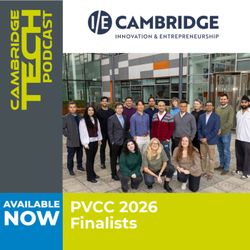
229. PVCC 2026: Seven Founders to Watch
36:36||Season 5, Ep. 229The Cambridge Tech Podcast goes inside the Postdoc Venture Creation Challenge (PVCC), to meet seven University of Cambridge teams turning rigorous research into investable ventures. Hosted by Faye Holland and James Parton, this episode is a snapshot of where the next wave of Cambridge innovation is forming: construction intelligence, regenerative medicine, industrial biotech, robotics, grid analytics, battery circularity and climate resilience.What you will hearCamentis, led by Dr Ashan Senel Asmone, is piloting a construction data platform that gives site leaders earlier visibility of productivity risks, helping prevent delays and cost overruns.A therapeutics company, led by Dr Jin Seok Lee, is developing a temporary mRNA signal designed to help heart muscle cells regenerate. The team is progressing from encouraging animal data towards further preclinical studies.DroplexBio, led by Brian Ng, uses RNA nanotechnology to create compartments inside bacteria, aiming to make commercially valuable proteins that are difficult to manufacture today.Haptos Technology, led by Zhuo Chen, is building electronic skin for robots. Its sensors capture pressure, temperature, texture and slip, with industrial robotics as the first market before wider applications in care, agriculture and surgery.Loom Light, co-founded by Dipanshu and Leonie Muck, provides grid risk intelligence for renewable projects, lenders, insurers and infrastructure investors.PeatWaterWise, co-founded by Dr Neha Joshi and Dr Hamid Rahimi, combines satellite data and hydrological modelling to help farmers and land managers understand water tables without manual dip well measurements.MetCycle, founded by Esther Gray, is developing a room temperature process to recover critical metals from used batteries, with potential to fit into existing recycling operations.For founders and investors, the recurring lesson is clear. Great science is only the starting point. The teams making progress are validating urgent customer problems, narrowing their first market and using mentors to turn technical capability into a compelling commercial story.With the PVCC Grand Finale approaching, this is an early look at founders building technologies with the potential to reshape major industries. Listen for practical insight on commercialising research, then subscribe to the Cambridge Tech Podcast to follow the next generation of deep tech companies as they move from breakthrough to business.Headline sponsor Holden Polestar Produced by Cambridge TV #CamTechPod
228. Weekly News Drop - 23 October 2026
02:48||Season 5, Ep. 228Cambridge Tech Podcast Weekly News Drop - 23 Oct 2026The weekly Tech news roundup from in and around the Cambridge Tech cluster. Featuring University of Cambridge, IonQ The Ray Dolby Centre, The Cavendish Laboratory, Speechmatics, NVIDIA, Anglia Ruskin University, TWI, Innovate UK, Charlotte Ridley, Memorify, Kodak Moments, UKRI, Department for Business and Trade, Innovate Cambridge, Pascal Levensohn, Cambridge Innovation Capital, Postdoc Venture Creation Challenge, ie cambridge, Cambridge Enterprise.Produced by Cambridge TV #CamTechPod