Share

Cambridge Tech Podcast
All things Cambridge Tech
Latest episode

224. Weekly News Drop - 9 October 2026
02:49||Season 4, Ep. 224Cambridge Tech Podcast Weekly News Drop - 9 October 2026The weekly Tech news roundup from in and around the Cambridge Tech cluster. Featuring Reclinker, Adviisa, Zenithon and QPT.Produced by Cambridge TV#CamTechPod
More episodes
View all episodes
223. The (UK) Deep Tech Playbook
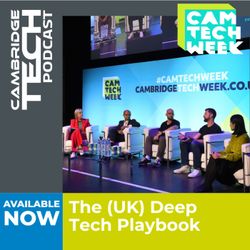
44:49||Season 4, Ep. 223From Cambridge Tech Week 2026: The (UK) Deep Tech PlaybookThe UK has the research, talent and capital to create category defining deep tech companies. The missing piece is a more connected system that turns breakthrough science into globally scaled businesses while keeping more of the economic value in the UK.In this Cambridge Tech Podcast panel, Joanne Hosker of Northern Gritstone is joined by Tom Adeyoola, Executive Chair of Innovate UK, Bradley Jones, founder and CEO of ThatRound, Owen Thompson, CEO of Cambridge Future Tech, and Dr Christina Yan Zhang, CEO of The Metaverse Institute. Together, they unpack the practical shifts needed to make the UK a stronger launchpad for founders building in fields such as quantum, AI, climate technology and advanced engineering.The conversation challenges a familiar assumption: that UK deep tech lacks capital. The panel argues that the issue is less about the total amount of money available and more about how confidently investors understand technical risk, how effectively funding connects with founders, and how incentives keep high value companies rooted in the UK.What you will hearWhy the UK’s world class science base needs stronger commercial pathways, not just more research fundingHow founders can adapt their pitch for different markets while keeping a genuinely global ambitionWhy early stage deep tech must be evaluated differently from software businesses with immediate revenueWhat investors look for when product market fit is still emerging, including defensibility, market access, resilience and coachabilityHow government procurement could become a major growth engine for UK innovationWhy employee ownership, exited founders and angel reinvestment can create a more circular capital ecosystemWhere US expansion makes sense, and why a UK research and development base can remain strategically valuableThis is a sharp, practical listen for founders, investors and operators who want to help build the next generation of UK deep tech leaders.Headline sponsor Holden PolestarProduced by Cambridge TV#CamTechPod
222. Weekly News Drop - 2 October 2026
02:43||Season 4, Ep. 222Cambridge Tech Podcast Weekly News Drop - 2 Oct 2026The weekly Tech news roundup from in and around the Cambridge Tech cluster. Featuring Cambrionix, Intralink, Raspberry Pi, Chinese International Economic Cooperation Association, Innovate Cambridge, Cambridge Enterprise, Cambridgeshire and Peterborough Combined Authority, Cambridge Innovation Capital, Paragraf, EPSRC, Hannah Goldsmith, The Centre for Computing History.Produced by Cambridge TV #CamTechPod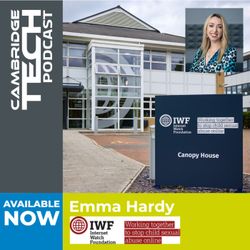
221. The Internet Watch Foundation: How Tech Can Protect Children Online
27:37||Season 4, Ep. 221Please note this episode covers some difficult topics, specifically the issue around child sexual abuse, which some listeners may find distressing. Listener discretion is advised.In this episode of the Cambridge Tech Podcast, hosts Faye Holland and James Parton speak with Emma Hardy, Communications Director at the Internet Watch Foundation, about the fast-moving fight to prevent child sexual abuse online.Emma brings a clear message for founders, investors and product leaders: safety cannot be an afterthought. From generative AI to user generated content, every new capability can create opportunities for harm as well as value. The strongest companies consider both from day one.The Internet Watch Foundation, or IWF, is a UK charity that identifies and works to remove online child sexual abuse imagery. Its teams combine specialist human judgement with technical tools, intelligence and partnerships across industry, government, law enforcement and academia. Emma explains how digital fingerprints, known as hashes, can help prevent previously identified imagery from being uploaded again on participating platforms.“Build it safe from the start. Don’t try and retrofit safety.” For startups and tech companies, the practical takeaway is simple: build safety into the product, the business model and the operating culture. Emma encourages teams to examine how an idea could be misused before it reaches scale, rather than attempting to retrofit protections after harm has occurred. The IWF can support organisations, particularly those handling user generated content, with expertise and services designed to make platforms safer.This is an essential listen for anyone building, backing or governing technology. Subscribe to the Cambridge Tech Podcast for candid conversations with the people shaping safer, smarter innovation across the UK tech ecosystem.Headline sponsor Holden Polestar Produced by Cambridge TV #CamTechPod
220. Weekly News Drop - 25 September 2026
02:57||Season 4, Ep. 220Cambridge Tech Podcast Weekly News Drop - 25 September 2026.The weekly Tech news roundup from in and around the Cambridge Tech cluster. Featuring Cambridge Vacuum Engineering (CVE), Cambridge Atomworks, Riverlane, Discovery District Maryland, Kendall Square, Boston, University of Maryland, British Business Bank, Andrew Cock-Starkey, Optimisey, Internet Watch Foundation.To submit your own news, visit https://www.cambridgetechpodcast.com and click "Call the Show"Produced by Cambridge TV#CamTechPod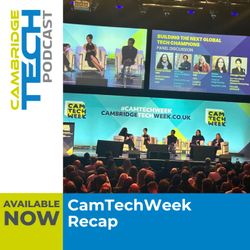
219. Cambridge Tech Week 2026: Where Ecosystems, Capital and Big Questions Converge
25:40||Season 4, Ep. 219Cambridge Tech Week has firmly earned its place as a must-attend moment for the UK innovation community. In the latest Cambridge Tech Podcast, hosts Faye Holland and James Parton are joined by Cambridge Angels Emmi Nicholl to reflect on a packed week of founder conversations, investor insight and the big questions shaping the sector.The Week retained its distinctive Cambridge energy: busy, organic and full of chance encounters. Alongside familiar faces were new connections across manufacturing, defence, security and international innovation ecosystems.Innovation Alley was once again a phenomenal success with one founder describing the session with Cambridge Angels “the most productive 25 minutes they had spent all year”.The Cambridge x Manchester Partnership offered tangible evidence of cross-cluster momentum, with four joint investments already spanning therapeutics, technology and life sciences. The lesson for founders is that regional networks are becoming increasingly connected, and a broader investor base may be closer than it appears.One of the week’s most compelling discussions examined the increasingly blurred boundary between civilian and military technology. The debate did not offer easy answers, but it made the need for active governance impossible to ignore.For technologists, the challenge is not only what can be built, but what should be built, and how companies set ethical boundaries as dual-use applications emerge.During the rest of 2026, #CamTechPod will be covering some of the key sessions from #CamTechWeek so subscribe on all major podcast platforms or visit cambridgetechpodcast.com to hear more of the conversation. Headline sponsor Holden Polestar Produced by Cambridge TV #CamTechPod
218. Weekly News Drop - 18 September 2026
02:01||Season 4, Ep. 218Cambridge Tech Podcast Weekly News Drop - 18 September 2026.The weekly Tech news roundup from in and around the Cambridge Tech cluster. Featuring Cambridge Tech Week, CWConnected, Echion Technologies, and Cambridge Enterprise.Produced by Cambridge TV#CamTechPod