Share
Build Like an Ancient
Build Like an Ancient Trailer
•
If you've listened to Build Like a Roman, now you can step back and see the bigger picture.
Welcome to Build Like an Ancient. Each season, we dive into the materials, methods, and the people behind ancient history's greatest buildings and their builders - from the Greeks to the Egyptians, the Inca to the indus.
If you loved exploring Roman construction, this is your chance to discover how the rest of the ancient world built.
Subscribe now and join us on Build Like an Ancient.
ktwsba7h
Apple
https://podcasts.apple.com/us/podcast/build-like-an-ancient/id1887035779
Spotify
https://open.spotify.com/show/312nAy9fvUvZaQbc2TWbFm?si=LF-PiVspT_mxLtZB9Bd-wA
More episodes
View all episodes
3. Build Like an Egyptian: Mud, Men and Monuments
18:34||Season 1, Ep. 3The Egyptian - Mud Men and the First Monuments!To the surprise of many people, the ancient Egyptians built far more in sun dried mud-brick, than they ever id in monumental stone.See our photos on Instagram for this episode https://www.instagram.com/p/DW2YHHJiBpChttps://en.wikipedia.org/wiki/Pyramid_of_Djoserechnical Glossary: Egyptian Mudbrick & PlasterDb.t: The Egyptian word for mudbrick. Often written with the brick determinative. Refers to the material itself, not just the shape.Hib: Egyptian term for a refined clay plaster, often mixed with powdered limestone. Smoother and brighter than plain mud plaster.Mastaba: Arabic for "bench." The modern term for the flat-topped, rectangular tombs of the Early Dynastic and Old Kingdom periods.Battered wall: A wall that slopes inward as it rises. Increases stability and sheds water.Nile alluvium: The clay-rich silt deposited by the annual Nile flood. The base material for mudbrick.Temper: Material (sand, straw, chaff) added to clay to reduce shrinkage and improve drying.Gypsum plaster: A plaster made from calcined gypsum (calcium sulphate). The dominant finishing plaster in Pharaonic Egypt due to low firing temperature and suitability in dry climates.Lime plaster: Plaster made from calcined limestone (calcium oxide). Requires higher firing temperatures (700-900°C). Rare before the Ptolemaic period.Stratigraphy: In plaster analysis, the sequence of layers. Egyptian plasters show deliberate layering: coarse mud base, fine clay levelling, gypsum finish.Silt (The Bulk): This is the "Goldilocks" particle size—smaller than sand but larger than clay. It provides the volume.Clay (The Binder): Pure Nile silt actually contains about 30% to 50% clay. This is the "glue." Without the clay content, the bricks would just crumble into dust once they dried.Organic Matter: The Nile "mud" was rich in decomposed plant matter, which acted as a natural plasticiser, making the mix easier to mould. It also helped (marginally) with tensile strength
2. Build Like a Greek - Before They Were Made of Stone
11:19||Season 1, Ep. 2The Greeks - Before they built with stone!The ancient Greeks are famous for the influential architecture of white marble. But from where did they get the inspiration for their buildings?In this episode, we look at the much earlier buildings of the Greeks, and the transition to stone.See our photos on Instagram for this episode https://www.instagram.com/p/DWQkvleiFaa/Have a look at three of the best preserved early Greek temples in the world, and they aren't in Greece! https://en.wikipedia.org/wiki/PaestumTriglyphs: The vertical blocks you see on a Doric temple are stone carvings representing the ends of wooden ceiling beams.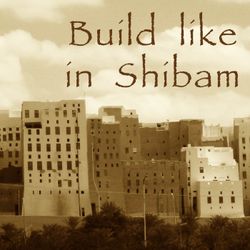
1. Build Like in Shibam - The Manhattan of the Desert
09:36||Season 1, Ep. 1The Manhattan of the DesertIn this, our first episode of both Build Like and Ancient and Build like in Shibam, we look at the adobe construction of the Yemeni city of Shibam.Photos of Shibam: See our Instagram for this episode https://www.instagram.com/p/DWJjX3MCFY/DefinitonsHadhramaut: The historical region in Eastern Yemen where the "death-defying" desert climate forced builders to become master vertical engineers.Wadi: A dry riverbed that stays parched most of the year but transforms into a destructive, building-melting sea during monsoon floods.Sources:Jerome, P., Chiari, G., and Borelli, C. (1999). "The Architecture of Mud: Construction and Repair Technology in the Hadhramaut, Yemen." APT Bulletin: The Journal of Preservation Technology, Episode 2: The Chemistry of the Vertical DesertLewcock, R. (1986). The Old Walled City of San'a' (and Shibam). UNESCO.Al-Radi, S. (1985). "The Architecture of the Hadhramaut." Colloquium on the Art of the Islamic World.ktwsba7h