Share
Epic Everyday
The Buddha Story That Explains Karma
Season 1, Ep. 11
•
What is karma, and how does it shape your life?
In this timeless Buddhist story, Gautama Buddha explains the true meaning of karma and the law of cause and effect through a simple yet powerful lesson. Discover how your thoughts, words, and actions influence your future and learn how to create a life filled with wisdom, peace, and compassion.
Watch until the end to understand one of Buddhism's most profound teachings and how it can transform your everyday life.
More episodes
View all episodes
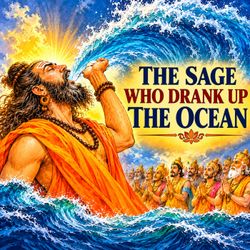
44. Why Did Agastya Muni Drink the ENTIRE Ocean?
15:33||Season 1, Ep. 44Discover the extraordinary story of *Sage Agastya drinking the entire ocean* in Hindu scriptures. When the mighty *Kalakeya Asuras (demons)* escaped the wrath of the Devas by hiding deep beneath the ocean, they continued attacking sages, Brahmins and innocent beings under the cover of darkness. Unable to reach these powerful demons hiding beneath the waters, the Devas approached Lord Vishnu for help. Lord Vishnu revealed that only the great **Rishi Agastya**, renowned for his immense spiritual power and penance, could dry up the ocean and expose the hidden Asuras. When the gods approached Sage Agastya, he agreed to help and performed an astonishing feat that left the Devas and the entire world amazed. Witness the legendary tale of **Agastya Muni drinking the ocean**, the defeat of the Kalakeya demons, and the extraordinary power of one of Hinduism's greatest sages. This fascinating episode from the **Mahabharata, Vana Parva**, reveals why Sage Agastya is remembered among the most powerful Rishis in Hindu tradition. Explore the story of Agastya Rishi, Agastya Muni, the Devas and Asuras, Lord Vishnu, and the miraculous drying of the ocean in this captivating account from ancient Hindu scriptures.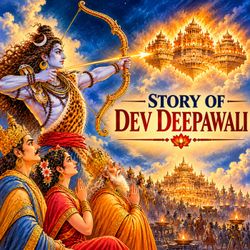
43. Mahadev Burned 3 Cities in ONE Arrow. Dev Deepavali Story
17:49||Season 1, Ep. 43Dev Deepawali, also known as Dev Diwali, is celebrated as the Diwali of the Gods. Observed on Kartik Purnima, this sacred festival holds a special place in Hindu tradition, particularly in the holy city of Varanasi, where thousands of lamps illuminate the ghats of the Ganga. But why is this day considered the Diwali of the Devas? How is it different from the Diwali celebrated across India, and why do the gods rejoice on this particular full moon night? The story takes us back to the time of Tripurasura, a powerful demon whose three magnificent cities became a threat to the heavens and the worlds. It was Lord Shiva who ultimately destroyed the three cities, earning the name Tripura taka. This victory is traditionally associated with Dev Deepawali. Discover the story behind this sacred celebration, its connection with Kartik Purnima, the traditions followed across different regions, and the spiritual significance of lighting thousands of lamps on this auspicious night.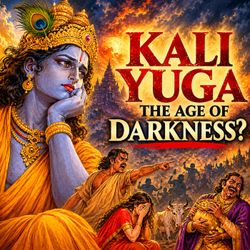
42. Why Didn't Krishna Stop Kali Yuga?
42:05||Season 1, Ep. 420:00 The Dawn of Kali Yuga 5:22 King Parikshit and the Cursed Fate 7:31 The Srimad Bhagavatam and Parikshit's Final Days 10:17 Lord Krishna's Demonstration of Kali Yuga to the Pandavas 14:18 Prophecies of Kali Yuga from the Puranas 26:30 The Glories of Chanting and the Coming of Kalki 30:03 The Transition to Satya Yuga
41. Kaliyuga Episode: How and When Kaliyuga Ends
06:32||Season 1, Ep. 41The Sri Kalki Purana is a prophetic work in Sanskrit that provides details about the life and times of Kalki, the tenth and final of the Dashavatara (the ten Avatars) of the Hindu deity Lord Vishnu. Hindus believe that, it gives insights on some of the major events to occur in the future. The narrative is set in the near end of the Kali Yuga or Dark Age, as revealed by the storyteller Suta. In addition to this Srimad Bhagvatam goes into further details, Sukadev Goswami gives an elaborate description to King Parikshit about what society will be like in Kaliyuga. The Puranas primarily describes the onset and exponential increase of evil and sin on earth during the end of Kali Yuga.
40. Brahma Episode: Why Saraswati Cursed Brahma at Pushkar
02:20||Season 1, Ep. 40Why Saraswati Cursed Brahma? According to the Padma Purana, once a few petals from the lotus of Brahma fell on earth. The places where these petals fell turned in beautiful lakes. When Brahma came down to earth to see the lakes, he named the region Pushkar. This resulted in three lakes being named – Pushkar, Madhya Pushkar and Kanishta Pushkar. Brahma then decided to perform a sacrificial ceremony also known as yagya to ensure purity and goodness of the region. A yagna is a ritual that a man cannot perform without his wife. So Brahma sent Narada to inform Saraswati to come to the yagya at the earliest. Saraswati could not reach the venue at the time designated as she was waiting for Lakshmi, Parvati and Indrani to join her. Brahma was becoming impatient and could not wait for his wife much longer. In his haste he married Gayatri and completed the yagya with his new wife besides him. Gayatri with a pot of amrit (elixir of life) in one hand and ahuti for the fire in the other helped Brahma complete his yagya. When Saraswathi finally arrived, she saw Gayathri sitting next to Brahma which was her rightful place. This made her furious and, in her anger, she cursed Brahma that he would never be worshipped by anyone. But upon the advice of Shiva and Vishnu, she reduced her cursed, allowing Brahma to be worshipped only in Pushkar.
39. Vishnu Avatars Episode: Why Only Lord Vishnu Takes Avatars On Earth?
04:14||Season 1, Ep. 39Why Only Lord Vishnu Takes Avatars On Earth? Unarguably, one of the most important curses in the history of Hindu Puranas was that given by sage Bhrigu to Lord Vishnu. Here is the story of Bhrigu cursing Lord Vishnu and how it changed the course of ancient Hindu history. During that time, it was tough for the Asuras to defeat the Devas in battles. Having lost several times, the Guru of Asuras, Shukracharya, decided to approach Lord Shiva for help to defeat Devas. He also performed penance to Lord Shiva to obtained the Sanjivani mantra that was capable of bringing the dead back to life. Therefore, Sukracharya started to meditate and pray to Lord Shiva to grant him Mrita-Sanjeevani Stotram that would make the Asuras invincible. Furthermore, Shukracharya’s triumph, that is, if he was granted the mantra of invincibility, would have made it difficult for Devas to defeat the Asuras. Meanwhile, Sukracharya asked the Asuras to take refuge at his father’s ashram, who was Maharishi Bhrigu. The Devas and Indra used this opportunity to attack the unarmed Asuras. In the absence of the sage, the Asuras fled to Bhrigu’s wife, Kavyamata for shelter. Kavyamata used her Yogic powers to immobilize Indra and protect the Asuras. Frightened by the immobilization of Indra, the Devas decided to take refuge at the feet of Lord Vishnu. Therefore, Vishnu decided to enter the body of Indra and to save the Devas. Kavyamata was enraged by this and warned to burn them down to ashes if they did not leave. However, Indra instigated Lord Vishnu to annihilate Bhrigu’s wife, and therefore, Vishnu used the Sudarshana Chakra on her. Hence, Vishnu used his Sudarshana Chakra to save Indra and the Devas, by severing the head of Kavya. Sage Bhrigu was devastated hearing what had happened. Bhrigu seeing his wife’s condition, got furious because Lord Vishnu broke his Dharma by killing a woman. Therefore, Maharishi Bhrigu cursed Lord Vishnu to be born on Earth many times and suffer the pain of birth and death as a mortal. Due to this legendary curse, Vishnu had to take countless avatars on Earth and endure all the worldly pain as a price. Although Bhrigu later revived his wife by sprinkling holy water from his Kamandala, he was so deeply infuriated and full of vengeance, he decided not to spare Lord Vishnu. Bhrigu’s curse demanded Lord Vishnu be born on Earth in several avatars. The avatars included some of the greatest Gods to ever walk on Earth as humans, such as Rama and Krishna. Without Rama, there would have been no Ramayana, and without Lord Krishna, there would have been no Mahabharata and hence, no Bhagavad Gita. Along with them, even the other Avatars of Vishnu, such as Narshima, Parasurama, and arguably Balaram or Buddha, and all the other avatars who have had undeniable contributions to shape the entire history of our civilization and scriptures.
38. Narada Muni Episode: Why Narada Muni Can Never Stay in One Place
06:48||Season 1, Ep. 38Why Narada Muni Does Not Stay In One Place? If you are aware about Narad Muni, you will know that he is known to carry around his Veena and travel the entire universe, one place to another all the time, chanting the name of Narayana. But have we ever wondered why is he always roaming? Why does he not stay in one place? Does he not have a place to settle, when other Gods have a place to live, like Shiva lives in Kailash, Vishnu is Vaikuntha Dhaam and Devtas in Svargalok (Heaven). If you think that roaming around and gathering gossip is just a part of Narada’s personality, then let us bring to you the story of the curse that made Narada Muni the kind of sage he is known for today. When Brahma created and populated the Earth, he appointed Daksha as the ruler of the all living beings on Earth, and hence he was called Prajapati Daksh. Upon becoming the Prajapati, it was Daksha’s responsibility to populate the earth with Saatvik (good and pure) beings and administer everything in the world and establish rules wherever necessary, but Narada causes him trouble through the process. When Dakṣa met Nārada Muni, he became furious ready to curse the sage.
37. Matsya Avatar: The First Avatar of Lord Vishnu
05:37||Season 1, Ep. 37Matsya Avatar - The First Avatar Of Vishnu Matsya, the first avatar of Vishnu, is in the form of a fish. Vishnu took the form of Matysa to rescue the Manu, the first man as per the Hindu epics from a huge destruction. Once King Satyavrata (the real name of ‘Manu’) was performing a sacred ceremony besides a river. While scooping in some water from the river to offer to Surya, the Sun God, he accidentally caught a tiny fish in the palm of his hand. Satyavrata was ready to release the fish back into the water, but the fish requested otherwise. The tiny fish begged him not to throw it back into the river as the river had bigger fishes that would prey upon it. To save itself from other predators of the sea, the fish requested the King to take it along with him to his palace, convincing him that his palace would be safe and big enough to accommodate a small fish. King Satyavrata took pity on the little fish and took it with himself to his palace. Upon reaching there, he put the fish in a small bowl. The King was happy and satisfied that he was able to save the life of this little being. The next morning Satyavrata came to check on the fish and was surprised to see that the tiny fish he had brought with him had grown large enough to fill the entire pot. This time the King transferred the fish to the largest lake of his Kingdom, but in no time the fish outgrew the lake too. The King had no other option but to drop the fish into the ocean from where he originally rescued it. He apologized to the fish that despite being a King he could not save her or provide enough to ensure her survival. As the fish was dropped into the ocean, its size knew no bounds. It grew beyond what Satyavrata eyes could see. At this point, Satyavrata concluded that this was no ordinary animal, but it had to be a divine appearance of God. After seven days, as Matsya had predicted, huge clouds appeared in all directions and began pouring on land and sea. The huge waves from the ocean flowed into the land, becoming one with it. Soon there was no land in sight and the entire earth was flooded with water. Then Satyavrata with all his companions saw a large mysterious boat floating towards them across the waves. Remembering the words of Matsya, Satyavrata onboarded the Seven Rishis, animals, all his belongings and himself on the boat, finding some safety. Soon Matsya appeared there with the snakkue Vasuki. Vasuki tied itself to the boat on side and held on to the horns of Matsya on the other side. Matsya with the help of Vasuki towed the boat across the waters of devastation. For countless days, darkness covered the world and they wandered across the stormy ocean waiting for the water to subside. During their journey and days of patience, Vishnu in the form of Matsya preached King Satyavrata and the seven sages the spiritual knowledge of the Vedas. Thus, Vishnu – The Preserver from the holy Trinity, was able to save mankind and brought them into the new era, the beginning of Satya Yuga. Satyavrata came to be known as ‘Manu’, the first man and the seven sages who accompanied became the Saptarishis going on to repopulate the earth.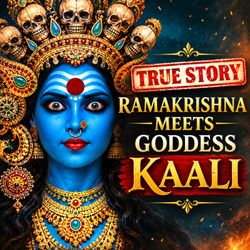
36. Why Goddess Kali Appeared to Sri Ramakrishna Paramahansa
07:59||Season 1, Ep. 36How Shri Ramakrishna Paramhansa Saw The Hindu Goddess Kali? Ramakrishna poured his heart and soul into the worship of Kali. While others perceive Kali as destruction, for him She was the all-loving Mother. While she wore a garland of heads on neck, Her waist was covered with human arms, two of her hands held weapons of death, and eyes that glazed fire, strangely Ramakrishna felt in her presence the soothing touch of tender love. Once when he was anxious and restless, he picked up a sword that was kept in Mother Kali’s temple to kill himself. Suddenly the Goddess appeared in front of him. In that moment he could see nothing else in the world, not even his own existence, all his eyes were able to see was the form of Kali. This vision disappeared immediately. Ramakrishna describes that moment to be so short that it last for blink of an eye, yet so limitless and infinite that it would remain with him for eternity.