Share
Brave Conversations
Bringing Louis Home
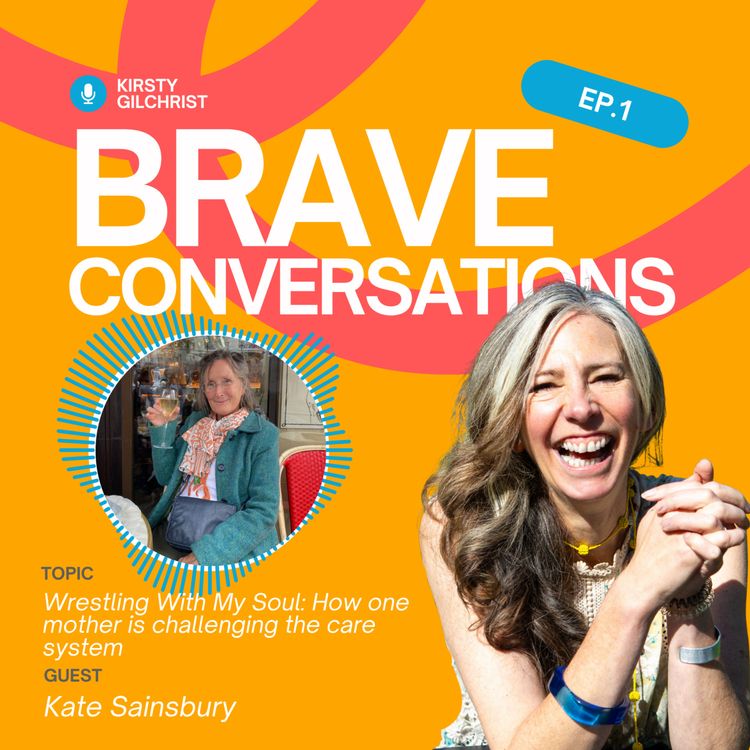
What does it take to look at a five-day-old baby fighting for his life in an incubator and choose a path you know will be profoundly difficult? For Kate Sainsbury, that 2am decision to embrace being mother to her son Louis—despite knowing he would face severe disabilities—was just the first of many brave choices.
Forty years later, Kate found herself facing another moment of reckoning. Louis, now in his thirties, was detained in a hospital hundreds of miles from home, being restrained, drugged, and increasingly traumatised. The care system had failed him. Kate realised she couldn't just go to "the door marked dentist" anymore—she would have to build the care herself. This is a conversation that weaves through love, devotion, faith and spirituality.
In this conversation, Kate shares:
The two pivotal moments that demanded courage—one as a new mother, one decades later when the system collapsed
Why she sees people with profound disabilities as leaders, not burdens, and how society needs to shift its lens
How she founded the Aiteal Trust and created an intentional community where Louis now lives in his own home
The reality of challenging professionals, local authorities, and national systems while maintaining relationships
What "wrestling with your soul" actually means when you're facing impossible choices
Her vision for ending systemic disabilism and why she believes small collaborative answers matter more than magic wands
Kate's bravery isn't loud or combative—it's rooted in deep knowing, persistent love, and a willingness to see what others can't or won't.
This is a conversation about what it means to step off the conventional path when someone you love depends on it, and how one mother's fight is reshaping how we think about care, community, and dignity.
Chapters
00:00 The moment Kate realised she had to step off the conventional path
05:21 Possibility versus risk and loss for Kate and Louis
07:28 Seeing Louis - Really seeing Louis
14:22 The importance of trauma informed care
17:08 Seeing another way
23:43 Assumptions about the status quo to unlearn
28:05 The practice of spirituality and community
36:16 What listeners could do differently tomorrow
41:53 What's next for Kate and Louis
More episodes
View all episodes
4. The Biggest Transition Nobody Told You About
51:16||Season 1, Ep. 4When a woman becomes a mother, her brain is permanently rewired. Science has now proven this.Which means the woman who went on maternity leave isn’t coming back - and that’s not a problem to fix. It’s a transition to understand.That’s matrescence. And Beth Bellingham knows it’s time we all understood it.Matrescence is the process of becoming a mother. Not the feeding schedules and the sleepless nights — that’s mothering. This is the deeper, irreversible transformation that happens to the woman herself. The rewiring of identity, priorities, relationships and sense of self. The version of herself she keeps looking for, who isn’t coming back.Beth discovered matrescence ten years into her own struggle — scrolling through Facebook, recognising herself in a concept she’d never heard of. The relief she felt in that moment never left her. Neither did the question of why no one had told her sooner.Beth’s background is about as far from the soft-edged world of motherhood coaching as you can get. Management consulting at Deloitte. A full time career in construction. Environments where you fix problems, hit targets and move on. Which is precisely why her take on matrescence cuts through. She’s not bringing this conversation from inside the motherhood bubble. She’s bringing it from the boardroom and the building site, and demanding that those worlds pay attention too.What makes Beth’s take brave is where she points the lens. Rather than adding to the chorus validating how hard motherhood is — and it is — she’s asking a harder question: why are mothers drowning in validation but starving for solutions? And why is the conversation only happening between mothers, in corners, in voice notes at 3am?Beth wants workplaces, partners, managers and families to understand what’s actually happening to the women in their lives. Because the person who left for maternity leave is not the person who comes back. That’s not a warning. It’s just true. And pretending otherwise helps no one.In this conversation, Beth shares:• What matrescence actually is — and why it belongs in the same conversation as adolescence• Why high-achieving women often feel the push and pull of matrescence most intensely• The map of matrescence she’s built to make the invisible visible — for mothers, partners and workplaces alike• Why she spent five years building before she launched — and why that patience was its own kind of bravery• What it means to trade independence for shared strength — and why that’s not weakness, it’s wisdomTo find out more visit The Matrescence Project or follow Beth on Instagram at the_matrescence_project
3. The Crisis Growing on our Doorstep
56:06||Season 1, Ep. 3What does it take to build something the world needs, before the world knows it needs it?Marie-Amélie Viatte has spent her career at the intersection of environmental crisis and social inequality — and food has been the thread running through all of it. Not food as a lifestyle choice or a charity cause, but food as the single largest contributor to climate change, biodiversity loss, and poor human health. And yet, the community growers quietly tackling that crisis on our doorsteps are chronically under-resourced, overlooked, and invisible to the systems that could support them.So Marie-Amélie stopped waiting for someone else to fix it.Sowing Our Horizons is her answer — a radically different model for flowing resources into local food ecosystems. Not a charity. Not a carbon offset. An invitation for individuals and organisations to invest locally, reconnect with where their food comes from, and become part of building the resilience our cities desperately need. In a country that is not food secure, where supply chains stretch invisibly across the world and community growing projects survive on goodwill and grant funding, this work isn’t idealistic — it’s urgent.In this conversation, Marie-Amélie shares:• Why the global food system is the crisis hiding in plain sight — and what’s already growing on our doorsteps that could change it• The unconventional business model behind Sowing Our Horizons and why it deliberately sits outside the charity and investment frameworks we’re used to• The moment she stopped looking for someone to hand her a pot of money and decided to build the thing herself• What she’s had to unlearn — about money, identity, self-worth, and what it means to do work that matters before the world catches up• The practices that keep her grounded when the fear and uncertainty of going off-piste get loud• And the one thing she’d want every listener to do differently tomorrowThis is a conversation about being brave — the quiet, persistent kind that shows up every Tuesday morning at a market garden, that holds the vision when the income isn’t there, and that keeps planting seeds in the belief that what you grow today is the insurance policy for tomorrow.To find out more about Sowing Our Horizons visit https://www.sowingourhorizons.org/
2. If You Can't Be Brave, Be Quiet
49:24||Season 1, Ep. 2In this episode of Brave Conversations, Kirsty Gilchrist speaks with Charlie McMillan, Director of Human Rights Consortium Scotland, LGBTQI activist, and community developer, about courage, justice, and speaking up in turbulent times.Charlie reflects on a lifetime of activism — from coming out in Thatcher’s Britain to challenging the erosion of human rights today — and shares why fear, disconnection, and misinformation are driving much of the current political and social crisis. The conversation explores human rights as a living, everyday framework, the power of community and solidarity, and the importance of reclaiming the narrative.With honesty and warmth, Charlie also discusses anger, burnout, and the practices that sustain long-term activism, including mindfulness, boundaries, and compassion-based action. This episode is a call to reflect, to care for ourselves, and to choose brave — because, as Charlie reminds us, “If you can’t be brave, be quiet.”