Share
Brain In Progress
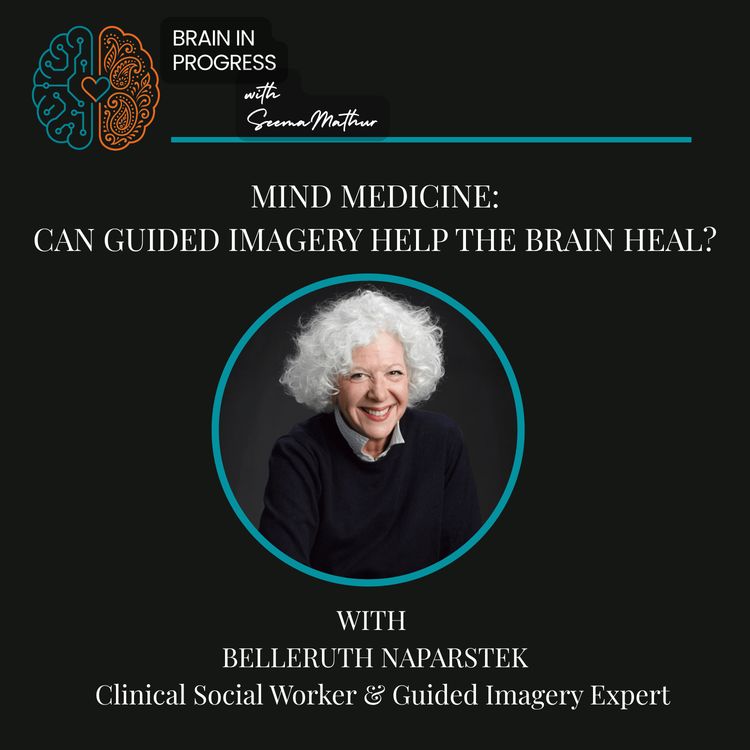
Mind Medicine
Is it the brain controlling the mind—or the mind shaping the brain?
In this episode of Brain In Progress, Seema Mathur sits down with Belleruth Naparstek, a pioneer in guided imagery. She began her career as a clinical social worker in the late 1960s and started creating audio tapes to support her patients’ healing. Increasingly over the years, her work has been used alongside mainstream medicine.
Blending science, storytelling, and Seema’s deeply personal healing journey after brain injury, this conversation explores the fascinating intersection of guided imagery, biology, and neuroplasticity.
With emerging research on guided imagery and meditation—including brain imaging studies—showing activity in areas tied to emotion, pain, and cognition, guided imagery is proving to be more than relaxation—it may be a way to actively boost your own brain health.
In This Episode:
- Guided imagery and affirmations: how words impact the body and brain
- The science: brain imaging studies reveal how guided imagery “lights up”
- parts of the brain involved in cognition and emotion
- The powerful role of emotion—especially gratitude, safety, and love—in healing
- How stress impacts disease—and whether imagery can help counter it
- Making these practices accessible for real life—even for those who can’t sit still
- Seema’s personal story: using guided imagery during recovery from brain injury
More episodes
View all episodes
6. The Sound of Survival
26:45||Season 1, Ep. 6In this deeply personal episode of Brain in Progress, Medical journalist and brain champion, Seema Mathur shares the story of surviving a life-threatening Acoustic Neuroma at just 19 years old — It was a golf-ball-sized brain tumor pressing against the brainstem that controls breathing, consciousness, and life itself.The surgery that saved her life was performed by legendary neurotologist Dr. William House, the pioneering physician whose work transformed Acoustic Neuroma surgery and developed cochlear implants, allowing people who otherwise would have been deaf to hear.More than 30 years later, Seema sits down with Dr. John W. House — Neurotologist, House Clinic physician, and nephew of Dr. William House — for an intimate conversation about the House family legacy, the evolution of brain surgery, hearing loss treatment, tinnitus, cognition, balance disorders, and the mysteries of the brain itself.Together, they explore:• What Acoustic Neuroma/ Vestibular Schwannoma patients want to know• How to catch these brain tumors before they become life-threatening or disabling• Facial paralysis, identity, and resilience• How hearing loss affects cognition and isolation• Tinnitus and the connection between sound and the brain• The pioneering spirit and personalities of a family of physicians that revolutionized hearing medicine and brain surgery• Why attitude, hope, and purpose matter in healingThis episode is both a tribute to medical innovation and a reflection on survival, gratitude, and what it means to fully live after trauma
5. Peaceful Brain
28:11||Season 1, Ep. 5In this episode of Brain In Progress, medical journalist Seema Mathur explores the powerful intersection of music, emotion, and neuroscience with composer Yuval Ron—whose work spans film, world music, and sound-based approaches to healing.From the way a film score can instantly create suspense… to deeply personal experiences of recovery after brain surgery, this conversation asks a compelling question: can sound help optimize brain health?Yuval shares how his journey—from creating music to create political harmony in the Middle East to composing for personal wellness— which led him to explore emerging research on sound and the brain, including studies from Massachusetts Institute of Technology investigating 40 Hz stimulation and its potential impact on brain health.Blending science, storytelling, and lived experience, this episode looks at how music may influence the brain—not just emotionally, but biologically—and what that could mean for focus, memory, and overall well-being.IN THIS EPISODE: How music shapes emotion—and why your brain reacts instantly to soundSeema’s personal story: using music during recovery from brain surgeryThe concept of brainwave synchronization—and how the brain responds to rhythmWhat 40 Hz stimulation is, and what early research (primarily in animal studies) suggestsHow Yuval translates scientific concepts into layered musical compositionsThe role of culture, sound, and music in healing and human connectionThe difference between listening to music—and actively making it—for brain health
3. Unlocking the Brain’s Barrier
30:31||Season 1, Ep. 3What if one of the biggest problems in brain medicine isn’t the drugs—but getting them to the brain?Seema Mathur speaks with Dr. Chad Gordon, a Neuroplastic and Reconstructive Surgeon at Johns Hopkins School of Medicine, about a bold new innovation: a skull-brain implant designed to bypass the brain’s natural defenses and deliver medicine exactly where it’s needed.This conversation explores what could be the next frontier in brain medicine—potentially changing the fate of those facing serious neurological disease, as well as anyone hoping to protect and enhance brain health as they age.In This Episode:A powerful and personal conversation about hope, persistence, and innovation in medicineUnderstanding the blood-brain barrier—how it protects us while also blocking life-saving treatmentsThe “aha moment” that led to NeuroPASS, a first-of-its-kind implant designed to deliver medicine past the blood-brain barrierHow this innovation could change outcomes for patients with brain cancer and transform treatment for conditions like seizures, Parkinson’s, dementia, depression, and moreThe future of brain medicine—and what it could mean for brain health and healthy aging
2. A Stroke of Fortune
24:38||Season 1, Ep. 2Seema Mathur sits down with Dr. S. Thomas Carmichael—neuroscientist, neurologist and Chair of Neurology at UCLA—to explore a question that could change stroke recovery: What if a pill could help repair the brain?Stroke is a leading cause of adult disability, and even with intense therapy, many people never fully regain movement—especially in the arm and hand. Dr. Carmichael explains neuroplasticity and the brain’s “sensitive period” after stroke, when the brain is most open to rewiring. He then shares the science behind a surprising target: a receptor called CCR5, which becomes highly active after stroke and can lock down the brain’s ability to form new connections. His team is studying whether blocking CCR5—using a drug originally developed for HIV—could help “reopen” plasticity and strengthen recovery.Seema also reflects on her own experience with neuroplasticity and what it means to fight your way back—one repetition at a time.In this episode:Why stroke recovery is often limited—even with rehabWhat neuroplasticity really is (and what it isn’t)The brain’s post-stroke “sensitive period” and the window of opportunityCCR5: the molecule that may limit recovery by locking down connectionsWhy an FDA-approved HIV drug is now in clinical trial for stroke rehabilitationWhat researchers hope to improve most: meaningful arm and hand functionIf the treatment could be extended to multiple variations of traumatic brain injury
1. The Story I Never Told
39:41||Season 1, Ep. 1In the premiere episode of Brain In Progress, Seema Mathur sits down with ABC News journalist—and longtime friend—Kyra Phillips for the most personal conversation of her career.Seema shares the story she has never told publicly: her brain tumor diagnosis at 19 and what it means to live today with a second rare, currently incurable brain disease. She reflects on how being close to death can make embracing life feel unmistakably clear.This episode introduces Seema—and launches her deeper exploration of the brain in future episode conversations.In this episode:The moment everything changedThe fortune of surviving multiple brain conditions and brain traumaUsing your life for purposeLiving with ongoing uncertaintyWhy Seema is launching Brain In Progress now
Brain In Progress Trailer
01:30||Season 1Award-winning medical journalist Seema Mathur turns her journey with brain disease into purpose. Her story — how Western medicine is saving her life and Eastern practices help her heal — becomes the thread that launches a deeper exploration of the brain.In Brain In Progress, Seema speaks with the world’s leading neuroscientists, physicians, and integrative experts to investigate the future of brain health — from neuroplasticity and brain implants to meditation and consciousness.This is a show about possibility. About resilience. About unlocking the brain’s potential and deepening our understanding of the organ that shapes how we perceive ourselves and the world.