Share
Books of All Time
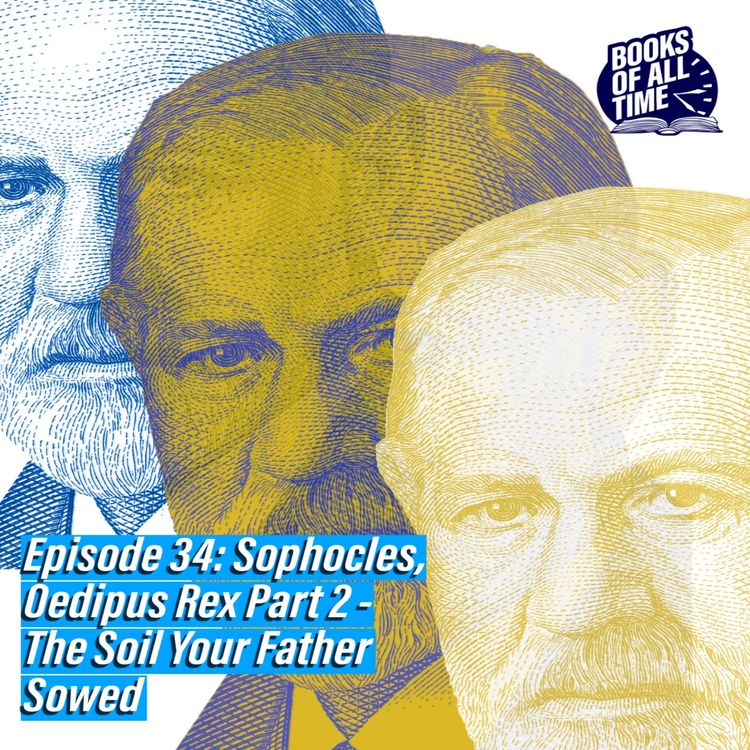
Episode 34: Sophocles, Oedipus Rex, Part 2 – The Soil Your Father Sowed
Since 1900 or so, anyone trying to engage with Sophocles' play Oedipus Rex has had Sigmund Freud breathing over their shoulders. This episode looks at how Freud, inspired by (and slightly obsessed with) Sophocles' play, concocted a theory that began as a stage of child development but soon expanded to become a universal explanation for all of culture, religion, and art.
CONTENT NOTE: This episode contains discussions of sex and sexuality from very early in the runtime (and more than one Hall and Oates reference). Please consider people around you — or your own tolerance for topics like incest and sexual assault — before listening.
Want to read a transcript of this episode, or see the reference list? Click here. Don't forget to like, share, and subscribe!
More episodes
View all episodes
44. Episode 44: The Mahabharata, Part 1 - Sacred and Marvelous Tales
01:02:52||Season 2, Ep. 44Eight times longer than the Iliad and the Odyssey combined, the Mahabharata has a little of everything: philosophy, spirituality, myths, romances, geography, a heroic polycule, and one transgender warrior who knows how to follow up on a grudge. First written down around 300 BCE (but, like its brother epic, the Ramayana, much older than that), the Mahabharata is at its core a story about two sets of warring cousins. Hitch up your chariot and gallop with us through this summary of the main action.Want to read the transcript? Click here. Don't forget to share, rate, and review us!
43. Episode 43: Valmiki, The Ramayana, Part 2 - By Means of Every Sacred Rite
42:55||Season 2, Ep. 43In our second episode on the Ramayana, which began to be written down in Sanskrit c. 350 BCE, we dive deeper into the theme of dharma. We explore some of the many different meanings of this term and trace the development of the three oldest dharmic faiths: Hinduism, Buddhism, and Jainism. We also compare how Buddhist and Jain retellings of the Ramayana differ from the one revered by today's Hindus. Finally, we fangirl out over Hanuman a little more. Want to read the transcript? Click here. Don't forget to subscribe, rate, and review us—and share with your friends!
42. Episode 42: Valmiki, The Ramayana, Part 1 - Tiger Among Men
58:14||Season 2, Ep. 42It's time for some good old-fashioned epic action with our first episode on the Ramayana, one of the great Sanskrit-language epics from India. Composed as a written work from about 350 BCE onward (but probably much earlier as an oral poem), the Ramayana tells of the trials and tribulations of Rama, Prince of Kosala and avatar of the god Vishnu. It has everything from romance and battle to deep spiritual wisdom and a divine monkey hero who overthinks a lot.Want to read a transcript or see our references? Click here. Don't forget to subscribe, leave a rating or review, and share us with others!
41. Episode 41 – Plato, The Republic, Part 3 – I Completely Agree, Socrates
52:43||Season 2, Ep. 41We come to the end of our three-episode exploration of Plato’s Republic, the seminal work of political philosophy composed mostly around 380 BCE. This episode covers pre-Socratic philosophy, the life of Socrates, and a really regrettable period of Plato's life when he tried to go into business as a political consultant and wound up stuck in the middle of what almost became a civil war. Don't leave the academy, bro.In this episode, Rose also announces an exciting upcoming guest spot on the Omnibus podcast, where she'll be talking about E.A. Wallis Budge. For a transcript and a full list of references for this episode, click here to visit our website. Thanks for listening. Don't forget to subscribe, rate, review, and share!
40. Episode 40 – Plato, The Republic, Part 2 – Out of the Cave
47:19||Season 2, Ep. 40In this episode, we continue our three-part, supersized exploration of Plato's Republic. Having defined morality and the ideal society in the first half of the book, we now move on to the pure philosophy part, which features Plato's theory of forms, his ideas about what constitutes true knowledge, and, of course, a ton of allegories—including the famous Allegory of the Cave. Listen now and know the true, Platonic form of a podcast. Want to read the transcript or see our reading list? Click here. Thank you for listening, and don't forget to subscribe, review and share us!
39. Episode 39 – Plato, The Republic, Part 1 – The Education of Our Heroes
43:40||Season 2, Ep. 39It's philosophy time, friends. Join us for the first of three episodes about the ancient Greek philosopher Plato's book The Republic, the most influential work of philosophical literature ever written by a single author. It's the record of a long conversation Socrates has with some friends, in which they pick over two questions: what is morality? and does morality really have any intrinsic benefits for those who practice it? This conversation also covers what the ideal society should look like, including the best plan of education (heavily censored, obviously), how the ruling class should live (in communes with eugenically controlled matings, duh) and a surprising number of metaphors that mention shoemakers. Episode one covers the first half of The Republic, which focuses on politics. Want to read the transcript or see the reading list we used to write it? Click here. Don't forget to rate, review, and share us!
38. Episode 38 - Aristophanes, Frogs, Part 2 – Criminally Funny?
38:16||Season 2, Ep. 38Aaaaaand we're back. Aristophanes, the comedian of ancient Athens, has a reputation for getting into hot water for his jibes about the demagogue Cleon (which landed him in hot water, legally) and his portrayal the philosopher Socrates (which, according to Plato, fatally damaged Socrates' image for a generation). But is this reputation deserved? This episode looks at the evidence for how much Aristophanes really influenced Athenian politics and discourse.Want to read the transcript? Click here. Don't forget to rate, review, and share us with your friends!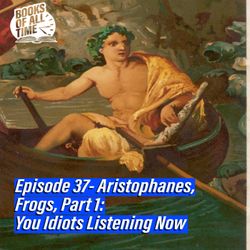
37. Episode 37 - Aristophanes, Frogs, Part 1 – You Idiots Listening Now
39:59||Season 2, Ep. 37Produced in 405 BCE, just months before Athens' disastrous loss of the Peloponnesian War, Aristophanes' Frogs is a play about how important — and ridiculous — great art can be. Featuring a poetic battle royale between the ghosts of Aeschylus and Euripides, the play blends highbrow literary satire, bawdy sight gags, and more than a little bit of reactionary xenophobia. So nothing's changed there, then.Walk through the story with us as we wrap up our Big Fat Greek Summer of Theatre. Want to read the transcript? Click here. Thanks for listening — don't forget to leave a rating or review!
36. Episode 36: Euripides, The Trojan Women, Part 2 - I Was One of Those Girls
41:49||Season 2, Ep. 36Euripides's plays, including The Trojan Women, include a great many complex and sympathetic female characters. In this episode, we use Euripides's interest in women as a jumping-off point to look at the real lives of women in Classical Athens during the 5th century BCE, when Euripides would have been alive and writing.Or at least, we try to. Join us on a slightly frustrating journey through the slim evidence for actual Greek women's existence, exploring childhood, marriage, funerals, and the occasional bawdy all-girls camping trip.Want to read the transcript of this episode or see the references used to write it? Click here. Thanks for listening, and don't forget to leave us a rating and review!