Share
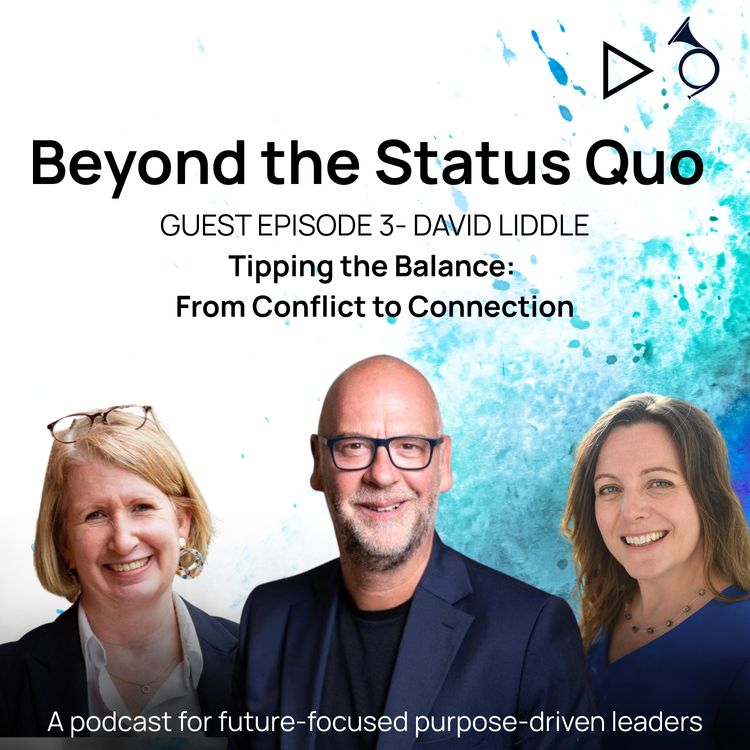
Beyond the Status Quo
Episode 3 - Tipping the Balance: from conflict to connection with David Liddle
Season 1, Ep. 3
•
In this episode of Beyond the Status Quo, David Liddell, a recognized authority in people, culture, and conflict management, shares his insights on challenging the status quo in organisations. He discusses the importance of transformational leadership, the need for connection and belonging in workplaces, and the role of policies in shaping organisational culture. David introduces his Align Model, emphasising the significance of listening, inclusion, and nurturing growth. He advocates for constructive conflict and the necessity of a counter narrative in today's polarised society, encouraging leaders to be courageous and open to challenges.
Takeaways
- David Liddell emphasizes the importance of breaking the status quo in organisations - but not recklessly
- Transformational leadership requires a focus on connection and belonging.
- Policies should be designed to foster positive behaviours and culture.
- Conflict can be constructive if approached with psychological safety.
- The Align Model offers a framework for effective leadership and organisational culture.
- Listening and inclusion are critical for effective leadership.
- Organisations must create a counter narrative to divisive societal messages.
- Values should be lived and reflected in organisational policies.
- Leaders should be open to challenges and different perspectives.
- Courage and collaboration are essential for meaningful change.
Useful links
Recommended Reading | The TCM Group
More episodes
View all episodes
4. Ed Kirwan- Empathy: Connection that Inspires Learning
51:59||Season 3, Ep. 4Summary:In this episode of Beyond the Status Quo, Tamara and Kathryn speak with Ed Kirwan, founder of Empathy Week and Empathy Studios, which use film to build the skill of empathy in schools around the world. Ed traces his own first challenge to the status quo back to a Year 11 class he refused to write off, and follows a through-line from that classroom to his work today. His argument: trust is built on connection, connection is built on understanding, and empathy is the skill underneath both, the thing that turns belonging and human flourishing from aspiration into something schools can actually build.Takeaways:Trust is built on connection, and connection is built on understanding, the chain running underneath everything Ed does.Film works as a catalyst for empathy: it creates a shared emotional moment that direct conversation on its own rarely reaches.Belonging has to be built through repeated, trusted connection over time, not simply declared as a school value.The more contact people have across different backgrounds, the less room bias has to take hold.Ed’s advice: think like an entrepreneur, try small things, measure what happens, and ask forgiveness rather than permission.Ed treats empathy as a skill, built deliberately through specific, repeatable methods, the same way any other skill is learned.Optimism is part of the job: educators are role models, and hope has to be modelled, not just felt.Links:Empathy Week | Website Ed Kirwan | LinkedIn Why Empathy Is Good for Business, and How to Improve It | World Economic ForumConnect with Kathryn and Tamara on LinkedIn:Tamara Zaple Rolfs FCCT | LinkedIn Kathryn | LinkedInSign up to receive our newsletters:Newsletter | My DeltaRate and review the podcastIf you found this episode of Beyond the Status Quo informative, please do rate and review it on Apple Podcasts or Spotify.If you’re kind enough to leave a review, please do let Kathryn or Tamara know so that they can say thank you. You can reach us at: tamara@my-delta.co.uk kathryn@clarioneducation.co.ukEnjoyed this episode?Hit subscribe on your favourite podcast app to be notified each time a new episode of Beyond the Status Quo is released.We are a proud member of the Education Leaders podcast network. For more great education shows, head to www.educationleaders.co/network
2. Tiffany Beck OBE- Relationships as Infrastructure
45:22||Season 3, Ep. 2Summary:In this episode of Beyond the Status Quo, Tamara and Kathryn speak with Tiffany Beck, Head of Education at PLMR and co-founder and chair of trustees of Maritime Academy Trust. Tiff makes the case that governance and communication are built on the same foundation: relationships treated as infrastructure, not afterthoughts. She traces this back to a school in the US, where raising a welfare concern about a classmate was met with "pray it will be fine," through to building a board culture based on trust rather than catching people out, and school systems designed around listening and connection before problems arise. Her closing advice: find the humour, even in hard times.Takeaways:Being told to "just pray it will be fine" as a teenager was Tiff's first experience of questioning the status quo, and it shaped her career.The best governance question a board can ask a leader: what do you need from us to succeed?Tiff's approach to mistakes: step back, take perspective, and "fail up" rather than assign blame.Relationships work best as infrastructure: built deliberately, ahead of time, rather than summoned in a crisis.Home visits before the school year starts and a community ambassador in every school are two ways Maritime builds trust before it's tested.England's 250,000 school governors and trustees are the country's largest volunteer workforce, and need far more investment.Humour and positivity build real resilience, even in the hardest, most heartbreaking corners of school life.Links:LinkedIn Tiffany Beck PLMR Maritime Academy TrustIf you're enjoying these conversations, we'd love your help to amplify the ideas and voices we're bringing to the table. ✅ Like and share this post with your network✅ Follow, rate and review the podcast wherever you listen✅ Share your reflections, challenges and questions✅ Tell us who you'd like to hear from nexthttps://forms.gle/TTbDTcDrASraFkKMAThank you for listening, engaging and helping us explore what lies beyond the status quo. It means the 🌍 to us.We are a proud member of the Education Leaders podcast network. For more great education shows, head to www.educationleaders.co/network
2. Alice Gregson- Bridging Silos
36:53||Season 3, Ep. 2Summary:In this episode of Beyond the Status Quo, Tamara and Kathryn speak with Alice Gregson, former CEO, independent leadership specialist and founder of Elevating Leadership. Drawing on a 20-year "sector nomad" career spanning policing, adult social care and health, the civil service and education, Alice makes the case for bridging silos: the belief that while every sector likes to think its challenges are uniquely complex, most of what leaders actually face, technology, finance, people and rising demand, is common ground, and it's context, not challenge, that's genuinely unique. She argues for starting small and saying yes to cross-sector conversations rather than waiting for the perfect plan, for knowing yourself and those you serve as the foundation of real priority-setting, and for treating consistency as one of the most underrated leadership skills in a polarised, fast-moving world.Takeaways:· Sectors love to believe they're uniquely complex, but it's context, not challenge, that's actually unique.· Bridging silos doesn't need a perfect plan, say yes to a conversation outside your sector and see where it takes you.· Sharing the load matters as much as sharing the learning: one sector's problem is often everyone's to carry.· Knowing yourself and those you serve is what turns cross-sector working into a real priority, not just an idea.· System leadership means impact beyond your own role, at any scale, and it counters feeling like a victim of political churn.· In polarised times, consistency is an underrated skill: being a steady presence matters as much as having the right answer.· No action is too small. Small, consistent steps are often where the biggest shifts start, so just do something.Links: ElevatingLeadership | Specialising in supporting leadersCommon Ground | Facilitated collaboration for organisationsIf you're enjoying these conversations, we'd love your help to amplify the ideas and voices we're bringing to the table.✅ Like and share this post with your network✅ Follow, rate and review the podcast wherever you listen✅ Share your reflections, challenges and questions✅ Tell us who you'd like to hear from nexthttps://forms.gle/TTbDTcDrASraFkKMAThank you for listening, engaging and helping us explore what lies beyond the status quo. It means the 🌍 to us.We are a proud member of the Education Leaders podcast network. For more great education shows, head to www.educationleaders.co/network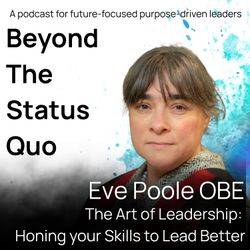
1. Eve Poole- The Art of Leadership: Honing Your Skills to Lead Better
59:26||Season 3, Ep. 1In this Season 3 opener of Beyond the Status Quo, Tamara and Kathryn speak with Dr Eve Poole OBE, chair of the Woodard Corporation and pioneer of the "leadersmithing" movement. Drawing on a career spanning the Church Commissioners, Deloitte, Ashridge Business School and a string of chair and interim chief executive roles, including the Royal Society of Edinburgh and the Carnegie Trust, Eve argues that leadership isn't a title bestowed on the charismatic few but a craft forged through hard experience, failure and deliberate practice. She makes the case for "stacking the deck": seeking out difficult moments on your own terms that build the templates leaders draw on under pressure, and for reclaiming the "junk code" of being human- the emotion, intuition and storytelling that AI can't replicate and leadership has always actually run on. Takeaways: · Leadership isn't a title for the charismatic few, it's a craft ("leadersmithing") built through hard experience, failure and deliberate practice. · "Stacking the deck": deliberately seeking out difficult experiences on your own terms builds the templates you'll need when real pressure hits. · Imposter syndrome isn't a flaw, it's a sign you care enough to try, and it shows up in almost every good leader. · AI has absorbed our "rational" knowledge, but our "junk code"- emotion, intuition, storytelling, meaning-making - is what makes leadership actually work, and it matters more than ever. · Good governance is unglamorous but essential: clarity about delegated authority is what keeps organisations, and their leaders, safe. · Reclaiming words like "bossy" matter. Much of what holds women and diverse leaders back is a heroic leadership myth modelled on a narrow, historically male archetype. · Know why you're doing the job, and have an exit strategy: that clarity is what lets you make hard calls and know when to walk away. Links:https://www.linkedin.com/in/evepoole/ https://evepoole.com/Leadersmithing | Eve Poole | TEDx Durham University https://www.youtube.com/watch?v=73L1613KDnw Robot Souls: Programming in Humanity? | Eve Poole | TEDx https://www.youtube.com/watch?v=uMVDkSuzQbk If you're enjoying these conversations, we'd love your help to amplify the ideas and voices we're bringing to the table. ✅ Like and share this post with your network ✅ Follow, rate and review the podcast wherever you listen ✅ Share your reflections, challenges and questions ✅ Tell us who you'd like to hear from next https://forms.gle/TTbDTcDrASraFkKMA Thank you for listening, engaging and helping us explore what lies beyond the status quo. It means the 🌍 to us.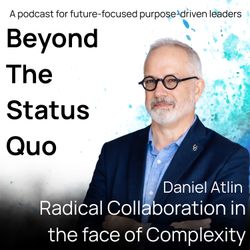
8. Daniel Atlin- Radical Collaboration in the face of Complexity
30:18||Season 2, Ep. 8Summary:In this episode of Beyond the Status Quo, Tamara and Kathryn speak with Daniel Atlin, a Canadian leadership executive and researcher, about leading through complexity. Drawing on his dissertation research with 25 university leaders across the UK, Canada, Australia and New Zealand, Daniel introduces his framework for sense-making as the antidote to leadership myths built on charisma and control. He argues that leaders must first make sense of themselves before they can make sense of others, and turns to higher education as a case study in radical collaboration, examining how institutions built for permanence must now adapt or risk becoming irrelevant.Takeaways:· Leadership isn't about having all the answers — it's about making sense of the mess with clarity, purpose and courage.· Inner sense-making (self-awareness, emotional regulation) matters as much as outer sense-making (exploration, narrative, collaboration).· Put your own oxygen mask on first: leaders must understand their impact on the system before leading others through it.· The traditional charismatic "convening power" model of leadership is a myth that needs busting.· Universities built for permanence and scale must adapt their business models or risk irrelevance.· Radical collaboration — merging, restructuring, rethinking pedagogy — is now essential for institutions to survive.· Disengagement, not attendance, is the real crisis in education at every level, from schools to universities to the workplace.Links:Daniel Atlin | LinkedInDJA SensemakingRadical Collaboration: Why UK Universities Are Moving Faster Than Canada | LinkedInMessy with Daniel Atlin | Podcast on SpotifyIf you're enjoying these conversations, we'd love your help to amplify the ideas and voices we're bringing to the table.✅ Like and share this post with your network✅ Follow, rate and review the podcast wherever you listen✅ Share your reflections, challenges and questions✅ Tell us who you'd like to hear from nexthttps://forms.gle/TTbDTcDrASraFkKMAThank you for listening, engaging and helping us explore what lies beyond the status quo. It means the 🌍 to us.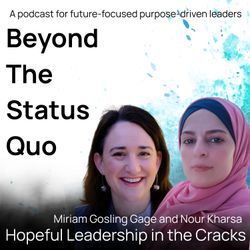
7. Nour Kharsa and Miriam Gosling Gage- Hopeful Leadership in the Cracks
24:52||Season 2, Ep. 7Summary: In this episode of Beyond the Status Quo, Tamara and Kathryn are joined by two guests for the first time: Nour Kharsa, who leads a charity supporting displaced children and families in Lebanon, and Miriam Gosling-Gage, Head of Programmes at Co-Create Consultancy and Co-Director at Pelumbra. Recorded through a patchy internet connection from Lebanon, a fitting metaphor for the conversation itself. Nour describes the daily reality of running a centre for around 150 children and their families through displacement, economic collapse and two wars, and what it means to choose to show up when no one else will. Miriam draws on decades of work with leaders navigating complexity, unpacking the difference between critical, tame and wicked problems, and why leadership, not management, is what wicked problems demand. Together they explore what it takes to hold multiple truths, ask better questions instead of forcing solutions, and find hope that isn't abstract but built from small, real wins.Takeaways:Wicked problems need leadership, not management, there's no clean fix, only better questions.Hope isn't abstract; it's measured in the actual children and families reached.Showing up, even on the hardest days, is a choice, not a job you clock out of.Understanding someone else's reality means stepping fully into their perspective.Psychological safety grows when leaders loosen hierarchy and turn directives into conversation.Small wins are what sustain people through work that never fully switches off.Becoming a global citizen starts with questioning your own vantage point rather than assuming it's neutral.Links:Nour Kharsa Nour Kharsa | LinkedInInstagram: @mawtin_al_amalCentre Instagram: @daralamal2021Nour Kharsa (Director): nourkharsa960@gmail.comMawtin Al Amal (Organisation): info.mawtinalamal@gmail.comIf you'd like to donate to this very worthy cause then here is the link to do so. https://rrym.uk/snowdonclimb2026/Miriam Gosling Gage Miriam Gosling Gage | LinkedInhttp://www.cocreateconsultancy.comhttp://www.pelumbra.comIf you're enjoying these conversations, we'd love your help to amplify the ideas and voices we're bringing to the table.✅ Like and share this post with your network✅ Follow, rate and review the podcast wherever you listen✅ Share your reflections, challenges and questions✅ Tell us who you'd like to hear from nexthttps://forms.gle/TTbDTcDrASraFkKMAThank you for listening, engaging and helping us explore what lies beyond the status quo. It means the 🌍 to us.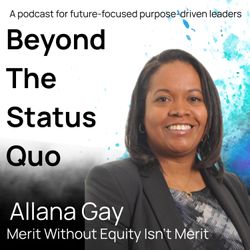
6. Allana Gay- Merit Without Equity Isn't Merit
42:39||Season 2, Ep. 6Summary: In this episode of Beyond the Status Quo, Tamara and Kathryn speak with Allana Gay, headteacher, education consultant and co-founder of the BAMEed Network, about why representation in education leadership remains so stubbornly unequal. Drawing on her rejection from headship roles and her upbringing in Trinidad and Tobago, Allana argues that meritocracy is a myth unless equity sits underneath it. She unpacks how narrow governance structures and a single, inherited image of leadership keep shaping who gets to lead, and shares what has sustained her through the personal cost of being a visible voice for change: curiosity, community, and knowing who's actually ready to listen Takeaways:Governance shapes leadership far more than we acknowledge, and needs far greater scrutiny.Merit without equity isn't really merit at all.Curiosity, built early, becomes the foundation for lifelong advocacy.Career growth is more like rock climbing than climbing a ladder.Genuine dialogue only happens with those willing to learn.Sustaining change requires a network that reminds you why you're doing the work.Leadership needs to flex beyond a single, narrow image of what it looks like.Links:About Us – BAMEed NetworkAllana Gay | LinkedInIf you're enjoying these conversations, we'd love your help to amplify the ideas and voices we're bringing to the table. ✅ Like and share this post with your network ✅ Follow, rate and review the podcast wherever you listen ✅ Share your reflections, challenges and questions ✅ Tell us who you'd like to hear from nexthttps://forms.gle/TTbDTcDrASraFkKMAThank you for listening, engaging and helping us explore what lies beyond the status quo. It means the 🌍 to us.
5. Jeremy Hannay- Leaders Walk Slowly
54:03||Season 2, Ep. 5Summary:In this episode of Beyond the Status Quo, Tamara and Kathryn speak with Dr Jeremy Hannay, Executive Principal of Three Bridges and Wolffields Primary Schools, about leading schools through trust, curiosity and human-centred growth rather than fear and compliance. Drawing on his Canadian background and experience challenging traditional school improvement models, Jeremy explores the impact of high-stakes accountability on educators and learners. He argues that sustainable improvement comes from psychological safety, teacher agency, collaboration and a clear sense of purpose. Through examples from his own schools, he demonstrates that happy, thriving schools can also achieve exceptional outcomes without relying on excessive scrutiny or control.Takeaways:• Psychological safety is essential for innovation, learning and growth.• Teacher development is most powerful when it is collaborative and research-informed.• School culture shapes classroom culture.• Strong outcomes can be achieved without excessive monitoring and compliance.• Leaders create conditions for growth.• Looking beyond national systems can inspire new possibilities.• Meaningful change happens slowly and requires courage, curiosity and patience.Links:Three Bridges Primary School - HomeHome | Wolf Fields Primary SchoolDr Jeremy Hannay | LinkedInIf you're enjoying these conversations, we'd love your help to amplify the ideas and voices we're bringing to the table.✅ Like and share this post with your network✅ Follow, rate and review the podcast wherever you listen✅ Share your reflections, challenges and questions✅ Tell us who you'd like to hear from nexthttps://forms.gle/TTbDTcDrASraFkKMAThank you for listening, engaging and helping us explore what lies beyond the status quo. It means the 🌍 to us.
4. Laura-Jane Rawlings MBE- Lead with Joy, Change the System
53:14||Season 2, Ep. 4Summary:In this episode of Beyond the Status Quo, Tamara and Kathryn speak with Laura-Jayne. Rawlings MBE, CEO of Youth Employment UK, about the growing disconnect between education, employment and the realities facing young people today. Drawing on her own experience of poverty and an unconventional route into work, Laura-Jane challenges the assumption that current systems are serving young people well. The conversation explores findings from Youth Employment UK’s Youth Voice Census, highlighting rising anxiety, inequality, lack of work experience opportunities and a growing sense of futility among young people. Laura-Jane argues that the social contract has broken down, with hard work no longer guaranteeing opportunity. She calls for greater youth voice, system-wide change, shared leadership responsibility and a renewed focus on purpose, agency and joy. Take Aways: · Young people want to work but face growing barriers to opportunity. · The “social contract” feels broken for many young people. · Youth voice must shape policy, education and employment systems. · Trusted adults can empower agency rather than direct decisions. · Apprenticeships offer lessons in personalised learning and support. · Leadership is everyone’s responsibility, not just those with titles. · System change requires shared purpose across organisations. · Joy, belonging and hope are essential for meaningful learning and work.Links:Youth Voice Census - Youth Employment UKAbout Youth Employment UK | Youth Employment UKYoung people and work: interim report - GOV.UK