Share
Beyond Billable Podcast
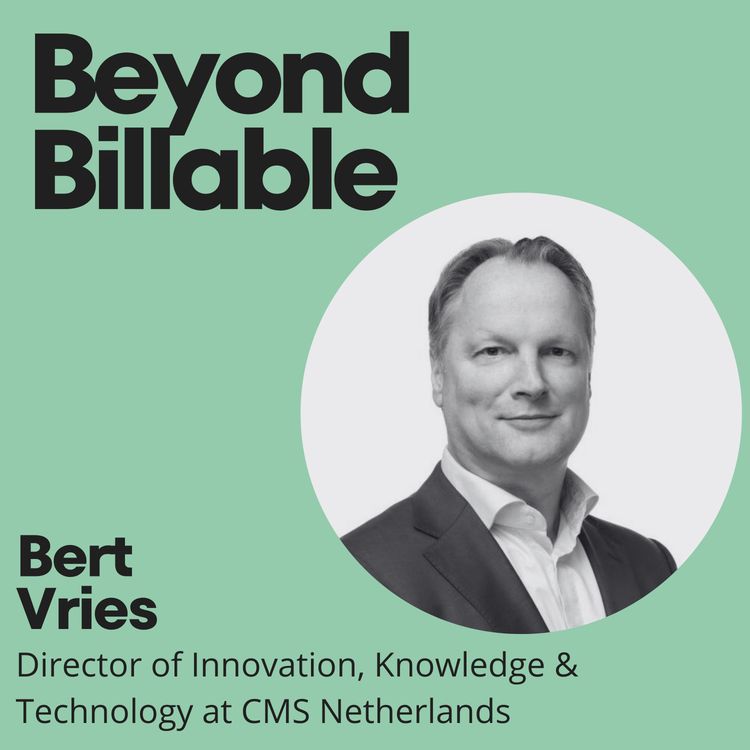
Bert Vries: Negeer de hype, bereid je voor op de tsunami
Pim Betist spreekt met Bert Vries, Head of Innovation, Knowledge and Technology bij CMS Nederland, over wat er nodig is om een advocatenkantoor voor te bereiden op AI.
Bert legt uit waarom de impact van AI op korte termijn vaak wordt overschat, terwijl de gevolgen op langere termijn mogelijk worden onderschat. Hij vertelt hoe CMS werkt met gecontroleerde experimenten, kantoorbrede toegang tot Harvey en praktijkgroepspecifieke toepassingen om AI om te zetten in meetbare waarde.
Ook bespreken ze waarom het aantal prompts weinig zegt over succes, hoe AI juridische prijsmodellen kan veranderen, waarom het declarabele uur relevant blijft en hoe advocatenkantoren zich geleidelijk ontwikkelen tot hybride organisaties waarin juristen, software, workflows en agents samenwerken.
Een nuchter gesprek over juridische innovatie, gedragsverandering en de toekomst van het advocatenkantoor.
More episodes
View all episodes

Daan Potjer: From AI Adoption to AI Adaptation
45:01|AI adoption was only the first step for firms. The next challenge is adapting the law firm around it.Pim Betist sat down with Daan Potjer, Director of Commercial and Legal Excellence at Loyens & Loeff.Daan is not a lawyer. Before joining Loyens & Loeff, he built his career in finance and real estate, most recently as COO of Colliers. That gives him an outsider’s perspective on how legal services are organised and what needs to change next.Pim and Daan talk about why AI adaptation will affect much more than technology, including:- Why the legal profession’s “glass half empty” mentality can make change harder- How mid sized firms may get squeezed between large firms and specialised boutiques- The one change Daan would make if he had a magic wand- Why multidisciplinary teams will become increasingly important in legal service delivery- And how law firms can help in house teams become more strategic business partnersIf you work in legal and are wondering how the next phase of AI looks, this is one for you.
Bert Vries: Ignore the Hype, Prepare for the Tsunami
12:34|This episode is an English summary of Pim Betist’s conversation in Dutch with Bert Vries, Head of Innovation, Knowledge and Technology at CMS Netherlands, about what it really takes to prepare a law firm for AI.We explain why the short term impact of AI is often exaggerated while its longer term consequences may be underestimated. We share how CMS uses controlled experiments, firm wide access to Harvey and practice specific use cases to turn AI adoption into measurable value.We also cover why prompt counts reveal little about success, how AI could reshape legal pricing, why the billable hour still has a role and how law firms may gradually develop into hybrid organisations combining lawyers, software, workflows and agents.The episode offers a pragmatic perspective on legal innovation: move step by step, focus on client outcomes and prepare for fundamental change without reacting to every new wave of hype.
Lucienne van der Geld: de paradox van AI, meer technologie vraagt om meer menselijkheid
50:08|In deze aflevering spreek ik met Lucienne van der Geld, directeur van Netwerk Notarissen en docent notarieel recht aan de Radboud Universiteit.Lucienne neemt een bijzondere positie in binnen het debat over juridische AI. Ze gelooft sterk in het belang van menselijk oordeel, empathie en onafhankelijkheid in het juridische vak. Tegelijkertijd is ze een van de drijvende krachten achter de AI adoptie binnen de notariële sector.Ik begon dit gesprek met de overtuiging dat AI uiteindelijk een groot deel van het werk van notarissen zou overnemen. Aan het einde van het gesprek dacht ik daar anders over. We bespreken waarom betere AI niet automatisch leidt tot minder werk. Lucienne legt uit waarom prompt engineering waarschijnlijk geen vaardigheid wordt die iedere jurist hoeft te beheersen, waarom AI steeds meer zal verdwijnen in de software die professionals dagelijks gebruiken, en waarom de groeiende stroom aan AI gegenereerde informatie een van de grootste uitdagingen van het notariële beroep kan worden. Uiteraard praten we ook over de economische gevolgen van AI voor het notariaat. Zorgt AI voor lagere prijzen? Wordt value based pricing de nieuwe standaard? Of blijven cliënten volgens uurtje-factuurtje betalen voor wat technologie niet kan bieden?
Lucienne van der Geld: The Human Advantage for Notaries in an AI driven World (English summary)
10:41|This is an English summary of my conversation with Lucienne van der Geld, managing director of Netwerk Notarissen and lecturer in notarial law at Radboud University.Lucienne occupies a unique position in the debate on legal AI. She strongly believes in the importance of human judgement, empathy, and independence in the legal profession. At the same time, she is one of the driving forces behind AI adoption within the notarial sector.I went into this conversation convinced that AI would eventually replace a large part of the work notaries do. By the end of our conversation, I thought differently.We discuss why better AI does not automatically lead to less work. Lucienne explains why prompt engineering is unlikely to become a skill every legal professional needs to master, why AI will increasingly disappear into the software professionals already use every day, and why the growing stream of AI generated information may become one of the biggest challenges facing the notarial profession.Naturally, we also discuss the economic impact of AI on the notarial profession. Will AI lead to lower prices? Will value based pricing become the new standard? Or will clients continue to pay by the hour for something technology cannot provide?
Martin Woodward: Why AI Is Forcing Law Firms to Rethink Everything
47:20|Martin Woodward spent over a decade as a lawyer at one of the larger Dutch firms. Now he's Randstad's Global Responsible AI Officer, and he has a blunt prediction: he'd be very surprised if the traditional law firm model survives the next few years unchanged.Pim sits down with Martin to talk about what AI is doing to legal work, told from inside a company that's already deep into it.Randstad uses Google’s workspace solutions, which gave Martin’s team early access to enterprise-grade Gemini before most organizations had it. He also joined a Claude Code hackathon for lawyers and built a working EU AI Act risk-classifier app in about an hour, with zero coding background.We get into:Why "training, training, and more training" is his only real defense against automation bias, the human habit of trusting whatever the computer saysHis worry that younger lawyers won't develop the gut sense for when something's off if they lean on AI from day oneWhether specialized legal AI providers like Harvey and Legora can hold off the frontier labs now that Anthropic, OpenAI, and Microsoft have all targeted the legal marketThe Legora exec who openly said they're going after the 1 trillion dollar legal services market, not the 40 billion dollar legal tech marketWhy relationships, one of the most human things lawyers have, might be the thing that saves the professionMartin thinks the tipping point isn't here yet, but it's getting closer. The firms that survive will be the ones that can say exactly what's still worth paying a human for.
Ari Kaplan: The Legal Tech Historian on why connection creates opportunity
19:45|Pim had been curious for a while about the story behind Ari Kaplan the tall, energetic New Yorker known for hosting legal innovation events around the world. So, last year, during Lexpo 2025- The Legal Innovation Event he decided to sit down with him and find out. t turns out Ari has spent decades tracking the legal sector as a lawyer, writer, researcher, speaker, and host of one of the deepest podcast archives in legal tech. Ari started recording interviews in 2009, before podcasting had even fully found its name. Today, that body of work amounts to a remarkable archive of conversations with leaders across legal, legal tech, and adjacent markets. He's done 60+ research reports and published over 900 podcast episodes.This gives him the long view of legal innovation. In the episode, we explore: - Why connecting people is still one of the most valuable skills in legal - Why consistency is underrated in building trust, visibility, and opportunity - How generosity and community building create real long term advantage If you work in legal innovation, business development, or leadership, this conversation will give you plenty to think about.This episode is sponsored by Lexpo.com get your tickets now.
Frans Post: What happens when the billable hour stops being the carrier of value?
56:15|Artificial intelligence is forcing law firms to confront a question many have avoided for decades. What happens when the billable hour stops being the carrier of value?In this episode of Beyond Billable, Pim Betist speaks with Frans Post, a seasoned financial leader in the legal industry with more than thirty years of experience inside major international law firms.Frans began his career at Clifford Chance when the Amsterdam office was still a five partner startup and helped grow it into a 300 person firm. He later held senior C suite roles in law firms across London, New York and other international markets. He went on to become CFO at De Brauw Blackstone Westbroek and most recently led a major Microsoft Dynamics implementation at Houthoff, focused on creating a technological foundation for data and AI.Drawing on decades of experience in the financial engine room of law firms, Frans shares his perspective on how AI will reshape the economics of legal services. The conversation explores the future of leverage, the decline of hours times rates, and why pricing will become one of the most strategic capabilities inside law firms.They also discuss the shift toward value based pricing, margin management, subscription models and the changing role of partners in a technology driven legal market.This episode is essential listening for law firm leaders, partners and legal professionals who want to understand how AI is transforming the business model of law.This episode was recorded on De Gewoonboot in Amsterdam Noord.
Sarah Wilson-Ward: From firefighting to focus
39:29|More regulation. More work. Higher expectations. And somehow, still the same sized legal teams. Sound familiar?In this episode of Beyond Billable, I speak with Sarah about why pressure on legal departments keeps compounding and why technology alone will not get them out of it.She offers a strikingly simple answer to a question many legal professionals are wrestling with right now. Which parts of legal work will be impacted by AI, and which parts truly require the human brain. We unpack how to make that distinction and why it matters in practice.Instead of starting with tools, Sarah argues for a reset. Decide what kind of legal department you want to be in five or ten years. Separate legal judgment from operational work. Only then does technology, including AI, make sense as an accelerator.We recorded this conversation on the Gewoonboot. A great place for law firms and legal departments to step back, slow down, and have exactly the kind of conversations we explore in this episode.