Share
Beyond Barbarossa: The Eastern Front of World War 2
From Malta to Yalta—Episode 93
Season 4, Ep. 93
•
Winston Churchill and Franklin Roosevelt meet in Malta in the Mediterranean in February 1945, to prepare to meet Josef Stalin in the second Big Three conference on Soviet territory—Yalta.
It was a meeting that shaped the world for decades.
Map 1: Malta to YaltaMap 2: The Western Front, 1 February 1945
Map 3: The Pacific Theatre, 1 February 1945 Map 4: Poland’s shift west, 1945 Photos
Left: Franklin Roosevelt in 1944. Right: Roosevelt and Churchill at Malta, 2 February 1945.
Averell Harriman and daughter Kathleen
The Vorontsov Palace, quarters for the British delegation
The Livadia Palace, quarters for the American delegation
The Yusupov Palace, housing the Soviet delegation
More episodes
View all episodes
100. The Fall of Berlin
01:02:37||Season 4, Ep. 100David Sumner of the Europe at War podcast joins to provide deeper insight into the last major battle in the European Theatre of the Second World War.Two huge Red Army fronts, the 1st Belorussian and the 1st Ukrainian, crush the nazi capital between them, and bring an end to the Second World War in Europe.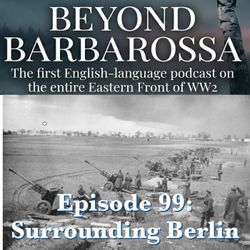
99. Surrounding Berlin: Episode 99
39:29||Season 4, Ep. 99In the 99th episode of the first English-language podcast that focuses on the full story of the Eastern Front of World War 2, Stalin’s top Marshals, Georgy Zhukov and Ivan Konev, race to be the first to raise the Red Banner over the Reichstag. Who will get there first?MapsMap 1: The Red Army’s Vistula to Oder operation
98. The Great Race Begins
31:54||Season 4, Ep. 98"From the moment Stalin heard that the Americans were across the Rhine, he knew that the race for Berlin was on.”—Antony Beevor. WIth the Allies on the Elbe, and the Red Army on the Oder, nazi Germany was being terminally squeezed by April 1945. But before they can drive on the prize, Berlin, the Red Army must take Vienna. Map 1: The Red Army’s advance, 1944–1945 Map 2: The Red Army on the Oder and Niesse Map 3: Advance into Vienna Map 4a: European front line, 1 April 1945 Map 4b: European front line, 15 April 1945 Historical photos Georgy Zhukov, Marshal of 1st Belorussian Front Ivan Konev, Marshal, 1st Ukrainian Front Rodion Malinovsky, Marshal, 2nd Ukrainian Front Fyodor Tolbukhin, Marshal, 3rd Ukrainian Front97. Spring Awakening and Upper Silesia: Episode 97
41:21||Season 4, Ep. 97The #6 Top World War 2 podcast continues following the Red Army’s advance into Hungary and Germany—and the expensive failure of the German Operation Spring Awakening. Map 1: Front lines in Europe, 1 March 1945 Map 2: Operation Southwind/Sudwind Map 3a: German plans for Operation Spring Awakening Map 4: The Soviet counter-attack, The Lake Balaton counter-offensive Map 5: Following Operation Spring Awakening Map 6: Upper Silesian locations in 2026 Map 7: The front lines, Europe, 1 April 1945 People Rodion Malinovsky Fyodor Tolbukhin Heinz Guderian Friedrich Schorner Walther Nehring (right)
96. Silesia, Part 1—Episode 96
36:13||Season 4, Ep. 96The Red Army penetrates deep into Germany, leading to the redrawing of eastern European borders after. Map 1: The Oder offensive–March 1945 Map 2: The Lower Silesian Offensive Map 3: The East Pomeranian Offensive Map 4a: European fronts, 15 February 1945 Map 4b: European fronts, 15 March 1945 Photos Marshal Ivan Konev, Commander of the 1st Ukrainian Front General Walther Wencke, chief of staff, Army Group Vistula, February 1945 Child soldiers in the wehrmacht: Hitler Youth in Breslau (Wroclaw), February 1945 Breslau (Wroclaw) in fighting, 1945
95. The Impossible Alliance, Part 2: Episode 95
42:19||Season 4, Ep. 95Why did the Yalta Conference end the way it did? Why did Churchill try an end-run around Roosevelt? Why did Roosevelt try to curry Stalin’s favour? What would this mean to post-war history? Author Giles Milton joins to discuss some of the Second World War’s most perplexing questions. People Author Giles Milton His latest book, The Stalin Affair: The impossible alliance that won the war The Big Three: Soviet Premier Josef Stalin, U.S. President Franklin Delano Roosevelt, and U.K. Prime Minister Winston Churchill Kathleen “Kathy” or “Puff” Harriman, daughter of Roosevelt’s right hand and Ambassador to the USSR in 1945, Averell Harriman Averell Harriman Pamela Churchill, WInston Churchill’s daughter-in-law in 1945, and later, Mrs. Averell Harriman Stalin and Churchill at the Moscow Conference, 1944 Franklin Roosevelt in 1945 Map 1: The division of Germany after May 1945 Map 2: Invasion of Poland, 1939 Map 3: Poland moves 100 km west Sources Giles Milton, author: https://www.gilesmilton.com/ Books podcast: Ministry of Secrets
94. The Impossible Alliance, Part 1: Episode 94
33:24||Season 4, Ep. 94Why were the Yalta Conference’s decisions so vague? Why did Stalin get everything he wanted? And why did Roosevelt act so naively? Giles Milton, bestselling author of The Stalin Affair: The Impossible Alliance that Won the War, joins the podcast today to help understand the relationships that had the greatest impact on the second meeting of the Big Three of the Second World War. Photos Author Giles Milton The Stalin Affair: The Impossible Alliance that Won the War by Giles Milton The Big Three at Yalta, February 1945. Roosevelt would be dead in two months. Map 1: Yalta in Crimea, on the Black Sea, site of the 1945 Yalta Conference of the Big Three Map 2: The tortured road from Saky Airfield to Yalta Sources Giles Milton, author: https://www.gilesmilton.com/ Books podcast: Ministry of Secrets92. Into Germany—Episode 92 of the first podcast to focus on the full story of the Eastern Front of World War 2
44:05||Season 4, Ep. 92The Red Army continues its continual advance onto German soil—and the flight of German civilians and military. Map 1: The siege of Kongisberg Map 2: Samland The Samland Peninsula in 1905, showing city and town names still present in 1945. Map 3: The (second) East Prussian Offensive Map 4: The advance across Poland Historical photos Franklin Roosevelt meets Winston Churchill in Malta, 2 February 1945 Civilians from Konigsberg walk across frozen Vistula Lagoon, January 1945 CIvilians flee Lodz, Poland, January 1945 Red Army arrives in Lodz, Poland, January 1945 Hitler shakes hands with Col. Claus von Stauffenberg at the “Wolf’s Lair," July 1944. Ruins of the Wolfsschanze, “Wolf’s Lair,” Hitler’s headquarters in East Prussia Sources Antony Beevor, The Second World War. New York, NY, USA: Little, Brown and Company, 2012. Scott Bury, Walking Out of War: Volume 3 of the Eastern Front Trilogy. Ottawa, Canada: The Written Word, 2017. Evan Mawdsley, Thunder in the East: The Nazi-Soviet War, 1941–1945. London: Bloomsbury Academic, 2016. Anthony Tucker-Jones, Slaughter on the Eastern Front: Hitler and Stalin’s War, 1941–1945. Stroud, Gloucestershire, UK: The History Press, 2017. David Sumner, Europe at War: A podcast about lesser-known battles of the Second World War. https://podcasts.apple.com/ca/podcast/europe-at-war-a-ww2-podcast/id1788043665 Larysa Zariczniak, Wandering the Edge: Ukrainian history and culture https://podcasts.apple.com/ca/podcast/wandering-the-edge/id1547149262 David Sumner, Europe at War: A WW2 podcast https://podcasts.apple.com/ca/podcast/europe-at-war-a-ww2-podcast/id1788043665 Morse code by Thane Brown Music composed and recorded by Nicolas Bury