Share
A Beginner's Guide to AI
The Matrix Asked the Question. Nick Bostrom Tried to Answer It.
🤖🧠💻 Could reality itself be software?
What if The Matrix wasn't just brilliant science fiction, but a serious philosophical possibility?
In this episode of A Beginner's Guide to AI, Professor Gep-Hardt explores the Simulation Hypothesis, one of the most fascinating ideas in modern philosophy. Inspired by philosopher Nick Bostrom's famous argument, we ask whether our entire universe could actually be an unimaginably advanced computer simulation.
📧💌📧
Tune in to get my thoughts and all episodes, don't forget to subscribe to our Newsletter:
📧💌📧
You'll discover why this idea has captured the attention of philosophers, physicists and AI researchers around the world. We separate science from speculation, explore the famous simulation argument, examine attempts to test the hypothesis using physics, and discuss why advances in artificial intelligence have made this debate more relevant than ever.
Along the way, we'll explain complex ideas using simple examples, explore what AI teaches us about consciousness and reality, and ask whether future civilizations might one day possess enough computing power to simulate entire universes.
If you're interested in artificial intelligence, philosophy, future technology or simply enjoy asking big questions, this episode is for you.
✅ What the Simulation Hypothesis actually is
✅ Nick Bostrom's famous trilemma
✅ Why AI is bringing this debate back into focus
✅ How scientists have tried to test the hypothesis
✅ What critics such as Sabine Hossenfelder argue
✅ What today's physics really says
✅ Why this thought experiment matters for AI, business and society
🙏 P.S. A special thank you to Diana Carter from Interview Valet for suggesting today's topic. It turned into one of the most thought-provoking episodes we've ever explored.
👤 About Dietmar Fischer
Dietmar Fischer is a podcaster, AI researcher and digital marketer from Berlin. Through A Beginner's Guide to AI, he helps business professionals understand artificial intelligence without the hype. If you'd like to accelerate your AI adoption or digital marketing strategy, visit https://argoberlin.com.
More episodes
View all episodes
17. The Invisible Label: How AI Watermarking Will Change Digital Trust
24:07||Season 16, Ep. 17AI-generated images, voices, videos and text are becoming harder to distinguish from human-made content. AI watermarking promises to help by embedding an invisible signal that detection software can identify. But what does that signal really prove, and can it survive editing, compression or a determined attacker?In this episode of A Beginner’s Guide to AI, Prof. GePhardT examines how AI watermarking works across images, audio, video and text. We separate genuine watermark detection from unreliable attempts to guess whether something “looks like AI.” We also examine why a missing watermark cannot prove that a human created the content.The EU AI Act has made this question urgent. Providers of relevant generative AI systems must make synthetic outputs machine-readable and detectable as artificially generated or manipulated. Watermarks are one possible solution, alongside metadata, digital fingerprints and cryptographic content provenance.Google SynthID provides our real-world case. The system places imperceptible signals inside supported AI-generated media and allows users to check for them. It demonstrates that watermarking can work at enormous scale, but also reveals the limits of compatibility, robustness and public understanding.🔍 What You Will LearnHow invisible AI watermarks are embedded into pixels, audio, video frames and textWhy watermarking is different from metadata and general AI detectionWhat Article 50 of the EU AI Act means for synthetic contentHow Google SynthID and the SynthID Detector workWhy C2PA and Content Credentials matterWhether AI watermarks can be removedWhy origin and truth are not the same thing📧💌📧Tune in to get my thoughts and all episodes. Don’t forget to subscribe to our newsletter.📧💌📧💬 Quotes from the Episode“A detected watermark does not prove that content is false, and the absence of one does not prove that it is human-made.”“AI watermarking should be treated as one layer of evidence, not a universal truth machine.”“Technology can provide the signature; judgement must still provide the truth.”⏱️ Chapters00:00 Why AI Content Needs an Invisible Label02:10 How AI Watermarking Works07:25 Watermarks, Detectors and Content Provenance10:25 What the EU AI Act Requires12:20 Google SynthID in the Real World17:15 What Watermarks Can and Cannot Prove 👤 About Dietmar FischerDietmar is a podcaster and digital marketer from Argo.berlin. If you want to know how to get your AI or digital marketing going, contact him at argoberlin.com
16. Cutewashing AI: The Hidden Cost of Cute AI
20:14||Season 16, Ep. 16AI agents are becoming more capable, more personal and much harder to ignore. They can use connected apps, prepare work in the background and act on your behalf. So why are Big Tech companies making them look like cheerful little creatures with giant eyes?In this episode of A Beginner’s Guide to AI, Professor GepHardT looks at cutewashing: the use of cute AI mascots to make powerful AI agents feel safe, familiar and harmless. From OpenAI dots to Meta Muse, these tools are moving beyond chatbots. They can access information, work across apps and take action.That makes trust, permissions and privacy more important than ever.🎯 In this episode:Why cute AI agents are everywhereWhat makes an AI agent different from a chatbotHow anthropomorphic AI design can shape trustWhy AI agent permissions and approvals matterWhat OpenAI dots and Meta Muse reveal about the future of personal AIHow to test an AI agent before you let it access your digital life📧💌📧Tune in to get my thoughts and all episodes. Do not forget to subscribe to our newsletter: beginnersguideto.ai📧💌📧Quotes from the Episode“Cute is not a security feature.”“The mascot can open the door. Control must be behind it.”“The most trustworthy AI is not the one that looks the most harmless. It is the one that makes its power visible.”👤 About Dietmar FischerDietmar Fischer is a podcaster and digital marketer from Argo.berlin. If you want to get your AI or digital marketing moving, contact him at argoberlin.com.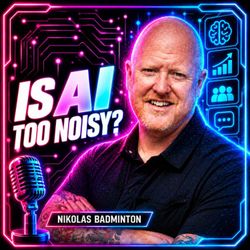
15. AI Isn’t Moving Too Fast. It’s Too Noisy - Nikolas Badminton
55:43||Season 16, Ep. 15🤖 Why AI Transformation Needs Intentionality, Not More TechnologyAI transformation is not about putting AI everywhere. Futurist Nikolas Badminton argues that successful organizations are becoming much more intentional about where AI creates value and where humans remain essential.In this episode of Beginner’s Guide to AI, Dietmar Fischer speaks with Nikolas Badminton, Chief Futurist and Hope Engineer at Futurist.com, about moving beyond AI hype and building organizations that can actually handle technological change.Nikolas argues that the world is not simply changing faster. It is getting noisier.Behind the endless stream of AI models, agents and automation promises are the same difficult questions companies have faced for decades: people, processes, governance, data, culture and leadership.So what changes when AI enters the picture?We explore why going all in on AI can make employees work harder instead of less, why intentionality is becoming central to AI strategy, and why successful AI adoption is fundamentally a transformation project.We also go beyond AI.Nikolas introduces the idea behind his new book, The Hope Engineer’s Playbook: hope can become a practical energy for organizational change when leaders combine vision with pathways, agency and wisdom.We discuss futures thinking, employee empowerment, sustainability, open-source AI, AI sovereignty and even science fiction as a serious strategic tool.🎧 In this episode:• Why AI feels faster and more chaotic than it really is• Why leaders should stop trying to use AI everywhere• The hidden organizational work behind AI transformation• Why AI can increase employee workload• Hope as an energy for change• Why agency matters inside organizations• Open-source AI and enterprise AI sovereignty• Why sustainability and futures thinking belong in business strategy• How science fiction helps executives experience possible futures• Whether AI leads us toward Terminator, Matrix or something completely differentGet the Newsletter!📧💌📧Tune in to get my thoughts and all episodes. Don't forget to subscribe to our Newsletter:https://beginnersguideto.ai📧💌📧🎙️ About Dietmar FischerDietmar Fischer is a podcaster and AI marketer from Berlin.If you want help with AI strategy or digital marketing, visit:https://argoberlin.com💬 Quotes from the Episode“The world is changing faster than ever before. I actually think it's noisier than ever before.”“It's a transformation project. There's still people and processes and governance, there's data, and that's messy.”“I get hired for the things I used to get fired for.”⏱️ Chapters00:00 Meet Futurist and Hope Engineer Nikolas Badminton01:26 Why AI Feels Faster Than It Really Is04:33 From AI Hype to Intentional Transformation09:16 Why Hope Is a Serious Leadership Tool17:16 Futures Thinking and the Courage to Think Differently25:10 How to Become a Hope Engineer29:22 AI Sovereignty and the Case for Open Source32:47 Sustainability, Science Fiction and Better Futures42:11 Will AI Create Terminator or Matrix?45:26 The Hope Engineer’s Playbook🔗 Where to Find Nikolas Badminton🌐 Website: futurist.com💼 LinkedIn: linkedin.com/in/futuristnikolasbadminton📕 The Hope Engineer’s Playbook: How Leaders Build Vision, Pathways, and Energy for Better Futures: https://futurist.com/hope-engineers-playbook/
14. AI Is Now the Business Standard. Are You Falling Behind? - DIETMARs OPINION
09:59||Season 16, Ep. 14🤖 AI has moved beyond technical teams and innovation labs. At Berlin’s BIG BANG KI Festival, Dietmar Fischer found packed stages, long queues, and business professionals searching for practical ways to implement artificial intelligence.In this solo episode of Beginner’s Guide to AI, Dietmar shares what he observed at the festival and what it tells us about AI adoption in the wider business world.The dominant questions were practical. How can a company integrate AI into its CRM? How can it build useful AI agents? How can it turn individual tools into repeatable workflows? The audience was not limited to developers or AI specialists. It looked like the audience at any large business conference.That shift matters. AI is no longer an unusual competitive advantage. It is becoming part of the expected business standard.The festival also exposed the continuing gap between AI marketing and AI implementation. Many exhibitors used impressive language without clearly explaining what their products did. Interest in AI is high, but clear business value is still difficult to identify.Dietmar also visits the robot arena, where humanoid machines dance and fight. The demonstration leads to a more serious question about how physical robots could change private security and other real-world services.💡 In this episode:What the BIG BANG KI Festival reveals about AI adoptionWhy AI has entered mainstream businessWhat business professionals want from AI agentsWhy CRM integration and AI workflows are becoming importantThe gap between AI buzzwords and practical business valueWhat humanoid robots could mean for securityWhy occasional AI use is no longer enoughHow companies can move from AI tools to systematic implementationThe message is simple: companies must do more than use AI. They must learn to systematize it, connect it to real processes, and make it productive.📧💌📧Tune in to get my thoughts and all episodes, and don’t forget to subscribe to our newsletter: beginnersguideto.ai📧💌📧Quotes from the Episode“AI arrived in the business world, definitely arrived.”“It makes AI a standard. And if you don’t follow the standard, you are below standard and you fall behind.”“It’s not just using AI. You have to get to the next level to systematize AI, to use it to really be productive, to use agents and all those things.”Chapters00:00 How Mainstream Business Sees AI01:26 Inside the BIG BANG KI Festival02:23 Packed Stages and Practical AI04:43 Agents, Acceptance and AI Buzzwords05:47 Robot Boxing and the Future of Security07:28 AI Is Now the Business StandardAbout Dietmar FischerDietmar is a podcaster and digital marketer from Argo.berlin. If you want to get your AI or digital marketing going, contact him at argoberlin.com.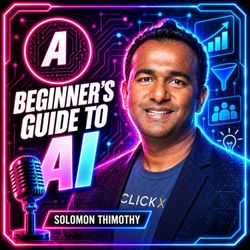
13. Stop Doing the Work. Start Directing the AI - Solomon Thimothy
56:58||Season 16, Ep. 13🤖 AI fluency is becoming a core business skill. But being AI fluent means much more than knowing how to prompt ChatGPT.In this episode of Beginner's Guide to AI, Dietmar Fischer talks with entrepreneur and growth marketer Solomon Thimothy about the transition from using AI as a chatbot to using AI as part of the workforce.Solomon describes how his teams use AI agents and coding tools to create software, automate workflows, prepare client work and increase capacity without simply adding more people.One example captures the shift: a client had a design process that normally took about a week. After rebuilding the workflow around AI, multiple branded materials could be produced during a single call. According to Solomon, the client estimated that the new process saved him $18,000.But this episode is not really about one tool.It is about a different way of working.Instead of employees doing every task themselves, Solomon argues that professionals increasingly need to direct AI systems that execute the work. That changes productivity, hiring, professional services, management and even the economics of running a company.We discuss:🤖 Why AI fluency matters beyond prompt engineering⚙️ How AI agents change everyday knowledge work📈 Why AI can increase capacity without immediately increasing headcount🧠 Why employees need to learn to direct rather than simply execute💼 What AI means for hiring and professional services💻 How non-programmers can build working software with AI⏱️ Why speed can be more valuable than pure cost reduction💰 Why AI token costs are becoming a management problem👥 Why human experience and context remain essentialThe larger question is simple:If AI can increasingly execute the work, what becomes your job?📧💌📧Tune in to get my thoughts and all episodes. Don't forget to subscribe to our Newsletter:https://beginnersguideto.ai📧💌📧👤 About Dietmar FischerDietmar Fischer is a podcaster and AI marketer from Berlin.If you want help with AI strategy or digital marketing, visit:https://argoberlin.com💬 Quotes from the Episode“We now need to drive the thing, we don't need to do the thing.”“I don't think we're going to be taken over by AI. I think we already are.”“It's your talent, your experience, your past work.”⏱️ Chapters00:00 Meet Solomon Thimothy01:05 Scaling a Business With “Tokenized Labor”07:02 How AI Changes the Agency Business Model12:24 Building Software Without Being a Developer18:24 Why Every Professional Needs AI Fluency27:14 Hiring and Leading in an AI-First Company36:09 Managing Multiple AI Agents and Models40:31 Has AI Already Taken Over?46:25 AI Costs, Books and Where to Find Solomon🔗 Where to Find Solomon Thimothy🌐 IMS: https://www.ims.net/🌐 Personal website: https://www.thimothy.com/💼 LinkedIn: https://www.linkedin.com/in/solomonthimothy/🏢 OneIMS: https://www.oneims.com/📚 Books: his upcoming "How to Have Buyers Chase You" is not yet out, you can find all the details here: https://www.thimothy.com/books
12. Jevons’ AI Paradox: Why Cheaper Models Raise Energy Demand
22:54||Season 16, Ep. 12⚡ AI is getting cheaper, faster, and more efficient. So why are data centres preparing to use far more electricity?In this episode of A Beginner’s Guide to AI, Professor GePhardT explores Jevons’ paradox and its uncomfortable lesson for artificial intelligence: using less energy per task does not guarantee that we use less energy overall.Better chips, smaller models, efficient inference, and AI agents make AI more affordable. But lower cost also creates more demand. One AI task becomes ten. One assistant becomes an agent. One model call becomes a long automated workflow running quietly in the background.We look at the AI rebound effect, AI energy consumption, data-centre electricity demand, sustainable AI, AI agents, and the infrastructure cost behind near-free inference. The episode also examines Google Gemini prompt efficiency alongside the larger growth in AI-focused data centres.📧💌📧Tune in to get my thoughts and all episodes. Don’t forget to subscribe to our Newsletter: beginnersguideto.ai📧💌📧👤 About Dietmar FischerDietmar is a podcaster and digital marketer from Argo.berlin. If you want to get your AI or digital marketing going, contact him at argoberlin.com.💬 Quotes from the Episode“Each individual task may become cheaper. The total number of tasks can explode.”“The efficient oven was not a failure. It did exactly what it was supposed to do.”“Efficient per what? And more of how many?”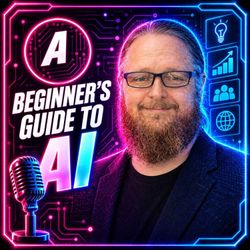
11. A Disturbing AI Story Big Tech Never Wants You to Hear, with Paul Hebert // REPOST
53:33||Season 16, Ep. 11🎙️In this episode of Beginner’s Guide to AI, Dietmar Fischer sits down with Paul A. Hebert, founder of AI Recovery Collective and author of Escaping the Spiral, for a serious conversation about AI chatbot harm, hallucinations, digital dependency, and the real-world psychological risks of generative AI. Paul shares how an intense experience with ChatGPT pushed him into a dangerous spiral, what he learned about the limits of large language models, and why AI literacy may be one of the most important skills of this decade.🧠 This episode explores what happens when AI stops feeling like software and starts feeling personal. Dietmar and Paul talk about hallucinations, trust, chatbot addiction, AI companions, mental health risks, youth safety, and why companies building these systems cannot hide behind product language forever. The discussion is intense, but it is also practical. You will come away with a clearer sense of how to use AI more safely, what warning signs to watch for, and why regulation is quickly becoming a much bigger part of the AI conversation. OpenAI has publicly discussed why language models hallucinate, while lawmakers in multiple U.S. jurisdictions have pushed new restrictions on AI systems acting like therapists or medical professionals.📧💌📧Tune in to get my thoughts and all episodes, don't forget to subscribe to our Newsletter: beginnersguide.nl📧💌📧👤 About Dietmar Fischer: Dietmar is a podcaster and AI marketer from Berlin. If you want to know how to get your AI or your digital marketing going, just contact him at argoberlin.com🔥 Quotes from the Episode“AI literacy is the most important thing anybody can work on.”“Had OpenAI responded to that first message and said this is a hallucination and you’re physically safe, I would have been fine.”“Never trust the thing it tells you. Even if it gives you a citation, go look.”🕒 Chapters00:00 Paul Hebert’s Shocking ChatGPT Experience08:14 Why AI Hallucinations Can Spiral Into Real Fear16:05 AI Literacy, Neurodivergence, and How He Got Out23:32 Why AI Companies Must Be Accountable30:02 AI Companions, Youth Safety, and Addiction Risks38:28 Terminator, Consciousness, and Practical Rules for Safe AI Use🔗 Where to find PaulThe AI Recovery Collective: airecoverycollective.comEscaping the Spiral on AmazonAI Recovery Collective Substack: airecoverycollective.substack.com/LinkedIn: Paul A. Hebert: linkedin.com/in/paul-hebert-48a36/🎵 Music credit: "Modern Situations" by Unicorn Heads
10. Why Your AI Content Feels Soulless - Diane Strand
48:31||Season 16, Ep. 10🤖 AI and creativity do not have to be opponents. Used well, artificial intelligence can help people work faster, develop ideas, and remove repetitive tasks. But it cannot replace the human vision, judgment, and emotional connection that make creative work meaningful.In this episode of Beginner’s Guide to AI, host Dietmar Fischer speaks with executive producer, educator, author, and creative entrepreneur Diane Strand about what generative AI means for creative professionals, entrepreneurs, marketers, and business leaders.Diane believes that AI should remain a tool with “the human in the middle.” Like a hammer, it can make a task easier, but someone must still decide what to build and how to build it.The conversation examines where AI adds genuine value and where automation begins to weaken the result. Diane explains why fully AI-generated content often feels generic, why businesses still need people who understand other people, and why creative professionals must retain control over their ideas.She also shares a practical example from the development of her book cover. AI helped her turn the themes, colors, and emotional tone of her book into visual concepts. A professional designer then used those concepts to create the final cover. This reduced a process that could have taken weeks to only a few days, without replacing the designer or Diane’s creative direction.Why This MattersAI is changing creative work, marketing, filmmaking, and entrepreneurship. It can help small teams produce more, allow independent entrepreneurs to start with fewer resources, and move employees away from repetitive tasks.However, faster production does not automatically create better work. If AI supplies the ideas, personality, and final judgment, the result can lose its originality and emotional value.Diane offers a clear warning: AI may not replace creative professionals, but professionals who know how to use AI may replace those who refuse to learn it.Key Takeaways🎨 Why AI should support creative thinking rather than replace it🧠 Why human judgment and iteration remain essential⚡ How generative AI can reduce production time📉 Why generic AI content often fails to connect💼 What AI means for creative jobs and future hiring🛠️ Why employees need AI fluency to remain competitive👥 How leaders can introduce AI without creating unnecessary fear🚀 How entrepreneurs can use AI to work with fewer resources♿ How AI can make creative expression more accessible🌍 Why the environmental cost of AI also deserves attention📧💌📧Tune in to get my thoughts and all episodes. Don't forget to subscribe to our Newsletter:https://beginnersguideto.ai📧💌📧About Dietmar FischerDietmar Fischer is a podcaster and AI marketer from Berlin.If you want help with AI strategy or your digital marketing, visit:https://argoberlin.comQuotes from the Episode“If you start relying on it to do your work, you're the first to be replaced.”“I don't think AI kills creativity. I think it forces us to be more creative.”“If you want a human to buy, you need to have a human initiating the marketing.”Where to Find Diane Strand🌐 Website: https://dianestrand.com🔗 Official social links, including LinkedIn, Instagram, and Facebook: https://linktr.ee/diane_strand🎬 JDS Studio: https://jdsstudio.live🎥 JDS Video & Media Productions: https://jds-productions.com🎭 JDS Creative Academy: https://jdscreativeacademy.orgClosingIf this conversation changed how you think about AI and creativity, share it with someone who is trying to find the right balance between automation and human judgment.Subscribe to Beginner’s Guide to AI for more conversations about artificial intelligence, business, creativity, and the future of work. 🎧
10. Why Your Brain Needs to Go to the Gym in the Age of AI - DIETMARs OPINION
13:39||Season 16, Ep. 10Dietmar Fischer explores cognitive offloading, critical thinking, and why learning must remain mentally demanding when AI can provide instant answers.🧠 What happens when AI solves every problem before you have had time to think?AI can make us faster and more productive. But if we use it to avoid every difficult mental task, we may also weaken the critical thinking, judgment, and problem-solving skills that make us valuable.Inspired by the question of whether the classroom should function more like a gym, Dietmar Fischer examines why our brains need resistance, repetition, and deliberate exercise. Just as muscles become weaker without use, our intellectual abilities can suffer when we outsource too much of the thinking process.The goal is not to compete with AI at everything. It is to recognize where AI performs better and where human abilities still matter. Creativity, empathy, strategic thinking, social intelligence, curiosity, and judgment remain essential. When we develop those abilities and use AI for the right tasks, humans and machines can become an effective team.🎯 In this episode:Why the classroom could become a gym for the brainHow AI can encourage cognitive offloadingWhy easy answers do not always produce real learningThe difference between reaching a result and understanding itWhy intrinsic motivation matters in the age of AIWhich human skills will remain important at workHow to use AI without surrendering your ability to thinkWhy reading and difficult intellectual tasks still matterAI should help us think better, not remove thinking from the process.📧💌📧Tune in to get my thoughts and all episodes. Don’t forget to subscribe to our newsletter: beginnersguideto.ai📧💌📧Quotes from the Episode💬 “The better we train our brain, the better we can face what’s coming.”💬 “If we use AI for the things where AI is better and we develop our abilities where we are better, then we have a good team.”💬 “The middleman is the brain in this case. Don’t cut it out. You need it there.”About Dietmar FischerDietmar Fischer is the creator and host of Beginner’s Guide to AI and a digital marketer at Argo.berlin. If you want to get your AI project or digital marketing moving, contact him at argoberlin.com.Chapters00:00 Can We Still Think in the Age of AI?02:16 The Classroom as a Gym for the Brain04:31 Human Strengths AI Cannot Replace06:28 The Danger of Outsourcing Problem-Solving09:40 Learning as Lifelong Brain Training10:30 Reading, Storytelling and the Final Challenge