Share
Babes in Bookland
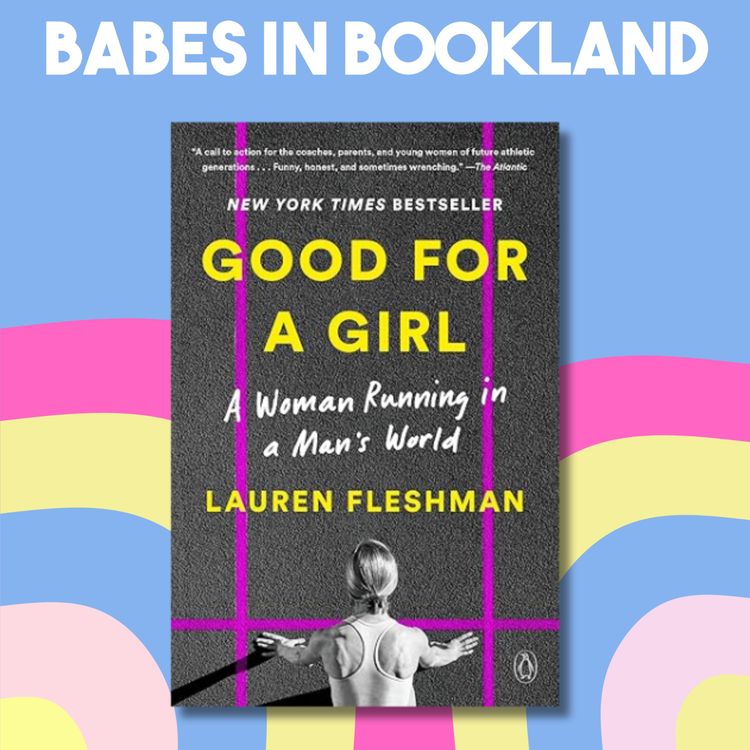
Objectify Her // Lauren Fleshman's Memoir "Good for a Girl"
What would it mean to build women's sports around women's bodies?
This week, my friend Becca returns to discuss Lauren Fleshman's memoir "Good for a Girl". What starts as a running memoir quickly reveals itself as something far bigger: an investigation into the science of female puberty and athletics, the eating disorder epidemic inside women's collegiate and professional sports, and one woman's relentless fight to change a sport she loves from the inside out. We discuss Lauren's unconventional path to running, the ways puberty has been treated as "the one injury a girl can't come back from," the NCAA's staggering lack of policy around eating disorders in women's athletics, Lauren's famous Nike "Objectify Me" campaign, and the ways female athletes are still being failed by the systems built to protect them.
This episode is for every woman who was ever told she was good — for a girl. The runners, the former athletes, the moms of daughters in sports, and anyone who has ever felt their body was working against them instead of for them.
If this conversation resonated with you, the best thing you can do is share it with a friend who needs to hear it, and rate and review the show wherever you listen. It makes a huge difference!
Other Links:
https://www.milesplit.com/articles/211759/dear-younger-me-lauren-fleshman (Lauren's letter to her younger self)
Follow Becca's bookstagram: @bookedwithbecca and her new running account: @run.with.becca
Support the show:
Subscribe to the Babes in Bookland Substack
Connect with us and suggest a great memoir!
Follow us on instagram! @babesinbooklandpod
Thank you for listening!
Xx, Alex
Timestamps!
00:00 — Intro: Lauren Fleshman's Good for a Girl
01:02 — Why did Becca pick this book?
03:33 — The book's dedication and opening lines
03:57 — How did Becca's running journey begin?
05:15 — How do you stay safe on solo runs?
07:05 — What would you tell your younger self?
08:09 — "You can do anything, Lauren" — her dad's voice in her head
09:58 — How do we hold space for people who shaped us for better and worse?
11:35 — "Dad was a wild tide, but mom was our shore"
12:08 — How do parents give equal love and attention in a big family?
13:44 — Beating the boys, and not questioning it
17:03 — Why do we still say "good for a girl"?
17:51 — Middle school dominance, then puberty hits
19:00 — Do we tie our identity to winning?
19:50 — Becca's Lauren Fleshman sighting on a race course
20:25 — Why are girls quitting sports by 14–17?
22:37 — Why does puberty help boys and hurt girls athletically?
23:32 — The clash between athletic function and the male gaze
25:39 — Finding her running form and making the team
27:20 — When did you first realize the boys were pulling ahead?
29:30 — How did Title IX change the culture of effort?
33:04 — "Puberty is the injury you can't come back from" — what did the captain mean?
34:20 — Why are eating disorders so prevalent in the running world?
35:53 — Why does the NCAA still have no policy on eating disorders?
39:06 — Stanford, Jesse, and asking the hard question up front
40:07 — "What made great women possible?"
41:19 — Body image and the college uniform
42:41 — Equity vs. equality — why "same" isn't fair?
43:16 — Why do female athletes peak in their late 20s and 30s, not their teens?
45:08 — Going pro on a $60K Nike salary
46:04 — Coming heartbreakingly close to the Olympics
47:01 — What happened when she emailed Nike's CEO?
47:46 — The "Objectify Her" campaign — reclaiming the gaze
49:19 — How do you let anger fuel advocacy instead of consuming it?
49:56 — Why did she start her blog?
50:49 — The granola bar company
51:04 — Why did Nike treat her pregnancy like an injury?
51:33 — What real change would actually look like for young female athletes?
52:20 — Final thoughts: what are we taking from this book?
More episodes
View all episodes

38. Nadia Bowers on Her Memoir "Dear Dealer"
51:55||Season 3, Ep. 38What do you do when the person who destroyed your family is also, undeniably, a human being?That's the question at the center of Nadia Bowers's Dear Dealer, and it's the question we sit with for this entire conversation. Nadia's sister Sasha died in 2015 after taking drugs laced with fentanyl, and rather than write a simple story of a villain and a victim, Nadia spent nearly a decade writing directly to the man who sold them to her. We talk about the letter that became a This American Life episode in 2018, the moment a producer emailed her that JJ Abrams wanted to option it as a film, and the year she spent unweaving a seven hundred page draft written entirely as letters before finding the structure that let the book breathe. Nadia talks about reading Truth & Beauty, Ann Patchett's memoir about her friendship with Lucy Grealy, years before Sasha died, and tucking away the idea that grief could be written about honestly and lovingly at once. We get into the specific stigma that surrounds women and addiction, the friend whose book on losing loved ones to the opioid crisis helped Nadia think about radical acceptance, and the moment her husband suggested her sister might have been closer to the dealer's side of the story than either of them wanted to admit.This is a conversation about what we owe the dead, what we owe ourselves, and how you write your way into forgiveness without forcing it. Share this conversation with anyone who has ever loved someone impossible to hold onto."I think maybe grief doesn't grow up, doesn't wither. It stays stubborn and young, rooted in the moment it was born." - Nadia Bowers, Dear DealerBooks referenced:Dear Dealer by Nadia BowersTruth & Beauty by Ann PatchettEverything Is Horrible and Wonderful: A Tragicomic Memoir of Genius, Heroin, Love and Loss by Stephanie Wittels WachsSupport the show:Buy us a bookBuy cute merchon PatreonSubscribe on AppleSubscribe on Substack Xx, AlexConnect with us and suggest a great memoir!Follow us on instagram! @babesinbooklandpod
37. Ariel Lawhon on "The Pirate Queen"
01:20:58||Season 3, Ep. 37What does it take to reclaim a woman's story when history itself was written by people who had every reason to erase her?That's the question at the center of our conversation with Ariel Lawhon, bestselling author of The Frozen River and her newest novel, The Pirate Queen, about the real life Irish chieftain Grace O'Malley. We talk about why Grace doesn't appear anywhere in official Irish history, and how the only record of her survives in the snide, grudging English state papers written by the empire that feared her. Ariel explains that she's drawn again and again to subversive women because women have always had to be subversive, and because for most of history, only the literate got remembered, which meant most women simply didn't. From Nancy Wake to Martha Ballard to Grace herself, she talks about borrowing personality and instinct from the women in her own life to fill in the gaps history left behind, sometimes literally turning a character into her own mother.We get into her process too, how she became a devoted plotter out of necessity after having four sons in five years and learning to write in stolen thirty minute increments, and how she still treats a deadline with the gravity of its original meaning, a line you did not want to cross on a battlefield. There's a genuinely magical detour into the children's book she read in an abandoned two room schoolhouse in New Mexico decades later and found sitting in a pile on the floor, the exact copy, waiting for her. And we spend real time on the moment in The Frozen River that readers talk about most, when Martha Ballard delivers her own kind of justice, and what it means that women are so often expected to pull their punches in fiction the way men never are. Ariel and I talk about intuition, the knowing, and trusting it, sometimes because it's the thing that keeps you alive.Share this conversation with the woman in your life who needs a reminder that the world has always underestimated women like Grace O'Malley, but Grace still soared.“Because men will never respect you if you try to be like them.” Gráinne lifts her head and meets her mother’s gaze. “Then how will they respect me?” “They won’t,” Maeve says with a shrug. Then she takes her daughter’s face in her hands and brings it close. Until their noses touch and their breath mingles. “Not unless you make them.”-excerpt from THE PIRATE QUEEN by Ariel LawhonConnect with Ariel Lawhon:@Ariel.lawhonBooks Referenced:THE PIRATE QUEEN by Ariel LawhonTHE FROZEN RIVER by Ariel LawhonCODE NAME HÉLÈNE by Ariel LawhonFLIGHT OF DREAMS by Ariel LawhonWAIT FOR ME, WATCH FOR ME, EULA BEE by Patricia BeattyCHRONICLES OF NARNIA by C.S. LewisTHE HOBBIT by J.R.R. TolkenLORD OF THE RINGS by J.R.R. TolkenWATERSHIP DOWN by Richard AdamsBARRIERS TO ENTRY by Ariel Lawhon (short story)Support the show:Buy us a bookBuy cute merchon PatreonSubscribe on AppleSubscribe on SubstackThis episode is produced, recorded, and its content edited by me. Xx, AlexConnect with us and suggest a great memoir!Follow us on instagram! @babesinbooklandpod
36. Emilee Hackney on Her Memoir "All That's Unseen"
01:01:21||Season 3, Ep. 36What does it cost to love a place and a faith that shaped you, even after they've hurt you?This week I sit down with Emilee Hackney, author of the New York Times bestselling memoir All That's Unseen, to talk about growing up in Tazewell, Virginia, and the long, winding path that took her from a Pentecostal church pew to Harvard Yard to a bestseller list.We talk about the church she grew up in from age five, the engagement she entered as a teenager, and the slow, painful process of questioning beliefs she'd never been taught to question until she left home for Harvard. Emilee is remarkably generous about her younger self throughout our conversation, and that same compassion runs through every page of her book. We get into the isolation she felt as an Appalachian student surrounded by people who saw her as, in her words, an exotic creature from a shameful corner of the country, and how spite became an unlikely motivator for her education.Of course... politics come up too. Emilee doesn't shy away from the uncomfortable truths in her research, from Trump's proposed defunding of the Appalachian Regional Commission to his rollback of coal dust health protections, even as she pushed back against easy judgments of the people who voted for him anyway. We talk about fear as a political currency, about algorithms that feed conservatism to anyone who engages with Appalachian content, and about the quiet apathy Emilee believes both parties have shown her home region for generations.We end with hope, opossums, and the strange, permanent tension of loving a place you can never quite be happy in or without. This is a memoir about reckoning with faith, class, and identity, and Emilee brought every bit of that nuance into our conversation.Share this conversation with anyone who grew up somewhere they had complicated feelings about leaving."A personal essay, as it turned out, was about more than the people and places I knew. It was about how those people and places affected me: how I saw them, how I interpreted them, how I understood them in my greater understanding of the world." - Emilee Hackney's memoir ALL THAT'S UNSEENConnect with Emilee Hackney:@emileehackneyBooks Referenced:ALL THAT'S UNSEEN by Emilee HackneySTOLEN PRIDE by Arlie Russell HochschildSupport the show:Buy us a bookBuy cute merchon PatreonSubscribe on AppleSubscribe on SubstackThis episode is produced, recorded, and its content edited by me. Xx, AlexConnect with us and suggest a great memoir!Follow us on instagram! @babesinbooklandpod
35. Friday Fiction: Rachel Hochhauser's "Lady Tremaine"
50:09||Season 3, Ep. 35What if the woman we've been taught to hate for six centuries was just doing what it took to survive in a world that gave her almost no options?That's the question Rachel Hochhauser sat with long before she ever sat down to write, and it's the question that turns into her debut novel, Lady Tremaine, the instant New York Times bestseller and Reese's Book Club pick that reimagines Cinderella's stepmother as a woman worth understanding rather than a woman worth fearing.Rachel and I talk about how the idea found her at the hardest possible time, scrolling her phone in a hospital while her husband recovered from emergency brain surgery, suddenly a single parent overnight, when an image of Lady Tremaine stopped her cold. She walks me through the years she spent away from fiction after her first manuscript didn't sell, the puzzle company she built in that gap called Piecework, and what it meant to come back to her desk and have it feel, in her words, like coming home to herself. We get into her research process, including a deep dive into falconry that started with a pandemic hotel workshop and turned into Lucy, the peregrine falcon who becomes one of the book's most vivid characters. And we talk about Ellen, her version of Cinderella, and why Rachel chose to make her one of the more complicated, less immediately likable Cinderellas in the canon, and why that complication is the point.We also get into the line Rachel calls her favorite in the entire book, the one she was writing toward long before she knew how she'd get there, and what it means that the book ends up being a message from a mother to her daughters instead of a fairy tale ending at all.Share this conversation with the friend who still has strong feelings about Ever After.“Goodness is always contextual.”― Rachel Hochhauser, LADY TREMAINEConnect with Rachel Hochhauser:@hochhauserBooks Referenced:LADY TREMAINE by Rachel HochhauserSupport the show:Buy us a bookBuy cute merchon PatreonSubscribe on AppleSubscribe on SubstackThis episode is produced, recorded, and its content edited by me. Xx, AlexConnect with us and suggest a great memoir!Follow us on instagram! @babesinbooklandpod
34. Mallary Tenore Tarpley on Her Memoir "SLIP"
59:53||Season 3, Ep. 34What if recovery was never meant to be a finish line?Mallary Tenore Tarpley spent over twenty years writing and rewriting the story that became Slip: Life in the Middle of Eating Disorder Recovery, and what she landed on upends how we're taught to think about healing. She calls it the middle place: the space between acutely sick and fully recovered where most people actually live, and where almost no one gives them permission to stay.Mallary story starts at eight years old, when her mother died of metastatic breast cancer. In the wreckage of that loss, an idea took root that if she could keep her body the same size it was when her mother was alive, she could stop time and stay close to her. That thought, formed by a grieving child in a health class learning about good foods and bad foods, spiraled into anorexia and five hospitalizations at Boston Children's, followed by seventeen months in residential treatment. It is a reminder that eating disorders are rarely about vanity. They're about control, grief, and a body trying to speak what a person cannot yet say out loud.We talk about why Mallary built her memoir as reported journalism as much as personal narrative, weaving in the voices of 700 survey respondents and 175 interview subjects specifically because she didn't want her story, as a thin, white, middle class woman, to stand in as the only face of this disease. We get into what it was like reading her own childhood journals, calorie counts and self-loathing tucked inside Winnie the Pooh covers, and the moment she caught herself slipping back into old behaviors just from transcribing them. We talk about the staggering gap in medical training, the history of women being excluded from clinical trials, and how diet culture, GLP-1 drugs, and AI beauty filters are reshaping an old danger into something that feels newly urgent. And we talk about what it means to write an ending that refuses a tidy bow, because pretending to be fully healed would have made her, in her words, an unreliable narrator.If you've ever felt like you were failing at recovery because you weren't finished with it, this conversation is for you.Share this conversation with someone who needs permission to be in progress instead of fixed.The National Alliance for Eating Disorders helpline is 866-662-1235, open 9:00am–7:00pm EST Monday–Friday. It's not a 24/7 crisis line — for after-hours support, they direct people to 988 (Suicide and Crisis Lifeline) or text "NEDA" to 741-741Connect with Mallary Tenore Tarpley:https://www.mallarytenoretarpley.com/@mallarytenoretarpleyBooks Referenced:SLIP: Life in the Middle of Eating-Disorder Recovery by Mallary Tenore TarpleyArticles Referenced:We Keep Arguing About Ariana Grande's Body. We're Missing the Bigger StoryWhen I Lost My Sense of Taste to Covid, My Anorexia Stepped In (gifted)Support the show:Buy us a bookBuy cute merchon PatreonSubscribe on AppleSubscribe on SubstackThis episode is produced, recorded, and its content edited by me. Xx, AlexConnect with us and suggest a great memoir!Follow us on instagram! @babesinbooklandpod
TEASER: UnReliable? // Jodie Sweetin's Memoir "UnSweetined"
11:14||Season 3Is a sobriety memoir still honest if the author was relapsing while she wrote it? That's the question Suz and I couldn't shake after reading and listening to Jodi Sweetin's "UnSweetined", and it's why we brought this one back as a bonus episode.We dug into Jodie's story from Full House's beloved Stephanie Tanner to the meth addiction she hid for years, and we couldn't agree on much except this: the book is fascinating, fast paced, and also strangely hard to trust. Jodie wrote most of "UnSweetined" while she was actively using, only getting sober once she became a mother, and we talked about what that means for a memoir that's marketed as a redemption story. We got into the newer audiobook forward Jodie recorded sixteen years after the book's original release, where she updates listeners on two more marriages, another child, and a version of sobriety she never quite defines for us.We also spent time in the good stuff, the Full House trivia we didn't know and the way the cast really did seem to love each other. But we kept circling back to the same tension. Jodie is disarmingly honest about her own manipulation and dishonesty, and yet there's a lack of accountability running underneath all of it, a scapegoating that never quite resolves. We talked about what we expect from addiction memoirs, whether humor can be armor, and whether a book like this would exist at all if she weren't famous.Share this conversation with someone who grew up watching Full House, or with anyone who's ever wondered what a redemption arc actually requires."I still don't know what it was that I was so unhappy about. To some people it probably looked like I had it all. If I had to sit and list what was bothering me at the time, I don't think I could have done it. All I knew was that I didn't want to be me." - Jodie SweetinThank you for supporting the show!xx, Alex
33. BSB: Isabel Klee's Memoir "Dogs, Boys, and Other Things I've Cried About"
16:30||Season 3, Ep. 33What happens when a book gives you everything you want on the surface and still leaves you wanting more underneath?I'm back with a mini review of Dogs, Boys, and Other Things I've Cried About, the debut memoir from Isabel Klee, the writer and content creator behind the dog-rescue account @simonsits. The book chronicles Isabel's twenties in New York City: a string of complicated boyfriends, a tight community of women figuring life out alongside her, and a parade of foster dogs she helped rehabilitate and rehome, including her first true love, a rescued pup named Simon.I dig into what worked and what didn't, and along the way, I share my own dog story, adopting my scrappy one-eared rescue terrier during my first stretch of living alone, and make the case for solo living as one of the most underrated things you can do for yourself in your twenties, lease restrictions and all.Share this conversation with someone who has a rescue dog story of their own.Please rate and review the show and share this conversation with someone who grew up in the church and is still working out which parts of their faith are actually theirs."Love and patience could heal a broken dog, but, most of the time, it wasn't going to heal a broken man." - Isabel KleeConnect with Isabel Klee:@simonsits on instagramBooks Referenced:Dogs, Boys, and Other Things I've Cried About by Isabel KleeSupport the show:Buy us a bookBuy cute merchon PatreonSubscribe on AppleSubscribe on SubstackThis episode is produced, recorded, and its content edited by me. Xx, AlexConnect with us and suggest a great memoir!Follow us on instagram! @babesinbooklandpod xx, Alex
32. Ariel Fitz-Patrick on Her Memoir "Imma See for Myself"
54:51||Season 3, Ep. 32What happens when you finally stop believing something just because you were told to, and start asking if it's actually true?TikTok creator, singer, and now memoirist Ariel Fitz-Patrick joins me on Babes in Bookland to talk about her new memoir I See for Myself, which takes her viral catchphrase and turns it into a full reckoning with faith, family, and growing up in a strict Pentecostal household. Ariel opens up about being raised by Caribbean immigrant parents in Quebec, the birthday party she wasn't allowed to fully attend, being thrown into a French-language school with zero support at fourteen, and the moment at twelve years old when she realized she didn't actually know God, she just knew of him. This conversation moves through doubt, poverty, spiritual warfare, and what it actually means to build a faith that's yours instead of one you inherited.Please rate and review the show and share this conversation with someone who grew up in the church and is still working out which parts of their faith are actually theirs."I'm telling you to be intentional about how you trust to help you walk through this difficult, confusing, frustrating, maddening thing we call life." - Ariel Fitz-PatrickConnect with Ariel Fitz-Patrick:@arielfitz.patrick@Ariel.fitz (tik tok)Books Referenced:Imma See for Myself by Ariel Fitz-PatrickSupport the show:Buy us a bookBuy cute merchon PatreonSubscribe on AppleSubscribe on SubstackThis episode is produced, recorded, and its content edited by me. Xx, AlexConnect with us and suggest a great memoir!Follow us on instagram! @babesinbooklandpod
31. Women Taking Care of Women // Dr. Mary Fariba Afsari's Memoir "Labor"
57:39||Season 3, Ep. 31What is your ripple effect?This week I'm joined by bookstagrammer and journalist Ashley Kritzer (@ashleykrtizer on instagram!) to talk about LABOR by Dr. Mary Afsari, a memoir Ashley championed hard-- and once I read it, I understood exactly why. In under 200 pages, Mary tells two intertwined stories: her own path as an OBGYN pushed to the edge by burnout, policy, and the overturning of Roe v. Wade, and her search for the truth about her grandmother's death in Iran. The result is a book that is medically intense without ever being gratuitous, and that manages to be both deeply personal and urgently political.Ashley and I dig into what makes the memoir work: its restraint, its refusal to wander into subplots that don't serve the story, and the dual timeline that lets Mary's family history illuminate her present-day fight for women's healthcare. We talk about the hardest case in the book, a child patient whose story exposes how broken the systems meant to protect her really are. We talk about Mary's decision to build a mobile OBGYN practice out of an RV, entirely self-funded, because the traditional system wasn't serving the women who needed her most. And we talk about the eerie, direct line she draws between the crackdown on women's rights in 1979 Iran and what's happening in America right now. We land, as we always seem to, on the same idea: women taking care of women is one of the most beautiful things.Grab a copy of LABOR by Dr. Mary Fariba Afsari, then come back and listen. Share this conversation with someone who needs the reminder that women taking care of women is still one of the most powerful things in the world."My belief that we were doing the right thing as the right time is what kept me going." - Dr. Mary Fariba AsfariConnect with Dr. Mary Fariba Asfari:@maryfaribapdxConnect with Ashley Kritzer:@ashleykritzerAshley Kritzer's SubstackBooks Referenced:LABOR by Dr. Mary Fariba AsfariSupport the show:Buy us a bookBuy cute merchon PatreonSubscribe on AppleSubscribe on SubstackThis episode is produced, recorded, and its content edited by me. Xx, AlexConnect with us and suggest a great memoir!Follow us on instagram! @babesinbooklandpod