Share
Autistic Culture Presents...
Mindful Mondays With Ashley Dupuy: Creative Alchemy | What We Make From What We Carry
After several years in which illness and healing necessarily made her world smaller, Ashley is beginning to venture out again - and discovering how readily the outer world begins speaking to the inner one when we are available to encounter it.
In this episode, two recent experiences become unexpected lessons in transformation and creative expression.
At a natural soapmaking workshop led by her friend Tanya Anderson of Lovely Greens, Ashley learns how carefully measured oils and caustic soda undergo saponification to become something entirely new. The process offers a powerful metaphor for the difficult material of our own lives - but also raises an important distinction: harmful experiences do not deserve credit for the meaning we may eventually create from them. The alchemy belongs to us.
A week later, a visit to Lancaster Castle leads to an unforgettable encounter with sculptor Alan Ward inside his working studio. Among clay figures, stone carvings and hidden details known only to the artist, another insight emerges:
Not everything hidden is a mask. Some things are private because they are precious.
Ashley explores why authentic expression does not require complete exposure, what this means for neurodivergent unmasking, and how creativity can give form to experiences that do not always arrive through words.
Along the way, she considers the neuroscience of creative thought, the relationship between spontaneous imagination and conscious discernment, and the Neurodivergent Nuance of creativity when perfectionism, sensory needs or executive dysfunction make “just create” feel like another demand.
There is also a little Bite-Sized Buddhism, exploring karma not as cosmic reward or punishment, but as intentional participation in what becomes possible.
The episode closes with Sculpting the Clouds, a gentle guided visualisation in which each exhaled breath shapes the clouds overhead into small, temporary works of art - giving the inner world space to become visible without needing to be explained.
Find more of Ashley’s meditations, Yoga Nidras, nervous-system practices and Bedtime Alchemy sleep stories on Insight Timer:
https://insighttimer.com/AshleyDupuy
Discover more about Ashley’s work:
https://www.integrativeiom.co.uk
Our Sponsors:
🧘♀️ Ashley Dupuy – Integrative Coaching, Breathwork & Hypnotherapy & https://insighttimer.com/AshleyDupuy
🤝 Sophie James - Neurodivergent Mentoring: sophiejamesndmentoring.com
🎧 The Neurodivergent Experience is available on Spotify, Apple Podcasts, and all major platforms.
🌈 Celebrate autistic voices with early access, ad-free listening, and our full archive at AutisticCulturePlus.com
🌐 Visit www.autisticculturepodcast.com
🎙️ Executive Producers: Amy Burns, Anamaria B Call, Andrew Banner, Anna Goodson, Ashley Apelzin, Audrea Volker, Ben Coulson, Brian Churcek, Cappy Hamper, Carley Biblin, Charlene Deva, Chloe Cross, Clay Duhigg, Clayton Oliver, Danny Dunn, Daria Brown, David Garrido, Emily Burgess, Eric Crane, Erik Stenerud, Fiona Baker, Grace Norman, Helen Shaddock, Jaimie Collins, Jason Killian, Jen Unruh, Jennifer Carpenter, Julia Tretter, Kathie Watson-Gray, Kenneth Knowles, Kira Cotter, Kristine Lang, Kyle Raney, Llew P Williams, Laura Alvarado, Laura De Vito, Laura Provonsha, Lily George, Nelly Darmi, Nigel Rogers, Rachel Miller, Tim Scott, Tyler Kunz, Victoria Steed, Yanina Wood.
🎧 Producers: AJ Knight, Bobby Simon, Da Kovac, Eleanor Collins, Emily Griffiths, Hannah Hughes, Jennifer Kemp, Jonas Fløde, Kate F, Katie N Benitez, Kendra Murphy, Lisa Dennys, Logan Wall, Louise Lomas, Melissa Nance, Nicola Owen, Rebecka Johansson, Sam Morris, Sarah Hannah Morris.
More episodes
View all episodes
2. The Dialogues: Autistic Joy, Access and Being Loudly Wrong
01:14:58||Season 25, Ep. 2In this episode of The Dialogues, Kassiane Asasumasu, Morénike Giwa-Onaiwu, Renae Martin, and Oswin Latimer explore Autistic joy, community, accessibility, and the increasingly complicated relationship between technology and disability.The group discusses the latest developments in US autism policy and research, including concerns around the IACC, the value placed on academic credentials within Autistic advocacy, and how the next generation can build on the work of earlier Autistic communities without recreating the same hierarchies and barriers.As the conversation unfolds, they also tackle some very Autistic questions: what does active listening actually look like? Why is eye contact still treated as proof that somebody is paying attention? Do Autistic people really all have the same “safe foods”? And what happens when the technology designed to make life easier creates entirely new accessibility problems?From football and barbecue to AI, AAC, pseudoscience and the return of some surprisingly familiar ideas about autism, this is a wide-ranging conversation about who gets listened to, whose expertise is valued, and why questioning the ideas presented to us remains so important.The Dialogues is produced in collaboration with Foundations for Divergent Minds for the Autistic Culture Podcast Network.🎧The Dialogues is available on Spotify, Apple Podcasts, and all major platforms.🌈 Celebrate autistic voices with early access, ad-free listening, and our full archive at AutisticCulturePlus.com🌐 Visit www.autisticculturepodcastnetwork.com📲 Follow us on Instagram: @autisticculturepodcast
Autistic Culture Podcast Rewind - Wikipedia is Autistic
01:26:05|In this episode of The Autistic Culture Podcast, hosts Dr. Angela Kingdon and Matt Lowry, LPP explore the hidden role autistic people play in making Wikipedia what it is today. While the platform thrives on autistic strengths like information organization, data hunger, and special interests, there’s also a darker side: exploitation, harassment, and ableism inside Wikimedia’s culture.🎧 What You’ll Learn:Why Wikipedia is perfectly aligned with autistic traits like pattern-matching, info-dumping, and justice sensitivity.How autistic editors contribute to making content more inclusive, accurate, and diverse.The autistic approach to “neutrality”: focusing on what is right rather than who is right.Reports of harassment and bullying of autistic employees behind the scenes at Wikimedia.The story of “Jane,” a former autistic Wikimedia employee whose diagnosis disclosure led to burnout after facing discrimination.The dangers of “A-Spectrumers” and functioning labels inside the organization.Why donating to local Wikipedia chapter groups (often run by autistics) may be more effective than giving to Wikimedia’s central fundraisers.A call to autistic editors: if you have the privilege and capacity, your high edit counts could help shift Wikipedia’s culture for the better—while remembering to protect your mental health.Resources:Wikipedia’s definition of ableismHow to become a Wikipedia editorWikipedia:WikiProject AutismAutism Spectrum Wrongly Described In WikipediaWikipedia likes us!Wikipedia:High-functioning autism and Asperger's editorsWikipedians with autismRelated Episodes:Industrial Light & Magic is AutisticProductivity is Autistic🌟 Connect With Us📱 Follow us on Instagram🎧 Find us on Apple Podcasts and Spotify🛍️Our Autism-affirming merch shop🌐 Learn more at www.autisticculturepodcast.com
88. The Neurodivergent Experience | Imposter Syndrome and the Neurodivergent Brain
57:33||Season 5, Ep. 88This is a re-run episode from 2025.In this episode of The Neurodivergent Experience, Jordan James and Simon Scott open up about imposter syndrome — the belief that you’re never good enough, never qualified enough, and that one day everyone will “figure you out.”With humour and honesty, they share personal stories of childhood bullying, masking, perfectionism and self-doubt, and how growing up misunderstood leaves many autistic and ADHD adults feeling like their achievements aren’t real. From turning down opportunities to assuming every success is luck, they explore why confidence is so difficult for neurodivergent minds.They discuss how imposter syndrome shows up in work, relationships, creativity and social media — and how therapy, self-compassion and supportive people can slowly rewrite the story.This is a raw, validating conversation for anyone who has ever worked twice as hard and still felt like a fraud. If you struggle to believe in yourself, this episode is proof that you’re not alone — and that healing is possible.Our Sponsors:🧘♀️ Ashley Dupuy – Integrative Coaching, Breathwork & Hypnotherapy & https://insighttimer.com/AshleyDupuy🤝 Sophie James - Neurodivergent Mentoring: sophiejamesndmentoring.com🎧 The Neurodivergent Experience is available on Spotify, Apple Podcasts, and all major platforms.🌈 Celebrate autistic voices with early access, ad-free listening, and our full archive at AutisticCulturePlus.com🌐 Visit www.autisticculturepodcast.com
6. Autism Help: Why Language Matters | Autism, Labels and Identity
55:51||Season 19, Ep. 6In this episode of Autism Help, Heather McKay explores the relationship between autistic identity, language and mental health, and how the words used to describe autistic people can influence the way they are understood and treated.Heather discusses the debate around identity-first and person-first language, the introduction of terms such as profound autism, and the importance of autistic people having a voice in conversations about their own lives. She also examines the role of advocacy, the impact of discrimination and dehumanising language, and the political decisions affecting autistic communities, including changes to disability support in Australia.Content Note:This episode includes discussion of depression, suicidal thoughts, discrimination, abuse, eugenics and the historical persecution of disabled people. Please listen with care if these subjects may be difficult or triggering for you.Disclaimer:This podcast is for general information only and does not constitute medical or legal advice. Please consult an appropriately qualified professional about your individual circumstances.🎧 Autism Help is available on Spotify, Apple Podcasts, and all major platforms.🌈 Celebrate autistic voices with early access, ad-free listening, and our full archive at AutisticCulturePlus.com🌐 Visit www.autisticculturepodcastnetwork.com📲 Follow us on Instagram: @autisticculturepodcast
3. AI and Autism: What Happens When You Unleash Your Autism on AI?
39:20||Season 26, Ep. 3What if the best way to use AI is to stop trying to make your thoughts neat and simply unleash your Autistic brain on it?In this episode of AI and Autism, Bre Ransome is joined by Francois Dabriel, an AI consultant and neuro-affirming coach working with late-diagnosed AuDHD adults. Together, they explore Acceptance and Commitment Therapy (ACT), emotional and nervous-system regulation, and how AI might reduce some of the everyday friction experienced by neurodivergent people.Francois and Bre discuss their experiences of Autistic meltdowns and why support isn't always about trying to stop what is happening in the moment. They also explore AI as a preventative tool, the difference between emotional regulation and emotional suppression, and what it can mean to better understand your own sensory and nervous-system needs.Tools mentionedWispr Flow — an AI-powered dictation tool discussed in relation to verbal processing and reducing the friction of typing.Claude — discussed by Francois as one of the AI tools he uses for research, problem-solving and technical tasks.Ash — an AI-powered app discussed during the conversation about emotional regulation.These tools are mentioned during the conversation and are not formally affiliated with the Autistic Culture Podcast Network or AI and Autism.Connect with FrancoisBut You Don't Look Autistic — Francois' writing on late-diagnosed autism, burnout, executive function and AI.Coaching — find out more about Francois' neuro-affirming ACT coaching.Connect with Bre:Subscribe to ai.tism — Bre's Substack exploring AI, neurodivergence and the ways she uses AI as an accessibility tool.Get in touch with Bre — share your experiences with AI, tell Bre what you're experimenting with, or express your interest in joining AI and Autism as a guest.🎧 AI and Autism is available on Spotify, Apple Podcasts, and all major platforms.🌈 Celebrate autistic voices with early access, ad-free listening, and our full archive at AutisticCulturePlus.com🌐 Visit www.autisticculturepodcastnetwork.com📲 Follow us on Instagram: @autisticculturepodcast
7. Creative Becoming: Roots to Recording
01:06:06||Season 12, Ep. 7How do you turn an idea into a podcast — and what happens when the creative process changes more than you expected?In the opening episode of Series 2 of Creative Becoming, Helen and Elizabeth return to where it all began, reflecting on the friendship, conversations and creative experiments that brought their podcast to life. From Helen's PhD research and her search for new ways to develop ideas, to Elizabeth's initial doubts about stepping behind a microphone, they explore how an unlikely collaboration became a meaningful part of both their lives.Together, they discuss the challenges of finding confidence, navigating imposter syndrome and learning to work across different neurotypes. They also consider how creativity can provide connection, purpose and unexpected opportunities for personal growth — and why making something together doesn't have to mean getting everything perfect.Whether you're thinking about starting a podcast, beginning a creative project or simply looking for the confidence to try something new, this episode is a reminder that sometimes the most important part of creating is simply getting started.Links & Resources:Helen's creative work:Helen's contribution to Northumbria University's What Are Words Worth 2U2? exhibitionDivergent Doodlers Symposium – information and ticketsHelen's Graphic Art Diaries – digital archiveHelen's Haiku ArchiveDownload Helen's Graphic Art Diary TemplateFurther listening and reading:Nadiya Hussain on We Need To Talk with Paul C. BrunsonUnderstanding Top-Down and Bottom-Up Processing – Structural LearningCavendish Spaces – StimpunksGet in Touch:Have a question, a creative project you'd like to share or something from the episode that resonated with you?Helen and Elizabeth would love to hear from you.Email creativebecomingpod@gmail.com — whether you've got a question, want to share your work or simply fancy saying hello.Produced for the Autistic Culture Podcast Network.🎧 Creative Becoming is available on Spotify, Apple Podcasts, and all major platforms.🌈 Celebrate autistic voices with early access, ad-free listening, and our full archive at AutisticCulturePlus.com🌐 Visit www.autisticculturepodcastnetwork.com📲 Follow us on Instagram: @autisticculturepodcast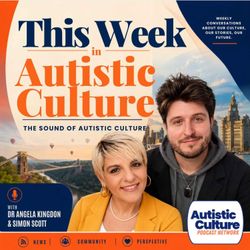
19. This Week in Autistic Culture #19 | Can AI Help Autistic People? | Is Robbie Williams Autistic Culture?
01:40:01||Ep. 19This week, Angela and Simon tackle one of the most divisive subjects in the creative world: artificial intelligence. With the launch of our new AI and Autism series sparking passionate responses from listeners, they explore the complicated relationship between AI, accessibility and Autistic creativity. Drawing on Angela’s experience as a writing coach and her book ‘The Equalizing Quill’, they discuss new research on how AI can improve employment opportunities for marginalised groups — and why better access to technology doesn’t stop discrimination.For this week’s excavation into the Autistic Culture Archive, Simon introduces Angela to one of Britain’s biggest pop stars: Robbie Williams.After Robbie’s public revelation of an Autism diagnosis of his autism, Simon and Angela use the Ten Pillars of Autistic Culture to look beyond the music and ask what his career, creativity and relationship with fame might reveal about Autistic identity and expression.Is Robbie Williams Autistic culture?As always, we’ll take you through everything coming up across the Autistic Culture Podcast Network this week!🌐 Subscribe to our newsletter and read our Autistic Culture Archive Field Reports: www.autisticculturepodcast.com🎧 Listen: This Week in Autistic Culture is available on Spotify, Apple Podcasts and all major podcast platforms.🌈 Become a Culture Builder: Get early access, ad-free listening and our full podcast archive at AutisticCulturePlus📲 Follow us on Instagram: @autisticculturepodcast
Autistic Culture Podcast Rewind - The Good Place is Autistic
01:11:28|In this episode of The Autistic Culture Podcast, hosts Dr. Angela Kingdon and Matt Lowry, LPP dive into the afterlife with NBC’s hit show The Good Place—unpacking its autistic-coded characters, neurodivergent themes, and the profoundly autistic joy of moral philosophy.🎧 What You’ll Learn:Chidi Anagonye as one of TV’s most autistic-coded characters—his special interests, concrete thinking, anxiety, and devotion to personal morality.Eleanor Shellstrop as potentially autistic, with her direct communication style, perspective-taking challenges, and trauma-filled backstory (common among late-diagnosed autistic women).Jason Mendoza through an ADHD/autistic lens—his monotropic focus and passionate interests.Janet’s journey as an AI echoing autistic unmasking: developing preferences, boundaries, and autonomy beyond “the programming.”Tahani Al-Jamil’s story as an allegory for masking exhaustion—with real-life parallels to actor Jameela Jamil’s co-occurring conditions.Michael the architect’s autistic tendencies—fascination with humans, concrete examples, and system-level thinking.Why the show’s obsession with philosophy feels so deeply autistic.Around 53:24, Angela spontaneously demonstrates elements of autistic culture in real time (listen for it!).Resources:How to Be Perfect by Michael SchurHow to be perfect with "The Good Place" creator Michael SchurChidi Anagonye, the Autistic Nerd Character Done RightHow The Good Place taught moral philosophy to its characters — and its creators5 Moral Philosophy Concepts Featured on The Good PlaceCharacter analysis It’s literally all of themRelated Episodes: Sesame Street is AutisticThe Trouble with Temple Grandin.🌟 Connect With Us📱 Follow us on Instagram🎧 Find us on Apple Podcasts and Spotify🛍️Our Autism-affirming merch shop🌐 Learn more at www.autisticculturepodcast.com