Share
AuDHD Flourishing
Mini: No, the World Doesn't Need More "Good Rich People"
No, more "good rich people" are not going to save the world. Not the least because the amount of money required to create systemic change (i.e. being a billionaire) seems to make one uninterested in systemic change... I wonder why?
p.s. the real answer is community organizing: power and strength in numbers!
The main problem with this idea is that if you try to massively redistribute wealth, at least in the USA the government will come down hard on you.
For example, I once read that the Black Panthers were much more heavily targeted by the US government after they started providing large numbers of free meals to Black children. (p.s. the link there is to a generally good source, but I can't remember the book I read the actual idea in, unfortunately)
This is also NOT an admonition not to become financially stable! I want more financial stability for all of us... but that doesn't require buying into shitty ideas.
If you like the Mini episode format or have a topic idea, please say so here!
Mentioned in Episode:
- Episode 10: Money & Surviving Capitalism
- Episode 20: Poverty is Not Your Fault!
- Sam Pollack's Substack post "Conventional Marketing Ain't Workin' Anymore," and my take on it
- My Book recommendation for Get Good With Money by Tiffany Aliche, and the direct link to the book
- How Trauma & CPTSD Cause Underearning
Resources:
More episodes
View all episodes
How to Make Projects Happen - Repost
43:24|AuDHD brains face many challenges when it comes to projects. It's something I've put a great deal of time and learning into, both personally and professionally. This episode covers many ideas and approaches that tend to work for us.Key Takeaways:We usually learn to use what I call the Adrenaline-Anxiety Approach. While effective short-term, it can lead to burnout and other issues.A monotropic approach is more sustainable and individualized... and it can feel slow at first.Experimentation as a core toolCreating just enough structure and safety to get going, without getting bogged down (loose planning)Working with the brain states you haveManaging interruptions, inputs, and daily lifeFinding the balance that works for youThe episode also walks through the Love Your Brain course, designed to help AuDHDers understand their mind-body system, work with brain states, and navigate project challenges. The course emphasizes self-compassion, experimentation, and building processes tailored to individual needs.Repost - originally posted July 12th 2024Links mentioned:Devon Price's Laziness Does Not Exist article, and a PDF if you're not on MediumThe transcript may be especially useful for this episode! (It'll take a few seconds for the link to fully load to this episode)Love Your Brain course (and the Sep/Oct 2026 live round info)
155 Making & Keeping Friends
27:41|Making friends is hard. Developing and keeping those friendships is hard. It's literally work! Today I talk about my friendship journey, more to give examples and share what I've learned rather than to teach. Because this is a deeply personal topic that's affected by your current capacity!Mentioned upcoming live round of Love Your Brain course (Sep-Oct 2026)AuDHD Flourishing resources:Transcript Doc (often a few weeks behind, but we do catch up!)Mattia's NewsletterLike Your Brain community space (Patreon/Discord)
154 Friendship Skills with Caroline Maguire
01:06:10|Caroline Maguire is passionate about learning how to bring your whole neurodivergent self to friendships... and not scaring people off!Her book, Friendship Skills for Neurodivergent Adults, includes not only skills but red and green flags, and info on masking vs adapting (which we also talk about in the episode).Mentioned in episode: next week's workshop with Grace BezaireConnect with Caroline:Book Friendship Skills for Neurodivergent Adults (affiliate link)Website https://carolinemaguireauthor.com/Instagram @authorcarolinemYouTube channelPodcast The ADHD Social PlaybookAuDHD Flourishing resources:Transcript Doc (often a few weeks behind, but we do catch up!)Mattia's NewsletterLike Your Brain community space (Patreon/Discord)153 Polyamory & Community Bonds
29:44|Thanks for the great topic suggestion from the community: polyamory & strengthening community bonds. Those are quite intertwined for me, since I've been out as poly/RA and exclusively in open relationships for almost 20 years now.This is a collection of thoughts on what I've noticed while being poly, and how it overlaps with community building and relationship maintenance in general.AuDHD Flourishing resources:Transcript Doc (often a few weeks behind, but we do catch up!)Mattia's NewsletterLike Your Brain community space (Patreon/Discord)
152 You Can't Trick a Nervous System
35:14|My cats Mac & Cheese (see episode pic) have been having a hard time. I've learned a lot observing their reactive nervous systems because it's so easy to feel compassion for them.This episode uses that extended metaphor to also talk about when AuDHD nervous systems feel reactive, including with meltdowns that can include anger or violence. Depending on how much reactivity is affecting your life, it may require professional help.No matter what, you deserve compassion <3Content note: episode mentions violence and medicationResources for anger and reactive nervous systems:Autistic anger (including therapy suggestions)Resource for non-autistic folks to understand meltdownsAuDHD emotional regulation (mentions RSD, justice sensitivity, alexithymia)ADHD rage & anger (note: I didn't find many AuDHD-specific resources on this topic - plz share if you have good ones!)Crisis Resources:USA-based anonymous crisis chatInternational crisis linesVarious types of crisis resources in about 10 countriesAuDHD Flourishing resources:Transcript Doc (often a few weeks behind, but we do catch up!)Mattia's NewsletterLike Your Brain community space (Patreon/Discord)151 The Skill No One Knew You Needed
40:25|The skill no one knew you needed: how to emotionally regulate while doing a task. It's simple yet difficult. And undiagnosed neurodivergent parents were even less likely to be able to help on some fronts, if they never learned how either.This is a skill you can practice (which the end of the episode covers), and there are many AuDHD factors complicating it for us. Even with different emotional processing or experience, it's still possible to take care of yourself during an activity.But it requires slowing down and being willing to stop if your brain or body are too triggered.Over time, this builds to being able to do more, more easily, with less stress. It is very, very worth it p.s. the "facilitator" example was MY experience in groups, not how I want people to think about me leading groups ;)Mentioned in episode:2 short vids explaining the Wall of Awful & strategies for going through & over it by Jessica McCabe of How to ADHD150 The Wall of Awful with Brendan MahanAuDHD Flourishing resources:Transcript Doc (often a few weeks behind, but we do catch up!)Mattia's NewsletterLike Your Brain community space (Patreon/Discord)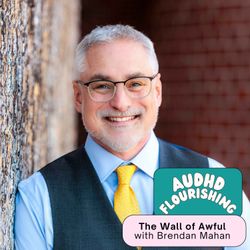
150 The Wall of Awful with Brendan Mahan
58:18|Brendan Mahan's concept of The Wall of Awful has taken on a life of its own. While originally geared toward ADHD, it's also extremely applicable to other neurodivergent folks including autism, AuDHD, OCD, and PDA.In short, there are a bunch of tough emotions built up over time between you and tasks that are difficult for you (whether or not anyone else believes they are easy). While you may instinctively figure out how to sidestep or smash through the issues, it's not really addressing the deeper problem that still affects you the next time.Brendan's book, The Wall of Awful, comes out Sep 1 2026, and you can learn an overview of the concepts at the YouTube videos listed under #3 belowConnect with Brendan / Mentioned in episode:The Wall of Awful book & resources, and if you're buying on Amazon here's my affiliate linkFriendship Skills for Neurodivergent Adults by Caroline Maguire, book, affiliate link2 short vids explaining the Wall of Awful & strategies for going through & over it by Jessica McCabe of How to ADHDAuDHD Flourishing resources:Transcript Doc (often a few weeks behind, but we do catch up!)Mattia's NewsletterLike Your Brain community space (Patreon/Discord)149 The Consistency That Matters
18:43|"Consistency" can feel like a dirty word in neurodivergent land... Consistency is a tool, not a final answer. It can be a better fit than habits for our brains (see past 3 episodes) It can be part of building systems that work for us (including reminders, since forgetting is a big reason for inconsistency) Kindness and self-compassion are where consistency REALLY matters, because they build capacity over time AuDHD Flourishing resources:Transcript Doc (often a few weeks behind, but we do catch up!)Mattia's NewsletterLike Your Brain community space (Patreon/Discord)148 Breaking Bad Habits
25:04|Builds on last two episodes: Self-Awareness vs. Solutions and Habits are Hard (but also very cool)Breaking "bad" habits is different (and more difficult) than building new habits. I also recommend not being too aggressive about it if those coping mechanisms are load bearing psychologically ;)AuDHD Flourishing resources:Transcript Doc (often a few weeks behind, but we do catch up!)Mattia's NewsletterLike Your Brain community space (Patreon/Discord)