Share
Horde of Rabbits
The Brush Talks
Season 1, Ep. 7
•
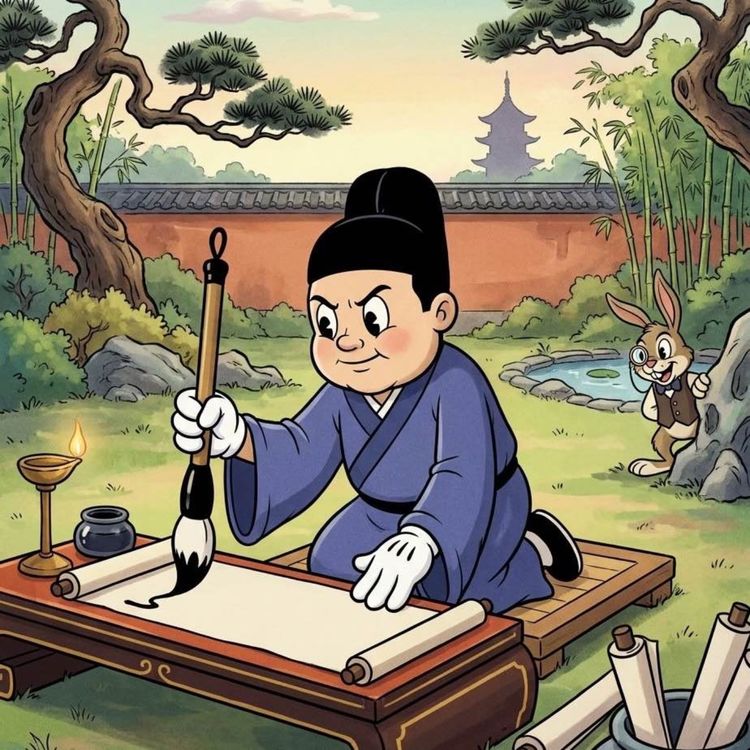
Shen Kuo had been one of the most powerful officials in the Northern Song Dynasty — diplomat, astronomer, mathematician, engineer, geologist, and military strategist. In 1081, he was blamed for a military defeat and stripped of his position. Exiled to his private estate near Zhenjiang, he had nothing but his brush and ink slab. He wrote down everything. The result was the Dream Pool Essays (Meng Xi Bi Tan), published in 1088 — an encyclopaedia of 507 entries covering astronomy, mathematics, geology, climate, medicine, engineering, archaeology, and natural phenomena. Among the entries was a meticulous description of movable type printing, invented by an artisan named Bi Sheng between 1041 and 1048. Bi Sheng had baked individual Chinese characters from clay, set them in an iron frame, and printed from them — 400 years before Gutenberg. Because Bi Sheng was a commoner, no other record of his invention survived. Shen Kuo's exile — and his decision to fill it with observation — is the only reason we know movable type was invented in China at all.
More episodes
View all episodes

10. The Movement That Pushed Her Out
11:41||Season 1, Ep. 10On 28 June 1969, police raided the Stonewall Inn in Greenwich Village, New York — a routine harassment of queer people that happened to go spectacularly wrong. Marsha P. Johnson, a Black transgender woman and street activist, was among those who fought back. Eyewitnesses place her at the front of the resistance, throwing a shot glass at a mirror in defiance — the 'shot glass heard round the world.' She became a tireless activist, co-founding STAR (Street Transvestite Action Revolutionaries) with Sylvia Rivera to house homeless queer youth. But as the gay rights movement became more respectable, it quietly pushed Marsha — Black, trans, poor, mentally ill — to the margins. She was found dead in the Hudson River in 1992. Police ruled it suicide; her community said otherwise. The investigation was reopened in 2012. History is finally putting her name back where it belongs.
9. The Ball Method
12:38||Season 1, Ep. 9Leprosy had tormented humanity for millennia. The only treatment — chaulmoogra oil — was so thick and bitter that patients vomited it up, and injecting it caused painful pustules. Alice Ball, the first woman and first Black American to earn a chemistry master's degree from the University of Hawaii, was approached in 1915 by Dr Harry Hollmann of the Leprosy Investigation Station. She was 23. Within months, she had solved the problem that had defeated every chemist before her: she isolated the active fatty acids from chaulmoogra oil and converted them into water-soluble ethyl esters that could be injected safely. By 1920, the 'Ball Method' had enabled 78 patients in Honolulu to leave quarantine and return home. Then Ball died — of accidental chlorine gas inhalation in her laboratory — before she could publish. The president of the College of Hawaii published her findings under his own name, calling it the 'Dean Method.' It took over 50 years, and the efforts of a single scholar, to restore her name to her discovery.
8. Here I Stand: Martin Luther at Worms
12:29||Season 1, Ep. 8On 18 April 1521, Martin Luther stood before Emperor Charles V at the Diet of Worms and refused to take back a single word of his writings. The Church had already excommunicated him. The Emperor could declare him an outlaw — which would mean anyone could kill him without legal consequence. Luther had been warned. He came anyway. When pressed for a simple yes-or-no answer, he delivered one of the most consequential speeches in European history: 'My conscience is captive to the Word of God. I cannot and will not recant anything, since it is neither safe nor right to go against conscience. Here I stand. I cannot do otherwise. God help me.' The phrase 'Here I stand' may have been added by a scribe, but the refusal was real, documented, and witnessed by the most powerful assembly in Europe. Luther was spirited away to Wartburg Castle by a sympathetic prince. From there, he translated the Bible into German — and the Protestant Reformation began. A monk's refusal to say sorry changed the map of the world.
5. The Moon Code
12:05||Season 1, Ep. 5Margaret Hamilton led the team at MIT that wrote the onboard flight software for NASA's Apollo program. During the Apollo 11 lunar descent, the computer was overloaded with data from a mistakenly left-on radar switch. Hamilton's priority-based error handling — which she had insisted on over objections that astronauts would never make mistakes — allowed the computer to shed low-priority tasks and focus on landing. Without it, the mission would have been aborted minutes before touchdown. She coined the term "software engineering" to give her field the same respect as other engineering disciplines.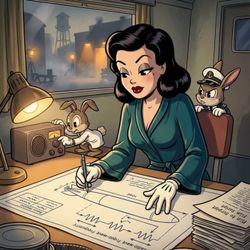
2. The Actress and the Torpedo
12:13||Season 1, Ep. 2Hedy Lamarr was born Hedwig Kiesler in Vienna in 1914. Her first husband was an Austrian arms dealer with ties to Mussolini and Hitler, whose dinner parties she attended while listening carefully to the weapons discussions. She fled him in 1937, escaped to London, and signed a contract with MGM. By 1940 she was the most famous actress in Hollywood, known as 'the most beautiful woman in film.' She was also, in her trailer during filming breaks and at home in the evenings, tinkering with inventions. In 1940, she met avant-garde composer George Antheil at a Hollywood dinner party. Together they developed a 'Secret Communication System' — a radio guidance method for torpedoes that used frequency-hopping spread spectrum to make the signal impossible to jam. They received US Patent No. 2,292,387 in 1942. The US Navy ignored it. The patent expired in 1959 without Lamarr receiving a penny. The technology was first deployed militarily during the Cuban Missile Crisis in 1962. It is now the foundational principle behind Bluetooth, Wi-Fi, and GPS. Lamarr received the Electronic Frontier Foundation Pioneer Award in 1997, aged 82.
3. The Real Excalibur?
12:12||Season 1, Ep. 3Everyone knows the legend of King Arthur pulling a sword from a stone. But in Tuscany, there's a real sword in a stone—and it's been there since 1180. Galgano Guidotti was a violent knight who had a vision of Saint Michael telling him to give up warfare. To prove his commitment, he drove his sword into a rock, turning it into a cross. The sword is still there, protruding from the stone floor of the Montesiepi Chapel. Scientific analysis confirmed the blade dates to the 12th century and is genuinely embedded in rock. Nobody knows if the Arthurian legend inspired Galgano, or if his act inspired the legend. Either way, the sword in the stone is real.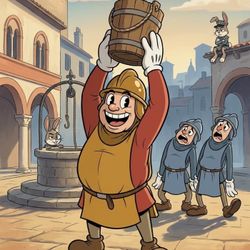
4. The Bucket War
11:20||Season 1, Ep. 4In 1325, the Italian cities of Bologna and Modena went to war over territorial disputes, part of the larger Guelph-Ghibelline conflict between supporters of the Pope and the Holy Roman Emperor. When Modena captured Bologna's fortress of Monteveglio, war erupted. At the Battle of Zappolino, Modena's 7,000 soldiers defeated Bologna's 32,000. After victory, Modenese soldiers took a wooden bucket from a public well in Bologna as a war trophy. Bologna demanded its return. Modena refused and has kept it for nearly 700 years. The bucket became legendary through Alessandro Tassoni's 1624 mock-heroic poem, and the 'War of the Bucket' myth - that the bucket caused the war - overshadowed the real history.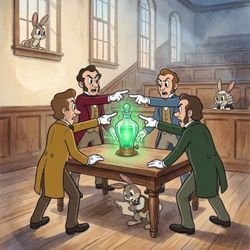
6. Ether Wars
12:23||Season 1, Ep. 6In the 1840s, four Americans — Crawford Long, Horace Wells, William Morton, and Charles Jackson — each claimed to have discovered surgical anesthesia. Long used ether in 1842 but didn't publish until 1849. Wells demonstrated nitrous oxide in 1845 but the demonstration failed when the patient cried out. Morton held the famous 1846 public demonstration at Massachusetts General Hospital. Jackson claimed he'd given Morton the idea. The priority dispute consumed and destroyed them: Wells became addicted to chloroform and died by suicide in 1848. Morton spent his life seeking recognition and died in financial hardship in 1868. Jackson was committed to McLean Hospital asylum in 1873. Long practiced medicine quietly and avoided the worst of the controversy — though he received less public recognition than Morton.