Share
Horde of Rabbits
Archimedes Palimpsest
Season 1, Ep. 17
•
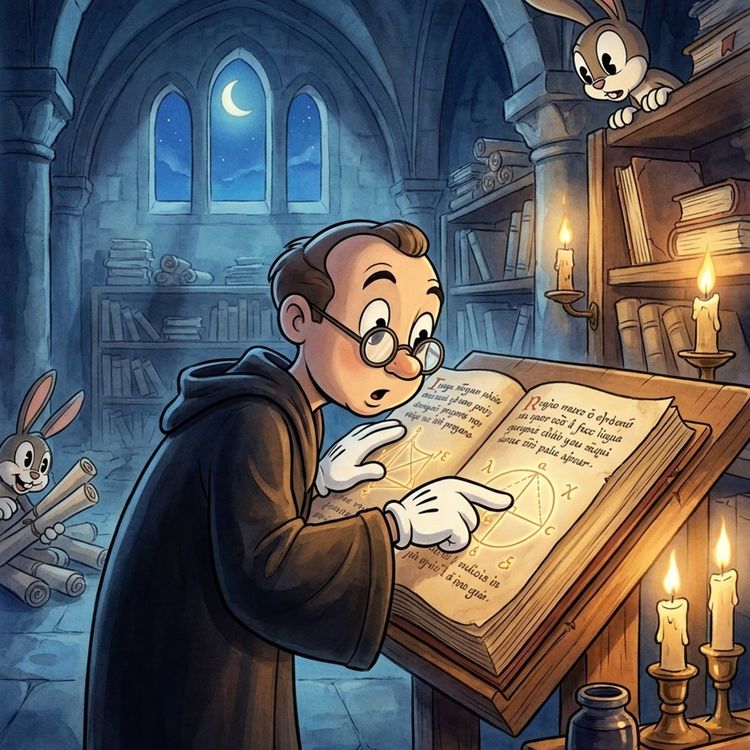
In 1906, a scholar discovered that a 13th-century prayer book in a Constantinople monastery had been made by scraping off and overwriting a much older text — a 10th-century copy of works by Archimedes. The palimpsest contained seven treatises, including "The Method of Mechanical Theorems," which was otherwise completely lost. In this work, Archimedes described techniques remarkably similar to integral calculus — 1,800 years before Newton and Leibniz. The manuscript was stolen, forged, and nearly destroyed before being auctioned in 1998 and subjected to advanced imaging that finally revealed its full contents.
More episodes
View all episodes
30. Blow-Up Army
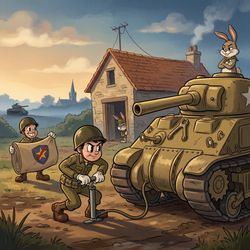
11:00||Season 1, Ep. 30The US Army's 23rd Headquarters Special Troops was made up of artists, sound engineers, and designers. Their job: create a phantom army to fool the Nazis. They used inflatable tanks and planes, fake radio transmissions, recorded battle sounds played through loudspeakers, and even costume changes to impersonate different divisions. Before D-Day, they staged elaborate deceptions to make Hitler think the invasion would land at Calais, not Normandy. It worked. German forces stayed in the wrong place, waiting for an army that didn't exist. Artists and theater designers helped win World War II—with rubber and imagination.
29. Al-Khwarizmi: The Father of Algebra
11:40||Season 1, Ep. 29Muhammad ibn Musa al-Khwarizmi, working in Baghdad's House of Wisdom around 820 CE, wrote "The Compendious Book on Calculation by Completion and Balancing" — the text that gave us the word "algebra" (from "al-jabr," meaning "restoration"). His name, Latinized as "Algoritmi," gave us the word "algorithm." He also introduced Hindu-Arabic numerals to the Islamic world, which eventually replaced Roman numerals in Europe. His work bridged Indian, Greek, and Babylonian mathematics and laid the groundwork for modern science and computing.
28. Buried in Translation
11:35||Season 1, Ep. 28In 1956, Soviet Premier Nikita Khrushchev addressed Western diplomats at a reception. In Russian, he used a common idiom: 'Мы вас похороним' (My vas pokhoronim)—literally 'We will bury you,' but idiomatically meaning 'We will outlast you' or 'We will attend your funeral' in the sense of outliving capitalism economically. Western translators took it literally. Headlines screamed: 'Khrushchev threatens to bury the West!' The mistranslation fueled Cold War paranoia, justified massive military spending, and accelerated the space race. A linguistic misunderstanding shaped geopolitics for decades.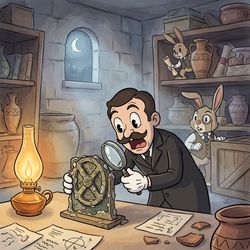
27. Ancient Computer
11:48||Season 1, Ep. 27In 1900, Greek sponge divers found a Roman shipwreck off the island of Antikythera. Among the statues and amphorae was a corroded lump of bronze. Nobody paid much attention until 1902, when archaeologist Valerios Stais noticed it had gears. The Antikythera Mechanism turned out to be an ancient analog computer from around 100 BCE, designed to predict astronomical positions and eclipses decades in advance. It had 30+ bronze gears in a complex arrangement that wouldn't be seen again until medieval clocks. Scientists spent over a century figuring out how it worked. The ancient Greeks had built a computer 1,500 years before anyone thought such technology existed.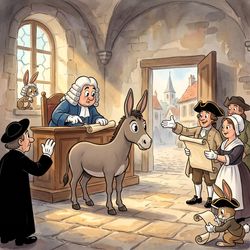
26. A Most Honest Creature
11:00||Season 1, Ep. 26For roughly five hundred years, European courts tried animals as genuine defendants — pigs for homicide, roosters for laying eggs, caterpillars formally excommunicated by the Church. By 1750 the practice was fading, but it had not yet disappeared. When a man named Jacques Ferron was caught committing a crime involving a donkey in the commune of Vanvres, just outside Paris, both were brought before the court together. Ferron was convicted and executed. The donkey's case was harder: the law required the court to determine whether she had been a willing participant or an unwilling victim. The people of Vanvres — her neighbours, the prior of the local convent, the principal inhabitants of the commune — signed a formal certificate attesting that they had known her for four years and that she was, in the precise legal French of the document, 'a most honest creature.' The court accepted the evidence, acquitted her, and sent her home. Strange in two directions at once: plainly absurd on its face, and yet — within a system that routinely denied the same courtesy to accused witches and servants — a small, careful act of communal solidarity for someone who could not speak in her own defence.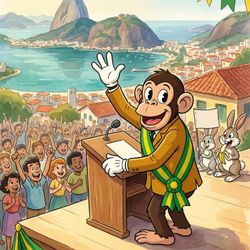
25. Vote Tião
11:41||Season 1, Ep. 25Rio de Janeiro, 1988. Brazil had just emerged from twenty-one years of military rule, inflation was running at over seven hundred percent, and the city had just declared bankruptcy. Into this fury stepped Tião — a bad-tempered chimpanzee at the Rio Zoo, famous for throwing mud at visiting politicians, who had struck three different mayors on record. A group of satirists from two comedy magazines decided he was the obvious candidate for mayor. They printed badges, sold T-shirts, held a packed campaign rally, and appointed a comedian named Bussunda as his press secretary, who held real press conferences with a completely straight face. Because this was 1988 and voting was done by hand, every single one of Tião's votes required a grown adult to walk into a booth and write a monkey's name on a ballot — deliberately, privately, on purpose. Around four hundred thousand of them did. Every vote was nullified. But Tião had out-polled real, registered politicians, finishing where third place would have been. He was not even the first: in 1959, a rhinoceros named Cacareco had received one hundred thousand votes in São Paulo's city council elections. It was, it turned out, a tradition — a specifically Brazilian way of saying something to the people in charge. It ended only in 1996, when Brazil switched to electronic voting machines. You cannot write a rhinoceros's name on a touchscreen.
24. Flush of Doom
12:30||Season 1, Ep. 24In April 1945, the German submarine U-1206 was on its first combat patrol in the North Sea when it sank — not from enemy action, but from a toilet malfunction. The sub featured a new high-pressure toilet system designed to work at depth, but it required specialized training to operate. When a crew member misused it, seawater flooded in and reached the batteries below, creating chlorine gas. Captain Karl-Adolf Schlitt was forced to surface, where the sub was spotted and bombed by Allied aircraft. The crew abandoned ship.
23. Moses: Harriet Tubman and the Underground Railroad
12:03||Season 1, Ep. 23Born Araminta Ross and enslaved in Maryland, Harriet Tubman escaped alone in 1849 — ninety miles on foot through swamp and forest, guided by the North Star. She reached Philadelphia. She was free. And then she went back. Thirteen times over ten years, she returned as a conductor on the Underground Railroad, using disguises, coded songs, live chickens as props, and a pistol she was entirely prepared to use. A childhood head injury had left her with sudden, uncontrollable sleeping spells — and she led every one of those night journeys knowing she might drop unconscious on a path with bloodhounds behind her. She went anyway. When the Fugitive Slave Act made the whole Northern United States dangerous, she simply extended her route to Canada. In 1857 she carried her own elderly parents out in a cart she rigged herself. By 1860, she had freed around seventy people — and lost none. Then the Civil War began, and Tubman went south again, this time as a Union spy and scout. On the night of 2 June 1863, she led three gunboats up the Combahee River in South Carolina, navigating past hidden Confederate mines using intelligence gathered from enslaved people who knew the land. More than seven hundred people ran to the water that night. She became the first woman in American history to lead an armed military raid. The reward ever actually posted for her capture — placed by the woman who had enslaved her, hunting a runaway called Minty Ross — was one hundred dollars. The famous figure of forty thousand was invented by a well-meaning supporter in 1867. They never caught her either way.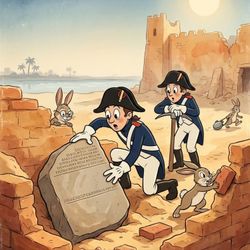
22. Rosetta Stone
12:10||Season 1, Ep. 22In July 1799, French soldiers were rebuilding and reinforcing an old fort in the town of Rosetta (Rashid), Egypt. Lieutenant Pierre-François Bouchard noticed a stone with three different scripts: Greek, Demotic, and hieroglyphics. He realized it might be important. The Rosetta Stone turned out to be the key to deciphering Egyptian hieroglyphics—a writing system that had been unreadable for 1,400 years. The same decree was written in all three scripts, allowing scholars like Jean-François Champollion to crack the hieroglyphic code by 1822. One stone, found by accident in a fort wall, unlocked an entire lost civilization.