Share
AoC Beacon Awards 2025/26 Best Practice Showcase Series
Education for All
The project encompasses a range of programmes and initiatives highlighting Hugh Baird’s ongoing commitment to being a ‘Beacon for our Community’ by ensuring education is accessible and impactful for all. In just 3 years, the College has increased its Foundation Studies offer (provision aimed at NEET young people), recruiting higher student numbers and expanding the range of technical and vocational qualifications available at Entry Level and Level 1. Whilst also further developing the curriculum offer at Thornton College, Hugh Baird’s specialist further education college, designed specifically for students with high needs. Leaders and managers recognised the need to take education to the young person rather than the only option being for young people to come to the main college site. We worked closely with our host local authority Sefton and Career Connect to support NEET students, aiming to reduce rising numbers and engage more young people in accessible, adulthood-ready education. Tailored support is offered to all young people across the department through the co production of support and care plans to ensure their needs are recognised and met whilst enrolled at college.
More episodes
View all episodes
Supporting ESOL learners into Vocational courses
25:22|‘English Into Vocational’ is a targeted initiative by The City of Liverpool College to support ESOL learners through integrated vocational pathways. Seven ESOL Level 1 programmes—Plastering, Culinary Skills, Teaching Assistant, Health and Social Care, Sport and Physical Exercise, Art and Design, and Science—combine English language development with sector-specific content. Funded by the Liverpool City Region, these courses help learners build the linguistic, academic, and practical skills needed for progression. For instance, the English into Science pathway offered 6.5 hours of weekly study over 32 weeks, focusing on scientific terminology, lab procedures, and report writing, leading to a Level 1 BTEC Certificate. This model breaks the cycle of language-only learning by aligning English with vocational goals and providing clear progression routes to Level 2, further education, or employment. Embedding ESOL into vocational contexts enables learners to use English for real tasks—writing care notes, reading diagrams, or completing risk assessments—while gaining industry knowledge. Co-teaching by ESOL and vocational tutors ensures inclusive, adaptive delivery. Employer involvement ensures that learners are developing in demand skills within our city region, and structured guidance supports next steps. This has resulted in faster progression, greater confidence, and improved employability in key growth sectors.
The Citizen Hub
28:07|This pioneering careers initiative exemplifies the power of collaboration in addressing local needs. Two further education colleges, located equidistant from a town lacking both a dedicated FE college and a job centre, joined forces to support a previously failing though centrally located Citizen Hub. This shared space offers careers advice, training, and wraparound support in partnership with local charities, ensuring that individuals receive holistic, accessible guidance in a friendly and welcoming environment. The colleges alternate staffing the Hub throughout the week, offering walk-in support and signposting individuals to additional services available on-site, such as housing advice, mental health support, and employability coaching. A dedicated training room enables the delivery of accredited courses to those unable to travel to college campuses—particularly benefiting unemployed individuals and leading to positive employment outcomes. Crucially, the colleges co-design the training offer to meet learner needs, regardless of institutional affiliation. Monthly co-design meetings with all Hub partners ensure a responsive, coordinated approach to community support. The initiative’s success has attracted national attention, with other regions seeking guidance to replicate the model. The Citizen Hub stands as a beacon of inclusive, place-based education and support—transforming lives through partnership and purpose.
Glasgow City Region College Local Innovation Centres (CLIC)
29:44|College Local Innovation Centres (CLIC) The CLIC project is a pioneering regional initiative supporting innovation across Glasgow City Region’s six colleges. Funded by Innovate UK, CLIC launched in April 2024 and is one of only nine college-led innovation programmes in the UK. Following a successful pilot year, with £1.2 million in funding, the project has been extended into a second year from April 2025. CLIC enhances business productivity by helping employers adopt innovative digital capabilities aligned with regional economic strategies. CLIC directly enhances business productivity by embedding digital innovation and upskilling workforces across diverse sectors. In its first year, the project exceeded its target by supporting over 300 businesses—surpassing the initial goal of 200. Each college leads a specialised innovation hub: • Glasgow Kelvin College: Digital Enablement • Glasgow Clyde College: Digital Creativity • City of Glasgow College: Innovation Leadership • West College Scotland: Advanced Manufacturing • New College Lanarkshire: Digitally Enabled Health • South Lanarkshire College: Sustainable Development CLIC redefines the role of colleges in the innovation ecosystem, traditionally dominated by universities. Using a bespoke digital assessment framework, it identifies areas of need and measures impact, demonstrating that digital innovation is relevant and transformative for all sectors.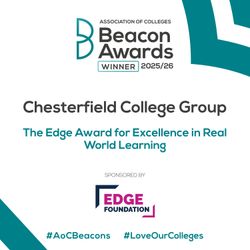
Smart Site - Real World Training at the Construction Skills Hub
33:53|The Construction Skills Hub, launched in October 2023 in partnership with the Borough Council, local charities and university, delivers innovative construction training in one of the county's most deprived areas. Situated on a live housing development and supported by large nationwide construction groups, the Hub replicates a real construction site, complete with site offices, toolbox talks, and site tours, offering learners immersive, hands-on experience that reflects industry standards. Since January 2024, 42 young people have studied at the Hub, most of whom were at risk of becoming NEET due to behavioural, emotional, and social challenges. The practical, outdoor learning environment has proven transformative, with 95% achieving a qualification and 97% progressing to a positive destination. The Hub also works with schools, engaging over 900 students through its careers insight programme. This initiative allows young people to explore construction careers, meet employers, and make informed post-16 choices. Over the next decade, the Hub will support more than 5,000 learners, from school leavers to adults seeking to retrain. Its curriculum is aligned with industry needs, including sustainability and the Future Homes Standard, ensuring learners gain relevant skills, confidence, and clear progression pathways into the construction workforce.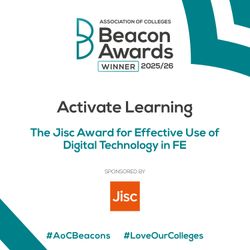
AI Tutor
39:30|Rooted in our distinctive Learning Philosophy—which unites insights from brain, motivation and emotions, the AI Tutors empower learners through Growth Mindset principles, fostering curiosity, resilience and deeper subject understanding. Integrated via the organisational Learning Management System, accessible 24/7, the AI Tutor delivers flexible, personalised support that adapts proven classroom strategies to the digital environment. This marks a significant shift from traditional, location-dependent learning to an inclusive, on-demand model that enables learners to engage at their own pace, receive immediate feedback and build confidence through guided practice rather than being given answers. The initiative has been especially transformative for our adult online learners, those with additional learning needs and individuals who are unable to access conventional classroom environments. By developing essential digital and soft skills, our AI Tutor prepares learners for success in an increasingly AI-driven workplace. Statistical analysis confirms a significant correlation between AI Tutor usage and GCSE grade improvement, with frequent users achieving notably higher outcomes. By integrating advanced AI technology with human coaching, our AI Tutor initiative sets a new standard for personalised, inclusive and future-ready education—empowering learners to unlock their full potential in a rapidly evolving digital landscape.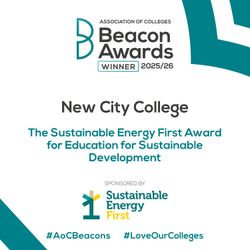
A Green Beacon for Further Education
25:50|Through this college’s strategic commitment to sustainability, it has: · Transformed and integrated climate action into every aspect of college life. · Achieved so far a 23% reduction in scope 1 and 2 emissions, saving over 600 tonnes of CO₂e. · Developed a framework that includes: curriculum transformation, carbon reduction, student engagement, staff development, and community collaboration · Embedded sustainability across all areas of the curriculum with green skills and climate literacy tailored to vocational and academic pathways. · Embarked on an ambitious programme of replacing gas boilers with air source heat pumps (operational at two campuses with a third underway) and introducing high efficiency VRF units. · Empowered students to lead climate campaigns and developed delivery of certificated carbon literacy super curricular programmes for students. · Embedded sustainability into staff CPD and teaching. Over 4000 sustainability CPD hours delivered so far. · Taken every opportunity to share best practice across the sector and beyond, contributing case studies to national platforms and regularly showcasing our environmental work at high-profile national conferences as well as welcoming informal visits from other colleges. The model is replicable, inclusive, and future-facing — positioning our college as a climate action leader: a Beacon for Education for Sustainable Development.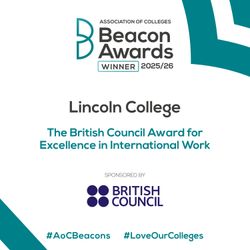
Supplementing and Improving Employment Prospects in Chinese Construction
19:20|Our nomination is for the Lincoln College Group’s work in China, set up 12 years ago and dubbed ‘Innovation China’, a jointly developed construction cost engineering programme. Developed with the intent of increasing students’ employability chances post-study on a Chinese qualification by adding an English language element combined with knowledge of Western construction practice. This has been delivered in the Sichuan Province, with more than 2,500 students having benefited from this innovative programme. The programme, delivered as part of an existing Chinese Construction Major course, also provides an inclusion element thanks to being taught in a Western style that also encourages interaction. Most Chinese students for example are used to learning ‘by rote’ and with repetition of key phrases and dictation. This means that their pedagogical norms are challenged and culturally, their minds are opened to new ways of learning and foreign job markets. We believe that this element has two key benefits, that it builds resilience for those Chinese students that are hoping to work in the USA, UK or in Europe by giving them a taste of how information is disseminated. Secondly, the course’s material, which will give them an advantage over students who have not had this essential element added to their standard courses.
Introduction to AoC Beacon Awards 2025/26 Best Practice Showcase Series
00:23|Dr Kate Webb, Chief Assessor for the AoC Beacon Ward's introduces the AoC Beacon Awards 2025/26 Best Practice Showcase SeriesThe Beacon Awards celebrate the best and most innovative practice among UK further education (FE) colleges.The AoC Beacon Awards showcase exactly why UK further education colleges are so important to every community and why people value them. The awards celebrate and showcase best practice and innovation and highlight excellence in the sector. They are designed to promote the interdependence of colleges, businesses, and professional and voluntary organisations and promote the far-reaching impact of colleges on their students and the communities they serve.