Share
alexis karpouzos's podcast
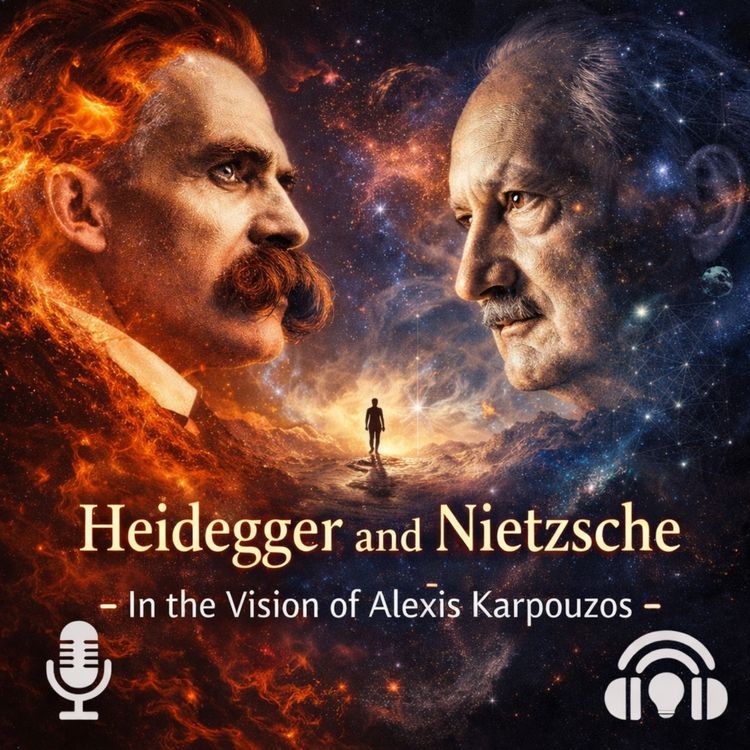
HEIDEGGER AND NIETZSCHE - ALEXIS KARPOUZOS
In the Vision of Alexis Karpouzos
The encounter between Nietzsche and Heidegger is not merely a dialogue between two philosophers, but a decisive event in the history of Being itself. In the vision of Alexis Karpouzos, this encounter unfolds as a tragic and luminous tension between the end of metaphysics and the possibility of a new beginning. Nietzsche appears as the last metaphysician and at the same time as the one who announces the collapse of metaphysics; Heidegger emerges as the thinker who listens to this collapse and seeks, through it, the still-unspoken truth of Being. For Karpouzos, Nietzsche’s proclamation of the “death of God” is not a simple atheistic gesture, but an ontological earthquake. It signals the exhaustion of all transcendent guarantees of meaning and exposes humanity to the abyss of becoming. Yet this abyss is not merely nihilistic; it is creative, Dionysian, and open. Nietzsche’s will to power and eternal return are not doctrines but cosmic gestures: attempts to think existence beyond fixed identities, stable truths, and moral absolutes. Being, for Nietzsche, is not what is, but what becomes.
Heidegger, however, hears in Nietzsche’s thought a deeper and more troubling resonance. According to Heidegger, Nietzsche does not escape metaphysics but brings it to its extreme fulfillment. The will to power, in Heidegger’s reading, becomes the final metaphysical determination of Being as availability, domination, and calculability. In this sense, Nietzsche is both the destroyer of metaphysics and its final prophet. Karpouzos emphasizes that this paradox is not a failure but a necessity: metaphysics must fully exhaust itself before another way of thinking can emerge. At the heart of their relationship lies language and silence. Nietzsche breaks language apart—through aphorism, poetry, irony, and song—revealing its masks and its creative violence. Heidegger, by contrast, seeks to listen to language, to let it speak from the stillness of Being itself. In the vision of Karpouzos, Nietzsche shatters the old words, while Heidegger waits in the clearing created by their collapse. One dances with language; the other dwells within its silence.
This tension reveals a profound ontological contrast. Nietzsche affirms becoming without ground, a world without ultimate foundation, where meaning must be created again and again. Heidegger seeks the groundless ground—the Ereignis, the event of Being that grants presence and withdrawal simultaneously. For Karpouzos, these are not opposing paths but complementary movements of thought: Nietzsche opens the abyss; Heidegger learns how to remain within it without reducing it to concepts.
Both thinkers confront nihilism, but in different ways. Nietzsche attempts to overcome nihilism through affirmation, through the creation of new values and the transfiguration of existence into art. Heidegger sees nihilism as the forgetting of Being itself, a historical destiny that cannot be “overcome” by will, but only thought through and endured. In Karpouzos’ vision, nihilism is not an enemy to defeat but a threshold to cross—a night through which thinking must pass. Ultimately, Nietzsche and Heidegger meet in the question of the human. Nietzsche dissolves the human as a fixed essence, opening the path toward the Overhuman as a figure of transformation. Heidegger dec enters the human in favor of Dasein, the being that stands open to Being. Karpouzos sees here a shared intuition: the human is not a substance but a passage, a site where the cosmos becomes conscious of itself.
The most central and famous concept of Alexis Karpouzos is that the World is neither pure order, nor chaos, nor a simple dialectical contradiction - it is an open and creative play of forces. Man does not dominate the world, but man and the world cooperate and co-form.
More episodes
View all episodes
13. THE POST - ONTOLOGICAL THOUGHT - ALEXIS KARPOUZOS
13:31||Season 1, Ep. 13A Paradigm Shift in 21st Century Philosophy by Alexis karpouzosThe Post-Ontological Thought of Alexis Karpouzos offers a groundbreaking re-examination of traditional metaphysics and philosophy. Emerging from a landscape where classical ontological inquiries often centered on the static nature of being, Karpouzos’s thought departs significantly, proposing a fluid, dynamic approach to understanding existence. His work intertwines metaphysics with contemporary social sciences, challenging us to rethink the foundations of reality, presence, and consciousness.1. Deconstructing MetaphysicsDeconstructing metaphysics begins with questioning the fundamental assumptions that have long governed philosophical inquiry about being and existence. Karpouzos critically engages with classical ontological paradigms, emphasizing that metaphysics should no longer be seen as a static foundation but as a dynamic process intertwined with social and existential realities. Karpouzos replaces fixed essences with fluid, emergent processes. His methodology involves deconstructing Western binaries—such as being/non-being and reality/illusion—moving toward a "reconstructivism" focused on relationships and becoming.2. Beyond Being: The Emphasis on BecomingAt the heart of Karpouzos’ philosophy lies a profound shift from "being" to "becoming." He advocates that existence is a continuous process rather than a fixed state. Philosophy, in this view, ceases to be an inquiry into what exists and becomes a study of how things emerge, transform, and connect within a web of interactions.3. The Post-Ontological TurnThe post-ontological turn signifies a movement away from conventional metaphysical absolutes towards fluidity, contingency, and relationality. Karpouzos rethinks fundamental concepts like essence, existence, and causality, proposing that these categories are constructs emerging from interconnected processes. This approach aligns with contemporary debates on complexity, chaos, and emergence.+24. Critique of Traditional MetaphysicsKarpouzos critiques traditional metaphysics for its tendency to reduce existence to a static, essentialist framework. He highlights how these classical systems neglect the living, dynamic aspects of reality. This critique is also social and political, questioning how ontological assumptions shape power dynamics and societal structures.5. Implications for Contemporary DebatesThe post-ontological perspective has profound implications for consciousness, identity, and social justice: Consciousness: Viewed as an emergent process shaped by social interaction and existential reality. Social Sciences: Fosters a nuanced analysis of power and inequality, aligning with Actor-Network Theory and relational sociology. 6. Key Concepts: Emergence, Relationality, and ProcessualityCentral to this framework are three pillars:Emergence: New forms of organization or consciousness arising from complex interactions.Relationality: The shift from viewing entities as independent to understanding them as nodes in an intricate web.Processuality: The emphasis on ongoing change over fixed states.7. Relevance in the 21st CenturyIn an era of rapid technological and ecological transformation, Karpouzos’s emphasis on interconnectedness provides tools to navigate climate change, social fragmentation, and information overload. It promotes a human-centered view where we are not isolated individuals but active participants co-creating the fabric of reality.8. Comparative PhilosophyWhile sharing affinities with Process Philosophy (Whitehead), Phenomenology, and Systems Theory, Karpouzos diverges through his integrative ambition. Unlike post-structuralism, he maintains a constructive ontology, advocating for active engagement in shaping reality through collective effort and dialogue.9. Future DirectionsThe evolution of post-ontological philosophy beckons for further interdisciplinary research, bridging:Physics: Quantum physics and the nature of reality.Neuroscience: The fluid nature of the mind.
12. THE SPHERICAL SPACETIME - ALEXIS KARPOUZOS
05:04||Season 1, Ep. 12The META- ONTOLOGICAL VISION OF ALEXIS KARPOUZOSSpherical Spacetime is one of the most profound and original concepts in the philosophy of Alexis Karpouzos. It does not refer to a mathematical or physical description like those found in the theory of relativity (e.g., a sphere-shaped curved spacetime), but rather to a metaphysical and holistic vision of the universe. It is a dynamic, transformative structure that unites space, time, consciousness, and "the void" into an eternal movement of creation and destruction.Core Characteristics of Spherical SpacetimeSphericity and Wholeness: The term "spherical" symbolizes the omni-centric and symmetrical nature of reality—there is no privileged center; instead, every point is the center. It is the sum-total of all perspectives: an invisible, fleeting center that relates and coordinates all differences, viewpoints, and experiences without flattening them. It ensures unity within multiplicity.Inseparability from the Void: Spherical spacetime is inseparable from absolute zero (the vacuum, the void). Nothing "exists" as a fixed constant—it is created and destroyed simultaneously. This means that existence is not permanent, but a continuous transformation emerging from the void and returning to it in a cycle of creation-destruction.Transformations and Indeterminacy: Its transformations are indeterminate and eternal. They do not follow a linear progression but a spiral movement. Within this spacetime, binary oppositions (e.g., Being/non-Being, light/dark, subject/object) are inscribed where they shift, negate one another, and coexist without contradiction, thanks to paradoxical logic.Connection to Consciousness and Evolution: Every human and living being is constituted by this spherical spacetime. It is the holistic unit of information connecting the microcosm (the atom) to the macrocosm (the universe). The evolution of consciousness occurs through the awareness of this spherical spacetime, where time is non-chronological and space is "atopic" (placeless).Relation to Other Concepts in Karpouzos' ThoughtConceptRelationship to Spherical SpacetimeRelational OntologySpherical spacetime is the ultimate web of relations—everything exists only through interdependence.Metaphysical OpennessOpenness arises because spacetime is indeterminate and constantly transforming.The Diagonal PathThe path crosses "diagonally" through oppositions and inscribes them into this spherical structure.Paradoxical LogicThe logic that embraces contradictions precisely because spherical spacetime incorporates them without conflict.
11. KNOWLEDGE AND WISDOM - ALEXIS KARPOUZOS
10:02||Season 1, Ep. 11KNOWLEDGE — WISDOM: ALEXIS KARPOUZOSFrom the earliest myths and Pre-Socratic cosmologies to the science of modernity, humanity has sought to understand, classify, and explain the world. Knowledge refers to the process of understanding phenomena. Wisdom, by contrast, concerns the understanding of the meaning behind those phenomena. Knowledge is analytical, wisdom is synthetic; knowledge separates, wisdom unites. The philosophical question posed is: can human beings transform knowledge into wisdom? That is, can one move from the science of the real to the consciousness of Being?1. Knowledge as the Logic of DistinctionIn Platonic philosophy, knowledge (episteme) is contrasted with mere doxa (opinion). In the Republic (VI, 509d), Plato places knowledge within a hierarchy culminating in the noesis of the Good—the pure vision of truth. Aristotle, in his Metaphysics, attributes to knowledge the character of causal understanding: "all men by nature desire to know." Knowledge is, therefore, an exit from ignorance and an appropriation of the world through reason.2. Knowledge as Power and LimitationWith the Enlightenment and Modernity, knowledge is transformed into a means of power. Francis Bacon declares that "Knowledge is Power," founding the spirit of the scientific age. However, as Martin Heidegger showed in The Question Concerning Technology (1954), this identification of knowledge with power leads to an anthropocentric oblivion of Being, where the world becomes a mere standing reserve (Bestand) for use. Knowledge, severed from wisdom, ceases to reveal and begins to control. Consequently, knowledge moves within linear and causal time; it is the product of analysis, logic, and method. Yet, as Heraclitus would argue, "much learning does not teach understanding"—the accumulation of information does not necessarily lead to prudence. Reason (Logos) must be connected to the xynon—the common meaning of the Whole—to be transformed into wisdom.3. Wisdom as Insight and Participation in the WholeWisdom, unlike knowledge, is an experience of unity. Heraclitus views wisdom as the understanding of the Logos of the world—the unity within the conflict of opposites: "all things are one." Plotinus, in the Enneads, describes wisdom as the return of the soul to the One, where the intellect falls silent and thought is transformed into vision (theoria). Wisdom is, therefore, meta-logical; it does not negate reason but transcends it. Like Nietzsche in Thus Spoke Zarathustra, wisdom is not the result of syllogism, but a tragic acceptance of the unity of life and death.4. Wisdom in Eastern TraditionsIn Taoist and Buddhist thought, wisdom (prajñā) is identified with non-duality: the experience that subject and object, visible and invisible, are but manifestations of the same whole. Lao Tzu writes: "The wise man knows without knowing, acts without acting" (Tao Te Ching, ch. 2). This non-adversarial stance toward the world is close to the spirit of Karpouzos, who links wisdom with empathy for the Whole, with the awareness that existence is not isolated but participatory.5. The Dialectical Relationship of Knowledge and WisdomKnowledge and wisdom, rather than being opposed, constitute two dialectical stages of human consciousness. Hegel, in the Phenomenology of Spirit (1807), describes the process of transmuting knowledge through sublation (Aufhebung), where the particular is synthesized into the universal. Knowledge is the thesis—the stage of distinction; wisdom is the sublation—the transcendence of distinction toward unity. Man is not called to reject knowledge, but to complete it within wisdom. Karpouzos, in his work The Cosmology of Consciousness, writes: "Wisdom is not the negation of knowledge; it is its liberation from the prison of the anthropocentric ego." This means that wisdom is the point where knowledge is transformed into self-knowledge—where the subject understands that the object of knowledge is not foreign, but a reflection of its own Being.
10. The philosophy of Jorge Luis Borges - Alexis karpouzos
09:24||Season 1, Ep. 10The Philosophy of Jorge Luis Borges – Alexis KarpouzosJorge Luis Borges is not merely a writer of stories, but a metaphysician of imagination—a thinker who transformed literature into a labyrinth of philosophy, time, and infinite reflection. In this episode, Alexis Karpouzos explores the philosophical universe of Borges, where fiction becomes a method of thought and storytelling becomes a gateway to metaphysical insight.Borges’ work unfolds around timeless questions: What is reality? What is identity? What is time? Through symbols such as mirrors, labyrinths, libraries, and infinite books, Borges reveals a cosmos in which certainty dissolves and meaning multiplies. His narratives challenge linear causality, stable selves, and absolute truths, inviting the reader into a world where every ending is also a beginning and every answer generates new questions. Alexis Karpouzos approaches Borges not only as a literary genius, but as a philosophical mind deeply engaged with idealism, mysticism, and the limits of human knowledge. From the infinite Library of Babel to the circular time of “The Garden of Forking Paths,” this episode examines how Borges anticipates contemporary debates on consciousness, multiplicity, and the constructed nature of reality. Through this exploration, Borges emerges as a thinker of radical humility and intellectual wonder, reminding us that knowledge is never complete and that reality itself may be a poetic illusion. This episode invites the listener into a contemplative journey where philosophy and literature merge, and where the act of thinking becomes an adventure into the infinite.
9. Existentialism | Camus, Kierkegaard & Dostoevsky : Alexis karpouzos
09:51||Season 1, Ep. 9Existentialism | Camus, Kierkegaard & Dostoevsky – Alexis KarpouzosExistentialism is not merely a philosophical movement; it is a profound inquiry into the very condition of being human. It arises at the moment when inherited certainties collapse and the individual stands alone before freedom, anxiety, suffering, and the silent vastness of existence. In this episode, Alexis Karpouzos journeys into the existential landscape shaped by Søren Kierkegaard, Fyodor Dostoevsky, and Albert Camus, three thinkers who transformed philosophy into an inner drama of consciousness.Kierkegaard confronts us with the anguish of freedom and the necessity of choice, revealing faith not as comfort but as risk—a leap into the unknown where reason reaches its limits. Dostoevsky plunges into the depths of the human soul, exposing the psychological and spiritual consequences of absolute freedom, guilt, rebellion, and moral responsibility. Through his characters, philosophy becomes flesh, showing how ideas can save or destroy the human being from within. Camus, standing before the collapse of metaphysical meaning, articulates the absurd condition—the tension between humanity’s longing for meaning and the indifferent universe—and responds not with resignation, but with revolt, lucidity, and ethical integrity. Alexis Karpouzos weaves these voices into a unified philosophical vision, revealing existentialism as a path of awakening rather than despair. This episode explores how freedom without awareness becomes chaos, how faith without inner struggle becomes illusion, and how rebellion without consciousness becomes emptiness. Existentialism here is understood as a transformative confrontation with the self—a movement from unconscious living to responsible existence. Through this dialogue, existential thought emerges as an invitation to authenticity, inner vigilance, and ethical depth. Meaning is not inherited, nor imposed from above; it is shaped through conscious action, self-knowledge, and the courage to exist without illusions. This episode invites the listener to stand face-to-face with the fundamental questions of existence and to discover, within uncertainty itself, the possibility of freedom, dignity, and spiritual clarity.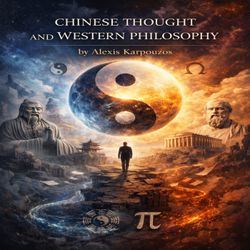
8. CHINESE THOUGHT AND WESTERN PHILOSOPHY
05:01||Season 1, Ep. 8CHINESE THOUGHT AND WESTERN PHILOSOPHYby Alexis Karpouzos and Ceo of AcademiaThe dialogue between Chinese thought and Western philosophy opens a horizon where two distinct civilizations of meaning encounter one another beyond the limits of cultural comparison. In the work of Alexis Karpouzos, this encounter is not treated as a synthesis imposed from above, but as a living resonance—an exploration of how different modes of thinking illuminate the same fundamental questions of existence, consciousness, and cosmic order. Chinese philosophy, shaped by Daoism, Confucianism, and Buddhism, approaches reality as a dynamic process rather than a fixed structure. It emphasizes harmony, relationality, and the continuous transformation of being. Concepts such as Dao, Qi, Yin and Yang, and Wu Wei articulate a worldview in which opposites interpenetrate and meaning arises through balance rather than domination. Knowledge here is not abstract mastery but attunement to the rhythms of the cosmos. Western philosophy, by contrast, has historically pursued truth through analysis, conceptual distinction, and the assertion of rational autonomy. From Greek metaphysics to modern rationalism and existential inquiry, it has sought to define being, subjectivity, and knowledge through logical clarity and critical reflection. Yet within this tradition lies an unresolved tension: the desire for absolute foundations alongside the recognition of finitude, becoming, and the limits of reason.Alexis Karpouzos approaches these two traditions not as opposites but as complementary expressions of humanity’s philosophical quest. Chinese thought offers a wisdom of immanence, continuity, and non-duality, while Western philosophy provides a language of critique, transcendence, and self-reflection. When brought into dialogue, they reveal hidden correspondences: between Dao and Logos, emptiness and being, intuition and reason, silence and speech. This comparative perspective does not aim to dissolve differences but to deepen understanding. It invites a rethinking of philosophy itself—not as a closed system of doctrines, but as a transformative path that integrates insight, experience, and ethical responsibility. In a world marked by fragmentation and cultural dissonance, the encounter between Chinese thought and Western philosophy becomes a gesture of reconciliation, pointing toward a more holistic vision of knowledge. Through this dialogue, philosophy regains its original vocation: to awaken consciousness, to harmonize thought with life, and to reconnect humanity with the living intelligence of the cosmos.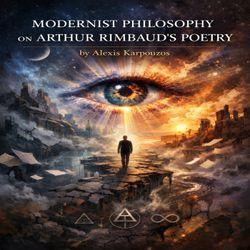
7. MODERNIST PHILOSOPHY ON ARTHUR RIMBAUD'S POETRY - ALEXIS KARPOUZOS
05:56||Season 1, Ep. 7MODERNIST PHILOSOPHY ON ARTHUR RIMBAUD’S POETRY by Alexis KarpouzosArthur Rimbaud stands at the threshold of modernity as both a poet and a metaphysical rupture. His poetry is not merely a literary revolution but a radical philosophical event—an anticipatory vision of modernist thought where language, selfhood, and reality dissolve into new forms of consciousness. Through Rimbaud, poetry becomes an experiment in being, an alchemical process that seeks to transfigure perception itself. Modernist philosophy finds in Rimbaud a prophetic voice: the collapse of the unified subject, the rejection of rational order, and the quest for transcendence beyond moral, aesthetic, and epistemological limits. His declaration “Je est un autre” announces the fragmentation of the self that later philosophy—from Nietzsche to Heidegger—would recognize as central to the modern condition. Rimbaud does not describe the world; he fractures it, revealing the hidden forces of desire, chaos, and visionary intuition that lie beneath appearances.In Rimbaud’s poetics, language ceases to be representational and becomes ontological. Words are no longer signs but energies—vehicles of transformation that aim at the unknown. This aligns his work with modernist philosophy’s central concern: the crisis of meaning in a desacralized world and the search for a new form of spiritual intensity beyond traditional metaphysics. Rimbaud’s poetry anticipates a post-religious mysticism, where illumination arises not from divine revelation but from the systematic derangement of the senses. From this perspective, Rimbaud emerges as a philosopher-poet of becoming, whose work prefigures the modernist revolt against fixed identities, stable truths, and linear time. His silence after poetry is as significant as his verses: an existential gesture that embodies the modernist tension between expression and negation, creation and withdrawal. Through a modernist philosophical lens, Rimbaud’s poetry reveals itself as a radical exploration of consciousness—a journey toward the absolute that burns itself out in its own intensity. His legacy is not a doctrine but an open path: a call to rethink poetry as a mode of thought and philosophy as a lived, visionary experience.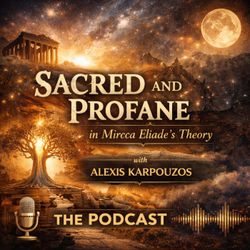
6. SACRED AND PROFANE IN MIRCEA ELIADE'S THEORY - ALEXIS KARPOUZOS
05:57||Season 1, Ep. 6Sacred and Profane in Mircea Eliade’s TheoryAlexis KarpouzosMircea Eliade’s distinction between the sacred and the profane constitutes one of the most influential paradigms in the phenomenology of religion. Within this framework, the sacred emerges not merely as a religious category but as a fundamental structure of human consciousness—an ontological mode through which reality is revealed, ordered, and experienced. In contrast, the profane represents the homogeneous, desacralized space of modern existence, characterized by fragmentation, historical contingency, and existential disorientation. In the research perspective of Alexis Karpouzos, Eliade’s theory is approached as a metaphysical anthropology that transcends historical religion and touches the deeper symbolic architecture of being. The sacred, manifested through hierophanies, interrupts profane time and space, revealing a transhistorical dimension where meaning, origin, and cosmic order converge. These manifestations are not symbolic projections but ontological disclosures—events in which Being itself becomes visible to human awareness.Karpouzos emphasizes that Eliade’s sacred is inseparable from the experience of cosmic participation. Sacred space establishes a center—an axis mundi—through which the individual aligns with the structure of the cosmos, while sacred time re-enacts mythical origins, allowing human existence to be regenerated through eternal return. In this sense, the sacred functions as a bridge between finitude and transcendence, history and eternity.Against the background of modernity’s desacralization, this research explores the loss of symbolic consciousness and the eclipse of metaphysical meaning. Yet, following Eliade’s intuition, Karpouzos suggests that the sacred never disappears; it withdraws, disguises itself, and re-emerges in altered forms—through art, philosophy, science, and inner experience. The task of contemporary thought is not to restore archaic religion but to reawaken the latent sacred dimension embedded within human consciousness and the structure of the universe itself. Thus, the sacred–profane polarity is not a rigid dualism but a dynamic tension that defines the human condition. Through Eliade’s vision, reinterpreted in Karpouzos’ cosmological and philosophical horizon, the sacred becomes a call toward ontological awakening—a return to a unified vision of reality where meaning, being, and consciousness are once again inseparable.