Share
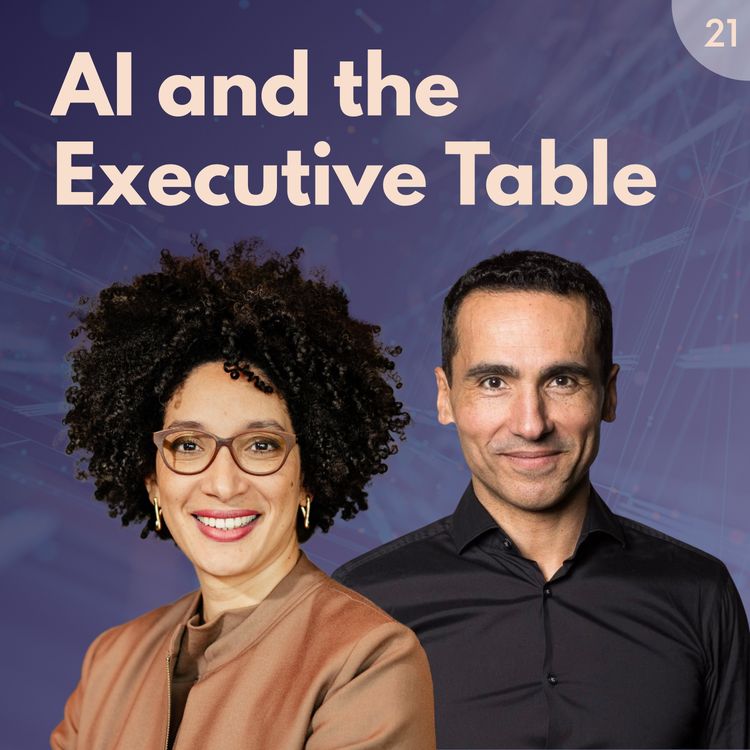
AI and the Executive Table
Rapid Fire
No research briefing. No script. No slide decks. Just two technology executives answering questions as fast and as honestly as they can.
After four consecutive research-heavy episodes — management illusions, forecasting science, behavioral data from 250,000 conversations — Kenza and Pascal take a different format. Rapid fire. Maximum 90 seconds per answer. The questions draw on everything covered in Season 3, but the answers come from experience, not studies.
Three rounds: what the research actually confirms from real professional experience, personal stories from careers spanning AI strategy, CIO leadership and corporate transformation, and a rapid-fire executive reality check covering everything from governance to the efficiency vs. efficacy distinction.
What was the worst AI project either of them has lived through? Which management illusion do they encounter most in their own consulting work? What is the dumbest question an executive can ask about AI — and what is the smartest? What single sentence separates companies that actually use AI from those that only claim to?
The format is deliberately lighter than the research episodes. The answers are among the most direct things Kenza and Pascal have said on the podcast.
Key Takeaways
- The management illusions both hosts encounter most in practice: the end-to-end illusion and the bottom-up illusion — executives who believe one AI agent can handle a complex process end-to-end, and organizations where AI champions have titles but no authority.
- The best question an executive can ask: 'What decision would we make differently if we had this capability?' It moves the conversation from technology to value every time.
- The worst question: 'What is our competitor's AI strategy?' It sends the entire organization into benchmarking mode instead of problem-solving mode.
- Friction in AI interactions is a feature, not a bug. Productive resistance increases human engagement and output quality.
- The sentence that separates companies that actually use AI from those that claim to: 'The ones that use it can show you a decision that changed.'
- The board decision that cannot wait: who is personally accountable when an AI-informed decision goes wrong. Until that question has a name attached to it, everything else is theater.
More episodes
View all episodes

23. KI im Contact Center
26:30||Season 3, Ep. 23In dieser Sonderfolge, aufgenommen auf der Genesys Xperience on Tour in Frankfurt, spreche ich mit Peter Graf, Senior Vice President Strategy bei Genesys. Ohne Hype geht es um das, was Contact-Center-Verantwortliche wirklich beschäftigt: hohe Fluktuation, Qualitätsdruck und verstreute Kundendaten. Und um die Frage, ob agentische KI diese Probleme löst oder neue schafft.Peter erklärt, wie sich KI-Agenten in bestehende Contact-Center-Strukturen einfügen und welche Features wirklich etwas bewegen. Wir sprechen auch darüber, was es braucht, damit die Automatisierung im Contact Center läuft, ohne dass die User Experience leidet. Außerdem geht es um eine Frage, die viele CIOs beschäftigt: Wie sorgt Genesys dafür, dass Datenkontrolle und Compliance gewährleistet bleiben, besonders in regulierten Branchen wie Finanzdienstleistungen oder dem Gesundheitswesen?Themen dieser FolgeDie größten ungelösten Herausforderungen im Contact CenterWas agentische KI realistisch übernehmen kann und was nichtWas Large Action Models sind und warum sie heute ein Game Changer für Contact Center sind Datenkontrolle und Compliance in regulierten BranchenLinksGenesys Experience Economy: https://www.genesys.com/blog/post/the-experience-economy-sets-a-new-standard-in-cx-ai-closes-the-gapExperience Orchestration Levels: https://www.genesys.com/en-gb/experience-orchestration/levelsPeter Graf auf LinkedIn: https://www.linkedin.com/in/peterggrafDiese Folge entstand in Zusammenarbeit mit Genesys.
22. Coffee Talk
25:36||Season 3, Ep. 22What would it have meant to have today's AI tools twenty, ten years ago — at the beginning of two technology careers that spanned CTO roles, CIO leadership, and AI strategy at some of Europe's largest organizations?This is the most personal episode of Season 3. No research agenda. No executive framework. Just Kenza and Pascal with coffee, talking honestly about the decisions they made, the mistakes that cost them, and the moments where having an AI in the room would have changed everything.Kenza reflects on what it would have meant to have AI-augmented analysis when making market entry recommendations, technology strategy calls, decisions made on incomplete data under time pressure, where better forecasting and pattern recognition would have changed the output. Pascal speaks from his experience as IT Innovation Director: the legacy architecture decisions that locked in constraints for years, the scaling challenges that consumed budgets no one had planned for, the talent calls made without the kind of organizational data that is now available. The most personal insight from this conversation: both Kenza and Pascal spent significant parts of their careers as the technology person in the room trying to explain complex IT decisions to board colleagues who didn't share the technical background. AI would have changed that dynamic fundamentally. Not by making the technology simpler, but by helping translate it, turning a €10M architecture decision into a crisp, executive-ready narrative under time pressure, without having to start from scratch every time."Key TakeawaysThe decisions that would have changed most with AI: market entry analysis, competitive landscape assessments, architecture choices with long-term lock-in consequences, and talent decisions made under time and information pressure.What AI would not have changed: the organizational politics, the leadership courage required to act on uncomfortable insight, and the personal accountability for the decision itself.Calibrated judgment — knowing when to trust AI and when to override it — is a skill that develops over time and through experience of being wrong. Executives building it now will have a real advantage in five years.The uncomfortable realization both hosts share: they would have used AI to help close the understanding Gap about Tech in the board room.
20. How People Really Work With AI
34:45||Season 3, Ep. 20We talk a lot about how executives think AI is being used in their organizations. This episode is about how it is actually being used — at scale, in the real world, across a quarter million real conversations.Stanford University's SALT Lab analyzed 249,834 real Claude.ai conversations to answer three questions: what work people bring to AI, what control they retain over the process, and where the collaboration breaks down. The findings challenge some of the most common assumptions executives hold about AI adoption.The most striking finding: 56% of conversations involving actionable tasks were consequential or hard-to-reverse work. Legal guidance. Financial decisions. Strategic choices. People are not using AI for trivial tasks — they are bringing their most difficult problems to it, often without any formal organizational sanction or governance framework in place. Legal and financial guidance had the highest Task Criticality Index at 2.14.And yet — the human remains in control. 72% of conversations were human-led, with AI assisting rather than directing. Users typically adapted AI outputs rather than using them verbatim. Higher-stakes tasks nearly doubled conversation length and engagement. And friction — which appeared in roughly half of all conversations — was often productive: users who encountered resistance from the AI emerged more engaged and more capable.The central tension the study surfaces: does working with AI build human capability, or substitute for human effort? Active teaching — where users explain context, correct outputs, and shape results — occurred in 67% of conversations. But the benefits were unevenly realized. The executives who understand this dynamic will design better governance. The ones who don't will discover the gap the hard way.Key TakeawaysPeople are already using AI for consequential, high-stakes work — whether organizations have sanctioned it or not. The governance gap is real and it is already being filled informally.72% of conversations are human-led. The narrative that AI is taking over is not supported by behavioral data at scale. Humans are still in the room — the question is whether the room has the right rules.Friction is not failure. Productive friction — where AI challenges or resists — increases human engagement and capability. Optimizing for seamless AI interactions may be removing something valuable.AI benefits are unevenly distributed. Employees who already know how to use AI effectively get more capable. Those who don't risk falling further behind. AI literacy is a strategic investment, not a nice-to-have.The governance imperative: the highest-risk work is being brought to AI first. Organizations that are still designing their governance framework are already behind the behavior curve of their own employees.Source: Shao, Y., Zhao, D., Padmakumar, V., Wang, J., & Yang, D. (2026). Human–AI Collaboration at Scale: Task Criticality, Agency, and Friction Across 250,000 Conversations. Stanford University SALT Lab. https://arxiv.org/abs/2608.human-ai-collaboration-at-scale
19. Management Illusions About Agentic AI (Part 2)
37:37||Season 3, Ep. 19After two episodes on what goes wrong in execution and deployment, this episode zooms out to the questions that keep boardrooms busy: What return can we realistically expect? How do we organize for this? And what does a credible AI strategy actually look like?In this second and final episode of the Management Illusions series, Kenza and Pascal cover the remaining three illusion domains — and the findings are the ones most executives will recognize from their own boardrooms.Illusion Domain 3 covers the ROI stage. The downsizing illusion — the most prevalent and most damaging of all ten illusions according to the expert survey — is the belief that AI agents will enable significant workforce reductions. Ford, Klarna, and Salesforce all had to rehire thousands of workers whose AI replacements showed unreliable performance. Up to 30% of workers laid off due to AI may need to be rehired within three years. The productivity illusion reflects the well-known productivity paradox: measured productivity improvements from agentic AI trail perceived and expected improvements. Accelerating one process creates little firm-level value if downstream processes become bottlenecks.Illusion Domain 4 concerns how firms organize for AI. The bottom-up illusion is the belief that AI champions or ambassadors at the mid-level can drive the transformation. No firm has succeeded with this model alone: champions lack time, technical authority, and formal power to change how work is organized. The agent=employee illusion is the urge to anthropomorphize AI agents — giving them human names, placing them on org charts — which early evidence suggests may undermine managerial oversight and accountability.Illusion Domain 5 addresses strategy. The master plan illusion is the belief that firms need a firm-wide agentic AI vision and roadmap. Agentic AI is an instrument for executing a business strategy — not a strategy in itself. The preparation illusion comes in two opposite failure modes: starting without sufficient foundations, or waiting indefinitely for perfect conditions that never arrive.Key TakeawaysThe downsizing illusion is the most damaging of all ten illusions. Up to 30% of workers laid off due to AI may need to be rehired within three years. Deploying AI agents requires substantial human resources to build, test, maintain, and oversee them.Productivity gains in individual tasks do not automatically translate to firm-level productivity. Accelerating one process is worthless if downstream processes become bottlenecks.The honest reframe: agentic AI is a long-term investment in competitiveness — not a short-term cost reduction lever.The bottom-up illusion: AI champions without dedicated time, technical depth, and formal authority produce monthly update meetings, not transformation. Successful firms combine top-down enablement with bottom-up initiative.In one firm of 30,000 employees, successful transformation required approximately 60 dedicated full-time employees centrally — with HR as a close partner, because scaling AI means reorganizing work.A firm-wide agentic AI master plan puts the cart before the horse. What firms need is a governance and infrastructure framework within which functions can deploy AI where it genuinely helps.The final test for any AI investment: if you removed the word 'AI' from the proposal — would it still be a compelling business case?
18. Management Illusions About Agentic AI (Part 1)
33:25||Season 3, Ep. 18Over 40% of agentic AI projects will be cancelled by end of 2027, according to Gartner. Many more remain stuck in experimentation. And even those that scale often fail to deliver the intended return on investment. The technology is not the problem. The mental models are.In this first of two episodes based on a major new study by Johannes Habel and colleagues — validated through a survey of 167 technical experts — Kenza and Pascal unpack the four management illusions that undermine agentic AI at the use case development and deployment stages.Illusion Domain 1 covers two illusions around developing use cases. The agent-first illusion is the belief that AI agents can and should eventually enter virtually any business process. In reality, only about 10% of automations in a large-scale transformation actually require LLM-based agents — the rest can be handled by simpler, more deterministic tools. The end-to-end illusion is the expectation that a single AI agent can reliably navigate complex multi-step processes. Today's agents require highly specialized scope and human orchestration; broader process improvement emerges by combining multiple agents with other technologies and humans in the loop.Illusion Domain 2 covers the deployment stage. The testing illusion is managers' systematic underestimation of the effort required to evaluate and safeguard agent reliability. AI agents that perform well in demos regularly fail in unattended production — often silently — and the availability of domain experts, not technical experts, is usually the bottleneck. The scaling illusion is the assumption that a successful pilot can be replicated quickly and cost-effectively. In practice, processes that look similar often differ in inputs, IT systems, and data quality — and the human resource challenges of scaling AI agents are as significant as the technical ones.Key TakeawaysAI agents should be the last resort for automation, not the first. Only about 10% of identified automations in one large-scale transformation required LLM-based agents.The end-to-end illusion: today's AI agents cannot reliably navigate complex multi-step processes. The right approach is specialized agents for clearly defined subtasks, orchestrated alongside humans and other tools.AI agents that pass demos regularly fail in production — often silently. A voice agent in automotive called former customers to reactivate them; it performed significantly worse than human agents and caused many opt-outs.The testing burden falls on domain experts, not technical experts. Their availability — not the technology — is usually what limits deployment timelines.Scaling is not replication. A pilot designed to prove feasibility is rarely designed to scale. The second implementation almost always takes longer and costs more than expected.Scaling AI agents ultimately means scaling human agents too — reorganizing roles, building new skills, and securing employee buy-in.
17. AI-Augmented Forecasting
26:14||Season 3, Ep. 17Show NotesMost executive decisions are forecasts in disguise. 'Will this market grow?' 'Will this AI initiative deliver ROI?' 'Will this acquisition integrate well?' These are all probability estimates — and most leadership teams make them without any structured method, relying instead on experience, intuition, and the confidence of whoever speaks loudest in the room.In this episode, Kenza and Pascal explore two landmark studies on AI-augmented forecasting and what they mean for executive decision-making. The first, by Halawi et al. (NeurIPS 2024), shows that a retrieval-augmented AI system can approach the forecasting accuracy of competitive human forecasters — and that combining AI and human judgment always outperforms either alone. The second, by Schoenegger et al. (2025, co-authored with Philip Tetlock, the world's leading expert on forecasting), shows that AI assistance improves human forecasting accuracy by 24–28% — even when the AI assistant is deliberately biased and overconfident.The key insight: the benefit is not just informational. It is cognitive. Engaging with an AI perspective — even an imperfect one — forces assumption-surfacing, reduces overconfidence, and makes human judgment measurably more accurate. The Brier Score — a rigorous calibration metric that measures how well-calibrated probability estimates are, not just whether someone was right or wrong — confirms the improvement is real and quantifiable.For boards making high-stakes decisions under uncertainty, this is not a hypothetical. It is a demonstrated, quantifiable capability that most executive teams are not yet using systematically.Key TakeawaysCombining AI forecasts with human judgment always produces better outcomes than either alone — confirmed across thousands of forecasting questions.AI assistance improves human forecasting accuracy by 24–28%, measured by the Brier Score — the gold standard for calibration.The benefit is cognitive, not just informational: AI forces you to surface assumptions you didn't know you were making and reduces overconfidence even in experienced forecasters.AI performs best exactly where boards struggle most — in the 30–70% uncertainty range where nobody is sure and overconfidence is highest.Most executive teams use AI to summarize and report. The studies suggest they should be using it to challenge assumptions before the decision is made.The practical starting point: pick one recurring decision type, introduce probability language, track outcomes, and score calibration over time.
16. New Frontiers
37:56||Season 3, Ep. 16Show NotesNearly 9 in 10 organizations report using AI regularly. Only 37% say AI has made a positive contribution to their EBIT. And only 6% qualify as genuine AI high performers. The rest? Optimizing. Automating. Saving costs. Declaring victory.In this episode Kenza and Pascal ask themselves: when does AI actually grow the top line?And close with a board checklist and a final provocation:"Do not ask what AI can do for your current business. Ask what business you can build because AI now exists."Key TakeawaysEfficiency asks 'how.' Growth asks 'what, for whom and why us?' These are different questions requiring different organizational conditions.Capability without mandate produces demos. Mandate without capability produces PowerPoint. Both without a business model hypothesis produce expensive activity.A Copilot license is not a strategy.The winners will not be the companies that bought the most AI. They will be the ones that used AI to become a different company while they still had the luxury of choice.
15. From Insight to Innovation
33:24||Season 3, Ep. 15Every week, AI teams deliver insights. Dashboards fill up. Reports multiply. And in most organizations nothing changes. Not because the AI didn't work. Because the insight never became a decision.In this episode, Kenza and Pascal tackle the hardest part of AI transformation: the gap between having insight and acting on it. Pascal brings a provocation that cuts to the heart of how most companies measure AI ROI: an insight is not an innovation. It only becomes innovation when it changes a product, process, customer experience, or business model.Key TakeawaysThe last mile of AI is not prediction. It is authority — who owns the decision that needs to change.An insight is not an innovation. If no decision, process, product or customer outcome changes, you produced information, not value.Process intelligence exposes the difference between how a process is described and how it actually behaves. That gap is usually where the real AI opportunity sits.A process map can be political. A timestamp is less diplomatic. Use process evidence to redesign the system, not to publicly grade departments.You cannot ask people to challenge the status quo while measuring them only on how reliably they preserve it.Data without decision rights is just expensive observation.