Share
Africa Here and NOW
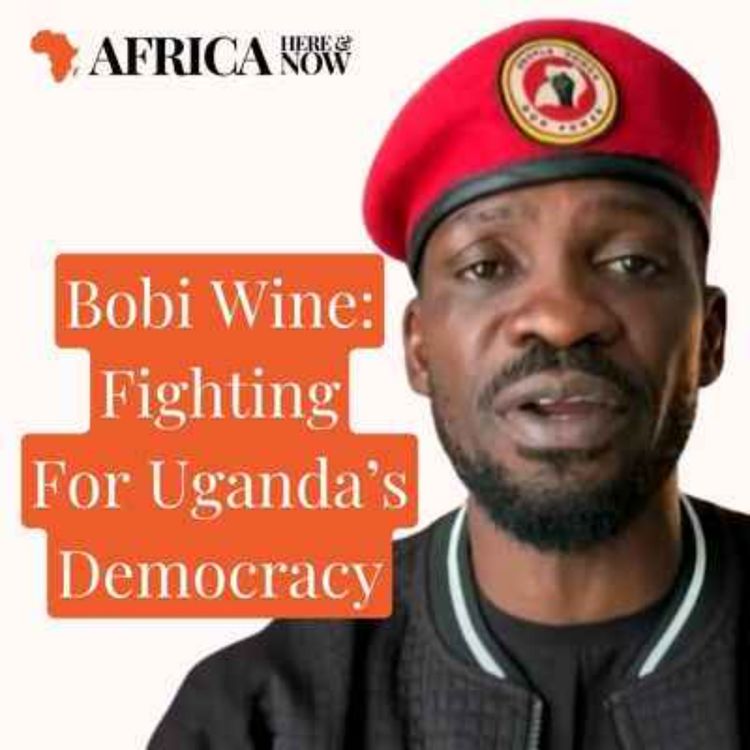
Uganda's Bobi Wine: Fighting for Democracy
I meet Bobi Wine as he visits London. He’s seeking support for his campaign to rid Uganda of what he calls the ‘ brutal rulership’ of President Yoweri Museveni who will have led the country for 40 years in 2026. That’s when Uganda is scheduled to hold its next presidential election.
Will Bobi run again? ‘Here I am,’ he says, ‘Not that I’m the Alpha and Omega, not that I’m the ultimate. But I’ve said I’m available if I’m required to lead …’
We look back at what happened at the last general election in 2021 which Bobi and his supporters say they won. ‘We defeated them, but the entire world watched as many of our campaign team was massacred….’
I ask him how does he keep going after all the beatings, the torture, the house arrest? He replies:
‘I’m in a better state than so many of my comrades in the struggle. They get locked up, they get beaten and nobody knows. When I get arrested the whole world knows….So I keep going by looking behind me. I get the least of the oppression and the most of the attention. But my friends that suffer in the dark are not complaining. They keep going”
What about your wife and 4 kids? Bobi says the whole family has agreed that although their activism is dangerous, it would be even more dangerous to give up.
What did the recent by-election in Kawempe North, which Bobi’s NUP won, tell him about how the general election is likely to be fought? There was well-publicised violence and claims of rigging.
2026 will be a protest vote, Bobi says: ‘We know that we will win the vote. But I’m not sure if we will win the count.’
Bobi reveals that he’s in talks with Dr Kizza Besigye’s Forum for Democratic Change about the possibility of collaborating as well as with other political parties. Dr Besigye’s continued imprisonment, Bobi says, ‘is meant to intimidate all of us’.
I suggest to Bobi that his popular support could be limited to his own tribe, the Baganda. The majority, if not all, of the Buganda constituencies vote for Bobi. He disagrees ‘ we won in the far west and in parts of the north…my wife comes from Museveni’s tribe…my colleagues come from tribes scattered all over Uganda.’
Looking ahead to next year’s election, I ask Bobi what’s in his manifesto? What are the issues he’s running on? ‘Corruption is the cancer that’s eating us’ he replies.
We touch on one of the most controversial issues in Uganda today: human rights particularly as experienced by the LGBQT+ community. A much younger Bobi Wine as a musician had been associated with homophobic lyrics. Today, he has a more nuanced approach to the matter: ‘The west should stop looking at the LGBT rights as the only human rights, otherwise they will provoke Africans and people of the world to start imagining that there’s a hidden agenda. People get killed every day in Uganda and they should all have rights.”
We end our chat on a rather optimistic note.
“The future doesn’t have to hold anything for me as an individual. I look at this as all of us. The future is robust. The future is hopeful.’
#uganda#HEBobiWine#democracy#corruption#humanrights#africa
More episodes
View all episodes

9. Dangote Refinery Won't Reduce Price of Fuel But No Return to Subsidies
32:38||Season 6, Ep. 9Why Dangote Refinery Won't Lower Jet Fuel Prices: Festus Keyamo on Airfares & SubsidiesIs the era of cheap air travel in Africa over? With Jet A1 fuel prices skyrocketing by 70% to 80%, Nigerian airlines and passengers are feeling the immediate impact on ticket prices. In this exclusive AHAN Special Aviation Series interview, I sit down with Nigeria’s Minister of Aviation, Festus Keyamo, to ask the question on everyone’s mind: Can the new Dangote Refinery insulate Nigeria from global fuel shocks?Minister Keyamo delivers a hard truth on the realities of global pricing, definitively ruling out a return to aviation fuel subsidies. Calling subsidies a "retrogressive" trap, he explains why Nigeria must stick to its new non-subsidy economic model—and hints at other "interventions" the government is exploring to save the aviation sector.In this interview, we cover:[00:00] The "Double Tragedy" of African Aviation: High costs and poor connectivity.[01:15] The Jet A1 Crisis: Why aviation fuel has spiked by 80% and its impact on ticket prices.[02:09] The Dangote Question: Can local refining actually lower fuel costs for local airlines?[02:40] Global Pricing vs. Local Production: Why selling below market value is a subsidy.[03:32] "Subsidies are Retrogressive": Keyamo’s firm stance on why the government cannot take a step back into the subsidy trap.💡 Key Quote: "I think it would be retrogressive to take a step back and begin to think of subsidies again... my fear is that you take one step back, you take two steps back, and before you know it you’re back to full-blown subsidy!" – Hon. Minister Festus Keyamo.Don't forget to LIKE, SUBSCRIBE, and hit the notification bell for more exclusive insights into Africa’s aviation and economic policies!#Aviation #FestusKeyamo #DangoteRefinery #NigeriaEconomy #JetA1 #AfricanAviationFestus Keyamo interview, Aviation Minister Nigeria, Dangote refinery aviation fuel, Jet A1 fuel price Nigeria, Nigeria airfare increase, fuel subsidy removal Nigeria, Martine Dennis interview, African aviation connectivity, Nigeria economy 2026, aviation fuel crisis Africa, AHAN Special Aviation Series, local airlines Nigeria intervention, Nigerian government aviation policy.Dangote refinery update, Nigeria aviation news, cost of flight tickets in Nigeria, Jet A1 pricing, economic reforms in Nigeria, Tinubu administration policies, travel in Africa.
8. The BATTLE for 1.4 BILLION airline Passengers
28:26||Season 6, Ep. 8Africa's Aviation Future: Insights from Henok Teffera ShawlExplore the promising growth and ongoing challenges within Africa's aviation sector through an in-depth interview with Henok T. Shawl, a seasoned expert in international relations and aviation, currently supporting Boeing's efforts on the continent. Discover how infrastructure, policy, and training are shaping the future of African aviation.Main Topics Covered:The role of Boeing and other stakeholders in developing African aviation infrastructure and capacityOpportunities from Africa's demographic growth, intra-African trade, and policy initiativesChallenges posed by high operating costs, fuel prices, and governance issuesThe potential of low-cost carriers (LCCs) and sustainable aviation fuels (SAF) to transform the sectorThe importance of regulatory cooperation and regional integrations like the Single African Air Transport Market (SAATM)Training and developing local aviation professionals for exponential growthKey Insights:Africa's airline industry has shown resilience despite disruptions, with a projected addition of 1,200 new aircraft over the next 20 years.The continent’s passenger numbers are growing faster than other regions, driven by urbanization, a rising middle class, and policy initiatives like free trade agreements.Infrastructure investments—including the new $12 billion Bole International Airport expansion in Ethiopia—are critical for accommodating growth.The high cost of fuel in Africa remains a significant barrier but is coupled with efforts towards developing sustainable aviation fuels (SAF).Effective governance and professional management are vital; Ethiopian Airlines exemplifies a successful model.Collaboration among governments, the African Union, and industry players is accelerating policy harmonisation and regional market opening.Timestamps: 00:00 - The significance of establishing Boeing’s Africa office in Addis Ababa 07:00 - The prospects and headwinds facing African airlines today 09:00 - The role of Boeing and industry groups in supporting policy implementation (SATA, SAATM) 11:00 - Infrastructure investments in airports across Africa as growth enablers 13:00 - Governance and professionalism as keys to airline success 15:00 - Projected demand for 1,700 new aircraft in Africa over 20 years 17:00 - The importance of intra-African trade and low-cost carriers in the continent’s aviation landscape 20:00 - Training African professionals: Boeing’s initiatives and regional workforce development 23:00 - The rise of low-cost carriers and infrastructure strategies for affordable travel 25:00 - Fuel costs and the shift towards sustainable aviation fuels (SAF) in Africa 29:00 - Policy gaps and the need for accelerated government action to unlock Africa’s aviation potential 32:00 - Boeing’s role in growing the aviation ecosystem and supporting local manufacturing 33:00 - Final thoughts on collaboration, professional management, and future opportunities
7. Why African Airlines Fail - The Challenges and Opportunities with IATA VP
16:42||Season 6, Ep. 7Africa Here and Now Aviation Special - we are asking why the sector is so problematic, what needs to be done to improve it and the huge potential it holds for the continent's development. KAMIL AL ALAWADHI, IATA Vice President for Africa and the Middle East shares insights into the unique hurdles facing African airlines, the impact of government policies, and strategies for sustainable growth across the continent. Discover how regional cooperation and safety initiatives are shaping the future of African aviation.My conversation with Kamil took place BEFORE the conflict in the Gulf. We discussed:*The role of IATA in aviation safety and sustainability *Key barriers to airline success in Africa: government interference, costs, and regulatory challenges*The importance of airline autonomy and strategic governance models in Africa*Success stories: Ethiopia, Rwanda, and Egypt’s airline development strategies*The impact of foreign investment and partnerships, including Qatar Airways*Blocked airline funds and recent progress in Nigeria*The significance and implementation challenges of the Single African Air Transport Market (SAATM)*Safety initiatives and the focus on lowering accident rates in AfricaTimestamps:00:27 - What is IATA and its role in global aviation sustainability01:20 - Current assessment of Africa’s aviation sector and growth challenges01:57 - Government interference and the need for airline autonomy in Africa02:39 - How political barriers hamper airline success across the continent04:01 - Why operating costs and perceived risks impact profitability in Africa04:32 - The disparity in airline profitability: Middle East vs. Africa05:00 - Cost factors: fuel, insurance, salaries, and operational expenses06:17 - The effect of regulatory and tax policies on airline viability06:49 - How non-aviation government decisions affect the aviation industry07:27 - Success stories from Ethiopia, Rwanda, and Egypt’s airline governance08:27 - The partnership between Rwanda and Qatar Airways and its benefits09:23 - Blocked airline funds: progress with Nigeria and regulatory efforts10:11 - The importance of supportive legal frameworks and international conventions11:03 - The future outlook for airline funding and financial flows in Africa12:05 - Challenges and delays in implementing the Single African Air Transport Market (SAATM)13:01 - The connection between open skies and Africa’s economic integration13:49 - Political hurdles to full regional aviation market liberalization14:19 - The need for industry-political collaboration and strategic leadership15:18 - The critical role of industry and government cooperation for success16:07 - Upcoming safety initiatives and safety performance in African aviation18:12 - Optimism for African aviation’s potential with continued effort and collaborationResources & Links:IATA - International Air Transport AssociationSAATM (Single African Air Transport Market) - African UnionCape Town Convention - Legal framework for aircraft leasingQatar Airways - Airline investment partner in Rwanda
6. Can ECOWAS manage the West African Security Crisis?
23:00||Season 6, Ep. 6Nigeria's Foreign Minister, YUSUF TUGGAR with his Ghanaian counterpart, SAMUEL ABLAKWA sat down with me at Chatham House to explore the complex security dynamics in West Africa, including threats from terror groups, regional cooperation efforts, and the importance of self-reliance and local solutions. Both ministers refuted suggestions that ECOWAS had been severely weakened by the exit of the three Sahelian states - Burkina Faso, Mali and Niger (AES). They revealed that there is regular contact with the AES and security arrangements are being made with their involvement.Earlier in the day, I had a 1+1 with Minister Tuggar and we delved deeper into Nigeria's regional security responsibilities and, more broadly, its approach to foreign policy. Key Topics:The proliferation of weapons and increasing attacks in the region, claiming at least 44 lives dailyThe role of regional military structures like the multinational joint task force and efforts to update security architecturesThe evolution of the ECOWAS security initiatives, including the new Coalition of the Willing and challenges faced by previous frameworks like the Accra InitiativeDiplomatic efforts to rebuild trust among countries in the Sahel, notably Nigeria's and Ghana's bilateral relations with Mali, Burkina Faso, and NigerThe importance of framing security issues as transnational violent extremism, not solely religious warfareThe need for regional ownership of security strategies, emphasising Nigeria’s leadership and contributionsAddressing root causes such as governance deficits, unemployment, and local economic development like infrastructure projectsThe global implications of regional insecurity, including energy markets and potential recession risksTimestamps:00:00 - The regional security crisis in West Africa and the need for multilateral collaboration00:36 - The daily toll of attacks and the impact on regional stability0:50 - Challenges of failed states, ungoverned spaces, and the epicenter of terror in the Sahel2:00 - Existing security architectures, including hot pursuit frameworks and cross-border cooperation3:42 - The evolving ECOWAS security initiatives, including the new Coalition of the Willing4:00 - The decline of the original Accra Initiative and political suspicions around regional efforts5:12 - Deployment of troops and the strategic approach to tackling insurgency6:36 - The importance of framing violent extremism beyond religious narratives7:22 - Nigeria's bilateral and regional security efforts and regional cooperation via ECOWAS8:52 - The cooperation among Sahelian countries and Nigeria’s engagement strategies9:08 - The significance of regional solutions led by African countries, avoiding externally imposed frameworks11:35 - The success of regional-led peacekeeping models like ECOMOG and local solutions12:40 - Challenges of cross-border conflicts like farmers versus herders and the need for coordinated approaches13:19 - Funding security efforts and Nigeria’s role in financing regional peace and stability14:14 - The strength of ECOWAS despite perceptions of weakening, and Nigeria’s historical leadership15:34 - Nigeria’s contributions to anti-colonial struggles and continental leadership recognition16:58 - Addressing root causes: governance, unemployment, and infrastructure development19:36 - Misunderstandings of Nigeria’s security situation in the West and global perceptions20:15 - The impact of global energy markets and the war in the Gulf on Africa’s economy21:17 - Mitigation strategies if critical regions like the Strait of Hormuz are compromised, including oil refinery developmentsResources & Links:
5. Botswana's Diamond Dilemma: Bogolo Kenewende on De Beers and the Race for Critical Minerals
19:14||Season 6, Ep. 5At 16, she was a policy volunteer. Today, Bogolo Joy Kenewendo is the economist rewriting the rules for De Beers and her country's diamond trade. In this exclusive interview, Botswana's visionary leader reveals why the "Diamond Era" is shifting—and how the country is racing to unearth a 70% unexplored frontier of critical minerals.We sit down at the 2026 Mining Indaba in Cape Town to discuss Botswana's seismic economic pivot under President Duma Boko. As the global market faces a diamond slump, Minister Kenewendo outlines a radical new strategy: moving beyond raw extraction into downstream beneficiation, regional power interconnectors, and the unearthing of green minerals like copper, nickel, and manganese.From the future of the De Beers partnership to the reality of Africa’s energy crisis and the "Kalahari Copper Belt," she outlines how she plans to navigate geopolitical turbulence while protecting Botswana's most valuable assets.Chapters:0:00 | The Diamond Dilemma: Why the monolith economy must pivot1:15 | The 70% Frontier: Unearthing Africa’s hidden minerals2:48 | Critical Minerals: Copper, Manganese, and the Green Revolution4:20 | Regional Collaboration: Mining in Zambia, DRC, and Sierra Leone5:50 | The Beneficiation Mandate: Why jewellery must be made in Botswana8:01 | The Career Trajectory: From youth delegate to Minister11:00 | Leading in a Male-Dominated Industry: “I stand my ground”12:45 | The New Social License: Beyond CSR and "School Shoes"14:30 | Nature Regeneration: Finalizing the new ESG policy16:03 | President Duma Boko’s Vision: Urgency and Diversification18:20 | Energy Security: The 500MW push for industrialization#botswana#diamonds#criticalminerals#mininginvestment#africa#
4. "Stop Importing Inflation" The AFC's Samaila Zubairu on Africa's Plans to Ban Raw Exports,
16:56||Season 6, Ep. 4SAMAILA ZUBAIRU, CEO of Africa Finance Corporation, explores the strategic importance of African minerals in the context of global economic competition, infrastructure development, and the need for leadership coordination. As we chatted at the 2026 Investment in Mining Indaba in Cape Town, he emphasised the potential for Africa to transform its mineral resources into bankable projects that can drive economic growth and job creation. In our conversation, Mr Zubairu highlighted the urgency of seizing current opportunities while balancing domestic needs with global market demands.Key Takeaways*The strategic minerals compendium aims to reframe conversations around African minerals.*Africa's minerals should not be viewed merely as commodities for export.*Infrastructure development is crucial for realising Africa's aspirations.*Leadership coordination is essential for effective resource management.*Regional collaboration is vital for industrial decarbonisation and economic growth.*Investment in mining can exceed four to five billion dollars annually.*Africa's market potential is significant and must be recognized.*Domestic needs should be prioritised alongside global market demands.*Job creation is a key metric for evaluating projects in Africa.*Current political will presents a unique opportunity for development.Chapters00:00Reframing Africa's Mineral Narrative03:28Seizing the Moment for Infrastructure Development07:28Navigating Global Competition and Local Opportunities11:30Balancing Domestic Needs and Global Markets14:30The Moment for Leadership in AfricaKey Words*Africa, minerals, infrastructure, investment, leadership, economic development, industrialisation, global competition, market opportunities, sustainable growth
3. Ghana: The Kingdom of Gold, British Looting and the Ashanti Golden Stool
34:23||Season 6, Ep. 3We talk to author, BARNABY PHILLIPS about his new book which details the British looting of Kumasi, the Ashanti heartland, in what is now Ghana. There had been many conflicts in the course of a century between the British and the Ashanti, but Barnaby focuses on the battle of 1874 in which the Asantehene's palace was systematically stripped of its treasures, many of which had sacred value. The loot was then officially auctioned off at Cape Coast Castle to British officers and traders. Described by one contemporary MP as 'simply a policy of robbery', the book highlights the moral contradiction of the British Empire. The British justified the invasion as a. mission to bring 'civilisation' to 'barbarians'. But the book sheds light on the 'racist hypocrisy' of the victors who, after destroying the city, sold the sacred religious artifacts to London jewellers and private collectors to raise fund for the war effort.The cultural heart and soul of the Ashanti kingdom - The Golden Stool - though was never taken. It was kept hidden in forests and protected by villagers for decades - ensuring the continuity of the kingdom despite the exile of its king and queen.Barnaby traces the specific journeys of famous items, like the 'Wallace Head',from the moment of their looting to their current locations. A key takeaway is how these objects shifted from being sacred royal regalia in Kumasi to being 'curios' in Victorian drawing rooms, and finally to contested museum exhibits in the 21st century.Barnaby tells us more about the recent return of some artifacts - a mere 32 of them - in 2024 and that it was the culmination of a century of diplomacy.Despite the burning of their capital in 1874, and the exile of their King Prempeh I in 1896, the Ashanti kingdom survived. We hear how the monarchy's prestige has been restored and how the current Asantehene, Osei Tutu II, successfully negotiated the return of his ancestors' treasures, if only on a loaned basis.I was joined by Patrick Smith, Editor of Africa Confidential and Writer and Broadcaster, Donu Kogbara.Barnaby Phillips' book The African Kingdom of Gold: Britain and the Asante Treasure is published by Oneworld
2. WARNING: The Next Pandemic is Coming - Africa CDC Chief on 32% Budget Theft and Survival
28:32||Season 6, Ep. 2COVID-19, Africa, health preparedness, pandemic response, vaccine production, health financing, regional collaboration, conflict resolution, health systems, infectious diseases, ghost workers, corruption, inefficienciesIn this conversation, Dr. Jean Kaseya, Director General of Africa's Centres for Disease Control and Prevention (CDC), discusses the impact of COVID-19 on the continent. He emphasises the continent's need for improved health preparedness and self-sufficiency. He outlines five key pillars for pandemic preparedness, including health financing, local manufacturing, and digital health initiatives. We also cover the importance of regional collaboration, innovative financing strategies, and the intersection of health and conflict resolution. Dr. Kaseya highlights lessons learned from the pandemic and the necessity of being prepared for future outbreaks, while also addressing the challenges posed by infectious diseases in Africa.Takeaways:*Preparedness is essential for national and global security.*Africa must increase health financing and reduce inefficiencies. *Local manufacturing of health products is crucial for self-sufficiency.*Innovative financing methods can enhance health budgets.*Vaccine nationalism highlighted Africa's dependency on external supplies.*Regional collaboration is vital for effective health responses.*Health outcomes are linked to conflict resolution efforts.*Lessons from COVID-19 inform future health strategies.*The next pandemic is likely to be zoonotic and influenced by climate change.*Addressing infectious diseases requires a multifaceted approach.Chapters00:00Assessing Africa's COVID-19 Experience03:05Pillars of Pandemic Preparedness06:01Innovative Financing for Health08:52Local Vaccine Production and Technology Transfer11:53Regional Collaboration in Health14:51Health and Conflict Resolution17:57Lessons Learned from COVID-1920:49Preparing for Future Pandemics24:11Progress and Challenges in Health Systems27:03Addressing Infectious Disease Outbreaks
1. The Ethiopian Blueprint: CEO Mesfin Tasew on $12.5B New Airport and Why Other African Airlines Fail
37:11||Season 6, Ep. 1Ethiopian Airlines, Mesfin Tasew, aviation leadership, African aviation, airline strategy, Vision 2040, infrastructure investment, MRO Services, airline culture, career achievements In this conversation, Mesfin Tasew, CEO of Ethiopian Airlines, shares his extensive journey within the airline, highlighting the importance of leadership, strategic vision and a strong corporate culture in achieving success. He discusses the ambitious Vision 2040 for Ethiopian Airlines, the challenges faced by African aviation, and the critical investments in infrastructure and human capital necessary for future growth. Mesfin reflects on his more than 40 year career at Ethiopian Airlines, his achievements and the spirit of collaboration that has driven the airline's success.Takeaways*Mesfin Tasew has over 40 years of experience at Ethiopian Airlines*Leadership succession from within has been key to the airline's success*Ethiopian Airlines has a strong corporate culture that motivates employees*The airline's Vision 2040 aims to significantly increase passenger and cargo transport*Investment in infrastructure is crucial for the airline's growth*Ethiopian Airlines has operational autonomy, allowing for strategic decision-making without political interference*Challenges in African aviation include high operational costs and lack of cooperation among airlines* The new Bishoftu International Airport is a major investment for future growth* Training and developing internal talent is a key priority for Ethiopian Airlines* Mesfin reflects on a fulfilling career and the collaborative achievements of the airline.Chapters:00.00 Journey of a Leader: Mesfin Tasew's Background09:59 Ethiopian Airlines: A successful model19.47 Vision 2040: ambitious Goals for Ethiopian Airlines29.56 Challenges in African Aviation: A Broader Perspective36.11 Reflections on a Career: Achievements and Legacy